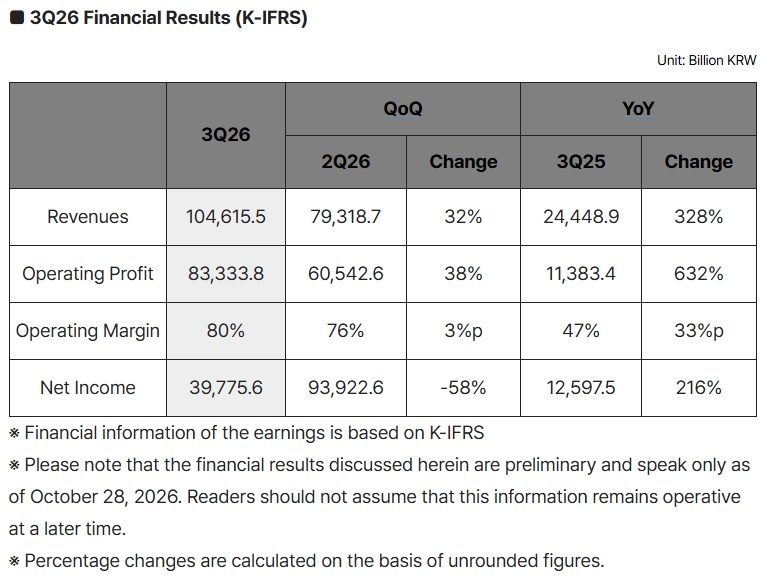
SK Hynix reported third-quarter revenue of KRW 104.6155 trillion, operating profit of KRW 83.3338 trillion, and net profit of KRW 39.7756 trillion. Quarterly revenue surpassed KRW 100 trillion for the first time in company history; with expanded sales of HBM4 and other high‑value‑added products for servers, HBM4 is set to become a core product starting in the fourth quarter. This year, the company plans to deliver approximately KRW 100 trillion in shareholder returns, sharing the majority of its investment gains from Kioxia with shareholders. Additionally, due to currency depreciation, the company recorded an exchange‑rate loss of KRW 11.6 trillion in the third quarter.
$SK hynix (SKHY.US)$In the third quarter of fiscal year 2026, operating revenue totaled KRW 104.6155 trillion, operating profit reached KRW 83.3338 trillion, and net profit stood at KRW 39.7756 trillion. The operating profit margin for the quarter was 80%, while the net profit margin was 38% (based on K-IFRS).
In a market environment where rising AI‑related storage demand has driven up prices for key products, the company leveraged the competitiveness of its high‑value‑added offerings to post record quarterly highs in both revenue and operating profit. Notably, revenue surpassed the KRW 100 trillion threshold for the first time in history, with quarter‑over‑quarter growth of 32% in revenue and 38% in operating profit.
The supply shortage in the storage market will persist through 2030.
 SK Hynix analyzes that, across multiple domains—including software development, customer service, and search—AI-driven gains in productivity and new revenue streams are steadily increasing AI adoption, which in turn is spurring expanded infrastructure investment. This virtuous cycle has now taken hold. Moreover, AI investment has moved beyond the early stage of reliance on a handful of companies and is expanding to both mainstream enterprises and the national level. As a result, the global AI data center infrastructure market is expected to maintain steady growth going forward.
In the storage market, the company expects demand to be driven in the short term by enterprise‑grade and consumer‑grade AI, while in the medium to long term it will be propelled by physical AI applications such as autonomous driving and robotics, ensuring continued growth.
On the other hand, the company believes that supply has failed to keep pace with market growth. As advanced process technologies become increasingly complex and the construction of new production facilities is time‑consuming, the supply‑demand imbalance is expected to persist through 2030.
By expanding production capacity and strengthening product competitiveness, next year's performance will reach a new level.
The company plans to leverage this favorable environment to accelerate capacity expansion and enhance product competitiveness, sustaining its current growth momentum and elevating both revenue and operating profit to new levels next year.
First, the company will rapidly increase the share of its sixth-generation 10-nanometer-class (1c) process and boost sales of DDR5 and LPDDR5 SOC‑AMM modules for AI servers, further strengthening its DRAM product portfolio with a focus on high-value-added offerings.
To meet surging HBM demand, the company plans to ramp up M15X fab capacity to full utilization by year-end, thereby expanding HBM4 production. Accordingly, the company expects HBM4 to outpace HBM3E in both shipment volume and revenue in the fourth quarter, solidifying its position as the flagship product.
In the NAND flash memory segment, the company plans to increase the share of its 321-layer process to over 50% of domestic South Korean production capacity in the fourth quarter, thereby boosting supply of high‑performance, large‑capacity eSSDs. Looking ahead to the medium and long term, the company aims to position NAND flash as a core solution for enhancing AI service throughput and cost efficiency, leveraging high‑bandwidth flash (HBF) and advanced system‑optimization technologies.
Long-term supply agreements already cover more than 50% of capacity for the 2027–2028 period, with a substantial expansion of investment planned for next year.
To enhance medium- to long-term demand visibility and strengthen its growth foundation, SK Hynix is expanding its long-term supply agreements (LTAs). Currently, the company has signed LTAs with 14 major customers, including leading global cloud service providers (CSPs), and is engaging in early-stage discussions with certain customers regarding extensions of these agreements, which typically have a five-year term.
To date, the LTA supply volumes secured amount to more than 50% of the total production capacity for 2027 and 2028. The company explained that the agreement is structured to reflect market conditions within a price range agreed upon by the customer, thereby establishing a framework that ensures earnings stability while remaining agile in responding to market fluctuations.
Building on assured demand visibility, the company will also focus on expanding its production capacity. With the official commissioning of the first-phase fab in Yongin next year and a surge in domestic and international infrastructure investments, the overall investment scale is expected to increase significantly compared with this year. Nevertheless, the company will carefully assess customer needs, product competitiveness, profitability, and investment efficiency, flexibly adjusting both the scale and timing of its capital expenditures.
This year, we will deliver approximately KRW 100 trillion in shareholder returns, sharing the majority of Kioxia's investment gains with our shareholders.
In line with its announcement in August this year, SK Hynix today unveiled an enhanced shareholder‑return plan. The company will pursue total shareholder returns of approximately KRW 100 trillion by fiscal year 2026, including cash dividends of over KRW 30 trillion and share buybacks and cancellations—comprising the KRW 40 trillion already announced in August—amounting to more than KRW 60 trillion. With this initiative, SK Hynix is fulfilling its commitment to allocate at least 50% of its free cash flow (FCF) to returning value to shareholders. Notably, the KRW 40 trillion share‑buyback program announced in August was completed last week and is now slated for cancellation.
The company also clarified that the dividend amount will be determined based on its operating performance, with additional returns provided through special dividends in the event of substantial investment gains, and that share repurchases will be conducted on a quarterly basis.
At today's Board meeting, the company resolved to distribute a third-quarter cash dividend of 14 trillion won and to repurchase treasury shares worth 20 trillion won. Of the treasury shares slated for repurchase, the 10 trillion won earmarked for shareholder returns will be entirely canceled, while the remaining approximately 10 trillion won will be allocated to employee performance bonuses and will not be counted toward the shareholder return total.
The third-quarter dividend totaled KRW 20,000 per share, comprising a KRW 10,000 dividend reflecting improved performance and a KRW 10,000 special dividend to share the results of Kioxia's investment. The company has decided to return the majority of this year's gains from its Kioxia investment to shareholders.
SK Hynix emphasized: "Going forward, we will continue to deliver stable performance driven by robust growth in storage demand and our technological competitiveness, while consistently sharing our results with shareholders."
Compiled from SK Hynix's official website.
 Earnings Flash: AI Insights into Key Points, Build an Options Strategy in Three Steps! Open Futubull > Stock Page > Tap [Company] >Earnings Flash Report