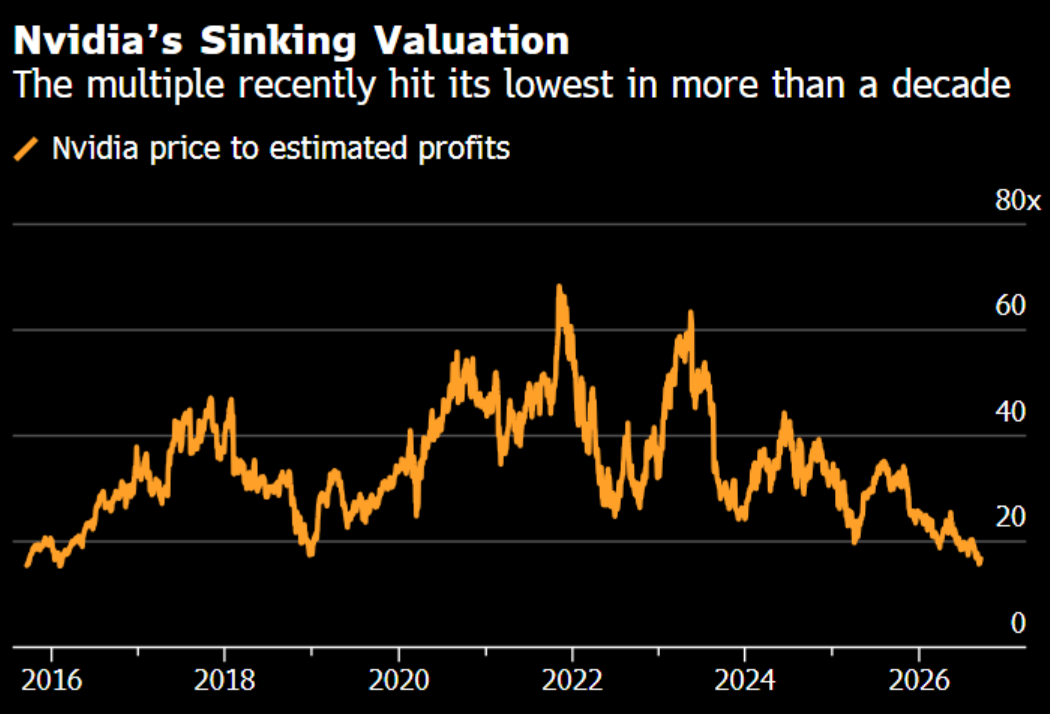
NVIDIA's price-to-earnings ratio has fallen below 17 times, roughly half of its 2025 level. Despite forecasts of 90% and 99% growth in revenue and net profit, respectively, for fiscal year 2027, the company's stock has risen only about 20% this year—far underperforming the Philadelphia Semiconductor Index. Meanwhile, gross margin is expected to decline from 75% in the second quarter to below 72% by the fourth quarter, as rising memory costs and customers' continued development of in-house chips keep pressure on margins. Whether AI-related capital expenditures can sustain their momentum has also become a key factor in the market's reassessment of NVIDIA's valuation.
$NVIDIA (NVDA.US)$Stock valuations have fallen to their lowest levels in more than a decade. Although corporate revenues and profits continue to grow at a robust pace, market concerns about the sustainability of earnings growth are mounting.
According to data compiled by Bloomberg, NVIDIA's current price-to-earnings ratio has fallen below 17 times, roughly half of its 2025 level and significantly lower than the over 25 times recorded in May this year. Meanwhile, the semiconductor sector as a whole has performed strongly, with the Philadelphia Semiconductor Index posting a year-to-date gain of nearly 76%, while NVIDIA's increase over the same period is about 20%, ranking it fifth from the bottom among the index's constituents.
 At the Goldman Sachs Technology Conference earlier this month, NVIDIA CEO Jensen Huang discussed the company's market positioning. He described NVIDIA as "the world's first and only growth‑value stock" and stated that the company "is severely misunderstood." Judging from its recent valuation and stock performance, investors are still wondering whether NVIDIA's current earnings levels can be sustained.
Fundamentals remain strong, while valuations continue to face downward pressure.
From a financial perspective, NVIDIA's growth momentum remains robust. The company's revenue is expected to increase by 90% year over year in fiscal year 2027, which ends in January next year, while net profit is projected to rise by 99%, both outpacing the 65% growth rate of the previous fiscal year. In its second-quarter earnings report released last month, NVIDIA also forecast that sales for fiscal year 2028 will grow by 70%, significantly higher than the market's earlier expectation of 45%.
However, strong earnings expectations have not been matched by a corresponding rise in stock prices. NVIDIA has gained about 22% year-to-date, Apple has risen roughly 25% over the same period, while Intel and Advanced Micro Devices have both posted gains of more than 180% during the same timeframe.
Eli Horton, Senior Portfolio Manager for TCW's thematic and durable growth equity funds, said the sharp decline in valuations reflects some uncertainty about whether NVIDIA's current earnings levels can be sustained. "Given such strong fundamentals, the stock's performance has been surprising, but it underscores that market expectations remain below the current analyst consensus."
Gross margins are under pressure, and the competitive landscape is also evolving.
In addition to valuation changes, profitability itself is also drawing market attention. According to the average analyst forecast compiled by Bloomberg, NVIDIA's gross margin for the second quarter is expected to be around 75%, but it is projected to fall below 72% by the fourth quarter before gradually recovering thereafter. Rising costs of key components, such as memory chips, are among the factors putting pressure on the gross margin.
David Russell, Global Market Strategy Head at TradeStation, believes that changes in gross margins are one of the key factors influencing NVIDIA's valuation. Meanwhile, customers' development of their own chips could also reshape the competitive landscape. Both Meta Platforms and Alphabet are advancing their in-house AI chip initiatives, and some major clients are also seeking to reduce their reliance on NVIDIA.
Russell stated that as customers adopt alternative solutions, NVIDIA's market share and pricing power may come under some pressure, casting uncertainty on whether its gross margin can improve further. He believes that whether valuation multiples can expand again will depend on the company's future earnings growth and changes in the competitive landscape.
AI capital expenditure remains a key variable, and there are still no clear signs of a near-term slowdown.
Another area of market concern regarding NVIDIA's outlook stems from AI infrastructure investment. As data center construction expands, the market is beginning to question whether the currently elevated level of AI capital spending can be sustained, while the high-interest-rate environment has also increased the funding costs associated with such investments.
Earlier this month, some figures in the AI community called for a slowdown in the development of state-of-the-art AI models, triggering a correction in the semiconductor sector; on September 14, the Philadelphia Semiconductor Index fell nearly 6% in a single day.
However, there are currently no clear signs of a slowdown in AI infrastructure investment. Early performance from Meta's new AI agent has been encouraging, bolstering market expectations for demand for AI chips and driving the Philadelphia Semiconductor Index up 4.3% on Monday—the largest single-day gain since August 4.
Horton believes that NVIDIA's current valuation already reflects some expectations of a slowdown in AI capital expenditures. To further confirm this concern, we would need to see ultra-large cloud providers significantly cut their capital spending, or for there to be substantial changes in regulatory policies—neither of which has yet materialized.
Over the past four years, NVIDIA's stock price has surged by more than 1,600%, and the company at one point became the world's highest-valued enterprise. Meanwhile, its revenue has grown from approximately $27 billion in fiscal year 2023 to an estimated $410 billion by fiscal year 2027. As NVIDIA has become one of the most emblematic companies in the AI investment cycle, its earnings growth, gross margin trends, and customer demand have continued to draw close attention from the market.
Editor/lambor