
Investment bank Bernstein believes that cloud‑computing demand continues to far outstrip supply, with the bottleneck now shifting from GPU availability to the physical capacity of power‑connected data centers. Meanwhile, the returns on massive capital expenditures and the methods of financing are emerging as the new decisive factors.
The Zhitong Finance app notes that in the second quarter of 2026, global cloud giants are collectively accelerating,$Amazon (AMZN.US)$AWS posted its fastest growth in 18 quarters, Google Cloud surged by 82%, and Oracle's OCI doubled. Investment bank Bernstein believes that cloud market demand still far outstrips supply, with the bottleneck having shifted from GPU availability to the physical capacity of power‑connected data centers, while the returns on massive capital expenditures and financing strategies are becoming the new decisive factors.
The four major cloud providers spent approximately $150 billion on capital expenditures in a single quarter, with a combined order backlog of $2.33 trillion.
 According to the research report's estimates, in the second quarter of 2026…$Microsoft (MSFT.US)$、 $Amazon (AMZN.US)$ 、 $Alphabet-C (GOOG.US)$ 、 $Oracle (ORCL.US)$Total cash capital expenditures amount to approximately $150 billion; the firm's model projects a full-year figure of $660 billion by 2026, which would approach $800 billion when combined with Meta. Over the same period, AWS, Azure, Google Cloud, and OCI reported combined cloud revenues of $105 billion, up 52% year over year; their aggregate backlog (RPO) reached $2.33 trillion, an increase of 188% compared with the prior year.
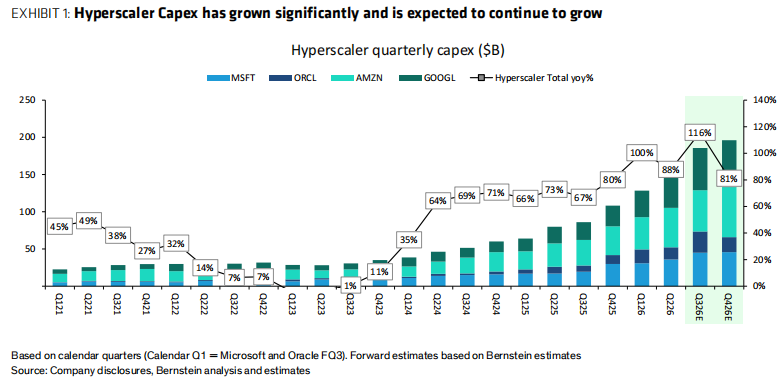
The firm estimates that the ultra-large‑scale cloud market is valued at between USD 1.3 trillion and USD 1.5 trillion, making it the largest tangible market in the software and internet sectors.
In terms of financing structure, with the exception of Microsoft, the other U.S. cloud giants have all shifted this year to external financing methods such as issuing bonds or conducting additional share offerings.
Can massive capital expenditures deliver returns?
Out-of-control capital spending and the AI bubble have been further stoked by Anthropic's CEO's call to slow down the development of cutting-edge models, intensifying market concerns. Addressing worries about runaway capital expenditures and the AI bubble, the firm notes that over the past few quarters, cloud‑provider revenues have accelerated in tandem with backlog, with demand consistently outpacing supply.
The research report cites Amazon's investment‑return framework: data center shells are commissioned about two years ahead of schedule, generating revenue for more than 30 years; servers are procured only months before deployment, recouping costs in 2 to 3 years, with contracts lasting 5 to 6 years, and subsequent generations of equipment can reuse the facilities, leading to progressively improved economics. AWS's average contract length has risen to 6.4 years, with most of its capacity locked in by 2027 and orders scheduled through 2028.
Regarding the Anthropic CEO's call to slow down the development of cutting-edge models, the bank notes that this is tied to the revenue growth and profit margin outlook for the largest cloud providers.
The firm believes that AI will weigh on the gross margins of IaaS and PaaS, at least during the construction phase, with the key variable being the actual service life of GPUs. Amazon had already shortened the depreciation period for some servers from six years to five by 2025; Microsoft, meanwhile, extended the depreciation period for data centers from 15 years to 25, reducing its calendar-year 2026 capital expenditure guidance from $190 billion to $175 billion. However, the company emphasized that this is merely an accounting adjustment and does not represent a cut in hardware spending.
Oracle passed on price increases for components such as memory to its customers through contractual terms, and disclosed that the renewal prices for older GPUs from three to four years ago were actually about 20% higher. Microsoft's management recently also stated that, over the long term, the profit margins of its AI business will approach those of its non-AI businesses.
The new cloud model is difficult to sustain.
The report will$CoreWeave (CRWV.US)$Positioned as a "transitional capacity provider": It benefits from electricity and GPU shortages, but faces customer concentration, buyers' tendency to build their own infrastructure, and constrained return structures. Once data center capacity eases, it will be among the first and most severely impacted. Despite CoreWeave's Q2 2026 revenue of $2.58 billion (up 112% year over year), an order backlog of approximately $104 billion (up 246% year over year), and a roughly 25% price hike across the board in July, Bernstein still assigns an "underperform" rating with a price target of $74.
Major cloud giants continue to benefit.
The firm maintains its "Outperform" rating on Amazon, with a price target of $320. It notes that AWS posted 37% growth in the second quarter, the fastest in 18 quarters, accelerating by roughly 9 percentage points quarter over quarter; backlog reached $496 billion, including approximately $100 billion from the Anthropic deal signed in April; AI revenue annualized at $25 billion, a substantial jump from $15 billion a quarter earlier; and self-developed chip revenue annualized at $25 billion. During the earnings call, management outlined a roadmap for AWS to reach $1 trillion in annual revenue.
Microsoft was also maintained at an "Outperform" rating, with a price target of $660. The firm emphasized that Microsoft's guidance for positive free cash flow in fiscal year 2027 and its ability to avoid new debt represent a key differentiating advantage.
Oracle has maintained an "Outperform" rating, with a price target of $325. The company reported OCI revenue of $7.4 billion, up 121% year over year; its RPO stands at $664 billion, including approximately $300 billion from OpenAI. For FY30, Oracle forecasts OCI revenue of $166 billion and plans to bring 10 GW of capacity online over the next three years. Capital expenditures for FY27 are guided at $90–95 billion, including $20–25 billion in customer prepayments. The firm notes that the company's peak cash needs are expected in fiscal year 2028.
Google, once the third-largest player in the cloud market, has emerged as a leading AI‑cloud contender through vertical integration—leveraging its proprietary models and self‑developed TPUs. Yet Bernstein's most cautious rating among the five covered stocks is precisely for Google. The firm maintains a "Market Perform" rating with a price target of $385, making it the only U.S. tech giant in the group that has not been assigned an "Outperform" rating. At the same time, the firm notes that the launch of Gemini 3.5 Pro has been delayed, and that the company's reliance on third‑party infrastructure due to constrained internal capacity will weigh on profit margins.
Editor/Deng