NVIDIA's latest insider trading filing adds another chapter to the ongoing trend of major shareholders selling shares. According to a newly filed Form 4 on Tuesday, NVIDIA Director Mark Stevens sold an additional 1.4 million shares in a transaction on September 18, valued at approximately $300 million.
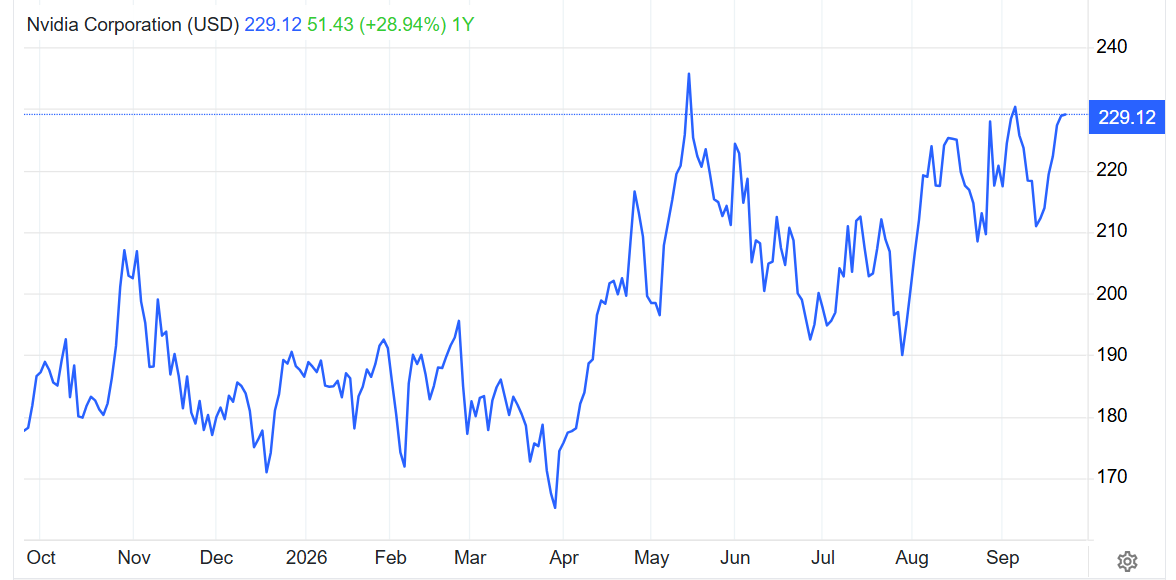
Zhitong Finance APP learned that, following the latest disclosure showing NVIDIA Director Mark Steven once again heavily selling NVIDIA shares, the world's highest-market-capitalization company—known as the "AI chip super-dominant player"—which has recently posted six consecutive gains,$NVIDIA (NVDA.US)$On Wednesday, ahead of the U.S. market open, the stock price traded in a choppy range, with its attempt to break through the all-time high of $236 once again running into significant selling pressure.
According to a recent Form 4 filing submitted on Tuesday, Director Mark Stevens sold another 1.4 million shares in a transaction on September 18, worth approximately $300 million, continuing the trend of substantial sell-offs by insiders at the chip giant. Prior to this latest sale, Stevens had already disposed of roughly $640 million worth of NVIDIA stock earlier this month.
 Notably, the filing does not indicate that recent sales transactions, totaling approximately US$300 million, were executed pursuant to a Rule 10b5-1 trading plan. Under Rule 10b5-1, a trading plan can be understood as a "pre‑arranged stock‑buying or selling schedule": when executives or Directors do not possess material nonpublic information, they set forth trading parameters in advance and, upon satisfying requirements such as a cooling‑off period, execute the plan as scheduled—this may serve as a defense against allegations of insider trading. However, failure to utilize such a plan does not, by itself, constitute a violation of the law or an indication of suspected insider trading.
As cutting-edge AI agent operating systems like Muse and Astra expand the scope of business tasks they can automate, the demand for computing power has grown from single‑turn question‑answering to highly complex agent workflows that require sustained, high‑efficiency operation. Global AI computing demand is expected to enter a new phase of expansion, with NVIDIA's AI GPUs and Vera CPUs both experiencing a dual‑pronged surge in compute capacity, driving NVIDIA's stock to post six consecutive trading gains since September 14. Its market capitalization currently hovers around $5.5 trillion, up roughly 25% year-to-date. Meanwhile, the Philadelphia Semiconductor Index, which includes leading players across the AI computing supply chain—such as NVIDIA, AMD, Broadcom, Intel, and Taiwan Semiconductor—has recently outpaced NVIDIA in gains, pushing its year‑to‑date increase to as much as 80%.
After six consecutive gains, NVIDIA's filing disclosed a large-scale cash-out.
NVIDIA's latest insider trading filings add another layer to the ongoing trend of major shareholders selling shares.
According to a recent Form 4 filing submitted on Tuesday, Director Mark Stevens sold another 1.4 million shares in a transaction on September 18, worth approximately $300 million, continuing the trend of substantial share reductions by insiders at this chip giant.
Stevens has been steadily reducing his holdings of NVIDIA stock. A former managing partner at Sequoia Capital, Stevens sold his latest batch of shares at a weighted average price of $219.72 and another 10,000 shares at $220.42. These shares were held through a trust. Notably, the filing does not indicate that these transactions were executed under a Rule 10b5-1 trading plan.
Prior to this latest sell-off, Stevens had already sold approximately $640 million worth of NVIDIA shares earlier this month. He has also been regularly selling NVIDIA stock throughout 2026, including a June sale valued at $186 million.
Stevens remains a substantial shareholder; according to his most recent filing, he directly holds 11.54 million shares and, through the Envy Trust, indirectly holds approximately 15.02 million shares.
After a strong rally driven by AI, NVIDIA's stock has largely traded sideways over the past few months, failing to reach new all-time highs, mainly because investors are increasingly weighing its exceptional growth against persistently high market growth expectations, intensifying competition in the AI chip sector, and concerns about the sustainability of AI infrastructure spending.
Despite NVIDIA's consistently impressive financial results, its stock performance has remained relatively muted. The company reported second-quarter revenue of $96.2 billion, up 106% year over year, with data center revenue surging 117% to $89 billion. NVIDIA also forecasts that its fiscal 2028 revenue will grow by approximately 70%.
CEO Jensen Huang stated in the August 24 earnings report that AI has reached an "inflection point," with demand accelerating as more cutting-edge labs, startups, and open-model developers scale up their systems.
On the Stocktwits platform, retail investors' sentiment toward NVIDIA is "neutral," remaining unchanged over the past week, as retail traders continue to closely watch the upcoming summit in Washington, which will be attended by U.S. President Donald Trump and numerous business and technology leaders.
NVIDIA's growth is accelerating, yet its valuation is being discounted.
Cutting-edge AI systems such as Muse and Astra have expanded the range of business tasks that can be automated, extending computing power requirements from single Q&A interactions to continuously running agent workflows. From a low-level architectural perspective, a complex task may involve multiple rounds of reasoning, tool invocation, code execution, and result validation: GPUs handle model matrix operations, while long-context pre-filling increases the load on input processing; continuous decoding and concurrent sessions, in turn, raise demands on computational throughput, memory bandwidth, and key-value cache capacity. Meanwhile, CPUs take on tool execution, sandboxed runtime, and task orchestration. The growing number of users, the expanding scope of tasks, and the proliferation of parallel workflows together form the foundation for the concurrent growth of GPU, CPU, storage, and networking needs. This is also the key rationale behind the market's expectation that the widespread adoption of agent applications will drive growth for compute‑power providers such as NVIDIA and AMD.
The value of the Vera CPU is particularly evident in the serial steps of an agent's workflow. NVIDIA's technical documentation notes that in high‑load inference systems, the longer the CPU spends executing tools, the more likely it is that the key‑value cache for the original request will be evicted from GPU memory by other requests, necessitating a reprocessing of the context when the task is resumed; a faster CPU can shorten this interval, reduce redundant computations, and increase the GPU's effective throughput.
Vera thus serves both the Vera Rubin system and the standalone CPU server market; vendors such as Dell, HP Inc., and Super Micro Computer have already announced related product roadmaps, while numerous model companies and cloud service providers are evaluating or planning to adopt it. This expands NVIDIA's growth opportunities from model computing further into agent-execution infrastructure, enhancing the commercial value of end-to-end system-level co-optimization.
NVIDIA's most notable pricing characteristic at present is that its earnings expectations are growing rapidly, while its stock price has not expanded in tandem, causing its forward price-to-earnings ratio to fall sharply to below 20 times—referring here to the P/E ratio based on expected earnings over the next 12 months, which is near its lowest level in more than a decade.
In response, NVIDIA reported second-quarter fiscal 2027 revenue of $96.2 billion, up 106% year over year, with data center revenue reaching $89 billion, a 117% year-over-year increase. Research from Visible Alpha, under S&P Global, also confirmed that the company has raised its fiscal 2028 revenue growth outlook to approximately 70%, surpassing the pre‑earnings‑release market consensus of 44%. Jensen Huang's reference to "growth value stocks" highlights the juxtaposition of rapid growth and relatively low valuations; investor disagreement centers on how certain these earnings forecasts are and for how long they can be sustained.
The market is primarily reassessing profit margins, the competitive landscape, and the sustainability of customer investments. Price hikes in key components such as memory are shifting some of the profits generated by AI infrastructure to upstream suppliers; meanwhile, large customers' increased adoption of self-developed ASICs is prompting the market to pay closer attention to NVIDIA's future market share and bargaining power. From an engineering‑economic perspective, custom chips are well suited for optimizing costs around relatively stable workloads, whereas NVIDIA leverages its programmable GPUs, software ecosystem, and system interconnects to meet rapidly evolving models and complex deployment requirements. At the same time, high interest rates and steadily rising capital expenditures have raised customers' expectations for return on investment. Consequently, even as overall industry demand continues to grow, the market will continue to evaluate both how much revenue NVIDIA can generate and what level of profit margin it can sustain.
If the commercialization of cutting-edge AI agents like Muse can robustly and consistently validate the returns on customers' AI infrastructure spending, it will provide substantial support for NVIDIA's long-term profitability. Should more billable AI workloads drive higher infrastructure utilization, increased customer orders, and growth in new-platform revenues, GPUs, Vera CPUs, and networking products could collectively expand revenue streams, while profit realization may also fuel a valuation recovery. The $350 price target set by Wall Street heavyweight Bank of America reflects its positive outlook on NVIDIA's strong long-term AI growth prospects.
Editor/Deng