
①Muse topped the free charts on the Apple App Stores in both the U.S. and Canada within about two weeks of its launch, as Meta seeks to expand its user base by leveraging free usage allowances and prioritizing traffic from social platforms; ②The product's focus has shifted from "answering questions" to directly executing tasks such as shopping, booking, and making payments, and it has already integrated with multiple third-party services; ③Long-term monetization may come from transaction fees and subscriptions, but large-scale commercialization is not expected until at least 2027, leaving returns still uncertain.
$Meta Platforms (META.US)$Today, the stock rose nearly 2% during trading and is up nearly 40% over the past month. On September 22, JPMorgan released a research report stating that Meta's newly launched AI agent, Muse, is demonstrating strong early user growth and could serve as a key gateway for the company to shift its AI initiatives from "advertising efficiency" to new revenue streams beyond advertising.
The firm reiterated its "Overweight" rating and $820 price target for Meta, noting that as consumers and businesses increasingly adopt their own AI agents, future shopping, bookings, and service transactions are likely to be conducted more and more on an "agent-to-agent" basis, opening up new business models for Meta beyond advertising.
Muse topped the Apple App Store for two weeks.
 Since the launch of Muse roughly two weeks ago, Meta's stock has risen by 21% cumulatively, while the S&P 500 index gained only 1% over the same period.
Even more noteworthy is the product's growth rate. Muse has now become the highest‑downloaded free app on the Apple App Store in both the United States and Canada, with daily downloads in the U.S. surpassing those of Meta's core apps, including Instagram, WhatsApp, Facebook, Threads, and Messenger.
JPMorgan believes that Muse's performance is driven primarily by three factors: first, its strong product-market fit and leading agent execution capabilities, while also prioritizing ease of use, privacy, and security; second, its relatively generous free-tier offering lowers the barrier to entry for trying out and reusing the service; and third, Meta's extensive social‑product ecosystem and large‑scale distribution advantages enable it to leverage existing traffic to promote the new product.
The Assistant Benchmark cited in the report shows that Muse achieved a composite score of 9.3, surpassing Instinct's 8.5 and Grok Bot's 7.3, and earned high marks across multiple capabilities, including shopping, email, calendar management, and third-party app integration. JPMorgan also emphasized that Muse is highly competitive in terms of usability, privacy, and security.
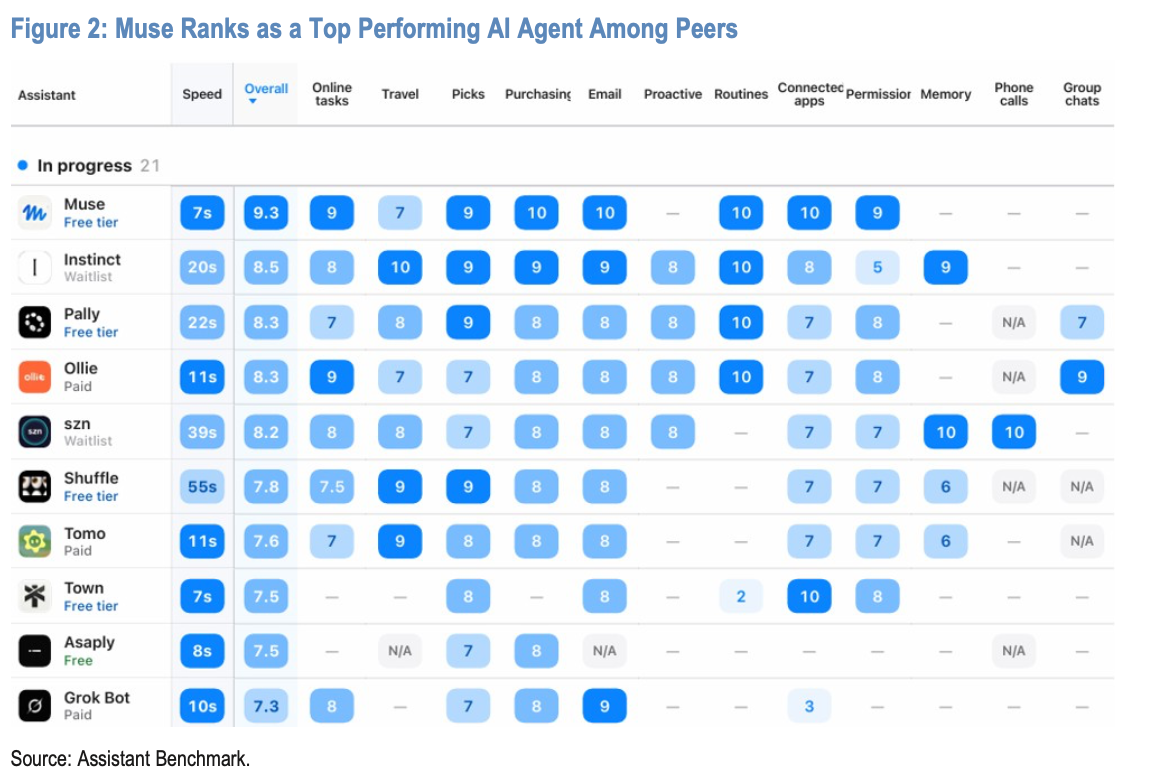
(The report conducts a comparative evaluation of multiple AI agents, with Muse ranking first with an overall score of 9.3 and earning high marks across several capabilities, including shopping, email management, calendar scheduling, and integration with third-party applications.)
The report even suggests that, although it remains in a very early stage, Muse has the potential to become the most widely used consumer‑grade AI application after ChatGPT.
Meta is currently clearly adopting a strategy of "scaling first, monetizing later."
The company has begun leveraging Instagram and Facebook ad inventory to promote Muse, launched nationwide TV commercials, and is offering free users 100 million Tokens per week; additionally, both the inviter and the invitee receive 1 billion Tokens each. By contrast, the report notes that Grok Bot charges over $30 per month, Gemini Spark costs about $20 per month, while the free Instinct service remains invitation‑only due to computing‑power constraints.
JPMorgan expects that, in the short term, Meta's primary focus will remain on boosting Muse's user adoption and engagement; apart from subscriptions by heavy users, large-scale commercialization is unlikely to begin until at least 2027.
Muse aims to truly "get things done" for its users.
The key difference between Muse and traditional AI chat products is that Meta aims to position it as a "personal agent" capable of directly executing tasks.
Meta CEO Zuckerberg previously suggested that in the future, billions of people could use intelligent agents capable of understanding personal goals and working on users' behalf around the clock, with applications spanning health, interests, finance, productivity, and interpersonal relationships. Accordingly, Muse is not merely tasked with answering questions; rather, through its computational capabilities and integration with third-party apps, it can further accomplish real-world tasks.
Currently, Muse can connect to services such as Gmail, Spotify, Peloton, and OpenTable. Recently, Meta has also granted developers access to the Connector framework, even enabling Muse to help users create custom connectors for services that are not yet supported.
The report summarizes a wide range of early use cases: in e‑commerce, Muse can track prices, locate coupons, research products, and complete orders; in the local services sector, it enables booking flights, hotels, restaurants, and event tickets; and in personal finance, it supports negotiating bills, reviewing subscriptions, securing refunds, and automatically claiming discounts.
In addition, Muse is also used for booking medical appointments, refilling prescriptions, creating fitness and nutrition plans, as well as managing calendars, sorting emails, planning trips, drafting documents, preparing spreadsheets, and making phone calls.
Meta is targeting "agent-to-agent" transactions.
In JPMorgan's view, Muse's most significant long-term business opportunities may not even come from consumers, but rather from enterprises.
Meta recently opened its Muse Connectors to developers, a move the company views as a major turning point. In the future, if tens of millions—eventually even hundreds of millions—of businesses have their own agents within the Muse ecosystem, the way consumers and enterprises interact could undergo a fundamental transformation.
For example, consumers no longer need to browse multiple shopping websites to compare prices or open airline, hotel, and restaurant pages one by one. Instead, they can simply specify their needs to a personal Muse, which then facilitates communication between the consumer's AI agent and the merchants' AI agents, ultimately completing a series of tasks such as product search, booking, and payment.
This is what JPMorgan calls the "agent-to-agent" model.
If this model gains traction, Meta could establish two primary monetization streams: first, charging commissions or transaction fees on purchases completed through Muse, restaurant reservations, flight and hotel bookings, and lead generation; second, offering users additional usage allowances and premium features via subscription.
JPMorgan believes that direct interactions among agents could ultimately serve as the foundation for Meta AI's commercialization.
This maintains a certain degree of continuity with Meta's existing advertising model. In the past, companies paid to compete for users' attention and ad clicks; in the era of AI agents, commercial value may further shift toward "directly driving user goals and transactions."
However, this process will not proceed without any resistance.
The report noted that Amazon has blocked Muse from accessing its platform. This also implies that the development of AI agents may encroach upon traditional internet platforms' control over user access points, data, and transaction workflows, thereby giving rise to new conflicts of interest.
However, JPMorgan expects that, if smart agents can drive additional traffic and transactions, more platforms will still join in the long run.
AI-driven investment is shifting from enhancing advertising efficiency to generating new revenue streams.
Meta's previous large-scale investments in AI have already begun to show results in its core advertising business. JPMorgan noted that AI is continuously enhancing Meta's ad ranking and recommendation capabilities, thereby boosting user engagement, advertisers' return on investment, and revenue growth.
Meanwhile, Muse represents the next stage: Meta is beginning to explore ways to turn AI itself into a new revenue stream—through consumer agents, enterprise agents, and model APIs, among others.
Meta is also moving at a rapid pace. Just two weeks after launching Muse, the company has already begun testing outbound calling to U.S. businesses, opened the Developer Connector, released Muse for Mac, and added support for Shop Pay's smart checkout.
JPMorgan believes that as the adoption and engagement of Muse continue to rise, Meta is poised to demonstrate that its AI investments can generate economic returns beyond advertising, with the associated total addressable market (TAM) potentially reaching several trillion dollars.
The report also highlights Meta Connect, scheduled for September 23–24, where Meta is expected to further showcase its AI models, agents, and developer tools. It may also unveil early user engagement metrics for Muse, new partners and Connector, as well as details on how Muse will integrate with hardware such as smart glasses.
As for the Watermelon model, which has been drawing market attention, JPMorgan believes it is more likely to be unveiled at a later date rather than being officially launched at this year's conference.
The pace of commercialization remains the biggest variable.
In terms of valuation, JPMorgan expects Meta's 2028 GAAP earnings per share to be $35.44, with the current stock price implying a forward P/E ratio of approximately 21x; its $820 target price corresponds to a 2028 forward P/E ratio of about 23x, which is higher than the S&P 500's implied valuation level of roughly 16x used in the report.
The firm believes that Meta's robust revenue growth, ongoing improvements in cost efficiency, and an increasingly clear path to AI commercialization can support a corresponding valuation premium.
However, whether Muse can truly translate into profitability remains a key risk.
JPMorgan has identified several key uncertainties, including: substantial AI investments that are commercializing more slowly than expected, which could weigh on GAAP operating profit, earnings per share, and free cash flow; revenue growth falling short of expectations, thereby limiting the upside for AI commercialization; new AI products failing to gain user acceptance; competition from companies such as Google, TikTok, and OpenAI; and product adjustments triggered by litigation that could disrupt the core advertising business.
Editor/Deng