
UBS Group therefore favors AI server and high-performance network infrastructure supply chains, as well as manufacturers of core components related to AI infrastructure—such as MLCCs, copper foil, and electronic fabrics—that can enhance the value per unit of product. At the same time, it remains optimistic about the prospects of traditional large PC manufacturers like Dell, which are shifting their growth drivers toward the AI computing infrastructure business.
Zhitong Finance APP has learned that, according to the latest global I/O technology hardware research report released by international financial giant UBS Group, as cutting-edge AI agent workflows such as Muse and Astra significantly expand the scope of business tasks that can be automated, global demand for AI computing continues to surge, substantially prolonging the price‑increase cycle for memory chips and further reinforcing the "memory supercycle" narrative. However, UBS's analyst team notes that budget growth on the consumer electronics side is struggling to keep pace, leaving the PC (personal computer) industry facing a "torn‑apart adverse scenario" characterized by rising prices, declining shipments, and sharply divergent profit dynamics.
UBS Group largely maintains its forecast of approximately 241 million global PC shipments in 2026, down 11% year over year, but has revised its 2027 shipment growth outlook from around 2% expansion to about a 4% decline, with price hikes expected to only partially offset the loss in volume. Amid the broader trend—driven by cutting-edge AI agents and large-scale AI models such as Meta's Muse and OpenAI's Astra—of widespread adoption of agent-based AI workflows, additional computing demand will continue to spread across servers, networking equipment, memory, and related components. Whether consumer electronics companies can benefit will depend on product appeal, procurement terms, and their ability to pass on costs.
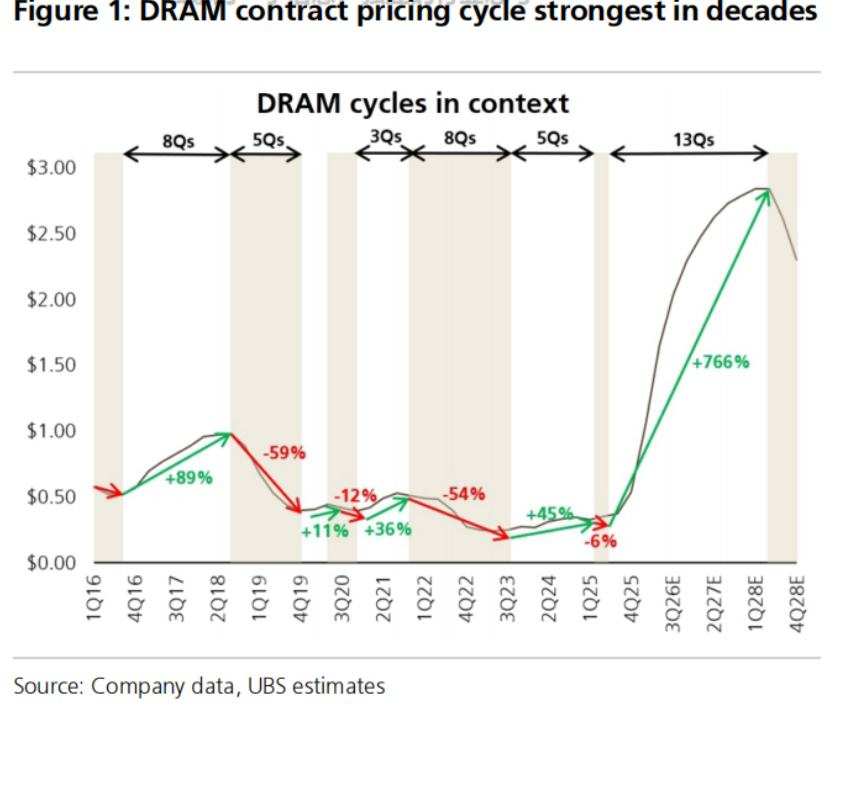
 UBS Group's calculations show that since mid-2025, the costs of dynamic random-access memory (DRAM) and NAND flash memory have surged by 766% and 471%, respectively. These cost increases are driving up personal computer prices.
UBS Group analysts emphasize that the sustained, sharp price hikes in memory chips have primarily suppressed demand in consumer electronics such as PCs and smartphones. Meanwhile, critical components like AI GPU‑equipped server clusters, data center CPUs, high‑performance Ethernet networking infrastructure, and data center optical interconnect systems are benefiting from an unprecedented AI infrastructure boom driven by the global popularity of Muse and Astra, which has spurred new orders and increased per‑unit product value. As a result, the hardware supply chain remains insulated from the costs associated with rising memory prices, leading to divergent profitability trajectories.
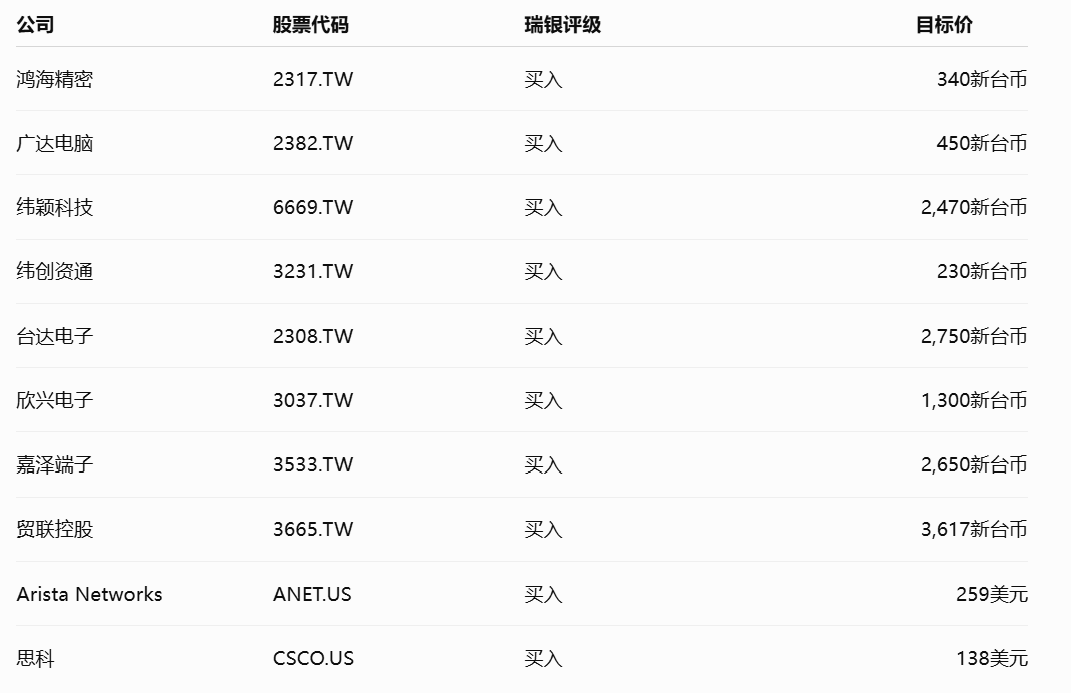
Compared with global top-tier consumer electronics suppliers like Apple, UBS Group places greater emphasis on the AI server and high-performance networking infrastructure supply chain, as well as manufacturers of core AI‑related components—such as MLCCs, copper foil, and electronic fabrics—that can enhance the value per unit. At the same time, UBS remains optimistic about the prospects of traditional PC giants like Dell, which are shifting their growth drivers toward AI computing infrastructure businesses. As for hardware manufacturers such as Foxconn Precision, Quanta Computer, Wistron, Compal, and Delta Electronics—companies that simultaneously focus on both the AI server manufacturing value chain and consumer electronics product lines—UBS continues to assign them its most bullish "Buy" rating, with a particular emphasis on the robust expansion of AI server cluster demand amid the AI computing boom. Below are UBS's top picks among AI hardware supply chain leaders poised to benefit from this sweeping AI infrastructure wave.
From price hikes and downgrades to investment divergence: UBS Group dissects the sixfold impact of the storage supercycle on the consumer electronics industry chain.
First, the PC market is digesting the overextension caused by front-loaded purchases, while rising costs are further weighing on subsequent sales. According to UBS Group's latest forecast, global PC shipments in 2026 are expected to reach 241 million units, down 11.0% year over year; for 2027, the projection has been revised downward from 246.6 million to 231.1 million units, representing a 6.3% reduction in volume, with the year-over-year growth rate turning from 2.1% expansion to a 4.1% decline. Meanwhile, the average selling price is projected to rise from $837 in 2026 to $888 in 2027, an increase of 6.0%, enabling the industry's revenue to still grow by 1.7% in 2027, reaching approximately $205 billion—though this falls short of the earlier forecast of around $210 billion.
By market segment, consumer PC shipments are expected to decline by 6.3% in 2027, commercial PCs by 3.0%, and Chromebooks by 14.6%, reflecting more pronounced pressure on price-sensitive segments. This trend is corroborated by order data: the five Taiwan-based laptop ODMs tracked by UBS Group have collectively lowered their third-quarter shipment forecast to approximately 25.08 million units, down 17% quarter-over-quarter and 26% year-over-year; full-year shipments are projected at around 109.7 million units, a 15% year-over-year decline. These shifts are further compounded by earlier device upgrades triggered by factors such as the end of Windows 10 support and anticipated price hikes.
Second, the duration of high prices has been further extended, and continued price hikes on the CPU side have added to the cost pressures for complete systems. UBS Group expects the DRAM upcycle to last until the second quarter of 2028 and has pushed back the peak NAND price from the fourth quarter of 2027 to the first quarter of 2028. Its model projects that in the third and fourth quarters of 2026, mixed DDR contract prices will rise by 22% and 9% quarter-over-quarter, respectively, while NAND prices will increase by 20% and 8%, respectively. In 2027, DRAM and NAND prices per Gb are expected to reach approximately $2.25 and $0.34, up 39% and 34.6% year over year, respectively. Moreover, UBS's forecasting model estimates that from 2025 to 2027, the cumulative price increases for these two components will amount to roughly 766% and 476%, respectively.
Meanwhile, a UBS Group research report indicates that CPU manufacturers are also pushing for double-digit percentage price hikes, meaning PC brands are facing simultaneous price increases across multiple key components, while consumer budgets often allow only for modest increases.
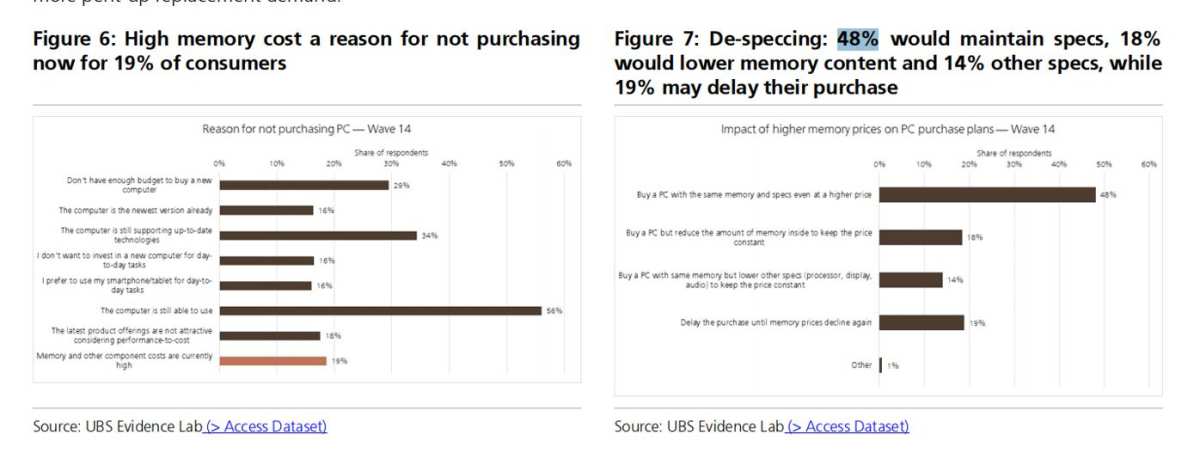
Third, consumers still intend to upgrade and purchase AI PCs, but their actual purchasing decisions are increasingly constrained by price. In August 2026, UBS Evidence Lab surveyed a total of 1,500 PC users in the United States and China. The average replacement cycle has shortened from 3.03 years to 2.86 years, and the proportion planning to buy a new PC in the next six months has risen to 32%. In China, the average purchase budget is approximately RMB 7,954, up about 3% from the previous survey, while in the United States it stands at around USD 825, essentially unchanged. However, among respondents who have slowed down their purchases, 50% cited rising storage prices as the primary reason, up from 37% in the previous round. Faced with more expensive configurations, 19% choose to wait for prices to drop, 18% reduce memory capacity, 14% lower other specifications, and 48% are willing to keep their current specs and accept higher prices.
UBS Group stated that the demand structure still holds promising highlights: 72% are interested in gaming PCs, and 69% are interested in AI PCs; among those interested in AI PCs, 79% say they may purchase or upgrade, with premium price expectations for AI PCs standing at approximately 18% in the U.S. and 16% in China. Consequently, UBS observes that replacement demand remains intact, yet consumers are curbing spending by postponing purchases, downgrading configurations, and switching brands.
Fourth, the impact of rising storage prices on overall device costs is already sufficient to alter product configurations and pricing strategies. Using a reference PC equipped with 32GB of DDR5 memory and a 1TB SSD as an example, UBS Group estimates that storage costs have increased from $160 to $770, while total component costs have risen from $506 to $1,116. To maintain the same configuration and absolute profit margins at each stage, the retail price would need to increase from $640 to $1,250—a rise of approximately 95%. In the same model, if ODM profit per unit remains at $10 but the cost base expands, the model's profit margin would decline from 2.0% to 0.9%, meaning that a drop in profit margin does not necessarily translate into a corresponding decrease in per-unit profit. UBS Group emphasizes that consumers operating within fixed budgets will increasingly face choices such as reducing RAM, shrinking SSD capacity, or lowering other specifications.
Fifth, brand competition is shifting toward pricing power, product mix, and procurement execution, with Apple and Lenovo demonstrating different response strategies. UBS Group notes that Lenovo and ASUS have maintained relatively solid sales and profit performance by raising prices, increasing the share of high-end products, liquidating previously purchased low-cost inventory, and capturing front-loaded demand. UBS further states that Apple has expanded its market share thanks to Mac product refreshes and strong sales of the lower-priced Mac Neo: according to UBS's brand‑level report, in the second quarter of 2026, Apple's PC shipments grew 20% year over year, with its market share rising to 11.3%, up approximately 2.3 percentage points from the same period last year.
Moreover, industry concentration has been steadily increasing, making it more challenging for smaller brands to ensure supply and absorb rising costs. A review of historical cycles by UBS Group further indicates that in the early stages of memory price hikes, price increases may bolster brand revenues, but profit margins tend to diverge; only as sales adjustments deepen does profit pressure typically become more pronounced, potentially driving a number of smaller brands out of business.
Sixth, investment opportunities in the global hardware sector are primarily concentrated among AI infrastructure component suppliers whose business is driven by incremental demand for AI computing clusters and whose unit‑product value continues to rise—such as MLCCs, copper foil, and electronic fabrics. Valuations already reflect significant differentiation. Across the hardware sector covered by UBS Group, the forward price-to-earnings ratio stands at roughly 18x; ODMs trade at about 13x, branded companies at around 10x, while component makers hover near 33x, indicating that capital is increasingly pricing in the growth potential of AI components. Accordingly, UBS's latest selection criteria for the global hardware technology chain include exposure to scaling AI server volumes, value enhancement from specification upgrades, and the ability to pass on costs—aligning with companies such as Arista, Cisco, Foxconn, Quanta, Wistron, Compal, as well as Delta, Unimicron, Catcher, and Lite-On.
UBS Group's research report also points out that laptop display-related components may continue to be weighed down by over‑shipment and channel inventory in the first half of 2026, with this pressure persisting into the second half of 2026 and into 2027. UBS notes that, within the global hardware supply chain, AI servers, network infrastructure, and key components tied to AI infrastructure are receiving new orders, creating a divergent earnings trajectory compared with the demand adjustments facing the mainstream PC supply chain.
Muse and Astra are further expanding the boundaries of computing! Why does the growing prevalence of AI put increasing pressure on consumer electronics costs?
The key change brought by Muse and Astra is that a single user command can initiate continuous, multi-step computational tasks. Meta explicitly disclosed that Muse runs on a dedicated cloud-based virtual machine equipped with a browser, stores the data required for the task, and can continue working even after the user closes the application; OpenAI, meanwhile, positions Astra as a model capable of handling computer operations, browser tasks, software development, and multi-step professional workflows. This means that beyond model inference, it also requires running browsers, code sandboxes, task schedulers, databases, and file services: GPUs, TPUs, and other accelerators handle neural network computations, while CPUs based on AMD, Intel, and Arm architectures manage tool execution and system services; long context lengths and concurrent requests increase the demand for KV caches and HBM, virtual machines boost server DRAM requirements, persistent memory and file processing raise storage access needs, and cross-node communication further drives demand for networking, optical interconnects, and power supplies.
OpenAI disclosed that its Habitat online storage platform has handled over 70 million requests per second and serves more than 500 PB of data, providing a concrete engineering example of the feedback loop linking "expansion of model capabilities," "increase in real-world tasks," and "scaling of the entire computing infrastructure." Total resource requirements depend on the number of users, task frequency, and the resource consumption of each individual task; even as efficiency gains reduce per‑task costs, if the scale of deployment expands more rapidly, overall infrastructure demand will continue to grow.
This growth poses a significant cost shock to price‑sensitive, low‑margin consumer electronics; at its core, it reflects the divergence in customers' willingness to pay and their expected returns on investment amid constrained supply. From the manufacturing side, HBM and standard DDR both belong to the DRAM ecosystem, competing for front‑end wafer capacity and capital resources. Micron has noted that, at the same process node and with equivalent bit output, HBM3E requires roughly three times the wafer capacity of DDR5, while differences in process technology, packaging, and certification further prevent rapid reallocation of production capacity. Meanwhile, NAND is affected along the trajectory of growing enterprise‑grade SSD demand and manufacturers' capacity‑allocation strategies.
From an economic perspective, cloud providers can absorb higher procurement costs through revenue from compute‑power leasing and AI services, whereas the room for expanding household PC‑purchase budgets is relatively limited; thus, price hikes are more likely to translate into delayed upgrades or reduced configurations. The divergence between servers and clients is already reflected in financial metrics: in Intel's second quarter of 2026, server product sales grew 9% year over year, with average selling prices up 48%, driven largely by a higher share of high‑end offerings, underscoring both demand for high‑performance computing and an upgrade in product mix.
This is why UBS Group emphasizes that a more accurate assessment of the consumer electronics sector hinges on cost pressures and profit reallocation: companies with strong supply-chain reliability, brand premium power, and robust AI product capabilities can still capture market share, while those lacking these strengths are more likely to face simultaneous pressure on costs, sales volumes, and profitability. This, in turn, underpins UBS Group's rationale for revising down its PC forecasts this time around, while simultaneously underscoring its continued preference for hardware suppliers whose growth is closely tied to the massive expansion of AI computing clusters.
Editor/Deng