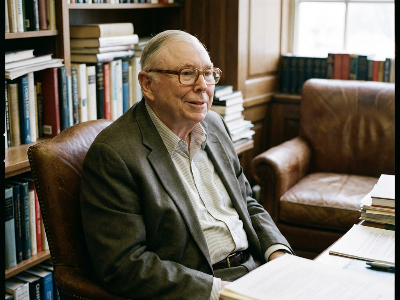
Source: Qilehui
Charlie Munger—Warren Buffett’s golden partner. Buffett’s son once said, “My father is the second smartest person I know; the first is Charlie Munger.”
Today, we have compiled key insights from Charlie Munger’s past speeches and Poor Charlie’s Almanack, inviting readers to listen to the wisdom of a sage.
I. Using Inverse Thinking Makes Problems Easier to Solve
 1. Investing in an excellent business at a fair price yields far better results than buying an ordinary business at a cheap price.
2. If you exclude our 15 best decisions, our performance would be quite mediocre. What you need is not a high volume of action, but immense patience.
3. Fully understanding a problem means it is half solved. As you have stated, this presents a contradiction: good opportunities offer significant potential at the entry stage, but become fraught with crisis if pursued to excess.
4. For complex adaptive systems and the human brain, problems often become easier to solve when approached through inverse thinking.
Let me apply some inverse thinking right now. What causes failure in life? What should we avoid?
For example, laziness and unreliability lead to failure in life. If you are unreliable, no matter how many other virtues you possess, you cannot avoid a miserable outcome. Therefore, you should cultivate the habit of keeping your word. Laziness and unreliability are clearly to be avoided.
5. In such situations, the correct persuasion technique is the one identified by Benjamin Franklin, who said, “If you wish to persuade others, appeal to their interests, not to their reason.”
6. At Berkshire Hathaway and the Daily Journal, we have consistently outperformed the average. The question arises: how did we achieve this? The answer is simple: we strive to do less.
7. If you borrow someone else's car, remember to refill the tank before returning it.
8. Think simply, but execute diligently.
9. People also need to cultivate the habit of using checklists.
Using checklists can prevent many errors, not just for pilots. You should not merely possess broad foundational knowledge; instead, you should organize it into a mental checklist and apply it accordingly. No other method yields the same results.
10. I was very fortunate to understand at a young age that the most reliable way to get what you want is to make yourself worthy of it.
This is a very simple principle, a golden rule. You must learn to treat others as you would wish to be treated yourself.
11. We prefer to allocate substantial capital to opportunities where no further decision-making is required on our part.
If you purchase an asset because it is undervalued, you must consider selling it once its price rises to your expected level.
However, if you can acquire shares in a few wonderful companies, you can simply sit back and relax, which is ideal.
12. We never try to be very smart; instead, we consistently strive to avoid being foolish.
13. Warren and I do not believe we have a significant advantage in the high-tech industry. In fact, we find it difficult to grasp the essence of developments in technology sectors such as software and computer chips. Therefore, we try to avoid these areas and acknowledge our own knowledge gaps.
14. Average outcomes are inevitably mediocre. As I often say, an iron law of life is that 20% of people achieve results superior to the other 80%.
15. Following the crowd will only pull you toward the average (resulting in merely mediocre performance).
16. Our success stems not from our ability to solve difficult problems, but from our skill in avoiding them. We simply focus on doing simple things.
17. It is an unpleasant aspect of modern life that megalomaniacs who overestimate themselves occasionally achieve great success. I have learned to accept this. While megalomaniacs can sometimes be big winners, I prefer not to have them flaunting themselves before me; I choose cautious individuals instead.
II. People Calculate Too Much and Think Too Little
1. You do not need to know everything; it suffices to absorb the most outstanding ideas from various disciplines, which is not difficult to achieve.
2. Acquiring systematic common sense is a powerful tool. Computers bring many dangers; people calculate too much and think too little.
3. I do not want you to mistakenly believe that we possess any learning or operational methods that can prevent you from making many errors.
I am simply saying that through learning, you can make fewer mistakes than others—and correct them more quickly when they do occur. However, it is impossible to live a prosperous life without making many mistakes.
4. Do not be afraid to admit when you lack understanding or relevant expertise. Some people always answer questions with confidence even though they do not actually understand the subject matter; I dislike associating with such individuals.
5. Excellent literary works require readers to engage in some reflection to fully comprehend them. If you have to think critically to grasp a principle, you will remember it better.
6. So-called common sense is actually knowledge that the average person does not possess. When we say someone has common sense, we essentially mean that they possess insights lacking in the general population.
People assume that possessing common sense is simple, but in reality, it is quite difficult.
7. If you train yourself to be more objective and acquire knowledge across multiple disciplines, you will be able to outperform even those who are significantly smarter than you when analyzing issues. I find this particularly intriguing.
Moreover, you can earn substantial wealth; I myself am living proof of this.
III. Strive to Acquire More Interdisciplinary Knowledge
1. Most people develop mental models from only a single discipline—such as economics—and attempt to solve all problems using just one approach.
As the saying goes, "To a man with a hammer, everything looks like a nail." This is an inept way of handling problems.
2. Merely reading books is insufficient; you must cultivate a character capable of mastering ideas and acting rationally. Most people fail to grasp correct thinking or do not know how to apply it.
3. I believe that, beyond history, there are many other subjects one must understand. By "many other subjects," I refer to the core ideas from all major disciplines.
You must acquire substantial knowledge and integrate it into a mental framework in your mind, enabling you to apply it automatically in the future.
If you achieve this, I solemnly assure you that one day you will unconsciously realize: "I have become one of the most efficient individuals among my peers."
4. The essence of the theory of economies of scale is that the more units you produce, the better you become at producing them. This constitutes a significant advantage and is closely linked to business success or failure.
5. You must possess numerous multidisciplinary models. You might exclaim, "Good heavens, that seems too difficult!"
Fortunately, it is not as difficult as it seems—mastering eighty or ninety models can largely equip you with worldly wisdom. Among these eighty or ninety models, only a few are critically important.
6. The foundational aspects of psychology—which I term the Psychology of Human Misjudgment—constitute extremely important knowledge, encompassing approximately twenty basic principles.
7. There are not many academic disciplines, nor are there many truly useful ideas. Mastering them thoroughly will bring you considerable enjoyment.
Furthermore, if you strive to understand these ideas through personal exploration rather than rote memorization of secondhand accounts, your grasp of them will be more solid.
8. My previous education was profoundly misguided; I had never read any works on so-called modern Darwinism. Although my reading was eclectic, I simply had not encountered this genre.
Last year, it suddenly dawned on me that I was quite foolish for having never studied modern Darwinism. Consequently, I went back to basics and, with the assistance of distinguished biologists such as Richard Dawkins at the University of Oxford and others, I filled this gap in my knowledge.
For me, understanding the Modern Evolutionary Synthesis has been an absolute delight. The theory is exceptionally elegant and robust. Once mastered, it becomes remarkably simple.
4. Only through exceptional diligence can one identify the few rare opportunities.
1. Whether you are right or wrong does not depend on whether others agree or disagree with you; the only thing that matters is the correctness of your analysis and judgment.
2. Merely parroting what a professor says is something anyone can do. The key lies in discerning which parts of the professor's teachings are correct and which are erroneous; this is the hallmark of a well-educated individual.
3. We do not pretend to be omniscient.
We remain acutely aware that only through exceptional diligence can we accurately identify the few rare opportunities. These few opportunities are sufficient.
4. From a very young age, I realized that significant opportunities—those belonging to me—are few in number. When such an opportunity arises, we must seize it decisively. Reflect on this: has your life followed a similar pattern?
5. The first rule of fishing is to fish where the fish are. The second rule of fishing is to remember the first rule. In an environment of intense competition, no amount of effort will yield results if the fundamental conditions are absent.
6. Stay in the game at all times. Keep a close watch, and do not let rare opportunities slip away when they arise. Recognize that the number of opportunities available to the average person is limited.
7. You must clearly identify your competitive advantages and compete strictly within your circle of competence.
8. It is critically important to know the boundaries of your circle of competence. If you do not know where the boundaries lie, it cannot truly be considered a circle of competence. Lacking the ability yet believing you possess it will inevitably lead to significant errors.
9. You must constantly compare what you can achieve against what others can achieve. You need to remain firmly rational at all times, and above all, avoid self-deception.
V. Speak the truth, and you will not need to remember your lies.
1. Fundamentally, we choose individuals whom we deeply admire to manage our subsidiaries. Generally, we get along well with them because we like and respect them.
2. I believe it is better to live as we do, without deceiving others.
Peter Kaufman and I have often said, “If swindlers knew how much money they could make by being honest, they would certainly stop being swindlers.” Warren also offered a classic remark: “Act with integrity, and the path ahead will grow wider.” This statement holds true.
3. The secret to making money is to curb expenditures and live frugally.
When Warren and I were young and had little money, we practiced frugality, saving our funds for investment. By maintaining this discipline throughout our lives, we ultimately achieved substantial wealth. This principle is understandable to anyone.
4. “Honesty is the best policy.” — Benjamin Franklin
“If you tell the truth, you don't have to remember your lies!” — Mark Twain
5. Life is more than just the shrewd accumulation of wealth.
6. Envy is a foolish sin, as it is the only one from which you can derive no pleasure whatsoever.
7. In general, envy, resentment, hatred, and self-pity are disastrous mental states. Excessive self-pity can lead to near-paranoia, and paranoia is one of the most difficult conditions to reverse. Do not allow yourselves to fall into the trap of self-pity.
I have a friend who carries a thick stack of cards with him. Whenever someone expresses self-pity, he slowly and dramatically pulls out the stack and hands the top card to the speaker.
The card reads: “Your story is deeply moving. I have never heard of anyone being as unfortunate as you.”
You may consider this a joke, but I regard it as mental hygiene.
Whenever you find yourself succumbing to self-pity, regardless of the cause—even if your child is dying of cancer—remind yourself that self-pity serves no useful purpose.
In such moments, give yourself one of my friend's cards.
6. The key to finding a good spouse is first ensuring that you are worthy of them.
1. What is the secret to longevity and happiness? This is easy to answer, as the principle is quite simple.
Avoid envy, refrain from complaining, and do not overspend; maintain an optimistic mindset in the face of any difficulties, associate with reliable people, and fulfill your duties...
These are all simple principles, indeed rather clichéd ones. Yet if practiced, they will benefit you for a lifetime.
2. Find a good spouse. What is the best way to find a good spouse? The single best approach is to first become someone who deserves a good spouse, because by definition, a good spouse is certainly no fool.
3. Befriend 'the deceased greats.' This may sound amusing, but if you truly befriend those deceased luminaries with outstanding minds in your daily life, I believe you will lead a better life and receive a superior education.
4. Over the years, reading has brought me numerous benefits.
5. The principle is this: Some things cannot be learned by everyone. Some people are naturally more talented than you; no matter how hard you try, there will always be others who are stronger.
My attitude is: 'So what?' Is anyone here absolutely compelled to stand at the pinnacle of the world? There is no such necessity.
6. The best armor for one's later years is a life carefully lived beforehand.
7. Become a little wiser each day than you were the day before.
1. Of all the smart people I have met in my life (smart people from all walks of life), not one fails to read every day—not one, not a single one.
2. I view life as a competitive arena, filled with rivalry. We must allow those who are most capable and most willing to become learning machines to play their greatest roles.
If you wish to achieve extraordinary success, you must become such a person.
3. Without lifelong learning, you will not achieve significant accomplishments. Relying solely on existing knowledge will not take you far in life.
After leaving here, you must continue to learn in order to go further in life.
4. For Berkshire Hathaway, its long-term performance in large-scale investments may be the most outstanding in human history.
The strategies that enabled Berkshire to generate substantial profits in this decade may not prove equally effective in the next, which is why Warren Buffett must remain a perpetual learning machine.
5. I continually observe individuals improving their lives over time. They are not necessarily the smartest, nor even the most diligent, but they are learning machines; each night when they go to sleep, they are a little wiser than they were that morning.
Young people, this habit will serve you well, especially given the long journey ahead of you.
6. Consider Warren Buffett: if you observe him with a timer, you will find that he spends half of his waking hours reading.
He devotes most of the remaining time to one-on-one conversations with highly talented individuals—sometimes by phone, sometimes in person—people whom he trusts and who trust him.
7. Cicero famously remarked that anyone who does not know what happened before they were born remains forever like an ignorant child.
8. I often share a joke about Max Planck.
After winning the Nobel Prize, Planck toured Germany delivering lectures on the new quantum physics theory, with largely similar content each time.
Over time, his driver memorized the lecture. The driver said, “Professor Planck, it’s rather tedious giving the same talk repeatedly. How about this: let me deliver the lecture in Munich while you sit in the front row wearing my driver’s cap?” Planck agreed.
So the driver took the stage and delivered a lengthy discourse on quantum physics. Later, a professor of physics stood up and posed a highly difficult question.
The speaker replied, “Well, I am surprised to encounter such a simple question in so advanced a city as Munich. I will invite my driver to answer it.”
I tell this story not to praise the protagonist’s cleverness. I believe knowledge in this world can be divided into two types: one is Planck knowledge, possessed by those who truly understand, having exerted effort and acquired genuine competence.
The other is chauffeur knowledge, characterized by rote repetition; its holders may have attractive appearances and pleasing voices, leaving a strong impression, but in reality, they possess only chauffeur knowledge disguised as real understanding.
9. Strive to become a little wiser each day when you wake up.
Execute your tasks diligently and excellently. Progress will come gradually, though not necessarily quickly. However, this approach lays the foundation for rapid advancement... by moving forward incrementally each day.
In the end—if you are fortunate enough to live a long life—you will receive what you deserve, just like most people.
10. It is difficult to encourage people to adopt a completely different habit when a competitive product remains untested. Every married person understands this principle.
11. You must have a strong interest in understanding the reasons behind events. If you can maintain this mindset over the long term, your ability to focus on reality will gradually improve.
12. To be competitive in any field, you must master every aspect of that field, whether you enjoy doing so or not; this is determined by the deep structure of the human brain.
8. Intelligence means constantly asking why.
1. Just as animals thrive in environments suitable for their growth, those in the business world who focus on a specific niche—and become highly proficient through such focus—often achieve favorable economic returns that would otherwise be unattainable.
2. The only way to win is to work, work, work, work, and hope to possess a bit of insight.
3. One of the key factors for successful investing is having a sound temperament—most people are either unable to restrain themselves or worry excessively.
Success requires immense patience, yet the ability to take decisive action when you know it is time to act.
4. Cultivate yourself into a lifelong autodidact through extensive reading; nurture your curiosity and strive to become a little wiser each day.
5. If you wish to become wise, you must relentlessly ask: "Why, why, why."
6. The path to becoming a winner is to work, work, work, and work again, while hoping to correctly identify opportunities a few times.
7. What should young people pursue in their careers? I have three fundamental principles.
While satisfying all three principles simultaneously is nearly impossible, you should strive to attempt it:
First, do not sell anything you would not buy yourself.
Second, do not work for someone you do not respect and admire.
Third, only work alongside people you like.
Hold yourself to strict standards, continuously improve your character throughout your life, and overcome the inherent weaknesses of human nature.
8. Different stages of life present different challenges, often highly棘手 ones.
I believe three factors help in coping with these difficulties: first, keep expectations modest; second, maintain a sense of humor; third, surround yourself with the love of friends and family. Most importantly, adapt to the changes in life. If the world had not changed, I would still have 12 shortcomings today.
9. Others’ Assessments of Charlie Munger
1. For both Charlie and Warren, diligent work has always been ongoing, regardless of whether it leads to an investment decision—usually it does not.
They spend more time studying and thinking than acting, a habit that is by no means accidental.
This reflects the blend of discipline and patience seen in true masters of every industry: an unyielding determination to 'play the hand you are dealt' well.
Like world-class bridge master Richard Sackhouzer, Charlie is less concerned with whether he personally wins the hand, but rather with whether he plays the cards in his hand well.
Although poor outcomes are acceptable in the world of Munger and Buffett (as some results are beyond their control), inadequate preparation and hasty decisions are unforgivable, as these factors are within one's control.
—Peter Kaufman, author of Poor Charlie’s Almanack
2. The source of Charlie’s confidence lies not in how many people agree or disagree with his views, but in his objective assessment and measurement of his own capabilities.
This self-awareness enables him to maintain a rare degree of objectivity when assessing the validity of his actual knowledge, experience, and reasoning.
— Peter Kaufman, author of Poor Charlie's Almanack
3. He is exceptionally intelligent, possesses wide-ranging interests, and seems never to forget anything, no matter how profound or trivial.
His greatest virtue is his unwavering commitment to honesty, ethics, and integrity.
— Louis Simpson, Director & CEO of Asset Operations, Government Employees Insurance Company (GEICO)
4. He possesses a rational temperament ideally suited for investment: unyielding patience, discipline, and self-control. Regardless of the pressure he faces, Charlie never wavers or compromises his principles.
— Louis Simpson, Director & CEO of Asset Operations, Government Employees Insurance Company (GEICO)
5. Charlie is naturally rational and applies this trait to his business endeavors, which has led to substantial commercial success.
In fact, I believe Charlie’s moral qualities are genuinely derived from Benjamin Franklin, whom he greatly admires.
He is honest and upright, consistently goes above and beyond his duties, and never complains about the actions of others.
— Warren Buffett, Chairman & CEO of Berkshire Hathaway
6. This approach to practicing tennis is akin to chipping in golf; few others are willing to adopt it, yet my father took great pleasure in it. As a result, he gained a competitive advantage in other aspects of life that drove others to distraction.
I truly fear being his opponent. Fortunately, my father and I are opponents on the tennis court, not in the business world.
— David Bostwick, son of Charlie Munger
7. He knows how to concentrate intensely and focus entirely on dissecting a problem without being distracted by external factors.
— Bill Gates, Co-founder of Microsoft
8. He is indeed the most erudite thinker I have ever encountered. From business principles to economic laws, and from the design of student dormitories to that of yachts, he has no equal. Charlie possesses the ability to capture the essence of matters through simple descriptions.
— Bill Gates, Co-founder of Microsoft
Editor/Jayden