
Meta Muse and OpenAI Astra are driving the expansion of AI applications into continuous‑execution, multi‑step collaborative agent workflows, prompting the market to reassess the CPU, memory, and storage requirements underpinning these use cases. Consequently, Micron's upcoming earnings report has become a critical window for gauging the trajectory of the storage supercycle.
As Meta Muse and OpenAI Astra drive the global expansion of AI applications toward sustained execution and multi-step collaborative agent workflows, global demand for AI computing power is expected to surge in a new wave of explosive growth. This is also why, in recent days, the global stock market has translated the unexpectedly rapid adoption of AI‑agent applications into…$SK hynix (SKHY.US)$、 $Samsung Electronics (005930.KR)$ 、 $Micron Technology (MU.US)$ 、$NVIDIA (NVDA.US)$and also$Advanced Micro Devices (AMD.US)$ 、$Taiwan Semiconductor (TSM.US)$And so on—these are the key rationales underpinning the growth expectations of leading players across the AI computing‑power industry chain, as well as of core computing‑power suppliers.
The market is currently reassessing the CPU, memory, and storage requirements underpinning these applications, making Micron (MU.US)—one of the three major memory‑chip manufacturers—whose earnings report is set to be released next week a key barometer for gauging both the trajectory of the memory supercycle and the unprecedented surge in AI‑related infrastructure investment.
 AI agents and cutting-edge large-scale AI models are rapidly penetrating industries worldwide, driving sustained and robust growth in demand for core AI infrastructure hardware—including AI GPUs and TPUs, data-center CPUs, optical interconnect systems, and data-center storage chips—and this demand is accelerating into…$SK Hynix (000660.KR)$, Samsung and$Micron Technology (MU.US)$These three major memory‑chip manufacturers continue to post record‑breaking financial results and deliver forward guidance that consistently exceeds market expectations. Whether valuations can keep rising in the next phase will hinge largely on the sustainability of earnings growth and the expansion of their earnings outlook.
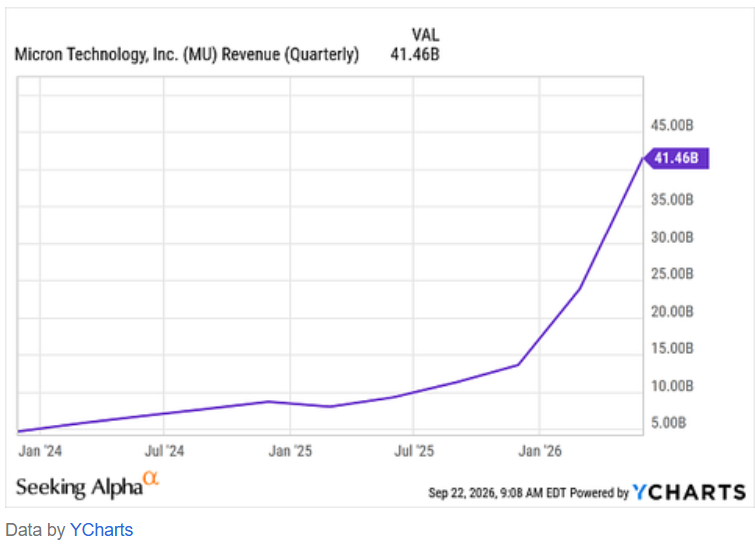
As shown in the chart above, Micron's revenue growth has accelerated, underscoring a rapid shift in storage‑chip demand toward tangible earnings. Micron is scheduled to report its fiscal fourth‑quarter results on September 30; in the previous quarter, revenue reached $41.456 billion, up roughly 346% year over year, with adjusted earnings per share of $25.11. Earlier, the company had guided for fourth‑quarter revenue of $50 billion, plus or minus $1 billion, a gross margin of approximately 86%, and adjusted EPS of $31, plus or minus $1. More significantly, Micron disclosed that, among the 16 strategic customer agreements it has signed, 14 are priced at the contract‑minimum rate, generating cumulative revenues of about $100 billion over the remaining contract terms—helping to bolster the visibility of future revenue and profitability.
However, it is worth noting that the recent exceptionally strong and stringent earnings guidance, aligned with Wall Street analysts' consensus expectations, signals that the market is not only focused on whether the current quarter will exceed forecasts but also on whether prices, shipment volumes, and long-term orders in fiscal year 2027 can continue to support upward revisions to earnings estimates.
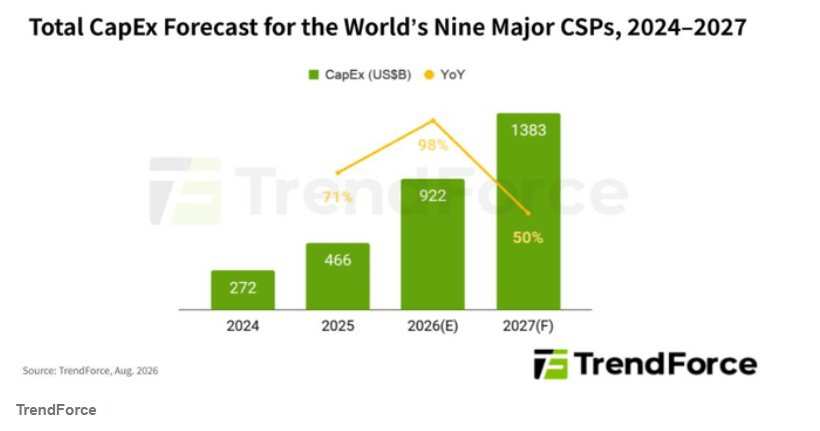
The key to supporting the bullish outlook lies in the fact that AI infrastructure procurement is now encompassing a more comprehensive range of computing systems. According to a Wall Street analyst consensus compiled in an S&P Global research report on September 22, Meta, Alphabet,$Amazon (AMZN.US)$and$Microsoft (MSFT.US)$These four tech giants are projected to collectively spend approximately $2.8 trillion on capital expenditures between 2026 and 2028. According to Visible Alpha's measurement framework, Wall Street analysts have significantly raised their fiscal 2027 earnings-per-share estimate for Micron from roughly $90 in March to about $156.
Meta's Muse and OpenAI's Astra have strengthened computers' capabilities in highly specialized tasks such as operations, programming, and multi-step processes. From this, it can be inferred that the accelerating expansion of AI applications is simultaneously increasing infrastructure investments required for both "model-based reasoning" and "actual execution." This is also why, as the commercialization of AI has improved significantly, UBS Group's team of senior analysts has substantially raised its 2027 operating cash flow forecasts for global hyperscale cloud computing providers and emerging cloud‑native companies by 30%, while Wall Street financial giant Morgan Stanley expects North America's four major superclouds to…$Oracle (ORCL.US)$The total capital expenditures of AI application vendors for data centers are projected to rise from USD 917 billion in 2026 to USD 1.47 trillion in 2027 and USD 1.64 trillion in 2028, while the deployed capacity is expected to expand from 35 GW in 2025 to a remarkable 145 GW by 2028.
The more AI becomes adept at "getting things done," why do CPUs and memory chips remain indispensable?
The most profound shift in AI agents' demand for computing power is the ability for a single user command to initiate a continuously running workflow. Research, programming, or enterprise‑level office tasks often involve planning, information retrieval, web browsing, file reading, code execution, result verification, and error correction—steps that frequently invoke models again and again, generating new contextual data at each stage. Meta has disclosed that Muse operates within a secure cloud‑based virtual machine equipped with its own independent browser, allowing users to keep advancing their tasks even after closing the application. Meanwhile, OpenAI highlights Astra's enhanced capabilities in computer operations, browser usage, and cross‑software professional workflows. From an engineering perspective, as such tasks scale from a small group of high‑frequency users to everyday enterprise processes, infrastructure requirements are driven simultaneously by user base size, task frequency, task duration, and peak concurrency.
This also explains why the market has begun to pay closer attention to data-center CPUs based on AMD, Intel, and Arm architectures. GPUs and ASICs handle large-scale neural-network computations, while CPUs are responsible for virtual machines, browsers, code sandboxes, task scheduling, data preprocessing, and tool execution. Whether an agent can complete tasks efficiently depends on how smoothly model inference and actual execution are coordinated; any delays in the CPU, database, or input/output stages can likewise reduce the utilization of costly accelerators. AMD's PACE technology solution explicitly adopts a collaborative approach, with CPUs orchestrating and GPUs executing heavy‑duty inference, and Arm likewise lists agent sandboxes and tool execution as key workloads for cloud‑based CPUs. This provides concrete engineering rationale for expanding CPU demand and makes server DRAM, storage, and networking critical links in the same demand‑driving chain.
From the perspective of large-model inference, the prefill stage processes the input context, while the decoding stage continuously generates the output; model weights and the key-value cache, or KV Cache, consume memory capacity and bandwidth. When the model and caching strategies are similar, longer contexts, higher concurrency, and more parallel tasks all increase the scale of state that the system must maintain simultaneously. This gives rise to a clear division of storage responsibilities: HBM supports high-bandwidth access for accelerators, server DRAM handles the CPU's working set and part of the cache, and enterprise-grade SSDs store files and application states, also taking on portions of the inference context in systems that employ tiered caching. NVIDIA's CMX solution has integrated an Ethernet‑connected flash layer between GPU memory and shared storage, enabling context to be stored, migrated, and reused across nodes; thus, storage capacity, access speed, and network bandwidth collectively influence the throughput of inference services.
This surge in demand is already being met by large-scale production systems. On September 11, OpenAI disclosed that its Habitat online storage platform processes over 70 million requests per second, manages data exceeding 500 PB, and handles tasks such as routing, compression, encryption, and checksum verification. This represents the aggregate data footprint across multiple OpenAI products, underscoring the massive application‑and‑storage workloads underpinning AI services. As more agents move into production environments—adding new execution nodes, database accesses, and inter‑node data exchanges—the demands on servers, memory, enterprise‑grade SSDs, and high‑speed interconnects will further intensify. Meanwhile, as cluster sizes and rack power capacities grow, procurement needs will extend to optical interconnects, power distribution, and cooling systems. However, the actual incremental requirements at each stage will still depend on deployment strategies and utilization rates.
The efficiency gains brought by more powerful models may also broaden the range of tasks that can be commercialized. Meta disclosed that, in comparative tests conducted by its engineers, Muse Spark 1.3 reduced tool calls by approximately 20% and token consumption by about 25% compared to version 1.2. This suggests that the resource costs of performing similar work could decline, making it easier for companies to delegate processes that were previously too costly or slow to AI. At the heart of the market's bullish outlook on computing‑power demand lies the expectation that, as costs fall, the addition of new users and the expansion of workload will outpace the reduction in per‑task resource consumption. For example, even under a simplified assumption based solely on token counts, a 25% drop in per‑task usage coupled with a roughly 33.3% increase in task volume would still result in an overall rise in total consumption. This demonstrates that efficiency improvements and infrastructure scaling can coexist, and underscores that demand elasticity is the key factor in determining whether the "Jevons paradox" will hold true.
A hundred-billion-dollar long-term contract has solidified the foundation—how will the market reprice the storage supercycle?
For Micron, the U.S.-based storage‑chip giant, its advantages extend beyond its comprehensive coverage of HBM, server DRAM, and NAND flash memory—enabling it to participate in upgrades across various layers of intelligent‑system infrastructure—compared with SK Hynix and…$Samsung Electronics (005930.KR)$The biggest advantage of these two storage giants is undoubtedly that they do not have to worry about the operational pressures that might arise from the immense political pressure imposed by the U.S. government to "bring chip manufacturing back to the United States," nor the uncertainty of the Trump administration's tariff policies, which could change at any time.
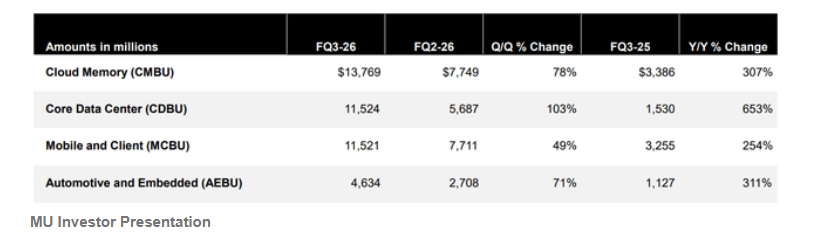
In the previous quarter, cloud‑memory revenue reached $13.769 billion, up roughly 78% quarter over quarter; core data‑center revenue totaled $11.524 billion, an increase of about 103% from the prior quarter. The company also disclosed that data‑center SSD revenue exceeded $5 billion, more than doubling compared with the previous quarter. Another NAND industry giant that has drawn significant market attention…$SanDisk (SNDK.US)$Its core business is centered on NAND flash memory and SSDs; therefore, Micron's financial results offer key insights into SanDisk's fundamentals and performance, primarily in terms of enterprise‑level storage demand, NAND pricing, and supply‑demand outlook. Although both companies are participating in the same wave of AI infrastructure development, their product mixes result in distinct profit elasticities.
The pace of supply‑side adjustments is a key driver behind this round of profit expansion in the memory sector. Building new fabs entails construction, equipment installation, process ramp‑up, and customer qualification; for HBM, it further involves multi‑layer stacking, advanced packaging, and system validation, meaning that any additional wafer capacity takes time to translate into deliverable products. Micron's management has previously projected that tight DRAM and NAND supply‑demand dynamics could persist beyond 2027, with industry supply gradually improving by 2028—though it remains uncertain when full demand will be met. Samsung's expansion of HBM4 capacity is therefore worth monitoring; however, the increase in its 4‑nm logic‑based production must be assessed alongside DRAM die yields, packaging yields, and customer certifications to gauge the ultimate level of HBM supply that can be delivered. From an investment perspective, the more meaningful metric is the growth gap between new effective supply and AI‑related procurement demand, rather than isolated expansion figures.
Long-term agreements provide an additional layer of support for Micron's earnings sustainability. During its June earnings release, the company announced that it has signed 16 strategic customer contracts, covering roughly 20% of its DRAM sales and one-third of its NAND sales over the contract periods; among these, 14 contracts, based on the minimum contracted prices, are expected to generate cumulative revenues of approximately $100 billion over their remaining terms. These agreements feature "take-or-pay" arrangements with agreed-upon purchase volumes, and some of the larger contracts include price‑range provisions.
The significance of long-term agreements between major memory‑chip manufacturers and AI‑computing‑power investors lies in the fact that customers secure supply guarantees in exchange for commitments to purchase over an extended period, while Micron gains clearer capacity planning and greater revenue visibility, helping to reduce its business's sensitivity to short‑term market price fluctuations. It is worth noting that Micron's claim—that "roughly half or more of its revenue is covered by such agreements"—refers to the projected outcome once all planned agreements are executed; this should not be interpreted as already realized.
Micron's management recently projected that these agreements will generate approximately $22 billion in cash deposits and related financial commitments, with about $18 billion in cash deposits. They reflect customers' willingness to secure long-term supply and help support capacity‑expansion plans. For accounting purposes, these cash deposits are classified as financing activities and will be gradually returned over the latter half of the agreement terms. Accordingly, the financial statements should focus on newly signed contracts, scope of coverage, product mix, and actual delivery schedules, as well as how these factors enhance the predictability of future operating cash flow.
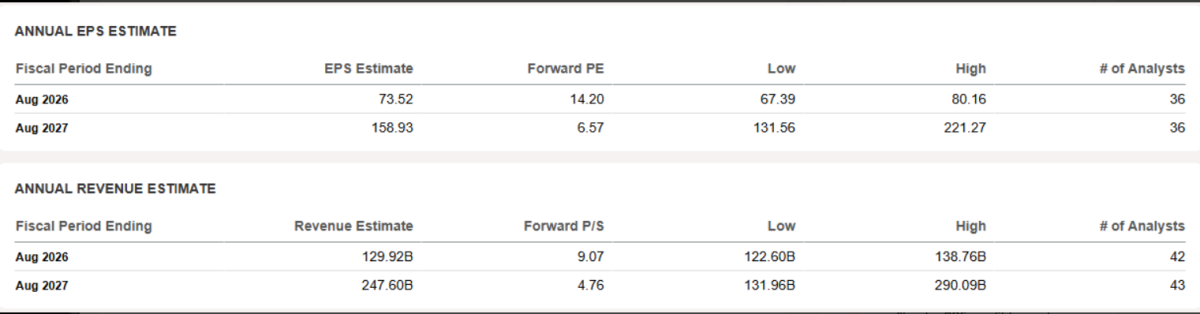
Moreover, Micron's fourth fiscal quarter includes an "extra week," which will directly affect how the market interprets its growth trajectory. This quarter spans 14 weeks, compared to 13 in the prior quarter: based on the midpoint of the $50 billion revenue guidance, nominal sequential growth would be approximately 20.6%, while weekly average revenue growth would be around 12.0%. Further mechanical calculations suggest that, once the next quarter reverts to a 13‑week structure, even if weekly average revenue remains unchanged, quarterly revenue would still reach roughly $46.43 billion. These figures underscore that, when assessing the new fiscal year's guidance, it is essential to consider week count, pricing, sales volume, and product mix; changes in total quarterly revenue alone do not necessarily signal a turning point in demand. Likewise, management's earlier comments about a deceleration in price increases should be analyzed in conjunction with both absolute price levels and shipment growth.

On September 30, U.S. local time, the most investment‑worthy insights from Micron's earnings report and its subsequent earnings call will focus on the sustainability of HBM and enterprise‑grade storage orders, trends in DRAM and NAND pricing, effective capacity expansion for fiscal year 2027, and whether long‑term agreements can continue to broaden their scope. According to TIPRANKS' compilation of Wall Street analysts' consensus, the average price target for Micron over the next 12 months stands at around $1,550, implying more than 40% upside from the September 23 closing price of $1,071.88.
Editor/Jeffy