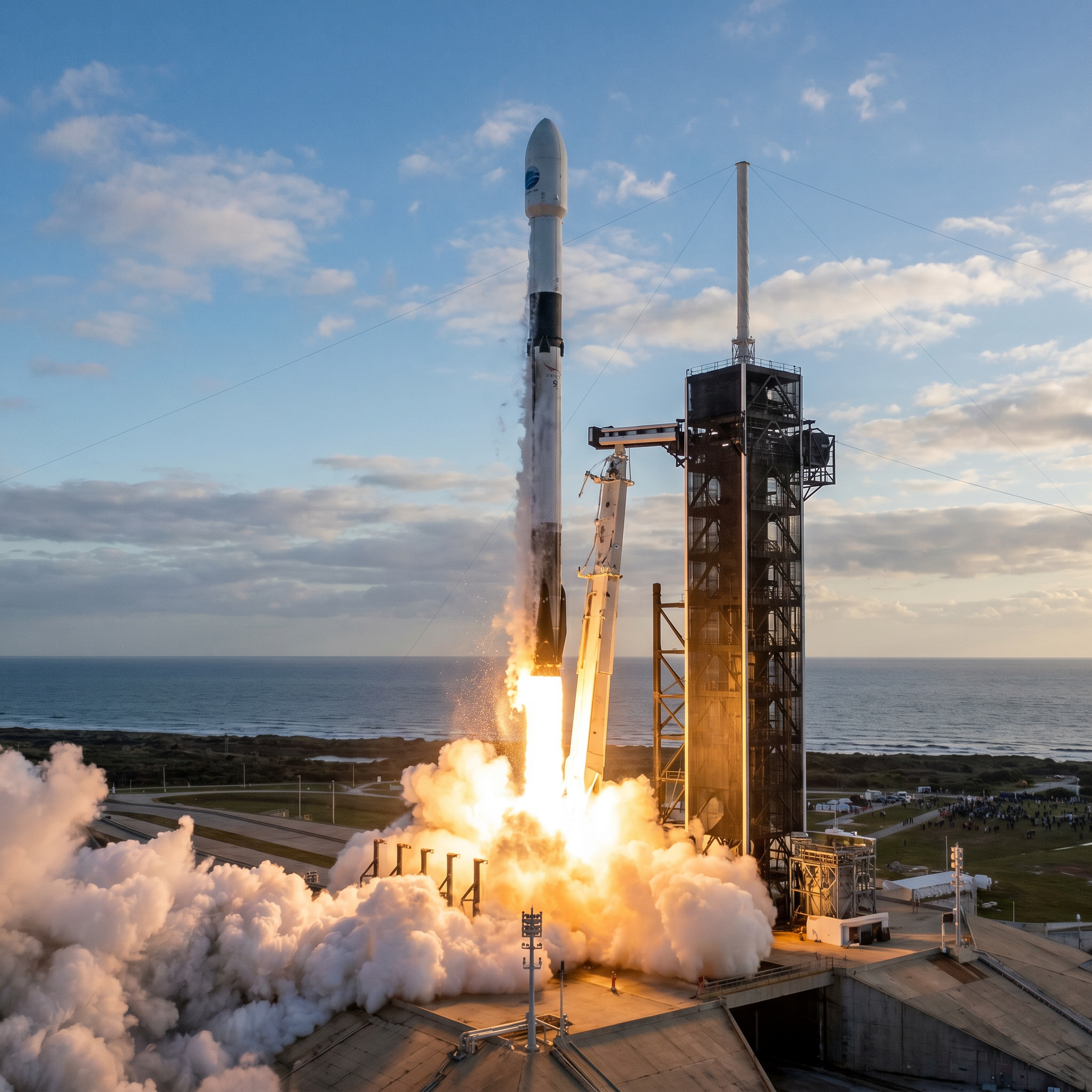
① On Monday, SpaceX will make its first attempt to launch Starship into orbit, a potentially pivotal step for the rocket; ② Starship has previously conducted suborbital tests, meaning it could return to Earth even if it were to lose control, whereas reaching orbit would eliminate that safety margin; ③ SpaceX stated that if any signs of malfunction arise within the first few minutes of the test flight, engine ignition could be aborted to keep Starship on a suborbital trajectory.
On Monday, SpaceX will make its first attempt to launch Starship into orbit, deploying the first batch of next-generation Starlink internet satellites. If this test flight is successful, it could mark a major milestone for Starship, bringing it closer to full operational service.
In a blog post, SpaceX acknowledged that, over the past 13 test flights, the company has deliberately placed Starship on suborbital trajectories. This means that even if the SpaceX team were to lose full control of the spacecraft, it would already be on a trajectory to reenter the atmosphere and splash down at the designated landing site.
 This time, the Starship will make its first attempt to reach orbit, which means that once it loses control, it will be extremely difficult to bring it back to Earth. It must fly at very high speed and along a precisely calculated trajectory; if successful, this will pave the way for Starship's future, more ambitious deep-space missions.
However, if Starship loses control in orbit, the rocket could collide with satellites or other critical assets already in orbit.
SpaceX previously stated that Starship's flight altitude will be significantly lower than that of crewed space stations, at approximately 275 kilometers. The International Space Station orbits at an altitude of about 400 kilometers, while China's Tiangong space station operates at an altitude of over 340 kilometers. Nevertheless, this does not entirely rule out the possibility of a collision between the rocket and a space station.
SpaceX stated that if any signs of malfunction arise during the first few minutes of Monday's test flight, the company may abort the planned engine ignition, keeping Starship on a suborbital trajectory.
Risks and Concerns
To date, most of Starship's test flights have lasted just over an hour, and all have been suborbital. But on Monday, the spacecraft could remain in the sky for nearly 10 hours, deploy its 26 Starlink satellites, and complete six orbits around Earth.
Subsequently, the spacecraft will attempt a safe, autonomous reentry into the atmosphere and execute a vertical, controlled landing in the Pacific Ocean off the coast of Chile. As with the Super Heavy booster, the spacecraft's controlled descent is critical—determining whether Starship can achieve reusable flight.
Joseph Gonzalez, an associate professor in the Department of Aerospace Engineering at the University of Illinois, stated that too many components could fail—such as a leak in the propellant system or ice forming on the top of a component, preventing the engine from igniting. In such a scenario, only an unignitable object would remain in orbit, potentially posing a threat to other satellites or spacecraft.
Musk noted that the team's primary concern is that if Starship were to disintegrate on land, debris could scatter across the area and injure civilians, which would deal a severe blow to SpaceX's reputation.
However, SpaceX is now poised to begin operations with Starship. Earlier industry reports indicated that SpaceX has explicitly stated it will reduce launches of its workhorse Falcon 9 rocket, a decision that has sparked concern, prompting many commercial customers to seek alternative launch providers or even establish their own launch capabilities.
Robert Sproles, CEO of the German launch brokerage and integration services company Exolaunch, noted that some people are overreacting to the gradual retirement of the Falcon 9, but demand for launches is indeed outpacing supply, which will inevitably drive up prices and keep the market in a state of persistent undersupply for the foreseeable future.
Editor/rice