
① On Monday, Japan's Vice Minister of Finance, Junichiro Mimura, once again issued a warning to the foreign-exchange market, urging it to "take seriously" the clear signals from Tokyo and Washington regarding a weaker yen; as a result, the USD/JPY exchange rate briefly plunged during trading. ② Japan has already deployed roughly 27.13 trillion yen in two rounds of currency intervention this year, yet fundamental factors such as the U.S.-Japan interest-rate differential and pressure from energy imports remain unchanged.
Cailian Press, September 28 (Editor: Shi Zhengcheng) — On Monday evening Beijing time, the yen, which has long faced a turbulent exchange rate, once again saw unusual movement, appreciating from 157.5 per U.S. dollar to 156.5 in a short span of time.
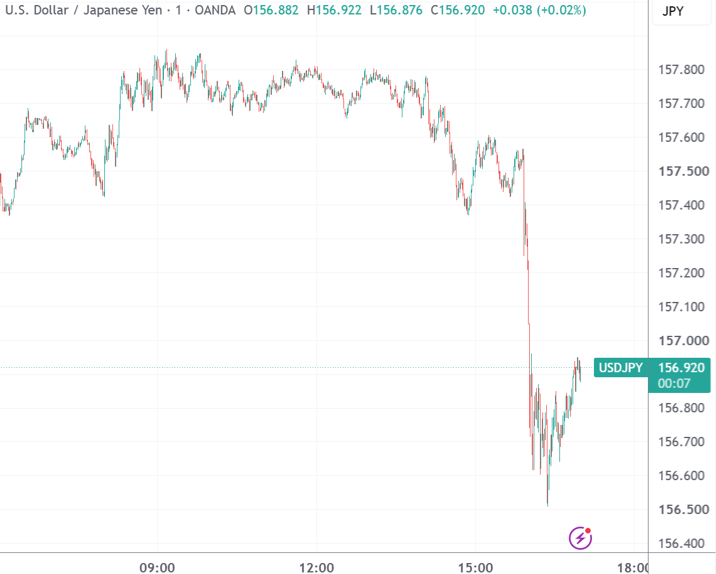
(USD/JPY minute chart, source: TradingView)
 On the news front, Japan's top official responsible for foreign-exchange policy, Junichiro Tamura, told the media that markets should take seriously the "very clear" message issued last week by Tokyo and Washington regarding the yen, and that they have signaled their determination to act against excessive depreciation of the currency.
As background, Japanese Finance Minister Taro Aso said last Friday that U.S. President Trump expressed concern about the yen's weakness during his meeting with the Japanese prime minister. This remark unusually revealed the content of the two leaders' discussions on currency issues.
In the latest report, Atsushi Mimura stated: "The Japanese Prime Minister, the Finance Minister, and the U.S. side have all conveyed a very clear message. The market should take this message seriously. I will closely monitor whether the market continues to do so."
Although Jun Mimura declined to comment on whether Japan would intervene in the foreign-exchange market again, he said he is neither satisfied nor reassured by the yen's recent performance.
Spending 27 trillion yen only managed to slow the decline.
As background, the Japanese government has already carried out two rounds of large-scale foreign-exchange intervention this year; however, since the underlying fundamentals driving the yen's weakness have not changed significantly, these interventions have primarily served to delay further depreciation rather than reverse the trend.
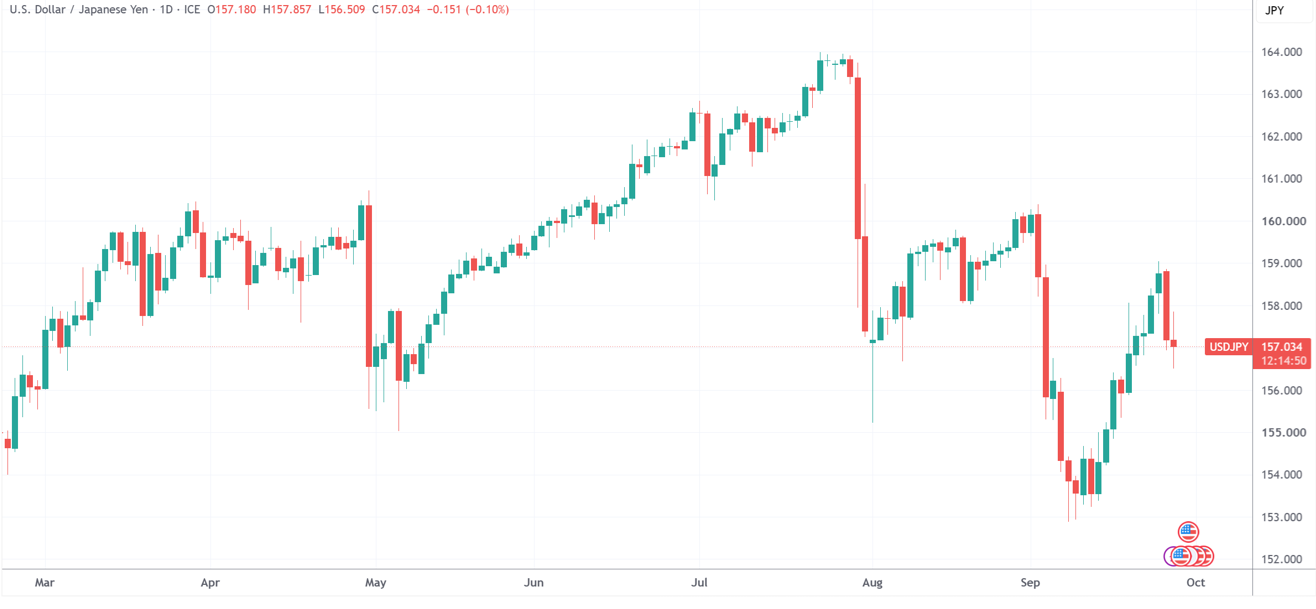
(USD/JPY daily chart, source: TradingView)
The first round occurred from late April to early May. At that time, the USD/JPY exchange rate broke through the 160 level, prompting the Japanese government to sell U.S. dollars and buy Japanese yen on three consecutive occasions. According to data released by Japan's Ministry of Finance, the intervention amounts on April 30, May 4, and May 6 reached JPY 6.28 trillion, JPY 780.2 billion, and JPY 4.68 trillion, respectively, totaling approximately JPY 11.73 trillion—setting a record at the time for Japan's largest single-month foreign-exchange intervention.
The initial impact of the intervention was quite pronounced. On April 30, the USD/JPY exchange rate briefly plunged from 160.7 to around 155.5, and by May 6 it had fallen further to near 155. However, this appreciation did not last long; by the end of May, the pair had rebounded to around 159.6, nearly returning to its pre‑intervention level.
The real policy upgrade came at the end of July.
At the time, the yen plunged to around 163.99 per U.S. dollar, hitting a nearly 40-year low. Japan and the United States subsequently launched an exceptionally rare joint intervention—the first coordinated move to influence the yen's exchange rate since 2011.
According to data from Japan's Ministry of Finance, during the period from July 30 to August 26, the Japanese government's spending on foreign-exchange intervention reached a further 15.40 trillion yen, once again setting a new monthly record.
The coordinated intervention at one point delivered a stronger deterrent effect. The yen staged a rapid rebound from near 40-year lows, with the USD/JPY pair swiftly retreating from close to 164 and briefly dipping to around 155.21.
The effect of the U.S.-Japan joint intervention lasted only about a month. In early September, the dollar–yen exchange rate once again approached 160, rising to as high as 160.39 on September 2.
Subsequently, the market sentiment reversed abruptly. On September 2–3, the yen appreciated sharply, prompting some to suspect that the Japanese government had intervened once again. However, based on estimates derived from Bank of Japan account data, analysts later concluded that no official foreign-exchange intervention took place at that time.
By contrast, Bank of Japan board member Takeshi Kanda signaled a more hawkish stance on interest-rate hikes, while U.S. officials publicly endorsed further monetary tightening in Japan, prompting the market to swiftly ramp up bets on a rate hike by the Bank of Japan—key drivers behind the yen's subsequent sustained strength.
However, just a few weeks later, the yen exchange rate had once again settled around 157, once again demonstrating the fundamental limitation of foreign-exchange intervention: while it can curb speculative positions, it cannot, on its own, alter the macroeconomic fundamentals that determine the currency's direction.
The most important issue remains the U.S.-Japan interest rate differential.
Although the Bank of Japan raised its policy rate by 25 basis points this month to 1.25%, the highest level in 31 years, the Federal Reserve has simultaneously re-entered a rate-hiking cycle. Adding to the disappointment in the foreign-exchange market, two members of the Bank of Japan's policy board voted against this rate hike. Despite Bank of Japan Governor Kazuo Ueda explicitly stating that he does not rule out consecutive rate hikes or even a one-time increase of 50 basis points, he did not provide a clear timetable for further rate increases.
In addition, Japan's own fiscal policies, coupled with the Middle East situation driving energy prices to persistently high levels, are also exerting sustained downward pressure on the yen.
Another rate hike in October or December?
Regarding the Bank of Japan's future pace of interest-rate hikes, Kazuo Kadoma, a former member of the Bank of Japan's Policy Board and chief economist at the Mizuho Research Institute, said in a media interview on the 25th that the central bank's next rate hike is "almost certain to occur in December."
As the Bank of Japan grows increasingly wary of risks to its 2% core inflation target, the timing of the next rate hike essentially comes down to a choice between October and December. Monma stated, "The key question is whether the Bank of Japan will conclude that it can no longer afford to wait until December."
From the perspective of assessing the financial environment, he believes that, in principle, the Bank of Japan will continue to raise interest rates at a pace of once every three months. However, depending on developments in the external environment and changes in economic and price conditions, "there is still a 20% to 30% chance of a rate hike in October." On the other hand, given that the Bank of Japan has now signaled more clearly its readiness to address the risks of rising inflation, Monma considers it "extremely unlikely" that the bank will delay the rate hike until January next year.
Monji also pointed out that, against the backdrop of the United States shifting toward interest-rate hikes, if the Bank of Japan delays raising rates, further depreciation of the yen will be difficult to avoid.
Editor/Deng