The bullish case for Wall Street isn't Starship—it's "computing power overtaking Starlink": SpaceX's computing‑power business could surpass Starlink as early as the first quarter of 2027.
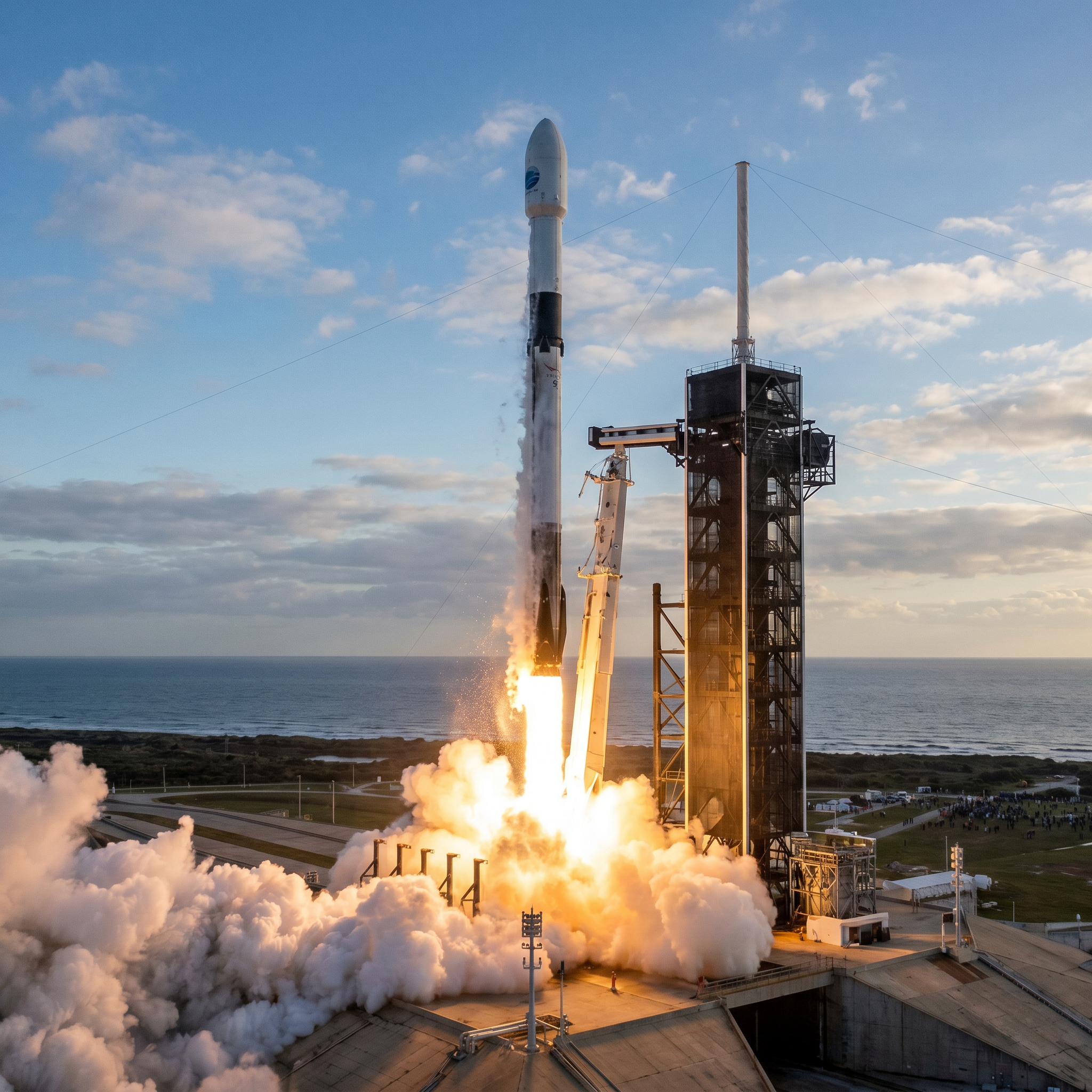
The Zhitong Finance app learned that on September 28,$SpaceX (SPCX.US)$Starship's 14th integrated flight test lifted off from the Starbase in Texas, achieving Earth orbit for the first time and deploying 26 third-generation Starlink (Starlink V3) satellites via the spacecraft's "candy dispenser" deployment mechanism. Clearly, the market is betting on more than just this single launch, with Wall Street investment banks lining up to express bullish views.
TD Cowen initiated coverage on Monday, assigning a "buy" rating and a $200 price target; together with the Royal Bank of Canada (RBC), Clear Street, and CLSA, the four firms' price targets range from $200 to $250, which, based on Monday's closing price, implies upside potential of roughly 37% to 72%. And in this round of bullish sentiment, what keeps getting mentioned isn't rockets—it's computing power leasing.
 Starship's first orbital flight: all satellites deployed, and it returned after just two orbits.
According to reports, this launch utilized the B21 booster and the S41 spacecraft, both part of the third-generation Starship system. One of the spacecraft's six engines malfunctioned, leading the live commentator to initially conclude that orbit insertion was impossible; however, after a reassessment, the engineering team confirmed that an orbital‑insertion burn could still be attempted. Approximately 25 minutes after liftoff, the Starship achieved orbit, followed by about half an hour of deploying its satellites one by one. The company established communication with all 26 satellites, and Musk confirmed that each is operating normally.
The flight was far from flawless. During the ascent phase, one engine shut down prematurely, and what had been planned as a mission to orbit Earth about six times at an altitude of roughly 275 kilometers—lasting nearly 10 hours—was ultimately shortened to approximately three hours, with only two orbits completed. The upper-stage's remaining engine was ignited for an extended burn to compensate. The over‑mass booster splashed down in the Gulf of Mexico; no attempt was made to recover it using the launch tower's robotic arm. Meanwhile, the spacecraft executed its first deorbit burn and splashed down in the designated Pacific recovery zone west of Chile.
The significance of this flight lies in the fact that, since the first integrated test flight in 2023, the previous 13 test flights had all remained suborbital; achieving orbital insertion is the fundamental threshold for a launch vehicle. Aerospace engineer Dean Sladeen described the deployment of 26 V3 satellites into their intended orbit as a "major victory," marking Starship's first revenue‑generating commercial mission—these satellites are valued at several million dollars. Meanwhile, Catherine Curley, a senior analyst at Georgetown University's Center for Security and Emerging Technology, adopted a more measured tone: while the mission represented substantial progress, it fell short of being a "resounding success." She noted, "By SpaceX's own metrics and objectives, they did not complete the planned 10‑hour flight, and there were indeed issues with the engines."
Single-star 1 Tbps: A quantum leap in capacity brought by V3
According to documents filed by SpaceX with regulatory authorities, the V3 satellite is designed with a downlink capacity of approximately 1 Tbps—enough to support roughly 10,000 households simultaneously streaming at 100 Mbps—and an uplink capacity of 160 Gbps. Compared to the V2, this represents about a tenfold increase in downlink capacity and a twenty-twofold increase in uplink capacity, with the antenna supporting 2,048 downlink and uplink beams (versus the V2's phased-array configuration of 192 downlink and 144 uplink beams). According to SpaceX's technical specifications, a single Starship launch can deliver into the constellation roughly twenty times the payload capacity of a Falcon 9 mission carrying V2 satellites.
Weight is another hurdle: a single V3 weighs about 2,000 kilograms—roughly twice that of the previous generation—making it impossible for the Falcon 9 to launch. Third-party commentary is more optimistic, though still subjective: Rob Moller, managing partner at First Principles Group, tweeted, "With just today's Starship launch, SpaceX has added more Starlink capacity in the past hour than it did in the first year and a half of Starlink operations"; meanwhile, Phil Beser, a former Apple executive now serving as a senior director at Rivian, stated that a single V3 is designed to support a user capacity of 1.16 Tbps, with inter-satellite optical links delivering 2.4 Tbps—links that could eventually form a network backbone capable of routing even greater traffic and potentially connecting computing resources to space.
Musk hopes that, once Starship enters regular service, each launch will deploy 60 V3 satellites. According to estimates, to achieve a significant improvement in the overall quality of Starlink's services, the constellation would need to reach roughly 1,000 V3 satellites in orbit—requiring at least 17 full‑payload launches. SpaceX has applied to the U.S. Federal Communications Commission (FCC) to operate up to 100,000 V3 satellites. As of September 2026, Starlink has launched approximately 13,000 satellites, with about 11,000 currently in orbit, serving tens of millions of users across more than 160 countries and regions.
Wall Street's Price Hike: Computing Power Is the Real Near-Term Engine
TD Cowen initiated coverage, led by analyst John Blakely, with a "Buy" rating and a $200 price target, noting that SpaceX's broader opportunities in AI and space are "massive." The firm projects that AI‑compute leasing will account for roughly 60% of revenue by 2027, with revenue growing at a compound annual growth rate of 62% from 2026 to 2031, and low‑Earth‑orbit launch activity expected to approach 1,000 missions by 2031.
TD Cowen also projects that by 2026, roughly 35% of sales will come from compute‑related businesses. This segment could surpass Starlink—the "crown jewel"—as early as the first quarter of 2027, and by 2028 it is expected to account for 65% of total revenue. Over the next few years, nearly half of its compute capacity is slated to be leased to external companies. Deutsche Bank analyst Edison Yu has assigned a "buy" rating with a price target of $235, estimating that the five contracted customers currently represent an annualized revenue run rate of approximately $54.5 billion, and adding that, as production ramps up, "we expect at least several more major deals to materialize."
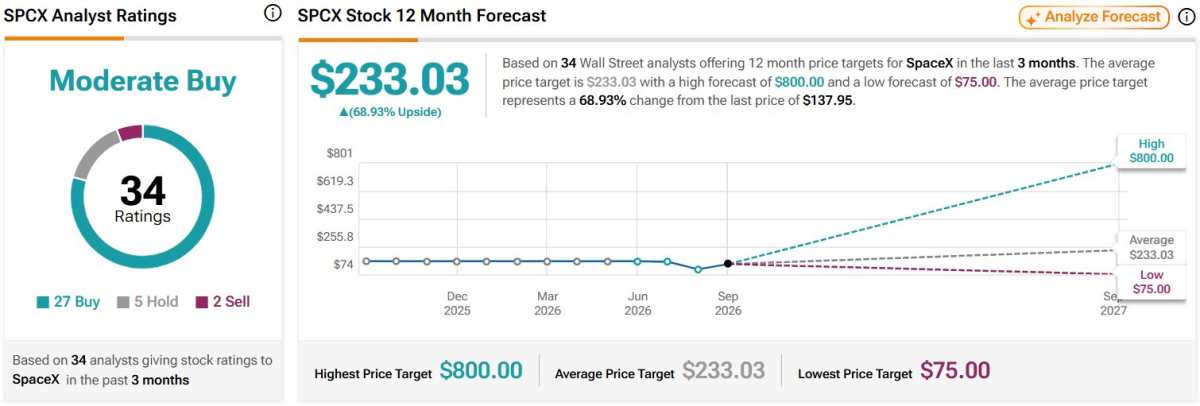
Other institutional moves on the same day: RBC reiterated its "Outperform" rating and a $225 price target, calling the 14th flight a key milestone for Starship's launch capabilities and V3 deployment; Clear Street maintained its "Buy" rating and $217 price target, noting that the mission advanced the company's ability to scale its high-capacity constellation, though engine issues underscore lingering execution risks; CLSA initiated coverage with an "Overweight" rating and a $250 price target; Bernstein and SocGen both kept their "Buy" ratings, with price targets of $248. According to Tipranks data, the average analyst price target stands at $233.
The details of the computing‑power contracts hold the key to understanding this round of expectations. Anthropic pays $1.25 billion per month to lease computing capacity at SpaceX's Colossus data center in Memphis; Google Cloud has signed a deal worth $920 million per month, effective starting next month; Reflection AI is paying $150 million monthly; and an unnamed client has been shelling out $1.11 billion per month since December—bringing the total to roughly $3.4 billion per month, or about $40.8 billion annually, once all commitments are fully fulfilled. However, among the five disclosed clients, only three have had their identities publicly confirmed; the fourth, revealed in July, has been speculated by some analysts to be the U.S. Department of Defense. These leases also include unusually short 90‑day termination clauses, making it relatively easy for customers to walk away.
The parent company's results provided support at the bottom. According to the earnings summary, SpaceX reported second-quarter revenue of $7.8 billion—up 92% year over year—exceeding the market consensus of $6.81 billion. Adjusted EBITDA reached $3.5 billion, a 191% increase, while net loss stood at $541 million. Notably, the AI segment generated $2.6 billion in revenue, up 247%. Chief Financial Officer Brett Johnson stated that the company aims to achieve an annual recurring revenue (ARR) run rate of $100 billion by the end of 2026. Management plans for its computing‑power infrastructure to reach 15 to 20 gigawatts by the end of 2027, and Elon Musk has moved his target of $1 trillion in annual revenue forward from 2031 to 2030.
The origin of this narrative around computational power lies in the merger announced in February this year: SpaceX acquired xAI in an all‑stock deal valued at roughly $250 billion, bringing the post‑merger enterprise value to about $1.25 trillion. In July, the AI division was officially rebranded as SpaceX AI, and Colossus subsequently became a publicly listed asset. Musk laid out the merger's rationale quite plainly: an orbital data center—SpaceX has filed with the FCC to deploy up to one million on‑orbit satellites dedicated to AI‑driven computing, with plans to begin launching them aboard Starships as early as the end of next year.
The Other Side: Approximately $1.9 trillion in market capitalization, a 20x price-to-sales ratio, and a surge in share unlocks.
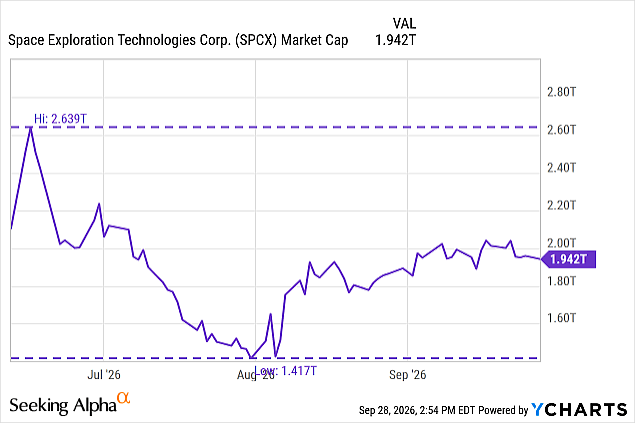
On the other side of the stock price lies valuation. As of the close on September 28, SpaceX's total market capitalization stood at approximately $1.92 trillion. According to the original report, the company's share price has fallen 10% year-to-date but has still risen 1% over the past month. Calculations show that in 2025, the company's revenue is expected to reach about $18.7 billion, though it will remain unprofitable. Meanwhile, Wall Street forecasts revenues of $44.8 billion and $108.3 billion for this year and next, respectively. Even if these projections are fully realized, the price-to-sales ratio based on the 2027 revenue outlook would still approach 20 times—far from cheap for a capital‑intensive firm—and its forward price‑earnings ratio would be roughly 204.
"Big Short" Michael Burry remarked at the time of the company's IPO that the prospectus contained nothing to justify even a $1 trillion valuation, later describing it as "a small slice of the space business, a niche telecom operation, a struggling social media platform, plus a 'lite version of CoreWeave.'" Share supply poses an even more immediate challenge: the company issued only about 4% of its shares in the IPO, and lock-up periods have been expiring one after another—on September 24, a batch was unlocked; on October 9 and October 24, up to 328.4 million shares each became tradable; and following the release of the third-quarter report, as many as 1.3 billion shares could flood the market. Meanwhile, Musk himself is locked up until next June, whereas employees and institutional investors are not.
Financing costs are also rising: according to the same report, shortly after its IPO, the company issued $25 billion in bonds with coupon rates ranging from 5.35% to 6.65%. With the Federal Reserve having just raised interest rates and signaling further hikes, any additional bond issuance to fund the next phase of computing‑power expansion and launch‑site construction would further narrow the path to profitability.
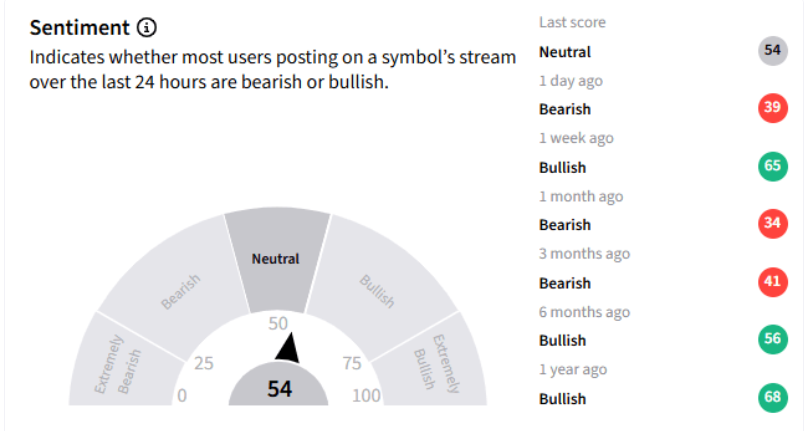
Retail investor sentiment has shown signs of recovery. On the Stocktwits platform, SPCX's retail sentiment index rebounded from "bearish" to "neutral," while 24-hour message volume surged by 74%. Some long-term holders commented, "The money will come—every major bank analyst has confirmed this," while others emphasized that the flames seen during reentry and the fiery ball upon splashdown are "entirely normal for this phase," calling the 14th flight a "historic success."
The lagging competitor, and NASA's moon‑landing bet on the Starship.
The situation of its competitors, by contrast, underscores SpaceX's position. Blue Origin's New Glenn made its maiden flight in January this year, but a mission in May ended in failure during the powered‑landing phase, resulting in the rocket's destruction and the loss of its sole launch pad; the company has set its next launch for before the end of the year. United Launch Alliance's Vulcan has been grounded since February due to an anomaly with its booster. As for Amazon's Leo constellation, its most recent successful deployment was on July 2, bringing its total launches to 396—still far behind Starlink's more than 11,000 satellites currently in orbit—and its target of commencing commercial service by mid‑2026 has already passed.
More critically, NASA's reliance on Starship is at stake. Industry media estimate that Starship is the sole crewed lunar landing system for the Artemis program, a mission that will require 10 to 20 "refueling Starships" and in-orbit transfers of cryogenic methane and liquid oxygen—processes that have no precedent to date. SpaceX has already postponed its in-orbit propellant-transfer demonstration twice, with the latest target now set for "no earlier than late 2026." Meanwhile, Artemis III is slated for an uncrewed lunar lander demonstration in Earth orbit by late 2027, and Artemis IV aims to carry out the first crewed lunar landing in early 2028—both contingent on the success of this demonstration.
Returning to Musk's own timeline: on Sunday, he wrote, "Starship is still 2 to 3 years away from a launch frequency of once per hour"; the longer-term goal is 10,000 launches per year by 2030. By comparison, Falcon 9 flew 165 times in 2025—already a company record and roughly half of all global orbital launches that year. TD Cowen projects nearly 1,000 low-Earth-orbit launches by 2031, which falls roughly within the range of fewer than three per day. The outcome of the engine anomaly investigation will determine whether the 15th flight can proceed as planned with an attempt to recover the spacecraft using the launch tower's mechanical arm.
Editor/Deng