
Micron's current valuation, at a forward P/E ratio of roughly 7x, reflects market concerns about a slowdown in growth, while also potentially signaling undervalued long-term prospects.
After the U.S. stock market closed on Thursday, Eastern Time,$Micron Technology (MU.US)$It concluded its fiscal year 2026 with an almost flawless financial report.
According to the financial report, the company posted fourth-quarter revenue of $54.23 billion, up 379% year over year and 31% quarter over quarter, marking a record for the sixth consecutive quarter. Adjusted earnings per share came in at $33.42, more than tenfold higher than the same period last year, while gross margin expanded to 87%, an increase of 2.1 percentage points from the previous quarter. For the full fiscal year, Micron's total revenue reached $133.19 billion, 3.5 times its record level from the prior year; data center revenue quadrupled year over year, and DRAM revenue surpassed $100 billion for the first time.
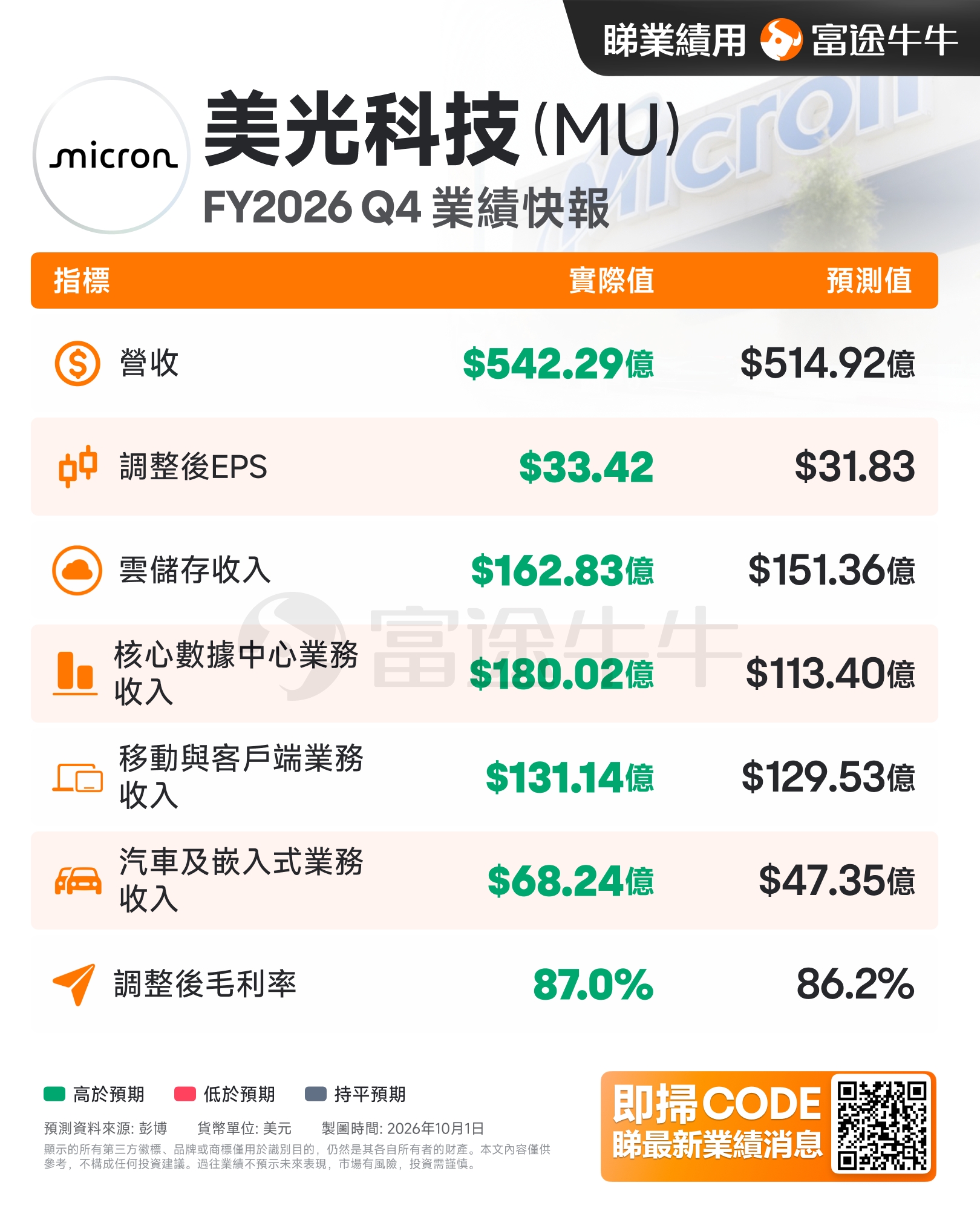
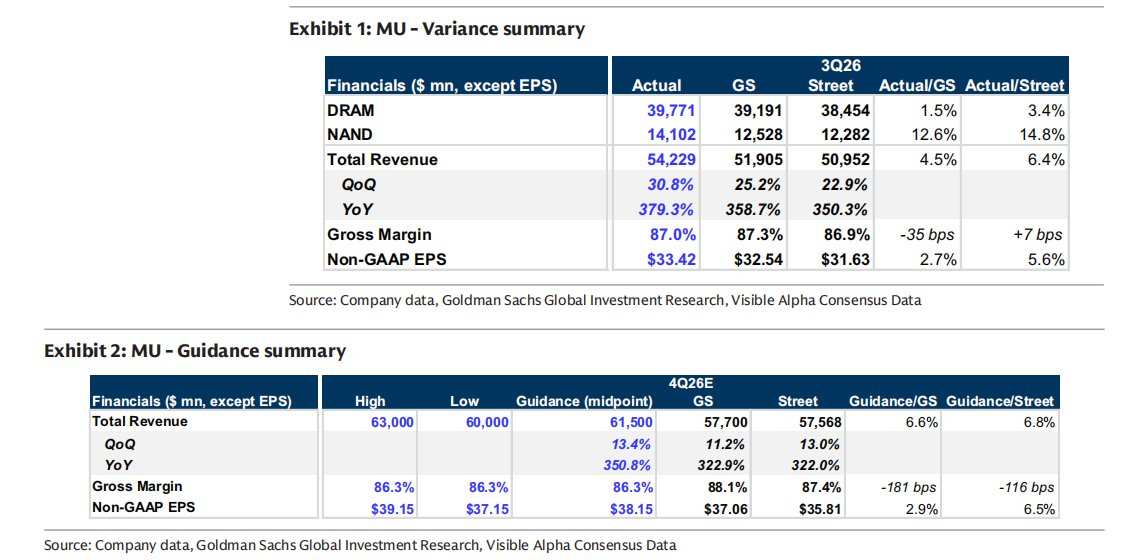
 The guidance for the next fiscal quarter also far exceeded expectations: the midpoint of the revenue forecast is $61.5 billion, above Wall Street's estimate of $57.57 billion; the midpoint of the adjusted earnings per share forecast is $38.15, higher than Wall Street's expectation of $35.81.
However, following the earnings release, Micron's stock price briefly rose about 2% in after-hours trading before quickly reversing course and fluctuating between gains and losses. As of press time, the stock was trading around $1,060 in pre-market activity, down roughly 0.5%.
Why hasn't an almost "perfect" earnings report ignited market enthusiasm?
The Strength of Performance: Beyond the Numbers
The strength of Micron's latest earnings report is first evident in the qualitative shift in its revenue mix. In the fourth fiscal quarter, its Core Data Center Business (CDBU) generated $18.0 billion in revenue, up 56% quarter over quarter, with a gross margin as high as 90%—more than tenfold year over year—driven primarily by robust demand for AI‑enabled servers.
Data center business currently accounts for 33% of the company's total revenue, while cloud storage generated $16.3 billion, or 30% of the total—together exceeding 60% of overall revenue. In the DRAM segment, revenue reached $39.8 billion, up 343% year over year; shipments grew by a low‑single-digit percentage quarter over quarter, but prices surged by a high single-digit percentage, indicating that growth was driven primarily by price increases rather than sheer volume expansion, underscoring extremely tight industry supply and demand. NAND revenue totaled $14.1 billion, up 526% year over year and 42% quarter over quarter; shipments rose by roughly 10%, while prices climbed by about 30%, further highlighting the severity of supply constraints.
Additionally, it is worth noting that Micron disclosed key insights into its future capacity during the earnings call: by fiscal year 2027, more than 75% of its shipments will be locked in through long-term agreements. The number of Strategic Customer Agreements (SCAs) increased from 16 in the previous quarter to 26, while total customer prepayments rose from $22 billion to $32 billion. Remaining Performance Obligations (RPO) reached approximately $150 billion, a substantial increase from about $100 billion in the prior quarter. These agreements are expected to account for over 35% of Micron's revenue through 2030, with roughly three-quarters already under defined pricing frameworks—most of which set price ranges—and some extending as far as 2031.
On the capital expenditure front, Micron has announced that it will invest approximately $25 billion in the first half of fiscal year 2027, with about $11.5 billion earmarked for the first quarter, and further increases planned for the second half. The bulk of this additional spending will be directed toward building new fabs rather than merely purchasing equipment. Regarding the ramp-up schedule, production at the first Idaho facility is now expected to commence by mid‑2027, the Singapore fab is slated to begin output in the second half of 2028, the Hiroshima plant's cleanroom construction is on track to be completed by the end of 2028, and construction of the New York facility has already begun.
Chief Financial Officer Mark Murphy disclosed on the earnings call that the fourth fiscal quarter generated $44 billion in operating cash flow and $33.2 billion in free cash flow, and pledged to return 100% of excess cash to shareholders going forward.
Storage is redefining the boundaries of AI.
Micron CEO Sanjay Mehrotra described the current industry transformation during the earnings call as: "Superintelligence is creating the most compelling opportunity in Micron's history." This statement is far from mere rhetoric.
From an industry‑logic perspective, the scaling of AI models entails not only a surge in computing power requirements but also an exponential increase in demand for memory capacity and bandwidth. During the earnings call, Mehrotra emphasized that running AI applications on platforms with enhanced memory capabilities enables more scalable growth and delivers a superior end‑user experience. In other words, storage is not only a critical component of AI infrastructure but also a key determinant of the upper limit of AI system performance.
In the HBM field, Micron has partnered with NVIDIA to develop the industry's first customized HBM solution. In the first quarter of 2026, Micron began mass-producing a 36GB, 12-layer stacked HBM4 product for NVIDIA's Vera Rubin platform, achieving a bandwidth exceeding 2.8 TB/s. Mehrotra revealed that most of HBM's supply for 2027 has already been contracted, "with prices rising sharply year over year, narrowing the gross margin gap between HBM and traditional DRAM." This signifies that the HBM business is shifting from a "strategic investment" to a "profit contributor."
Looking ahead, Mehrotra outlined "physical AI" as a new growth driver during the earnings call. He emphasized that autonomous vehicles at Level 4 and above typically require memory capacities exceeding 200 GB, with storage needs reaching several terabytes—about an order of magnitude higher than current L2+/L3‑level systems—and that humanoid robots are expected to have comparable requirements. He further noted that by the end of this century, physical AI will become a major catalyst for storage demand.
JPMorgan's supply-and-demand analysis released ahead of its earnings report indicates that the HBM market will face supply gaps of 20%, 19%, and 16% in 2026, 2027, and 2028, respectively, with cumulative shortages reaching 23 weeks by 2028. Citi's analysis is even more aggressive, projecting that the supply gap will widen from -21% in 2027 to -36% in 2028. Deutsche Bank's estimates suggest that the DRAM supply gap will continue to expand in 2027 and 2028, with the market not expected to achieve supply-demand balance until 2029.
These data point to the same conclusion: AI‑driven storage demand has entered a phase of structural shortage, rather than cyclical fluctuations.
Why has the stock price been fluctuating?
Given such strong fundamentals, why has Micron's stock price remained virtually unchanged?
First, the gross margin guidance acted as a "brake" on short-term sentiment. While the fourth fiscal quarter's 87% gross margin did exceed analysts' expectations of 86.9%, the guidance for the next fiscal quarter stands at around 86.25%, below the market consensus of 87.4%. CFO Murphy explained that the first fiscal quarter will mark the low point for the full-year gross margin in fiscal 2027, primarily due to the sale of higher‑cost inventory and increased compensation expenses. Going forward, gross margins are expected to gradually recover, though the pace of price increases is likely to moderate. With expectations already extremely high, even a 0.45 percentage-point gap in the gross margin outlook was enough to prompt some investors to take profits.
Secondly, the sharp surge in capital expenditures overshadowed the positive impact of the earnings beat. Market participants have begun to worry that Micron is shifting from a "gross-margin expansion model" to a "capacity‑expansion model." Analysts note that, as financial results continue to exceed expectations, Micron's stock may enter a consolidation phase, no longer rallying sharply solely on the strength of upbeat quarterly reports. The substantial increase in capital spending implies higher depreciation expenses going forward and could put structural pressure on profit margins—key factors weighing on the stock's near-term performance. Additionally, some analysts point out that the news of ramped‑up capital expenditures dampened the post‑market market reaction to the better‑than‑expected earnings report.
In its latest research report, Goldman Sachs analyst James Schneider's team also noted that Micron's latest quarterly results and its guidance for the next quarter both significantly exceeded Wall Street expectations. Additionally, the company disclosed more long-term customer agreements and substantially raised its capital expenditure plan, factors that are expected to support a moderate rise in the stock price. However, the gross margin fell slightly short of Goldman Sachs' expectations, and given that investor expectations were already quite high, this has limited room for further valuation expansion.
From an investor's perspective—and perhaps the most fundamental reason—the market's focus is shifting from "how strong the economic cycle is" to "how long it can last." Following its earnings report, Morgan Stanley noted that the market's attention is undergoing a shift: investors are no longer solely concerned with how good current results are; instead, they are beginning to assess whether this supercycle can endure beyond 2028. Micron's stock has risen sharply year-to-date, and the market has largely priced in earnings that have exceeded expectations. Despite strong fundamentals, Micron's shares are trading at a forward P/E ratio of around 7x, well below the two-year average of roughly 10x. The market's expectation of a significant slowdown in growth from fiscal years 2027 to 2028 has already been partially reflected in its valuation.
Moreover, expectations management may have already entered a phase where even "exceeding expectations" is no longer sufficient. Analysts, according to some assessments, now view Micron's outperformance of its own guidance as the norm, with the market increasingly anticipating "exceeding even the exceeded expectations." Options‑market data show that over the past 10 earnings reports, Micron's stock has posted an average next‑day move of 9.4%, with a median of 9.1%. By contrast, this time around, options are pricing in only about a 6.3% move, indicating that market expectations for sharp post‑earnings volatility have declined markedly.
Goldman Sachs maintained a "Neutral" rating on Micron following the company's earnings release, but raised its price target from $1,100 to $1,250, based on an 18x P/E multiple and an upgraded normalized EPS of $70. The Schneider team concluded that risk-reward is roughly balanced at current levels, but if the industry continues to demonstrate disciplined supply growth through 2028 and beyond, they would consider turning more bullish on Micron.
In fact, the significance of Micron's earnings report extends beyond the performance of a single company. The core message it conveys is that demand for storage driven by AI infrastructure is not a short‑term surge, but rather a long‑term structural trend that could persist through 2028 and beyond.
However, for investors, the challenge lies in this: when a company's strong fundamentals are widely accepted, the source of excess returns shifts from simply confirming economic momentum to assessing whether the cycle's duration can exceed market expectations. At present, with forward P/E ratios hovering around 7x, the valuation not only reflects market concerns about a slowdown in growth but may also harbor undervalued long-term potential.
 AI Insights into Key Takeaways: Build an Options Strategy in Three Steps! Open Futubull > Stock Page > Tap [Company] >Earnings Flash Report

Editor/lambor