
As the impact of some temporary measures by the Japanese government fades, Tokyo's key inflation gauge has risen sharply, bolstering the Bank of Japan's stance of continuing to raise interest rates as authorities accelerate the pace of policy normalization.
Zhitong Finance APP learned that, as the impact of some temporary measures by the Japanese government fades, Tokyo's key inflation indicator has risen sharply, bolstering the Bank of Japan's stance of continuing to raise interest rates after authorities have accelerated the pace of policy normalization.
Data released Friday by Japan's Ministry of Internal Affairs and Communications showed that Tokyo's core consumer price index, which excludes fresh food, rose 2.7% year on year in September. This reading exceeded the median forecast of 2.3% among economists and was also higher than last month's 1.8% increase. It marked the first time since January that the index has reached 2% or above.
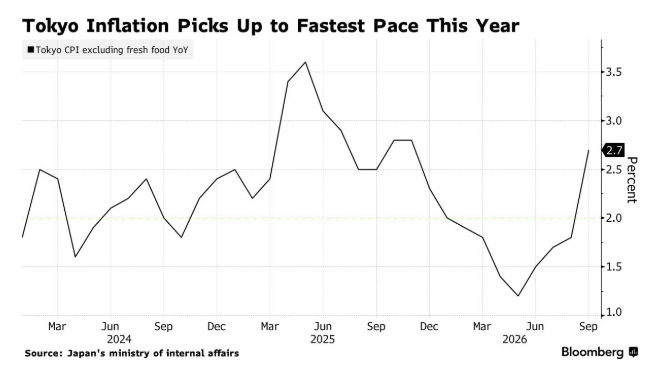
 The surge in the CPI has confirmed the Bank of Japan's concerns about upside risks to inflation—risks that could push core price trends beyond its 2% target. Having accelerated the pace of policy normalization last month with its second rate hike in three months—the shortest interval between increases since 1990—the Bank of Japan will now seek the appropriate timing for its next move.
The surge in the cost of living came even as Prime Minister Sanae Takaichi's energy subsidies continued to hold down the overall index by nearly 0.4 percentage points. Excluding energy and fresh food, Tokyo's inflation rate—a key gauge of underlying inflation—rose from 2% a month earlier to 3%.
Economist Taro Kimura stated, "The report will reinforce the Bank of Japan's view that core inflation is stabilizing near its 2% target—and heighten concerns about rising risks of overshooting. We expect the next 25-basis-point rate hike to occur in December."
"This is a robust set of data. The effects of childcare subsidies and water‑bill reductions were the main factors, but even without these, inflation remains strong," said Yoshiki Shinke, Senior Executive Economist at the Dai-ichi Life Research Institute. "Cost increases stemming from the Middle East conflict are pushing up the cost of living, and, unlike during the deflationary era, companies are passing these higher costs on to consumers."
Shinke stated that he expects the Bank of Japan to raise interest rates in December, maintaining its current pace of rate hikes.
Previously, Tokyo's inflation had been held in check by expanded childcare subsidies and summer water‑bill relief measures, leading the market to broadly anticipate a rebound. The primary driver of the overall increase was the cost of processed foods, which rose 3.6% year over year. According to a report by Teikoku Databank, Japan's major food and beverage companies raised prices on 4,965 products last month—more than double the figure from a year earlier.
Among the factors driving inflation higher, water bills surged, rising about 66% year over year, while accommodation prices reversed last month's 1.4% decline to post a 4.6% increase.
Service prices— a key indicator of demand-driven inflation—rose 2.3% year over year, marking the largest increase since November 2023.
On Thursday, the Bank of Japan released its quarterly Tankan survey, which showed that the business conditions diffusion index for large Japanese firms improved for the sixth consecutive quarter. Supported by global demand for artificial intelligence and a shift in corporate behavior—companies have begun passing on rising input costs to end consumers—corporate profits reached a record high in the second quarter, signaling that inflation expectations are taking root.
In addition, persistently high oil prices and a weak yen could keep inflationary pressures elevated. Despite coordinated currency intervention by the United States and Japan in July and ongoing warnings, the yen has remained near the key psychological threshold of 160 per U.S. dollar. Following the release of the data, the yen strengthened slightly, trading around 158.19 per dollar on Friday.
Earlier this week, the yen weakened after minutes from the Bank of Japan's September monetary policy meeting indicated that the central bank has no immediate plans to raise interest rates. The minutes also revealed that the Japanese government remains cautious about the central bank's rate‑hike trajectory. Following earlier comments by several cabinet ministers, markets had briefly anticipated a softening of the government's stance; however, these minutes dispelled that expectation.
"The trend of rising prices could spread further starting in October," said Shotaro Kugo, a senior economist at the Institute for International Monetary Affairs. "The Bank of Japan expects prices to increase in the second half of the fiscal year, and corporate procurement costs are clearly trending upward."
Editor/Deng