Logan, the Eagle King, has declared: "The second-in-command is saying, 'No need to rush'!"
The rift within the Federal Reserve is now under the spotlight.
Recently, Dallas Fed President Logan adopted a hawkish stance, calling for interest-rate hikes of "50 basis points or more," while Federal Reserve Vice Chair Jefferson, on the other hand, cautioned that "the shocks are too large to act hastily."
Hawks Strike Hard: No Easing of Inflation, No End to Rate Hikes
 On Thursday, local time, Dallas Federal Reserve President Lorie Logan sent a strongly hawkish signal.
She stated that the Federal Reserve needs to raise short-term borrowing costs by at least another 0.5 percentage point for monetary policy to reach a "moderately restrictive" stance and bring inflation back on track to the Fed's 2% target.
Logan stated that last month, the Federal Reserve raised its policy rate by 25 basis points to a range of 3.75%–4.00%, marking an "important first step" in tightening monetary policy.
"However, my current assessment is that the target range will need to be raised by another 50 basis points, or even more, in order to strike an appropriate balance between the outlook and risks facing our dual-mandate objectives."
"We must restore price stability."
She stated that the economy is strengthening and that the labor market is broadly balanced between supply and demand.
Although inflation is easing as temporary factors subside, without further interest-rate hikes, it is unlikely to fall below 2.5%, and the risk of persistent high inflation remains.
She stated plainly that several subsequent rate hikes would effectively offset the Federal Reserve's cumulative 75-basis-point easing in the fourth quarter of last year, thereby restoring a tightening monetary policy stance.
"With a few more rate hikes, the target range will be able to offset the rate cuts the FOMC implemented last fall in response to risk-management considerations."
What is intriguing are the market signals.
On the day Logan delivered this statement, the benchmark 10-year U.S. Treasury yield briefly climbed to a 24-year high before retreating to around 5.24%.
Logan said that the rise in long-term bond yields indicates that market participants expect robust economic growth and that the Federal Reserve's policy rate will remain at a higher level.
However, a rise in yields could also signal an increase in the term premium, which "may weigh on economic activity and, in turn, reduce the need for monetary tightening."
She stated that, at present, it remains uncertain what level the policy rate would need to reach to achieve a sufficiently restrictive stance, and that this threshold will evolve in response to changes in the broader financial environment.
"I will continue to monitor the labor market, price developments, economic growth, consumer spending, and financial market conditions to assess whether policy is moving toward a restrictive stance."
Dovish forces hit the brakes: The shock is too great; haste is not an option.
Unlike Logan's hardline stance, senior officials at the Federal Reserve have signaled a clear willingness to proceed with caution and adopt a wait-and-see approach.
As the market was digesting Logan's hawkish remarks, Federal Reserve "number two" Jefferson tempered expectations.
He dismissed the notion of persistently aggressive rate hikes, arguing that policymakers need more time to monitor economic data before determining whether further increases are warranted.
Jefferson acknowledged that inflation has remained at excessively high levels for far too long, and the risk of persistently elevated inflation is very real. A recent interest-rate hike represents a crucial step in anchoring long-term inflation expectations.
However, he also emphasized that the economy is currently facing multiple, complex shocks. Fluctuations in energy prices, the rapid rise of the AI sector, and adjustments to tariff policies are all interwoven, shaping economic trends in ways that are interconnected and inseparable.
Accordingly, the Federal Reserve will not adopt policies indiscriminately; all adjustments to monetary policy will be grounded in a comprehensive assessment of economic data trends, the evolving economic outlook, and the balance of risks. Policymakers will exercise independent and prudent judgment, refraining for now from implementing another round of interest-rate hikes.
He also acknowledged the current robustness of the economy and the labor market, noting that U.S. Treasury yields rose across the board following the September monetary policy meeting, reflecting a market reassessment of the macroeconomic outlook.
"Any future policy adjustments should be based on a careful assessment of data trends, the evolving economic outlook, and the balance of risks"—and this "may require additional time."
Jefferson's statement echoed the remarks made the previous day by New York Fed President Williams: after the September rate hike, there is no sense of urgency for another move.
Williams made it clear that, after the Fed completes its rate hike in September, there is no immediate urgency to raise rates again in the short term.
The dovish leanings of several senior officials have directly triggered a sharp shift in market expectations.
Data show that, at the start of this week, market pricing implied a 70% probability of a rate hike at the Federal Reserve's October meeting.
However, with Williams's remarks taking effect and the PCE inflation data released, market expectations for interest rate hikes have cooled rapidly, and the probability of a rate hike has now fallen sharply to below 30%.
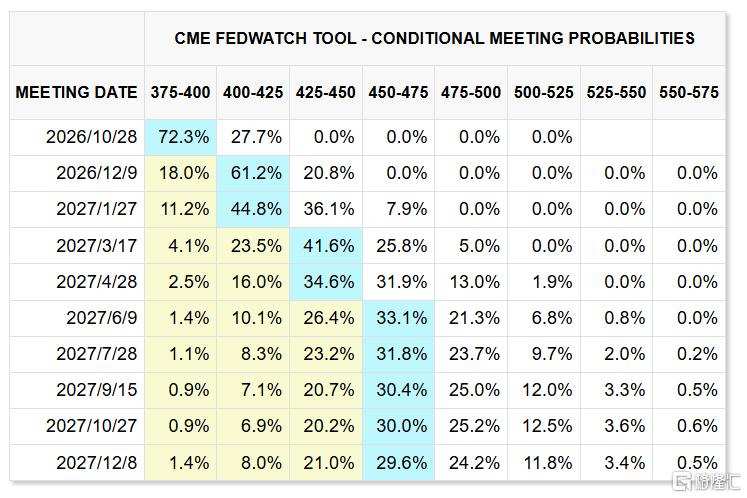
Overall, the Federal Reserve currently exhibits significant internal policy divisions: hawkish regional officials firmly advocate for continued rate hikes to decisively curb inflation, while the Fed's core leadership leans toward a cautious, data‑driven wait-and-see approach.
This policy‑game dynamic implies that the Federal Reserve's monetary policy will enter a phase of short‑term wait-and-see monitoring and flexible adjustments.
Going forward, interest-rate trends will be highly contingent on key economic indicators such as inflation, employment, and consumer spending, and will continue to drive volatility in U.S. Treasury yields and equity markets.
Editor/Jeffy