In a recent interview, OpenAI executive Tibo pointed out that the market has not yet fully priced in three major trends in AI evolution: most internet operations will be taken over by agents, models will achieve a tenfold improvement in cost efficiency within a year, and multimodal capabilities will seamlessly integrate. He revealed that an open ecosystem with a user base of over one billion and support for "revenue sharing" is the true "sleeping dark horse" reshaping business logic. Meanwhile, Tibo confirmed that OpenAI deliberately delayed the release of Astra 6.1 due to extremely high standards for safety monitoring.
After launching more than 20 new products in rapid succession, OpenAI executive Tibo provided the market with forward guidance on the "new AI era": as model capabilities leapfrog another tenfold within a year, the entire internet's traffic entry points, interaction logic, and commercial distribution will be thoroughly重构 (reconstructed) by agents.
At the recently concluded OpenAI DevDay, OpenAI launched more than 20 new products in quick succession. Hours after the event ended, Tibo Sottiaux, the core executive leading ChatGPT, Codex, and the latest personal agent platform "Dots," participated in an in-depth interview.
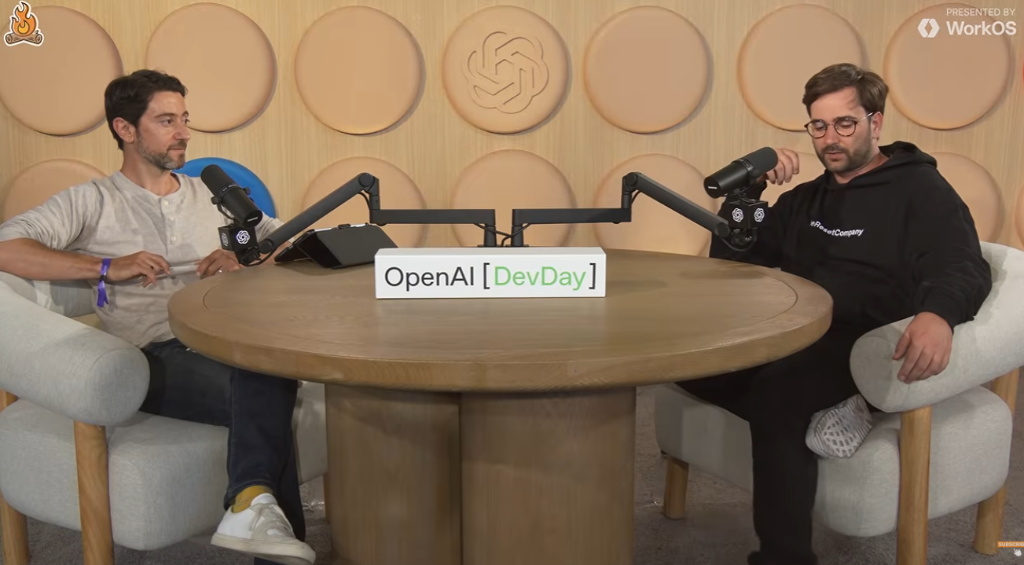
 Addressing market concerns regarding the pace of AI commercialization, Tibo detailed OpenAI's next strategic move. He explicitly stated that although the market has shown great enthusiasm for the new platform "Dots," it has not yet fully priced in the "second-order effects" of AI technological evolution.
In the future landscape, internet infrastructure will shift from being "human-centric" to "agent-centric." The "open ecosystem and revenue sharing" model built by OpenAI on its massive user base is the true commercial dark horse currently overlooked by the market.
He positioned the newly released Dots as the next core gateway for AI and revealed that ChatGPT Work and Chat will merge, with Dots' capabilities integrated into ChatGPT to reach 1.2 billion users. He also confirmed that OpenAI already has the "Astra 6.1" model internally but chose not to release it, stating bluntly that work methods will "continue to change dramatically until they are no longer clumsy."
Three Major Trends Misjudged by the Market and the "10x Rule"
"What exactly are people failing to price in?" In response to this question striking at market expectations, Tibo gave a very clear answer: the market has severely underestimated the speed at which models will reduce costs and increase efficiency, as well as the subsequent restructuring of interaction methods.
He summarized three major trends that the market has yet to grasp: First, the vast majority of operations on the internet will be completed by agents; second, models will become cheaper and faster at an incredible pace; third, all modalities will achieve true seamless integration.
Tibo stated bluntly that many AI-based startup products currently on the market are heading in the wrong direction.
"I often observe what people are building and feel they miss the point. If you push yourself to imagine that everything could be roughly ten times better in a year than it is today, you would approach product development in a completely different way."
This "10x evolution" will trigger significant second-order effects. Tibo cited Notion as an example, noting that once applications open their interfaces to Agents, a substantial volume of operational traffic will be generated by these Agents, imposing immense traffic pressure and challenging existing economic models.
"If your product aims to succeed in the Agent era, you must prepare for a certain degree of scalability. It is inevitable that the majority of interactions will be driven by Agents."
The True "Sleeper Hit": An Open Ecosystem with Over a Billion Users and Revenue Sharing
At this DevDay event, the personal agent platform "Dots" was undoubtedly the most captivating concept. However, in an interview, Tibo revealed that he believes the true "sleeper hit"—one that will have a profound impact yet remains overlooked by the market—is OpenAI’s open ecosystem and its commercial revenue-sharing logic.
"I believe the real sleeper hit is the ecosystem. We are deeply committed to comprehensive openness," emphasized Tibo.
Currently, 16 partners have integrated "Sign in with ChatGPT." Addressing the market's primary concern regarding developers' commercialization pathways, Tibo provided guidance with significant potential: OpenAI is introducing a "shared economics" model.
"We allow everyone to publish products on a platform with approximately 1.2 billion users and benefit from it. We will pay for plugins that are popular and heavily used, and they will also receive a share of the revenue," stated Tibo.
Regarding traffic distribution logic, OpenAI no longer prioritizes SEO or flashy packaging but focuses directly on core business metrics: "We look at retention numbers and the success and quality of plugins. If your plugin performs poorly, recommendations will cease."
Farewell to "Prompt Engineering": The Demise of UI and the Ambitions of the Dots Platform
Tibo has expressed significant "impatience" with existing workflows and product forms. He argues that while people previously focused on configuring complex loops and graphs to make AI function, this is not the direction for the future.
"I do not believe this is how AI should operate over time. You simply need a system capable of learning; you should not have to think, ‘I must loop it in this precise manner to achieve results.’"
This is also the core logic behind OpenAI’s launch of "Dots"—a permanently active intelligence that is online 24/7, requires no model configuration, and operates across all devices. Tibo even predicted the demise of the current app paradigm:
"I myself am fatigued by configurations such as model pickers and inference efforts; you practically need a ‘Ph.D. in model selection.’ I hope to eliminate all of these as soon as possible. Model capabilities are advancing to the point where apps could virtually disappear entirely."
Regarding the relationship between Dots, ChatGPT, and Codex, Tibo revealed an integration roadmap: the Chat and Work modes of ChatGPT will be merged to reduce complexity; all capabilities of Dots will ultimately be built directly into ChatGPT, reaching "1.2 billion users." "We want it to be truly seamless," he said.
It is worth noting that during the public beta launch of Dots, each user was allocated only one "dot." However, Tibo confirmed that functionality for multiple dots (virtual teams) will be launched soon, allowing users to create dots with specialized roles. For instance, he already has a dot dedicated to monitoring Twitter.
Security Moats and Compute Allocation: Why Was "Astra 6.1" Withheld?
As model capabilities surge, market concerns about the risks of AI losing control are intensifying. In this regard, Tibo disclosed OpenAI’s internal logic for compute allocation and its security stance.
He stated that OpenAI allocates a very high proportion of compute resources to its security stack, even introducing a "dual-track compute" model: "Part of your compute is allocated to the main system for task execution, while a substantial amount is dedicated to monitoring to ensure the primary agent does not take high-risk actions."
This extreme conservatism regarding security has even overridden the impulse to release new technologies. Tibo revealed a key fact: "News reports mentioned that we had version 6.1 of Astra, but we did not release it. This is something I am very proud of." He explained that when building products for over 1.2 billion users, OpenAI "cannot gamble" on security.
Hiring Trends: Typing speed is no longer important; taste and judgment are what matter.
When asked about changes in hiring criteria, Tibo gave a straightforward answer:
"Skills in decline: Fast typing, which is no longer as useful. Skills on the rise: Exceptional taste, a genuine understanding of users, and the ability to connect with the audience for whom you are building."
He also revealed that OpenAI currently employs more than 120 founders from Y Combinator-backed ventures, stating, "This is a super venture. Knowing what is good and having the passion to build something truly important is more critical than ever before."
Regarding young professionals entering the workforce, he specifically highlighted a new team member named Ahmed Ibrahim, who joined OpenAI as a fresh graduate and is now responsible for all of OpenAI's computational resources and application deployment. "He is like a sponge, learning everything at a pace I have never seen before."
When asked whether work methods would continue to change dramatically, Tibo did not offer a vague response:
"They will continue to change quite dramatically. Even today, it still feels somewhat awkward. I believe it will continue to feel awkward until one day it no longer does. Then you will say: Wow, I can talk to this thing just as we are talking now, and it perfectly remembers everything."
He described ChatGPT Spaces (shared collaborative whiteboards) as the "very early beginning" of this transformation, envisioning the future: "You can imagine us having a shared whiteboard where collaboration can take place between people, and between people and Agents."
Addressing the pressure to "do one more thing" brought by AI and the sense of isolation among engineers, he admitted that this is an issue the entire industry must confront. "The promise of AI is not to process one more prompt per second, but to reduce noise, allowing you to focus your attention where you truly want it."
The full transcript of the interview is as follows (translated with AI assistance):
Tibo Sottiaux:
I often look at what people are building and feel that they haven’t fully grasped the potential. You know, if you push yourself to truly imagine a scenario that is roughly ten times better than today—say, a year from now—you would approach the build in a completely different way.
Lenny:
What do you think people overlook when assessing future trends?
Tibo Sottiaux:
Most activities on the internet will be carried out by agents. If you want your product to succeed with these agents, you must build for scale.
Lenny:
In your daily work, how many agents do you find yourself running simultaneously?
Tibo Sottiaux:
As I continue to explore the frontier, I find myself building increasingly large teams of agents. Then, when we achieve the next breakthrough in models, there is suddenly a sense that, well, a single, larger agent can handle everything. So I scale the team back down. This cycle of expansion and contraction repeats itself.
Lenny:
This brings to mind the concepts of loops and graphs.
Tibo Sottiaux:
Having to configure and fine-tune your loops might have been exciting in the past, but I don’t think that’s how things will work over time. You simply want a system that can learn on its own. You shouldn’t need to deliberate, “I must structure this loop precisely in this way to achieve the desired result.”
Lenny:
Do you anticipate even more radical changes in the way we work?
Tibo Sottiaux:
Significant changes will continue to occur. Even today, the experience feels somewhat cumbersome, and I believe it will remain so until it no longer does.
Lenny:
Tibo, thank you for joining this interview.
Tibo Sottiaux:
Yes, thank you for the invitation. Certainly. This is a nice room.
Lenny:
You released a significant amount of content today. How was your sleep? Did you sleep well? Are you doing okay?
Tibo Sottiaux:
I’m doing well. I’m fortunate to have an exceptional team. So while I was sleeping, they were up almost all night. We have a great space in our office called the "Library," which we completely transformed into a super war room. The atmosphere there was simply impeccable. Everyone stayed very late.
Lenny:
You worked as an engineer for a long time. Do you still write code? Are you still submitting pull requests? Or are you now primarily focused on documentation and meetings?
Tibo Sottiaux:
"What exactly is 'writing code'?"
Lenny:
Are you still submitting pull requests? I’m not sure—is that the case...?
Tibo Sottiaux:
I occasionally merge some code. Technically speaking, a significant amount of code is written for me to conduct various analyses, such as understanding the business, evaluating the next feature, or assessing how our previous releases performed. Much of this code is generated by Codex; as you know, I no longer write it by hand. Occasionally, on weekends, I have a small "therapeutic moment" where I manually solve a LeetCode problem. But that is the only time I truly write code by hand.
Lenny:
In your daily work, how many agents do you find yourself running simultaneously?
Tibo Sottiaux:
I used to run many more simultaneously. Later, we were fortunate to achieve a breakthrough with Ultrafast. So now, you know, I feel able to re-enter a flow state. Having a faster agent has been tremendously helpful. I am excited that we will soon launch the six-month version of Ultrafast. Then, yes, I think this will bring about changes—as I continue to explore the frontier, I find myself building increasingly large teams of agents. Then, when we achieve the next breakthrough in models, there is suddenly a sense that, well, you know, a single larger agent can handle everything, keeping all content in memory and learning continuously. So I scale the team back down, and thus I go through cycles of expansion and contraction, expansion and contraction.
Lenny:
Could you elaborate? This reminds me of the whole concept of loops, and then there is the whole concept of graphs. Is this, to some extent, an evolution of those concepts, or...
Tibo Sottiaux:
I believe that the need to configure and fine-tune your loops, and then figure all of this out—perhaps exciting to some—is not ultimately how it will work. I think the true mode of operation is what we are currently positioning towards, and what we are releasing through Dots: you have an extremely intelligent Agent that operates around the clock, understands your goals, comprehends your preferences, and learns from feedback. What we have released is not perfect, and I will learn a great deal from opening this product to our professional users. But over time, you simply want a system that learns from the objectives you wish to achieve. You do not necessarily want to think—as I just mentioned, having to loop in precisely this way to obtain results.
Lenny:
So now we have Codex, ChatGPT for Work, ChatGPT for consumers, and also Dots. What I am hearing is that you believe we are moving towards Dots as the primary interface for interacting with AI, which then orchestrates all other services.
Tibo Sottiaux:
Yes, I believe that fundamentally, if you step back, regardless of whether it is Dots or not, the key lies in liberating oneself from technology by having this always-on intelligence that knows everything it needs to do and can be invoked through any client or any screen. You can summon it; for example, perhaps you walk into a conference room, and it appears in the meeting to take notes for you; then you continue interacting with it via email; and if needed, you can text it. It is not about staring at your laptop or constantly holding your phone; rather, it appears when you need it and recedes when you do not. I cannot wait to see this fully realized, because I feel that carrying around a laptop like a brick ties you to technology, rather than having technology serve you.
Lenny:
I was about to ask you this. It feels that over the past two years or so, our ways of working have changed significantly, especially for engineers, but the daily routines of many roles have also shifted markedly. I am curious whether you think we are gradually stabilizing into the work model of the future—say, five years out, or perhaps two? Two years feels too distant to imagine clearly. Or do you believe that work methods will continue to undergo more radical changes? I feel it will continue to evolve.
Tibo Sottiaux:
It will continue to change quite radically. Even today, although technology seems to be finally converging in areas such as voice and multimodal input/output, it still feels somewhat clumsy. I believe it will continue to feel clumsy until one day it suddenly does not, and you will say, "Wow, I can speak to it in exactly the same way we are conversing now, and it remembers everything perfectly." If I want to brainstorm or generate ideas, it can instantly sketch something out. We have a collaborative interface—this is what we released with ChatGPT Spaces—which is just the beginning of that direction. You can imagine us having a shared whiteboard where people can collaborate with each other and with Agents. I believe it will go beyond conversation and beyond many of the clients you have today. Since none of this is fully realized yet, I think we will undergo this massive new transformation. What I hear is that Dots is a crucial component of that future, an AI assistant that handles everything for you, so you do not have to think about whether to use Codex or ChatGPT. Yes, regarding Codex and ChatGPT, we are merging them—we have Chat, and we have a work-mode toggle. We have clearly heard the feedback: people appreciate the capabilities within work mode, but at times they prefer using Chat because it is faster and more convenient. So we are merging these to reduce complexity. Ultimately, we will also integrate all Docs functionalities directly into ChatGPT to enhance the base experience for our 1.2 billion users—at which point we will see how many users we have. We hope it will be truly seamless. One thing that excites me greatly about Dots is that it has no model selector and no configuration; you simply speak to it. The only thing you need to configure is the channels through which you wish to interact with it.
Lenny:
It feels very much like the worldview depicted in the movie Her. I wonder, do you often think about that film? That particular concept...
Tibo Sottiaux:
I’ve watched it once. Yes, I find it quite interesting to reflect on... Perhaps I think more often about science fiction from three or four decades ago and how prescient it was. Is there a specific sci-fi work that has influenced you the most? Books like Neuromancer, and the original Star Trek—I think about that one often. Star Trek has a certain quality, I feel—it portrayed a very practical kind of technology where, obviously, you could speak directly to the computer and it would act on your behalf. You could talk to your spaceship, and it would move. This is becoming reality; we are entering that era.
Lenny:
We are recording this episode in front of a live audience. There’s a long queue outside, with everyone waiting to meet you and hear you speak. How do you view all of this—the position you hold and the responsibility you bear? What does it feel like to build what you are building, and to consider its impact on people’s lives? How do you think about this?
Tibo Sottiaux:
I believe it is crucial to be part of a community and to build alongside people. In a sense, we are exploring this technology together, discovering what we can achieve collectively. So every time I interact with people, I am reminded: you are doing this, which I had not anticipated at all; it has impacted your life in some way, and also the life of another person. Overall, this is both deeply humbling and incredibly inspiring. I consider this essential for building something truly useful to humanity. I don’t know how we could have achieved all this without the community.
Lenny:
This is something I often hear from many people developing AI products—they have no idea what their product will become until after launch, when they observe how users engage with it and see what emerges. What you’re describing sounds like co-creation with users, rather than saying, “This is our vision, and we have figured it all out.”
Tibo Sottiaux:
Even the Twitter community has generally been very friendly.
Lenny:
Yes, you are quite active on Twitter. Sometimes a bit provocative, but indeed impressive. How do you find the time to tweet? I don’t understand how someone in your position has the time to sit on Twitter, posting tweets and replying.
Tibo Sottiaux:
I spend about half an hour each day browsing, and then take action when inspiration strikes or when I have something interesting to share; it usually emerges naturally in the moment. Perfect Twitter etiquette. Also, while we haven’t yet released the team Dots feature, today we launched the main Dot. You can configure it and get accustomed to what a single Dot connected to your applications can do, but we will be releasing the functionality to create multiple Dots. So, I have a dedicated Dot specifically for Twitter.
Lenny:
Okay, please continue. So currently everyone has one Dot. Right, they cannot add more Dots at this stage.
Tibo Sottiaux:
Yes.
Lenny:
They will be able to have multiple Agents, allowing us to discuss development directions in this area.
Tibo Sottiaux:
Yes, so we want to start with one—namely, the primary Agent. This Agent, as you know, which you can also text, can gain the deepest understanding of your preferences. We then observe how people use it to determine how we need to adjust the system, learning through collaboration with the community. Soon, you will be able to add a second, third, or fourth Agent. You can have as many as you need, much like building your virtual team. You can then assign them specific roles, right? For instance, while I don’t think it’s absolutely necessary, sometimes I have tasks that require significant effort, such as monitoring Twitter for me. In such cases, this would be quite a heavy workload, enough to occupy an entire Agent. Under these circumstances, you could have several Agents share the load.
Lenny:
If you consider everything announced today, it feels like Agents might be the most appealing feature. I am curious: is there anything you believe is not receiving the attention it deserves but will become very important in the future? That is, something visionary and significant that people are currently overlooking.
Tibo Sottiaux:
I believe the greatest potential lies in the ecosystem. This involves opening up everything and our deep commitment to openness. We have signed 16 partnerships with ChatGPT and are very proud of this. When we started this initiative, it truly came to us suddenly at some point. Last year, while talking with the founders of Pi and Open Code, I realized that, of course, you should be able to log in directly using a Codex account and utilize the corresponding usage quotas. Typically, we would just shake hands—virtually speaking—meaning, trust this authentication and assume you won’t do anything harmful. That approach grew and obviously became quite popular. We then turned it into a formal product supporting many partners, and I look forward to its rapid development. On the other hand, there is the opening of all infrastructure and how we build for ChatGPT, including plugin extensions and plugin discovery. This allows everyone to publish products to approximately 1.2 billion users and benefit from this distribution. We also have revenue sharing; although it was not mentioned in the keynote, we will pay those plugins that are popular and have high usage volumes. They will receive a share of the revenue. Therefore, I believe this commitment to an open ecosystem will be very exciting.
Lenny:
That’s great. Okay, for example, take Notion. If someone uses the Notion plugin or Figma plugin within ChatGPT, can Notion and Figma earn money from user activity within the application?
Tibo Sottiaux:
Yes, exactly. All our ChatGPT subscribers receive a certain usage allowance. When users utilize this allowance through plugins or within other products—specifically when they use the “Log in with ChatGPT” feature—we establish a revenue-sharing mechanism, ensuring that developers receive corresponding compensation.
Lenny:
I’m not sure. One thing that excites people about plugins and the ecosystem is the distribution platform—a way to get discovered. People find my app, and it takes off. What advice do you have for those who want their plugins to stand out and gain visibility?
Tibo Sottiaux:
Build a high-quality plugin. Yes, here is how it works: while we will certainly adjust the system, we primarily look at retention data to assess the success and quality of a plugin. Based on this, we begin recommending it to users in conversations. Consequently, your plugin could be recommended to a significant proportion of users. Obviously, if your plugin does not meet quality standards, recommendations will cease. That’s the process.
Lenny:
That’s great. So you are monitoring user retention rates for plugins.
Tibo Sottiaux:
Yes. We evaluate whether it truly adds practical value and enables ChatGPT to perform new functions.
Lenny:
Understood. So it’s less like AEO, where you find the right keywords to get people to write about you, and more about people continuously using it and sticking with it. Yes, I think that’s right. Okay, so you see this as a high-potential candidate that will become a major player. I know this is somewhat of a second attempt; you previously had an app marketplace, but this time you’re heading in the right direction. Okay, this time it will succeed. Perhaps let’s return to Dots, as it feels like a crucial part of your future vision. When did you start working on this? Clearly, there was a pivotal moment with Open Claw, when Peter joined and the foundation was established, followed by developments like Grokbot, Muse, and Instinct. I suppose, how long have you been working on this? Why did it take so long to launch the product?
Tibo Sottiaux:
Do you remember the Codex plugin? Yes, the first one. That was about a year ago, right? If you look back at Codex Cloud and the small animation we used, I believe that was the inspiration for Grok Bot. Yes, it’s very similar—I would say strikingly similar. But seriously, regarding research into long-cycle tasks for sustained continuity, this is something we have been studying for over two years. The memory system for maintaining coherence also took roughly the same amount of time. We deployed many of these features directly into ChatGPT. I think users really appreciate how much relevant information ChatGPT knows about them. Many people I’ve spoken with have little anecdotes, such as, “Hey, I was sick, and ChatGPT remembered that I had been grilling and making tequila cocktails with lime, and then it pointed out that the burn on my hand might actually be phytophotodermatitis caused by the lime.” You wonder, how did it know? This exemplifies how effectively memory works in ChatGPT. Therefore, we have invested heavily in research in this area. All of this, built upon the Codex framework and the capability to operate 24/7 with high efficiency, constitutes what we launched with Dots. So, this is the result of many months of work. Another critical aspect was ensuring robust safety and security. This is also why we launched Astra alongside it, as it is our safest and most value-aligned model. Significant additional effort was dedicated to making Dots truly safe and reliable.
Lenny:
I’d like to ask our podcast guests a question: In which areas do you believe the human brain will continue to demonstrate its value over time? In your actual work, where do you find yourself indispensable, and where is AI taking on an increasing share of the workload? Where do you think the human brain will continue to play, and excel in, its role as time goes on?
Tibo Sottiaux:
Yes. I think this largely depends on how we build the technology. At OpenAI, our design philosophy places humans at the core, constructing AI as an extension of humanity—extending your intent and your taste. So it truly functions as a tool for super-empowerment. I believe that as long as we continue down this path, it will allow you to amplify your desired actions, creativity, and taste in a way that feels genuinely rewarding. Right now, it serves as a true artistic tool, doesn’t it? We may no longer have programmers in the traditional sense, but we have more builders than ever before. I think certain aspects will remain profoundly human, such as the desire to learn and to see what other humans are building. You know, I’m more interested in this interaction—I am here, not speaking to Dot, but speaking to you, right? I believe this dynamic will remain true for a very long time.
Lenny:
Among engineers, in particular, one trend has gradually emerged: their lives have changed, involving more context switching. There is also a growing trend of loneliness, as they spend all day interacting with agents rather than with other humans. I’m curious how much you consider this aspect—the impact of AI on people’s lives—and what measures you might take. Are there any solutions? Have you thought of ways to mitigate this distress?
Tibo Sottiaux:
Yes, this has been on our minds. Reducing configuration fatigue is one aspect. Another is alleviating the sense that interacting with an agent is like a solitary adventure—where you have a single conversation, waiting for a response from one agent, while delegating many tasks across multiple agents. We want these experiences to converge, making the overall process more enjoyable. This is something my team and I have spent considerable time contemplating. Therefore, I believe the ideal way to accomplish tasks is to integrate them into your physical space, much like our current conversation. The system can observe—for instance, capturing ideas we jot down on paper—and then begin building in the background. If you mention another idea, it starts constructing that as well, projecting it onto a screen. As you converse with it, it seamlessly integrates into discussions with other humans. You avoid that sense of fatigue; there is no need to stare at a screen or deliberate over prompt engineering. It becomes almost supernatural. That is the direction we are heading. While we have not fully realized this vision today, I believe we will achieve it in the future.
Lenny:
Another downside emerging along these lines is the pressure to do more. Or rather, because we can do more, everyone is saying, “Go ahead, run 30 agents simultaneously. Why aren’t you publishing more?” Everyone is increasing their output. Do you think this issue can be resolved? Or do you believe it is simply part of human nature—that if we can do more, we will do more?
Tibo Sottiaux:
I believe we have also heard Sam’s commitment in this regard: to reduce noise and allow you to focus your attention where you choose. Whether important or trivial, various matters compete for your attention. By slightly lowering the volume on those distractions, you can concentrate on what truly matters. I find it remarkable that every time I take a vacation and disconnect completely for a week, I begin thinking in different, more creative ways. I am eager to see if we can bring that state into daily life. Perhaps you would need fewer meetings, or perhaps you would not need to do as much. If you are better rested, you may actually become more productive. Therefore, I believe the industry needs to figure this out. This, rather than processing one additional prompt per second, is where the true promise of AI lies.
Lenny:
I am currently building a bot—an energy audit bot—that monitors my calendar and asks me, “Does this event energize you or drain you? Could someone else handle this task?” I feel AI should be able to say, “Hey, Lenny, perhaps you could eliminate these items to become happier.” Have you recently used AI for anything particularly interesting—a cool use case that made you think, “Wow, that was truly amazing and eye-opening”? Or have you heard of any such examples?
Tibo Sottiaux:
Oh, there is one cool story—though the live demo failed, right in front of everyone. So that was not cool. However, my assistant, Dot, recognized the situation. On Dev Day, our ChatGPT production environment went down. Five minutes before the live demo, it messaged me, which was quite tense, stating, “Hey, the production environment is down.” I thought, “Oh, well,” and then it asked, “Would you like me to try fixing it?” I replied, “I don’t think you’re quite ready for that step yet, little Dot. But thank you for offering.” I then contacted the engineering team, and we began investigating the issue. They resolved it. But having a system that understands context—that a significant event called Dev Day is occurring, involving a production system and a live demo potentially reliant on that system, and that these elements are correlated with an event happening in five minutes—so it proactively notified me because I might want to know. I consider this quite remarkable.
Lenny:
Wow, so it just knew this was about to happen and told you. I like the fact that it wanted to fix it. Then you said, "Not quite yet; you're not there yet."
Tibo Sottiaux:
I don't think it's the type that, you know, tries to impress you. But that would have made for a better story.
Lenny:
How do you feel about granting it access to these resources? I mean, does it have access to the production codebase, for instance?
Tibo Sottiaux:
It can access certain production systems under safeguarded conditions. We built what we refer to as dedicated docs, but these dedicated docs operate with additional safeguards, enhanced monitoring, and on their own hardware. We actually run some of them on Mac Minis. There is a fundamental difference in how we build docs: the runtime framework does not execute on the machine itself, which many people may not yet realize. It can connect to any number of devices. It has its own computer, and you can also connect it to your own laptop. Over time, you might connect it to ten different devices, allowing it to control all of them, much like an octopus.
Lenny:
So essentially, you are interacting with your dot, which resides in a virtual machine somewhere, and then it can...
Tibo Sottiaux:
Correct. It might be a virtual machine, or it might not. It is simply a device that can connect to many other devices.
Lenny:
You are indeed hiring extensively. I am aware of your large-scale recruitment efforts. During your interview process, which skills have you found to be increasingly valued and prioritized? Which skills are becoming more critical for success? Conversely, which skills do you find are declining in importance, giving rise to the sentiment that they are no longer as necessary?
Tibo Sottiaux:
I would say that fast typing is a skill that has become less useful; it is on the decline. The skills on the rise include, as you know, excellent taste, user-centric thinking, and the ability to connect with your target audience. Many former founders are now highly successful, particularly serial entrepreneurs. We observed this trend during our recruitment at OpenAI, where we have hired numerous founders. Currently, there are over 120 former Y Combinator founders at OpenAI. It resembles a super venture. I believe that passion, the desire to build meaningful products, and the discernment to recognize quality are more important than ever before.
Lenny:
I have long argued that Product Managers (PMs) will thrive in this era, as these responsibilities essentially define the PM role. They ask: What should we build? They assist others in building it, and then evaluate: Is this correct? Is it good? And they iterate continuously. So, I am uncertain.
Tibo Sottiaux:
I agree. Furthermore, the boundaries between various roles are blurring. Previously, you might have focused solely on design or worked exclusively as an engineer, often feeling somewhat out of place. However, now is the time for you to shine.
Lenny:
Do you miss the engineering aspect of your work? I used to be an engineer for ten years, as you may not know. You know, that state of flow, the wonderful sensation of pure building and watching your creation take shape. Do you miss those moments a bit, or do you just think, "Well, that was my past life"?
Tibo Sottiaux:
I did miss it for a while. But now, with truly ultra-fast speeds, I have rediscovered that feeling. So I am very excited to democratize it as much as possible. Of course, it will take some time to make it truly ubiquitous and accessible to over a billion users. But now, you know, with the ultra-fast speed we can achieve—about six months, or at a cost roughly comparable to Astra—the progress in this area is truly staggering, even for us internally. We are all thinking, "Wow, we can do these things," also because we are using Astra, and we find that, you know, we can push it very far. When you have that kind of speed, especially when you can control it with voice, you re-enter that truly creative mental state, that flow. It is different from the flow of the past, but I no longer miss it.
Lenny:
Yes, like in your last two release videos, people were just standing there talking to their AI while cooking, or...
Tibo Sottiaux:
Exactly.
Lenny:
sitting in a recliner. While mingling at the event, I asked people what they would like to ask you. One thing mentioned several times was advice for new graduates and those in the early stages of their careers. I think many people look up to you; they want to be the next Tibo. What advice do you have for people early in their careers regarding what to do, what skills to cultivate, and what activities to pursue?
Tibo Sottiaux:
I think the next Tibo is already at OpenAI; his name is Ahmed Ibrahim. I really enjoy working with him. He was hired by OpenAI as a fresh graduate, and now he is responsible for all computing, compute cluster, and application work at OpenAI. This is a huge responsibility, and he has also built a significant portion of the Codex runtime framework. What really makes Ahmed stand out and succeed is that he is extremely kind, highly collaborative, and always strives to solve truly important problems without putting himself first. He is like a sponge, learning incredibly fast, absorbing everything, and utilizing all the latest technologies at a pace I have never seen before. So his growth within the company over just a few months to a year has been truly remarkable. He is now someone I trust deeply, responsible for OpenAI's most challenging releases.
Lenny:
Well, I should invite him onto the podcast.
Tibo Sottiaux:
You definitely should.
Lenny:
So, thinking about how things work internally at OpenAI, is there anything that would surprise people? From the outside, it feels like you’re constantly shipping code, and things seem a bit, you know, chaotic but great. I’m not sure what would surprise people about how work gets done inside OpenAI.
Tibo Sottiaux:
From the outside, it feels like you’re constantly shipping code, and things seem a bit, you know, chaotic but great. I’m not sure what would surprise people about how work gets done inside OpenAI. I don’t know if this is surprising, but it is the case. You know, as I mentioned, many former founders are driving many exciting, bottom-up initiatives. For example, the Decisions API progressed very rapidly. We realized we had a very strong model, Luna, which allowed us to perform constrained sampling, and then, you know, release it in different forms via the Responses API. And when we did that, it was faster and provided a much better user experience.
So in some cases, if you look closely at internal operations, you’ll realize that a Slack channel emerged. Initially, only four people were experimenting together over the weekend, but it eventually became as ubiquitous as company-wide initiatives. Then people got excited and started building, saying, “Oh, we can support visual inputs, and this is better than anything currently available.” Then, you know, excitement grew, and people began participating in a completely unstructured manner, pushing forward and releasing various features. Meanwhile, we tried to maintain high quality standards, halting releases before they went live or suggesting further refinement. There were many features we could have launched at Dev Day, but we decided to exercise restraint and stagger the releases so that we would have more announcements for the following weeks.
But that’s the incredible bottom-up energy, and then, you know, people step into their roles to channel that energy productively.
Lenny:
One thing that is very clear and distinctive about OpenAI is that you seem to have a great deal of autonomy. It feels as though you can press the reset button at any time and post on Twitter whenever you wish. This appears to be a very unique culture where you possess significant autonomy, which I imagine requires a substantial amount of trust. Perhaps we could discuss this, as it seems to be one of OpenAI’s advantages—this cultural philosophy enables you to act more quickly.
Tibo Sottiaux:
You are granted considerable autonomy, and with that comes accountability. We simply trust people to make the right choices. When things go wrong, we fix them quickly or learn from the mistakes. So far, so good. It is indeed a highly empowering environment. I do have the privilege of pressing the reset button whenever necessary or appropriate. This allows me to stay closely connected with the community in ways that would otherwise be impossible, as I do not need to navigate layers of approval.
Lenny:
You mentioned that people sometimes make mistakes. Have you ever made any missteps regarding autonomy and trust? What did you get wrong?
Tibo Sottiaux:
Yes. I think there were times when I could have better motivated the team to build less complex solutions rather than constantly pursuing complexity. In the early days of Codex, which was during my initial period at OpenAI, I caused several outages. In fact, I broke the production environment on my third day. Fortunately, I was not fired, and I learned from the experience.
Lenny:
Another question people want me to ask you is: How many resets should they expect in the coming month or week?
Tibo Sottiaux:
It depends on how many times we break things.
Lenny:
Okay, so that’s the concept. You break something, then reset it. That is,
Tibo Sottiaux:
Yes, break things and celebrate outcomes.
Lenny:
Taking a slightly broader view, what aspects of future trends and impending changes do you believe remain underappreciated? People are not seeing them as clearly as they should.
Tibo Sottiaux:
There are many factors that I believe are still underappreciated. I think most online activities will be executed by AI agents. Models will become cheaper, faster, and incredibly efficient. Ultimately, we will be able to integrate all modalities in a seamless manner.
I believe that when I observe what people are building externally, it often feels incomplete, as if they haven’t fully grasped the concept. You are almost there, but if you push yourself to envision a version that is roughly ten times better than today’s baseline, you would approach construction differently in a year’s time. Do you see the resulting second-order effects? In a world where most actions are executed by agents, the majority of traffic will likely originate from them. Yes, you have considered some of these second-order implications.
Indeed, there are many considerations. First, if you want your product to succeed with agents, you must build for scale. We worked closely with Notion, for example; when they built their Model Context Protocol (MCP), it suddenly became available to all those agents capable of executing tasks. I use that MCP, so they observed a significant influx of traffic, which clearly placed substantial pressure on the system, forcing them to figure out the underlying economic logic. This creates a tension: if you are building a product, do you build an interface? You might defer this question temporarily, but it is inevitable. Given that most interactions will be driven by agents, building toward that future is, I believe, critically important.
Another point is that, conversely, creating genuinely delightful new experiences for humans—experiences that truly benefit from multimodal capabilities—is an area I consider underinvested.
Lenny:
Over the past year or so, what is something you have changed your mind about—something you used to believe but now view differently?
Tibo Sottiaux:
I originally expected that it would take another year or two to reach the capability level of the models we have today, such as Astra. Therefore, I had to revise my earlier assessment in this regard. Additionally, I did not anticipate such heavy reliance on voice interfaces. Many of my tasks are now completed via voice input or by directly calling my agent. I did not foresee that the experience would be this superior, so I had to adjust my thinking here as well. Furthermore, regarding recruitment, one thing I had not previously realized was the incredible talent and energy of the younger generation, and how they are the first to embrace these changes and find ways to navigate them. This has also shifted my perspective on hiring and related strategies.
Lenny:
To emphasize this point further, the idea is that new entrants to the workforce actually hold an advantage because they have not yet formed rigid work habits and can fully commit to leveraging AI from the start.
Tibo Sottiaux:
I believe another key factor is the ability to rapidly absorb and learn new information.
Lenny:
So you mentioned that models are becoming smarter and faster. Clearly, there is considerable discussion nowadays about what AI will be capable of in the future, as well as the risks it poses to humanity, such as "doomsday probabilities." You have slowed down some training activities, and the industry as a whole is pacing advancements at the frontier. How do you view the AI landscape and its potential risks to humanity? What are your thoughts?
Tibo Sottiaux:
For me, pacing advancements at the frontier means making substantial upfront investments, far exceeding what we might initially deem necessary. We are investing heavily in model alignment and safety, security safeguards, and guardrail mechanisms. We are allocating increasing computational resources to secondary monitoring systems. So, you have all the compute dedicated to the primary system—the agent performing the work—and then all the compute dedicated to monitoring. This involves monitoring the primary agent to ensure it does not take excessively risky actions, and intervening directly rather than merely interrupting operations in cases that appear to involve prompt injection. Most of our investment in the API technology stack has not actually flowed into the security technology stack. Therefore, for me, this is how we address these challenges: by ensuring our foundation is extremely robust. This is what we are doing—we have not yet released the next stage of capabilities surpassing Astra. We did release a version with similar intelligence levels to Astra but with higher efficiency. So we feel quite confident about this, but we will continue to invest heavily in this area, and I am very satisfied with our approach thus far. As you may know, this was reported in the news: we had Astra version 6.1, but we chose not to release it. This is something I am very proud of.
Lenny:
So what I'm hearing is that you are optimistic about our ability to solve the alignment problem and prevent AI from causing serious harm. Recently, AI has indeed been involved in many problematic incidents, such as those related to Hugging Face. But I sense an optimistic attitude that we will resolve these issues and that everything will turn out fine.
Tibo Sottiaux:
Yes. And I feel, you know, this is obviously a profound responsibility. At the same time, if you consider OpenAI's incentives, we are building products for 1.2 billion people. We cannot afford to get this wrong, right? We take very seriously the product we place in the hands of so many people, including those who are not particularly tech-savvy. You must get it right. So, we are not taking gambles in this regard.
Lenny:
One final question: regarding the current state of the application, what frustrates you—the kind of issue that makes you think, "We must resolve this"?
Tibo Sottiaux:
I feel these models are nearly there, but not quite. They are just shy of making the application interface virtually disappear. You know, I am eager to achieve that ultimate level of minimalism. Even I find myself exhausted by navigating model selectors, reasoning intensity settings, and decisions on whether to use multi-agent systems or Ultra mode, or understanding their actual capabilities. It almost feels like one needs a PhD just to operate the model selector. Right? I simply want to eliminate all this complexity as soon as possible.
Lenny:
Excellent. Tibo, thank you for participating in this interview.
Tibo Sottiaux:
Yes, thank you for inviting me.
Editor/Rcoky