
Goldman Sachs forecasts that S&P 500 earnings per share will grow 27% year over year in the third quarter, with Micron contributing 19% and NVIDIA contributing 15%, while the top ten companies collectively account for 68% of the earnings increase. Meanwhile, median S&P 500 companies are expected to see earnings growth of only 9%, a marked slowdown from the second quarter's 14%, indicating that market earnings and performance are increasingly concentrated among a handful of AI and energy leaders.
The U.S. stock market's third-quarter earnings season will kick off in full next week. Despite…$S&P 500 Index (.SPX.US)$Profit growth may reach its highest level since 2021, but this expansion is heavily concentrated among a handful of tech and energy giants, while earnings momentum for small- and mid-cap stocks and most sectors is weakening, further widening the divergence between index performance and individual stock returns.
According to Goldman Sachs' latest forecast, the S&P 500's third-quarter earnings per share growth is expected to reach 27% year over year, the highest since 2021. However, this growth rate is heavily reliant on a handful of companies: memory chipmakers Micron and NVIDIA are projected to account for roughly one-third of the index's earnings expansion, while the median S&P 500 constituent company's EPS growth stands at just 9%, a further decline from the second quarter's 14%.
 Profit concentration and narrowing market breadth are becoming core risks that investment banks are closely watching. Goldman Sachs points out that market breadth has fallen to its lowest level since the dot-com bubble—while the S&P 500 is just 2% below its all-time high, the median stock has already declined by an average of 17% from its respective peaks.
Morgan Stanley strategist Mike Wilson believes that the divergence between indices hovering near record highs and a large number of individual stocks experiencing bear-market pullbacks will "eventually converge in some way," with bond-market volatility likely to serve as the ultimate "arbiter."
Earnings growth is increasingly reliant on a small number of stocks.
According to the latest report from Goldman Sachs,$Micron Technology (MU.US)$It is expected to account for 19% of the S&P 500's third-quarter earnings growth, with NVIDIA contributing 15%; together, these two companies' incremental contribution is roughly equal to the combined contribution of the remaining 490 constituents.
The contributors who follow include$Meta Platforms (META.US)$ 、 $Alphabet-C (GOOG.US)$and$Broadcom (AVGO.US)$, contributing 7%, 6%, and 5%, respectively;
$Exxon Mobil (XOM.US)$、$Chevron (CVX.US)$and$Marathon Petroleum (MPC.US)$It has benefited from the heightened oil prices driven by the situation in the Strait of Hormuz,$Boeing (BA.US)$It also ranks among the top ten.
The top ten contributors are expected to account for 68% of third-quarter earnings growth, significantly higher than 47% in the first quarter and 48% in the second quarter.
From a thematic perspective, AI infrastructure is the primary driver of earnings growth. Goldman Sachs projects that "AI infrastructure (excluding hyperscale cloud providers)" will account for 54% of third-quarter earnings growth, while hyperscale cloud providers will contribute another 19%, together representing roughly three-quarters of S&P 500 earnings expansion.
Industry differentiation is equally pronounced. Driven by developments in the Strait of Hormuz and rising oil prices, the energy sector is expected to post a 109% year-over-year increase in earnings per share in the third quarter, while the information technology sector is forecast to grow by 64%. Together, these two sectors are projected to account for roughly 80% of the quarter's overall earnings growth. By contrast, the consumer discretionary sector is expected to deliver near‑flat earnings, whereas the consumer staples sector is anticipated to post negative growth.
Goldman Sachs also noted that analysts expect earnings growth across nearly all sectors to decelerate quarter over quarter, with information technology and communication services being the only two exceptions. Since the start of the third quarter, profit margin expectations for the median S&P 500 company have been cut by 11 basis points, and with the exception of information technology, downward revisions have been seen across all industries.
Micron was the first to report its results; beyond its strong growth, the market is increasingly focused on sustainability.
Micron was the first to release its earnings report on September 30, posting strong results: adjusted earnings per share came in at $33.42, surpassing the market consensus of $31.83; adjusted revenue surged to $54.2 billion from $11.2 billion in the same period last year; and gross margin reached 87%, well above last year's 45.7%. The company also provided a guidance range of $60.0 billion to $63.0 billion for the next quarter, significantly above the market's average estimate of $56.77 billion.
However, the results far exceeded expectations without triggering a corresponding surge in the stock price, as the market had already priced in higher growth prospects. Morgan Stanley analyst Joe Moore noted before the earnings release that market discussions around Micron had "shifted markedly from 'how good can it get?' to 'how long can this momentum last?'."
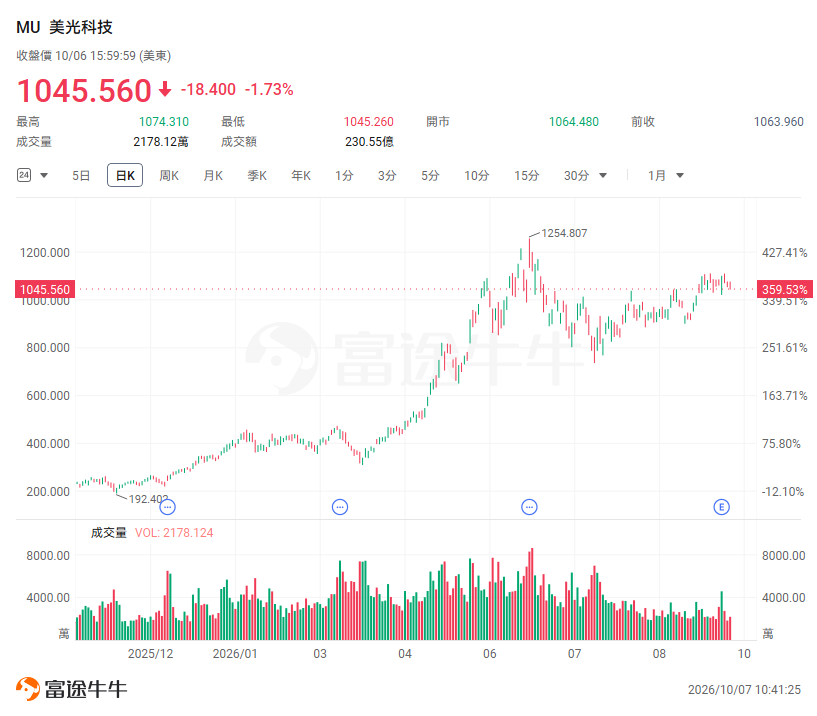
Since the beginning of this year, Micron's stock price has risen by more than 266%, making it…$PHLX Semiconductor Index (.SOX.US)$One of the best-performing stocks. With both earnings and share price surging, market attention has shifted from whether short-term results exceed expectations to whether AI‑related storage demand and high profit margins can be sustained.
Hyperscale cloud providers are ramping up capital expenditures, yet market expectations may remain subdued.
At the heart of the earnings growth for AI-related companies is the continued ramp-up in capital expenditures by hyperscale cloud providers. The market expects these companies' third-quarter capital spending to rise 116% year over year, up from 87% in the second quarter. Goldman Sachs forecasts that by 2027, capital expenditure growth will exceed 50%, with the total amount surpassing the current market consensus estimate of roughly $1.1 trillion.
Historical experience shows that market forecasts for the capital expenditures of ultra-large cloud providers have consistently lagged behind actual growth rates: at the beginning of 2024, the market projected full-year growth of 19%, but the actual growth ended up at 54%; at the beginning of 2025, the forecast was 22%, while the actual growth reached 73%; and at the start of this year, the projection was 36%, with the current actual growth already approaching 96%. Accordingly, Goldman Sachs believes that the market's expectation of a 37% annual growth rate in capital expenditures by 2027 may also be too low.
The acceleration of cloud‑business revenue is also underpinning this round of capital expenditures.$Amazon (AMZN.US)$, Google,$Microsoft (MSFT.US)$and$Oracle (ORCL.US)$As the cloud revenue growth rate of hyperscale cloud providers accelerated to 48% in the second quarter, Goldman Sachs expects it to rise further to 55% in the third quarter. Meanwhile, the combined backlog of cloud contracts at Amazon, Google, and Microsoft has approached $1.7 trillion.
However, the rapid expansion of AI capital expenditures has also led to increased financing needs, with a significant portion being met through debt financing. In addition, two accounting factors boosted corporate profits in the first half of this year: gains recognized from marking to market the equity stakes held by large tech firms in private AI companies, and tariff refunds issued by the U.S. Treasury.
Goldman Sachs estimates that large tech companies generated approximately $150 billion in second-quarter gains from the revaluation of their stakes in private AI firms, equivalent to 12% of S&P 500 earnings per share; meanwhile, the roughly $69 billion in tariffs refunded by the U.S. Treasury in the third quarter amounts to about 6% of total U.S. corporate pre-tax profits. Goldman Sachs has already excluded the former from its quarter-over-quarter comparisons and does not expect a comparable gain to reappear in the third quarter.
The index is near historic highs, and market breadth continues to narrow.
Beyond earnings concentration, market performance also exhibits an unusually high degree of concentration. The top ten constituents of the S&P 500 currently account for roughly 40% of the index's market capitalization and 37% of its expected earnings. According to Goldman Sachs data, the average realized correlation among S&P 500 components has fallen to 0.06, the lowest level in the firm's decade-long record, indicating that the index's overall performance is increasingly reliant on a handful of leading AI and energy stocks.
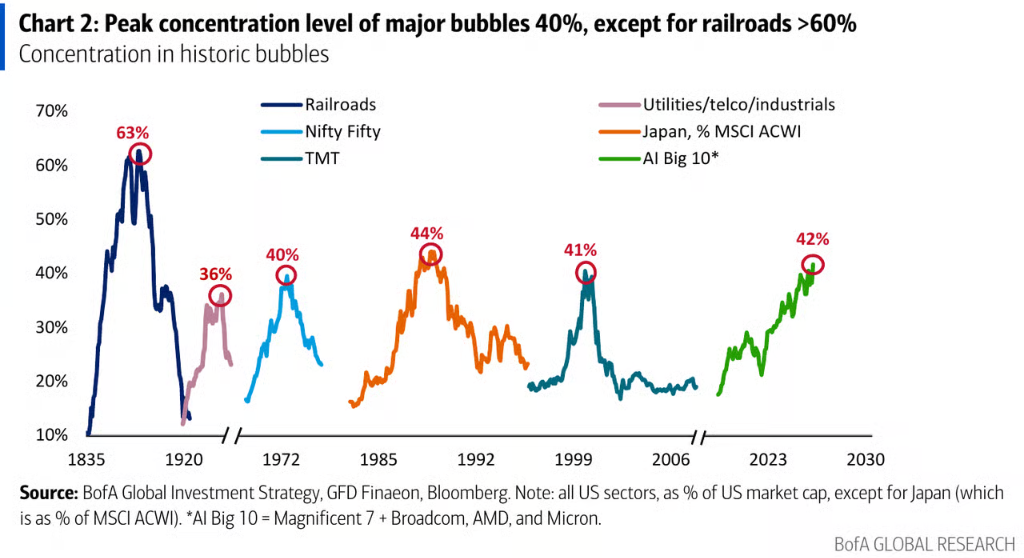
Bank of America Merrill Lynch strategist Michael Hartnett also noted that currently about 400 S&P 500 constituents have fallen below their 50-day moving average, and roughly 300 have dropped beneath their 200-day moving average. According to his "AI Big 10"—which comprises the Mag 7 plus Broadcom, AMD, and Micron—the market-capitalization concentration has reached 42%, surpassing the 40% of the "Nifty Fifty" era, the 41% during the TMT bubble, and the 36% of the 1920s. Among comparable historical cases, only Japan's 44% and U.S. railroad stocks in 1881 at 63% exceed this level.
However, investment banks remain relatively optimistic about third-quarter results overall. In its third-quarter earnings preview report, JPMorgan's market intelligence team upgraded its market rating to "tactically bullish," noting that after second-quarter earnings growth of 52%, the market's expectation of roughly 29% earnings growth for the third quarter may still be on the conservative side, and forecasting revenue and profit growth across all 11 sectors.
According to FactSet, if current expectations are met, the S&P 500 will post year-over-year revenue growth of over 10% and earnings growth of over 25% for the third consecutive quarter, with profit margins reaching the second-highest level on record.
Goldman Sachs currently projects that the S&P 500's earnings per share will reach $375 in 2026, up 36% year over year; in 2027, they are expected to rise further to $415, with target levels of 8,000 points by year-end and 8,700 points over the next 12 months.
As the largest constituent of the S&P 500 and the second-largest contributor to third-quarter earnings growth, NVIDIA is set to release its quarterly results in the third week of November. In today's market environment, where profits are highly concentrated, its financial performance—and its guidance on future AI-related capital expenditures and demand—could prove pivotal in determining whether this round of U.S. equity earnings momentum can sustain its upward trajectory.
 Want to pick stocks or analyze them? Curious about holding opportunities and risks? For all your investment questions,Just ask Futubull AI!

Editor/rice