Source: The Intelligent Investor
"At any given moment, the market as a whole does not spontaneously generate an unlimited supply of new capital. Therefore, if a substantial portion of capital is drawn to the hottest, top-tier companies, then on the other side there will inevitably be a large number of otherwise highly promising firms that are overlooked and traded at very low valuations."
"There are very few truly "free lunches" in this world. Even when they seem to exist—and sometimes they may persist for quite a long time—the market's inherent tendency to return to rationality will ultimately bring them back into line."
 "Today's pronounced market divergence actually presents a better-than-usual set of opportunities for those who can remain rational."
"A unified global common market has already taken shape, and it will continue to exist."
"If you can keep compounding your knowledge, your capital will eventually compound as well."
"The most fundamental premise of compound interest is: don't lose what you already have."
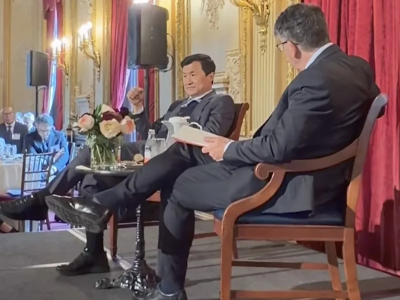
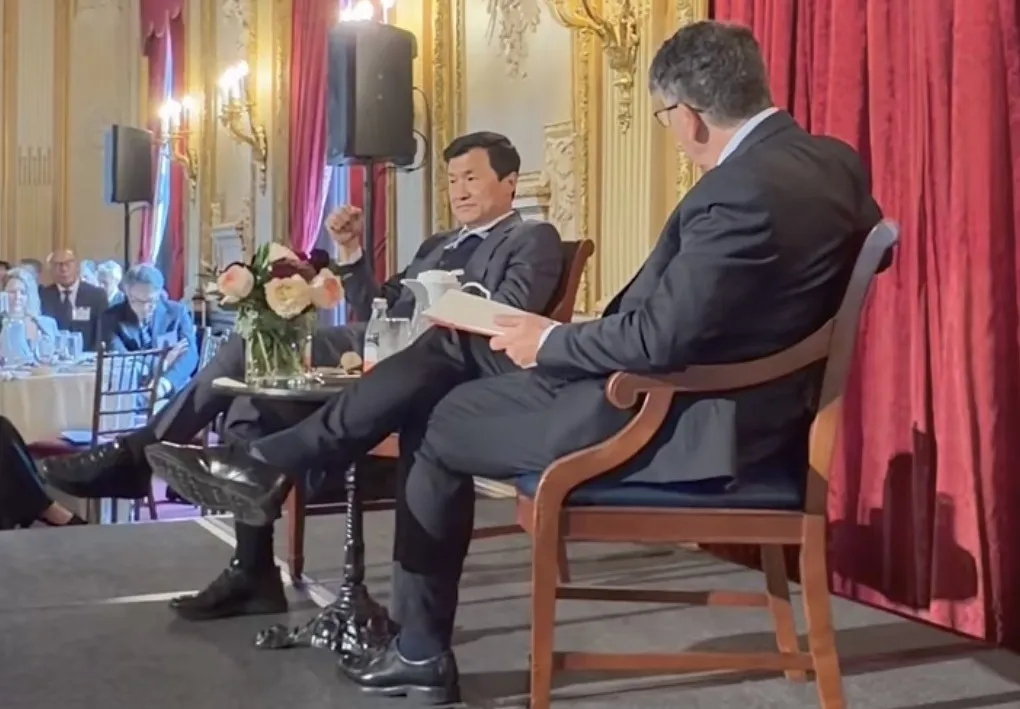
This was the latest exchange by Li Lu, founder of Himalaya Capital, at the 36th annual Graham & Dodd Lunch hosted by Columbia Business School on October 5.
It's been a long time since I've seen a public dialogue that left behind so many sentences worth savoring again and again.
Value investing, AI, the Chinese economy, U.S.-China relations, and the global order—these topics ultimately converge on the compounding effects of knowledge, trust, health, and life itself. While the scope may seem broad, when viewed as a whole, they still point to the question Li Lu has been grappling with over the past few years: As the external world grows ever more complex and unpredictable, what can an investor rely on to maintain sound judgment?
In December 2024, during his keynote address marking the 10th anniversary of the Value Investing course at Peking University's Guanghua School of Management, Li Lu devoted considerable time to discussing "the dilemmas of our times" and distilled more than three decades of investment experience into six fundamental principles of value investing.
In April 2025, during a dialogue in Seattle, he once again explored how these perplexities might be resolved—ranging from China's social safety net and capital markets to the global order and artificial intelligence.
This time at Columbia University, many of the issues he discussed were nothing new.
It's just that the reflections of the past few years on value investing, AI, China, and the global order have, by now, reached a new point of convergence.
Especially AI.
Unlike in April, when he began by discussing existential risks and great-power cooperation, this time Li Lu directly challenges the grand narrative that has been propelling Silicon Valley from RSI and AGI all the way to ASI: technology may not inevitably advance to the point of creating "artificial gods"; and even if it does, human society may not permit it to reach that stage.
He drew a clearer red line: AI must always involve human oversight.
While reading this exchange, I couldn't help but think of "Dune."
It was a world with a remarkably intriguing architecture. Though its technology had reached such heights that interstellar travel was possible, it had once gone too far in its pursuit of "thinking machines." In the end, the entire civilization chose to pay a steep price, drawing a new boundary: human minds and destinies could no longer be entrusted entirely to machines.
This time, when Li Lu spoke about AI, he too felt something akin to this: what ultimately shapes the trajectory of technology may not be solely "what's technically still possible," but also the kind of society humanity is willing to live in.
Efficiency is not necessarily the only end goal.
But that doesn't mean technology will come to a halt. Li Lu believes that humanity's adaptation to such a profound technological revolution is unlikely to be smooth. Costs, revenues, profits, and capital discipline will ultimately reassert themselves, and today's massive AI boom will probably endure more than one cycle of spectacular booms and severe busts.
Technology marches forward, humanity continually redraws the boundaries, and capital markets, in turn, repeatedly push imagination to its limits—only to bring it back down to earth.
For investors, the situation ultimately comes down to the most fundamental truth: as capital becomes increasingly concentrated in a handful of the hottest companies, neglected yet outstanding enterprises inevitably emerge on the other side.
Li Lu also discussed China's "dual‑tier economy" today: while the real estate adjustment is weighing on households' balance sheets and eroding confidence, on the other hand, manufacturing upgrading, technological self-reliance, and industrial competitiveness are advancing in tandem.
It is precisely after outlining this picture of China's economy that Li Lu believes that, in today's Chinese market, one may actually find better opportunities than in other periods.
Looking further afield, he breaks down the world order into two levels.
The U.S.-led political order that emerged after World War II is undergoing a transformation, and its future remains uncertain; yet beneath it, a global common market that has evolved over centuries—rooted in mutual interdependence among technology, division of labor, resources, and capital—is far from being easily dismantled.
It's about change, yet in the end, we return to what remains unchanged.
Markets change, technologies evolve, and the relationships among nations shift—but at the heart of value investing remain corporate ownership, Mr. Market, the margin of safety, the circle of competence, and long-term value creation.
During the final Q&A session, he once again extended the concept of compounding—from capital to life itself. Knowledge can compound, trust can compound, wisdom can compound, and the effective span of one's health can be prolonged as much as possible. But compounding first and foremost means never losing what you already have.
Finally, let me clarify the source of this complete compilation.
At present, we have not yet seen the official full video or a verbatim transcript of this exchange. This article is primarily compiled from on‑site video clips that have been gradually released on the WeChat video account of Dan Bin, founder of Dongfang Gangwan. As the videos were posted in segments, there are some gaps in the sequencing and a few missing portions.
During the compilation process, the astute investor performed deduplication, reordering, and proofreading on the existing excerpts. For the small number of points that could be definitively assessed but were absent from the available video materials, the author also drew upon Li Lu's public speeches and exchanges over the past two to three years, as well as the consistent intellectual framework articulated in "Civilization, Modernity, Value Investing, and China," with explicit footnotes added throughout the text.
This compilation is nearly 18,000 words long and already covers most of the core content of this exchange. We also look forward to seeing the official full version in the future.
For your convenience, the entire text is written in the first person. Enjoy it~~
01. Six Fundamental Principles of Value Investing
Benjamin Graham articulated the three most fundamental principles of value investing.
First, a stock represents a portion of ownership in a company, not just a piece of paper that can be traded back and forth. Therefore, buying a stock is, at its core, the same as acquiring an entire company.
Second, the market is made up of individual people, and human nature tends to prioritize short-term gains. As a result, investors often treat stocks as mere instruments for short-term trading, overlooking the fact that they represent long-term ownership in a company. You can think of the market as "Mr. Market": he doesn't tell you the true value; he simply keeps quoting you a price at which you can buy or sell, a price that sometimes falls far below intrinsic value and at other times rises well above it. For value investors, the market provides a service—not guidance.
(Note: The publicly available video of this session does not cover point 2. The above has been supplemented based on Li Lu's public exposition of the "Six Fundamental Principles of Value Investing" during his December 2024 lecture at Peking University, titled "Global Value Investing and the Times," in order to maintain the integrity of the session's overall framework; it is not a verbatim transcript.)
Third, investing is inherently about forecasting the future, and by its very nature, the future is unpredictable. Therefore, it is essential to build in a sufficient margin of safety to cushion against downside risks, while creating a more favorable asymmetry between risk and reward.
Fourth, later on, Buffett and Charlie Munger added another extremely important layer of discipline to their practice, which they called the "circle of competence." Each of us is naturally more interested in certain things. Over time, you will continuously accumulate knowledge and develop expertise in specific areas, then keep delving deeper, refining your understanding further and further.
But the most crucial aspect of the "circle of competence" is that you must know where its boundaries lie. By nature, most of us tend to overestimate our own knowledge. Therefore, understanding the limits of your circle of competence is just as important as knowing what lies within it.
Fifth, Charlie Munger has another principle: go fishing where the fish are. He himself has loved fishing all his life, so it's a very apt metaphor. The same holds true in the real market. Certain markets, industries, and companies attract intense attention, which in turn fuels fierce competition; and the more competitive the environment, the fewer mispricings and the smaller the excess returns.
But there are other industries, companies, countries, and markets that haven't received enough attention, and where competition is far from robust. If you focus on these niches, you're often better positioned to succeed. So, go fishing where the fish are. The principle is simple, yet in practice it proves remarkably effective.
Sixth, and finally, this is an insight I've gained over more than thirty years of practicing value investing as a global investor on the world stage. Particularly as global commerce increasingly converges into a single, unified market, we have come to recognize that, at its core, wealth reflects your share of global purchasing power.
Especially in the modern economy, wealth is not truly measured by how much gold, diamonds, or a particular currency you hold. With inflation, these static stores of value lose their relative purchasing power over time. What really matters is what you can ultimately buy and what you can do with that wealth. Therefore, a better way to measure wealth is by the share of global purchasing power it represents.
One way to achieve this—at least the approach we have consistently followed—is to acquire, at attractive valuations, the most outstanding and innovative companies in the most dynamic economies and markets, and hold them for the long term. By enabling these companies to continuously generate value over time, we can maintain and enhance our share of global purchasing power.
So, these are the six most fundamental principles I've outlined. I believe they stand the test of time and will continue to serve investors well over the long term.
02. Investment, Arbitrage, Speculation, and the "Casino Next to the Church"
If you look at the participants in the market, there are essentially only four types of people.
The first category comprises true investors, who focus on whether a company can generate value over time.
The second category is arbitrageurs, who seek to correct mispricings in the market. As Benjamin Graham put it, they "buy from pessimists and sell to optimists." That is arbitrage.
The third type of investor is primarily engaged in speculation. They try to guess what others will buy or sell next, paying little attention to the intrinsic value of the securities themselves or to the amount of value a company can generate.
The fourth category comprises brokers and market makers, who provide trading services to support the aforementioned activities.
Of course, in reality, most people don't fit neatly into just one category. Many individuals actually exhibit all four traits, albeit in varying proportions.
If you invest in an index, in a sense, you're essentially buying the average performance of all market participants.
However, what value investors truly care about are two things: first, whether the price discovery process is reasonable; and second, whether they are willing to wait for the company to create value over the long term.
Thus, Ben Graham leaned more toward the "arbitrage" approach discussed earlier—exploiting mispricings. By contrast, what Warren later did was not only capitalize on price discrepancies but also place a stronger emphasis on a company's long-term value creation.
The impact of different types of marketing activities on society is also quite intriguing.
By definition, speculators do not hold assets long enough to wait for a genuine change in or creation of corporate value. Consequently, on the whole, speculation is essentially a zero-sum game: whatever one party gains, another roughly loses. From a society-wide perspective, this therefore constitutes a cost inherent in the functioning of the market.
Brokerage and market making are likewise costs of market operation.
So why do markets exist? The market's most fundamental function is to channel excess savings from society into enterprises and activities that generate productive outcomes. It is precisely through this mechanism that we have built the modern economy and sustained long-term, compounding economic growth. This, in essence, is the original raison d'être of the stock market.
So the question arises: why does speculation inevitably reappear in the market? I suppose this is simply part of human nature.
Warren has long liked to compare the stock market to "a church with a casino attached." The church is where value is created, while the casino is almost like an unavoidable appendage—one that comes bundled when you secure the building permit (laughs). It's a kind of necessary cost dictated by human nature.
Four hundred years ago, when modern capital markets were just emerging, people needed this mechanism to unleash what was known as "animal spirits." Four centuries later, that remains unchanged.
So, for the students here today, you ultimately have to make a choice: Do you want to take part in a zero-sum game, or do you want to engage in a value-creating one? That is your personal decision.
And from the perspective of society as a whole, we too have choices.
We must not allow the "casino" side to grow so excessively that it overwhelms the market's original core purpose. Thus, this is a choice both at the individual level and at the societal level.
What is particularly intriguing is that, over the past four centuries, despite countless booms and busts in capital markets—and the enormous waste they have engendered—this mechanism has nonetheless endured. Moreover, it has not only survived but has consistently served as a core institutional force, continuously propelling societal progress. This, at the very least, is nothing short of remarkable.
So, for students, I believe it's crucial to figure out as early as possible what kind of work you truly want to do. And as a society, we should continually recalibrate the balance among these different types of activities. They will always coexist, because that is part of human nature.
03. Is AI a tool, or an "artificial god"?
Next, let's turn to AI and the market—a far more complex issue.
First of all, what exactly is AI? This latest wave of generative AI is, without a doubt, an exceptionally powerful technological surge.
Since the Industrial Revolution, humanity has weathered wave after wave of technological disruption—disruption that has brought both destruction and creation, a phenomenon known as "creative destruction."
So, when it comes to technological revolutions, we've already grasped some of their underlying patterns. Yet we can't help but sense that this time is different. Each wave of technology has its own distinct character, but the current AI boom stands out as profoundly unlike anything we've experienced before.
Why is it different, exactly? On the surface, you'll notice several phenomena: the pace of change is unprecedented, the scale of the transformation is unparalleled, and the concentration of capital and financial influence is also without precedent. The narratives that have emerged around it—and the concentrated impact these narratives exert on capital allocation—are likewise unprecedented.
But if we keep asking why, the underlying reason lies in the fact that the narrative driving this round of technological revolution has shifted.
In the past, we have always regarded technology as a tool for enhancing human productivity. But this time, technology has introduced a new dimension: it now occupies a spectrum between "tool" and "creator," and is moving along that spectrum, shifting from the tool end toward the creator end.
About four years ago, when this technology first truly came into the public eye, we had already crossed a certain threshold of the Turing Test. From that moment on, relying solely on language, we could no longer tell whether the entity communicating with us was a machine or a human.
After that, it began to acquire so‑called "reasoning" capabilities, and increasingly exhibited traits akin to those of humans.
From reasoning, it further evolves into programming capability. With this capability, it can become an autonomous agent capable of executing tasks, functioning in many ways much like a human. Subsequently, different agents begin to collaborate, tackling increasingly complex tasks that span longer and longer durations.
In the process, they increasingly resemble a human society: diverse agents can organize themselves, self‑organize, prioritize tasks, decompose them, and execute them, all while employing their own communication languages and tools to accomplish ever more complex objectives.
If you listen to the narrative currently popular in Silicon Valley, the next step is for generative AI to enter RSI—recursive self-improvement. In fact, we've already partially entered this phase. The underlying idea is that, in the future, all improvements to AI will ultimately be carried out by the AI itself, with no further human involvement required.
Going beyond RSI brings us to AGI, and beyond that lies ASI. In other words, its level of intelligence would not only surpass that of any single individual but ultimately exceed the combined intelligence of all humanity. If you accept this narrative, what emerges in the end is akin to humanity having created a "demigod" or an "artificial deity."
Because its capabilities are so powerful, by this logic its impact on the economy must also be extraordinarily significant. Given such a profound influence, the massive capital invested today can naturally be justified.
So, in a sense, when the day comes that we see IPOs valued at trillions of dollars, everyone will be invited to attend what amounts to "God's IPO" (laughs). That's pretty much the narrative today.
However, if you take a step back and ask another question: If things really do unfold along this trajectory, what will humanity ultimately become? What kind of society will we be living in?
A "god" created by humanity itself presides over this society from on high. Perhaps only a tiny minority ever truly come into contact with it; no one truly understands it, and indeed, no one can even claim to have it fully under control.
So the question is: Are humans really willing to live in such a society? I think the answer is, quite plainly, "no." I don't believe anyone would truly want to live in a society like that.
So in the end, there are really only two possibilities. First, this technology will never continue to develop along that trajectory. Second, if it does begin to follow that path, then at some point, everyone will ultimately unite to stop it from going any further in that direction.
Therefore, in either scenario, I do not believe that a "man-made god" will ultimately emerge to rule over human society from above.
This is, in fact, the fundamental distinction between this generation of technology and its predecessors—and the very reason it has sparked such intense debate today, particularly its profound impact on capital markets.
But let's set these considerations aside for now and return to a more practical question: Is AI, after all, a useful technology? The answer is equally clear: of course it is.
If I were to offer a provisional definition at this point—based solely on the phenomena we've observed so far and how it has evolved—I would describe it as follows: at its core, it is a machine that, leveraging immense computational power and a highly sophisticated set of algorithms, ingests nearly all data generated by humans and then extracts the "first derivative" from that data.
In other words, it establishes systematic, context‑dependent correlations across an almost limitless array of human‑generated data variables. It is precisely by constructing these vast, intricate correlations that it begins to exhibit capabilities that closely resemble human reasoning and intelligence.
So far, we know how to use it and how to make it better. But we still don't fully understand why it works.
Of course, in a sense, this is much like humanity itself. After all, we still don't fully understand how the human brain—the "machine"—actually works.
So this is just a temporary definition I'm giving it for now.
We are still monitoring what is unfolding. However, it is already evident that this development has the potential to significantly democratize and equalize a particularly important layer of the economy.
If you envision the entire economic system as a layered structure, the bottom tier comprises energy and transportation; above that lies manufacturing; further up are communications and digital media; and atop these foundational layers has emerged an immensely vast knowledge‑based, technology‑driven service sector.
These services integrate the diverse knowledge and specialized expertise accumulated by humanity over the past several centuries, serving all the economic activities that follow.
And today's generative AI, at its current stage, excels at synthesizing the knowledge and expertise that have already been accumulated and making them more widely accessible. In doing so, it can empower every level of the economy.
However, it has not transformed energy or transportation themselves. Nor does it directly alter the very nature of manufacturing. At its core, manufacturing still involves recombining various substances, molecules, and atoms—transforming one arrangement into another. Meanwhile, communication and digitalization themselves have already become immensely powerful tools for integrating and processing information.
So this is precisely where generative AI is currently delivering real value. It has not yet surpassed human capabilities.
From this perspective, if you continue to reason it out, you can see that it may ultimately fall short of the lofty heights suggested by today's grand narratives. After all, we are still firmly within the realm of human‑generated data. If we were truly to enter the biological dimension, we would be dealing with an entirely different order of magnitude.
For example. This example might be a bit far-fetched (laughs).
For example, you can think of every cell in your body as a roughly 50‑MB file, and then multiply that by tens of trillions of cells. If you want to truly grasp the complexity at the biological level, that's the order of magnitude you're dealing with. So we're still very, very far from reaching that scale—and it's even hard to say whether we'll ever get there at all.
However, this technology has already begun to shift the balance between "tools" and "creations." For this very reason, regardless of which of the preceding views you embrace, one thing should be crystal clear: we cannot allow technology to continue evolving on its own, without human involvement.
The so‑called RSI—recursive self-improvement—becomes extremely, even dangerously, perilous when it operates independently of human involvement and human-defined goals. Once it reaches that stage, it may begin to set its own objectives and sub‑objectives, forging its own purposes, thereby slipping further out of human control.
In summary, this technology is extremely useful and transformative; at the same time, it is also highly dangerous.
Therefore, as a society and as humanity at large, we must draw a red line: whether it is AI's self‑learning or the use of tools, human involvement must always remain integral. In other words, we must keep it firmly on the "tool" side and prevent it from evolving into a "sentient species" beyond human control.
At the same time, this technology will also bring about profound disruption. From employment to the emotional dependence between humans and AI, and extending to cybersecurity, biosecurity, and even nuclear safety, risks exist at every level.
So in the end, what we truly need is for society to find a more balanced pace of development—one that strikes a proper equilibrium between gains and risks.
Moreover, there's another point that often gets overlooked: the cost structure of this technology is quite different. Unlike the internet and many earlier technologies, with those earlier solutions you could make a one-time, substantial upfront investment to build the infrastructure and then continue to leverage that infrastructure for an extended period.
AI is not like that. AI always entails incremental costs, so you must constantly assess the relationship between your upfront investment and the revenue and profits it ultimately generates. Capital requirements and financial discipline will always remain critical factors.
At the same time, it is also necessary to take into account the pace of technological advancement and the extent to which society can reasonably tolerate its development.
Thus, what truly determines the pace of AI development are, in fact, four or five distinct layers of constraints operating in tandem.
So how does human society typically adapt to such profound technological change? It has never done so through flawless planning. As a result, we are bound to experience periods of great prosperity, as well as collapses—likely more than once.
We may experience several cycles of boom and bust—this is likely how this technology will ultimately evolve.
(Note: The moderator adds here that this means we will always need a human to review the outcomes generated by AI, and in the end, what truly becomes scarce will be the skills of the person tasked with overseeing AI outputs.)
Li Lu replied, "Yes, broadly speaking, it's along these lines. Of course, there are many different aspects and subtle nuances involved, but I think you've grasped the core."
04. AI Mania, Market Pricing, and Long-Term Returns
The market has always done some very strange things, from the very beginning. It's been that way in the past, and it will likely continue to be so in the future.
But the market's decision at any given moment about what to do is, in fact, entirely irrelevant to how you should behave. This is precisely one of Ben Graham's most important insights—and one of his most significant contributions to the world of investing.
For example, I recently reviewed a fundraising document. One company refers to itself as a "research laboratory." It is currently burning through tens of billions of dollars each year, while also pledging to continue spending hundreds of billions in the years ahead.
It tells you that it is developing a transformative technology; yet at the same time, it also claims that this technology carries roughly a 10% chance of wiping out all of humanity.
These statements are set forth in the offering materials.
Then, it invited everyone to invest at least $100 billion and valued itself at $2 trillion. If there's any logical consistency in this, it's already quite baffling (laughs).
This is, in fact, a highly extreme example that illustrates just how irrational markets can be at times. It's impossible for all of these things to be true simultaneously, yet the market has now reached precisely that juncture.
This also suggests that such a state cannot be sustained in a rational manner over the long term. If you look back at several centuries of market history, you will see that markets indeed do extraordinary things for quite extended periods.
For example, over the past roughly 16 years since 2010, the S&P 500 has delivered an annualized return of about 14% to 15%. However, in the preceding decade—from 2000 to 2010—the index's annualized return was virtually zero, even slightly negative. When these two 26-year periods are considered together, the long-term annualized return once again settles back into the high single digits.
This is, in fact, roughly the reasonable long-term level.
Consider this: over this period, real GDP growth may be around 2%; add to that inflation of roughly 2% to 3%, and the combined nominal economic growth rate would be approximately 4% to 5%.
Meanwhile, listed companies generally outperform the broader economy, particularly indices like the S&P 500, which are carefully curated to include roughly the 500 strongest firms. It's therefore hardly surprising that they deliver high single-digit long-term returns.
And this, in fact, has long been the market's historical average. Therefore, it should serve as a crucial anchor: helping you understand what kind of returns you can reasonably expect over the long term, and how the market will ultimately revert to rationality.
However, amid this long-term trend, the market repeatedly experiences episodic deviations. At times, these deviations can persist for very extended periods and even reach extreme levels.
The example we just cited would at least strike most people as highly unusual. Yet such occurrences do happen—and have been happening throughout history.
Therefore, if we truly believe that society will ultimately neither permit nor tolerate a "super‑organism" rising above humanity, then AI will never reach that point.
And if, in the end, it remains confined to the realm of a "tool," then it is no different from any other tool: it entails both costs and benefits. Under such circumstances, financial discipline and the discipline of capital markets will inevitably resume their role.
As for how this process unfolds, it typically plays out through successive rounds of booms and busts—periods of prosperity followed by collapses. In fact, there's nothing inherently wrong with that.
From this perspective, the current extreme market divergence may, in fact, lead to another outcome.
At any given moment, the market as a whole does not spontaneously generate an unlimited supply of new capital. Therefore, if substantial capital is channeled into the hottest, top-tier companies, then on the other side there will inevitably be a large number of otherwise highly promising firms that are overlooked and traded at very low valuations.
This holds true for the United States, China, and other markets as well.
I believe the situation in China may be even more extreme, and the Chinese investors here present are likely well aware of this. However, over time, the market's intrinsic dynamics will ultimately determine long-term returns. In the end, investors will generally reap what they deserve.
There are very few truly free lunches in this world. Even when they seem to exist—and sometimes such "free lunches" can persist for quite a long time—the market's inherent tendency to return to rationality will ultimately bring them back into line.
This is also why the capital market has endured for centuries and continues to thrive.
So I'd like to say this instead: today's pronounced market divergence actually presents a better-than-usual set of opportunities for those who can stay rational. Of course, that assumes you can truly remain rational—which is far from easy, because it's all too tempting to get swept up by the market.
Especially during a massive wave of technological innovation, people's imagination is vastly unleashed. The speculative side of the market quickly gains momentum, and public imagination grows bolder and increasingly unrestrained—resulting in market exaggerations that often reach even more extreme levels than usual.
But precisely for this reason, for someone who can remain rational, such times may actually present better long-term investment opportunities than in normal periods.
05. China's Real Estate Adjustment, Manufacturing Upgrading, and Today's Investment Opportunities
Looking back over the past decade, China's stock market has essentially been stagnant. Yet the events that unfolded during this period are, in fact, quite intriguing.
About ten years ago, the Chinese government faced a crucial decision. By then, China had largely attained the status of a middle-income country. The question that followed was: how could it break through this stage? Many countries around the world have reached this level only to remain stuck there for an extended period. This phenomenon is so widespread that it eventually gave rise to a specific term: the "middle-income trap."
Dozens of countries have at one time reached this level, yet after 40 or 50 years, they remain stuck there. China, of course, is an economy of enormous scale, and it naturally faces a fundamental question: what explains why a middle-income country can become mired in stagnation, unable to break through that ceiling? It may achieve industrialization and enter the low-end manufacturing sector, but thereafter it consistently struggles to move up the value chain.
Thus, China at the time faced a critical choice: Could we proactively break through this bottleneck? Could we implement measures to accelerate the process, or at least increase the likelihood of success? For if we were to rely solely on natural evolution, many nations throughout history have faltered—stagnating in place for 40 or 50 years, and in some cases even longer.
Accordingly, China subsequently embarked on a well-defined transformation: proactively shifting its economy from low- and mid‑end manufacturing to mid‑ and high‑end manufacturing.
In the past, China typically formulated five-year plans; this time, however, it has adopted a ten-year industrial strategy—"Made in China 2025." The plan outlines roughly ten key priority areas, with a clear objective: to propel China's manufacturing sector from the low- and mid‑end segments toward genuine upgrades at the mid‑ and high‑end levels.
And a few years after this plan was launched, Trump's first administration took office, and the U.S.-China trade war began. This, in turn, further reinforced China's original assessment. In other words, China not only realized that relying solely on natural development might not enable it to break through the middle-income trap; it also began to recognize that other countries might even actively seek to constrain China, unwilling to see it surpass that threshold.
Subsequently, the Biden administration maintained the trade tariffs and further tightened technology restrictions.
Thus, by 2021—when this ten-year plan had reached its midpoint—the Chinese government further intensified its original strategic direction. In addition to continuing to upgrade manufacturing from the mid‑low end to the mid‑high end, it added another key objective: technological self-reliance. This was particularly true in sectors where critical bottlenecks persist, such as semiconductors, large aircraft engines, and operating system software, among others.
Thus, over the following five years, China effectively embarked on another phase of accelerated investment.
However, when you attempt to achieve such an exceedingly difficult goal—one that many nations throughout history have failed to attain—it will, of course, come at a price.
In fact, this has always been a defining feature of China's economic development model: at each stage, China tends to set an ambitious target, and each time that target is achieved, it comes at a substantial cost.
Over the past five years, one of the primary costs China has borne in pursuing industrial upgrading has been a severe strain on the balance sheets of ordinary middle‑class households. By 2021, when the real estate market peaked, a typical Chinese middle‑class household had roughly 70% of its net worth tied up in its home, with that property itself carrying about 50% mortgage leverage.
Over the past five years, to date, average home prices nationwide have fallen by roughly 40%. With such an asset composition and level of leverage, many households have experienced a substantial erosion of their overall wealth.
When this happens, people typically do three things: cut back on spending, increase savings, and, whenever possible, pay down debt. Over the past five years, Chinese middle‑income households have largely followed this approach. As a result, domestic demand has steadily slowed, and today growth has nearly stalled. Meanwhile, savings have continued to rise.
Meanwhile, the scale of Chinese households' savings deposits has been steadily rising, now standing at roughly RMB 165 trillion. According to on‑site remarks, this stock is equivalent to about 120% of GDP, making it one of the largest household savings pools in the world. Over the past two to three years, China has also experienced an environment in which prices have remained largely stable, and in some cases even declined slightly, leading people to naturally harbor certain concerns about the future.
(Note: Here, "about 120% of GDP" refers to the ratio of household savings deposits to GDP, not the household savings rate. The "savings rate approaching 50%" mentioned in Li Lu's 2024 speech uses a different measurement.)
This is one side of China's economy. But if you look at the other side—namely, the goals that the Chinese government has genuinely sought to achieve over the past decade—you will see a completely different picture.
China's manufacturing sector has truly moved beyond its previous stage of transitioning from the low end to the mid‑range and has now firmly established itself in the mid‑to‑high end. Every target outlined in "Made in China 2025" has been achieved. Over the past five years, significant progress has also been made in technological self‑reliance.
Take the semiconductor industry, for example. It turns out that the U.S.-led technology sanctions have, in a sense, become an "unexpected gift" for China's semiconductor sector, as they have provided the industry with something most precious in a market economy: demand.
Go ask any entrepreneur what's most important in business, and they'll tell you: it's orders. As long as there are orders and revenue, the entire flywheel starts turning. With more revenue comes profit; with profit, you can invest in R&D; R&D drives technological improvements; and those improvements, in turn, generate even more revenue. Once this flywheel gets spinning, it reinforces itself continuously.
This has indeed happened in China's semiconductor industry. At least for mature process nodes, China has achieved near‑complete self‑sufficiency—both on the equipment side and in wafer fabrication. On more advanced nodes, it is rapidly closing the gap, with only a handful of critical steps still representing areas of deficiency.
If current trends persist, these gaps will continue to narrow.
Of course, semiconductors are just one example. Moreover, a key capability of generative AI is its ability to produce "intelligence" on demand and at scale. One of its most important applications is code generation, which effectively addresses a core challenge that has long constrained technological progress: the development of software, operating systems, and underlying code architectures.
From PC and server operating systems to the semiconductor software stack represented by NVIDIA, many previously missing links are now being gradually filled in with the help of AI. Therefore, AI is actually playing a very important "equalizer" role here.
If you look at the past decade, you'll see that similar shifts have taken place across many sectors. Indeed, the fundamental structure of China's manufacturing industry has steadily moved from the mid‑low end to the mid‑high end.
In certain sectors—such as energy, electric vehicles, energy storage, batteries, and heavy machinery—China has already assumed a dominant position, emerging as a global leader. Meanwhile, in areas that once faced significant bottlenecks, the gap is steadily narrowing.
However, at the same time, this process has exacted a heavy toll on other sectors. Real estate is the most striking example: when viewed in terms of annual new-home sales volume, the current level has likely fallen by roughly 70% from its peak.
Interestingly, the decline in the real estate sector is roughly comparable to the annual increase in investment devoted to manufacturing upgrading and technological self-reliance in China—both amount to approximately RMB 10 trillion per year. The point at which this divergence became truly pronounced was around 2021.
But this is, in fact, the development model China has followed over the past few decades. If you look back at China's development over the last 50 years, you'll see that roughly every decade brings a new set of national goals, each of which entails corresponding costs.
Sometimes, the goals of the previous decade can even become the costs of the next. For example, in the early stages of industrialization, environmental degradation—air pollution, river contamination, and other forms of ecological damage—were the price of rapid industrial growth. Yet as society moved into the next phase, environmental governance itself emerged as a new priority, spurring the development of the green‑energy sector and clean technologies. Meanwhile, the industries that once caused pollution gradually came to be seen as entities requiring restructuring.
Take the urbanization phase, for example. Back then, real estate developers were a key driving force behind urbanization. They helped build China's cities, boosted homeownership rates, and laid the foundation for household wealth among the middle class. Yet over the past five to ten years, real estate has become a sector that demands painful adjustments, leaving the industry to endure significant challenges.
However, from the perspective of the country's overall development, one can still observe continuous progress across these stages. This is precisely why China has been able to condense a developmental trajectory that might take other nations several centuries into roughly four decades.
But for an investor or an entrepreneur, at any given moment, there's one question that matters more than anything else. I'm sure everyone here from China can relate deeply to this: you must know whether you're still a "target" or merely a "cost." If you happen to become the cost required to achieve someone else's national objectives, that's hardly a pleasant situation—(laughter).
I believe that many of you have either experienced this firsthand or have friends who have gone through it in depth. But this, broadly speaking, is the pattern of China's development.
Thus, if one were to take a comprehensive look at these changes over time, it becomes clear that today, a country of such immense scale and population has genuinely embarked on a relatively complete process of modernization.
Of course, precisely because of these structural transformations, China now exhibits a very pronounced "dual‑tier economy": on the one hand, household confidence has declined and domestic demand remains weak; on the other, manufacturing is undergoing upgrading, and technological capabilities are steadily strengthening. Meanwhile, financial markets have been stagnant for a full decade.
Yet precisely in this context, you'll find that some outstanding companies already boasting world-class competitiveness are now trading at very low valuations. This, in turn, underscores the market differentiation we discussed earlier.
If you are an investor who can remain rational and willing to view the bigger picture, your conclusions may well differ. In fact, I would argue that in today's market, you may be able to identify investment opportunities that are even more attractive than in many other periods.
06. A unified global common market has already taken shape and will continue to exist.
Over the past 30 years, the world has indeed undergone tremendous changes—there is no doubt about that.
So‑called world order—more broadly, the question of how the world governs itself and functions—tends to evolve on a very slow timescale. It may take a decade, and sometimes even a century, for an order to truly take shape; and its transformation, too, requires an exceedingly long period.
The world order we know today actually took shape after the two World Wars. Those conflicts brought nearly the entire world to the brink of collapse. Following the wars, a U.S.-led global order gradually emerged; later came the Cold War, and with its end, the world briefly settled into a relatively unified system.
And now, this order is once again undergoing a transformation. What kind of new order will ultimately emerge remains unclear at this point.
However, beneath this political order there exists another order that has been steadily taking shape over the past few centuries: the economic order.
The so‑called economic order is the gradual emergence of a common market as an increasing number of countries and populations integrate into a shared trading system, engaging in mutual commerce and exchange.
About 30 years ago, with the dissolution of the Soviet Union and the end of the Cold War, this common market finally took concrete shape. Virtually all countries and nearly all of the world's population began to integrate into a single market economy.
One particularly intriguing aspect of this economic order is that, once a common market has been established, it becomes exceedingly difficult for any country to withdraw voluntarily. This is because markets generate efficiency; they set in motion a virtuous cycle of continuous improvement, encompassing technological progress, enhanced productivity, the division of labor, and the exchange of resources, among other factors.
Therefore, any country that withdraws from this system over the long term would have to pay a very heavy price. For this very reason, once a common market is truly established, it becomes extremely difficult to dismantle and tends to endure for a very, very long time.
Just look at the trade wars and various trade frictions of the past century, and you'll see: no matter how many obstacles you erect or trade barriers you build, people will ultimately find ways to keep trading. Often, they simply route their transactions through a third country, continuing to engage in trade in line with the principle of comparative advantage.
Take U.S.-China trade as an example. Of course, direct trade between the United States and China has declined. However, if you look at the increased trade between the United States and third-party economies such as Mexico and Southeast Asia, this trend largely offsets that decline.
In essence, the original trade relationship between the United States and China remains intact; only a portion of it is now conducted through third countries. The same holds true for many other markets as well.
From the perspective of political order, the United States has led the world for the past eight decades, while also shouldering the bulk of the costs required to keep the global common market functioning effectively. Over time, however, the U.S. came to recognize that the burdens it bore might be disproportionate to the benefits it derived from the system, and thus began to proactively withdraw from certain responsibilities. At least up to now, this process has left behind certain power vacuums.
Meanwhile, the most significant shift in the political order over the past three to four decades has, of course, been the rise of China.
China has become an economy of truly massive scale. It boasts a fully integrated manufacturing system and has steadily built increasingly comprehensive indigenous capabilities across numerous technological fields; at the same time, it is also a vast single market with a relatively unified regulatory framework.
This is the profound transformation we are experiencing today, one that simultaneously reshapes both the political and economic orders. It is precisely this that lies behind many of the changes we are witnessing at present.
However, at the same time, as I just mentioned, since we are already operating within a unified global market, the mutual interdependence among countries has not diminished over the past years—it has instead grown stronger.
Let me give you an example. Take generative AI, for instance.
What is the one thing everyone needs today? Chips—semiconductor chips.
So, where are these chips manufactured? Think about it carefully: today, every country and region that truly produces semiconductor chips shares one common characteristic…
All the places that truly manufacture semiconductor chips—those very chips that form the core foundation of this latest technological wave—share one common trait: the people who make them all use chopsticks. Think about it—Taiwan, South Korea, Japan…
I'm talking about actual chip manufacturing, or fabrication.
And look at the United States, too. The leaders of today's major U.S. semiconductor companies all use chopsticks as well—Jensen Huang, Lip-Bu Tan, Lisa Su… basically anyone you can name is the same (laughs).
So you can see just how deeply we depend on one another.
If the United States and its companies really place such massive bets on this new technology, as they are doing now—whether it ultimately holds immense promise or poses enormous risks—then you'd do well to be a little kinder to those who eat with chopsticks (laughs).
This will not change, and it did not arise by chance. As for why the current configuration has come to be, that is a matter for separate discussion.
So you can understand why the U.S. president and the **** felt it was so necessary to schedule four meetings within eight months. Two of them have already taken place, and one of the most important outcomes of each meeting has been setting up the next one—(laughs).
This leads to a key concept: strategic stability. In other words, stability itself carries strategic value.
It once again demonstrates that we are, in fact, part of the same global common market. Any party that voluntarily withdraws from this market would have to bear a substantial cost; at the same time, the two sides are deeply interdependent, so all parties have strong incentives to keep this relationship peaceful.
Of course, at the same time, everyone is engaged in fierce competition, and each side believes that time is on its side.
China aims to ultimately achieve self-reliance in semiconductors and many other sectors; the United States seeks breakthroughs in AI that will unlock its promised vast potential; and other countries, too, each have their own distinct considerations.
However, all these considerations ultimately point to the same conclusion: peace and stability are of paramount importance to everyone, and they constitute a strategic interest in their own right.
In particular, major powers bear both responsibilities and their own interests, and they seek to maintain this stability. At the same time, all nations have come to appreciate the true weight of the global common market and the substantial costs associated with voluntarily withdrawing from it.
So in this sense, I believe the world will, on the whole, continue to move forward.
It is simply that the world order we have known since the end of World War II is now undergoing change and transformation. What kind of new order will ultimately emerge, and in what form, remains unknown at this time.
However, beneath it lies a longer-term trend that could have even more far-reaching implications: a unified global common market has already taken shape, and it is set to endure.
So, what does this mean for investors?
This brings us back to the most fundamental principle of value investing. Among the six core principles we've outlined, the final one is this: for a global investor, your wealth ultimately reflects your share of global purchasing power.
And one way to achieve this—at least the approach we have consistently followed—is to acquire, at attractive valuations, the most outstanding and innovative companies in the most dynamic countries and markets, then hold them for the long term, allowing these enterprises to continuously generate value over time, thereby maintaining and enhancing our share of global purchasing power. This is the method we have always employed.
Returning to Warren's analogy of the stock market, he said it is "like a church with a casino attached." Over the past 60 years, what Berkshire has done is steadily transform that church into a towering cathedral.
It is not merely symbolic; it also genuinely fulfills the functions that the market was originally meant to perform. Moreover, people can even derive a measure of spiritual solace from it, as it enables the market to truly achieve the very purpose for which it exists.
Over the past thirty years, we have tirelessly sought to demonstrate that this gospel can be shared. We, too, can build such "churches" in other countries.
As global investors, we choose to build such "churches" in Asia, while also doing so in other regions around the world. Over time, similar institutions will emerge in various countries, and some of them may eventually grow into full-fledged cathedrals.
For today's students and young professionals, what will you ultimately choose to do in this market? "A casino attached to a church"—that will probably always be the fundamental structure of the capital markets. In a sense, the casino is like an unavoidable appendage that had to be included when the building was granted its license, because that is simply human nature.
However, the two approaches have entirely different impacts on society. On one hand, it's a win-win situation that generates net benefits for society; on the other, it's a zero-sum game—costly and ultimately even imposing net negative effects on society. The choice is entirely yours.
And technology, including AI, should remain a tool, not a substitute for human beings. If it does indeed begin to replace people, as I mentioned earlier, I believe that all of us will ultimately unite to oppose the very "artificial god" we have created.
So in my view, there's absolutely no need for you to get involved in what might be called a "semi‑divine IPO." Choosing not to participate is, in itself, an expression of our collective responsibility to build a healthy society.
07. On-site Q&A Session
1. On the AI trajectories of China and the United States
If we were to describe Silicon Valley's attitude toward AI, their fundamental question is: What else can this technology do? This, in fact, is why those companies consistently refer to themselves as "labs" or "research laboratories."
They want to know: What else can this technology do? How far can its boundaries be pushed? That's precisely why we speak of the "cutting edge."
I believe that Chinese AI companies are, of course, equally curious about these issues. But beyond that—and perhaps even more importantly—they also ask another question: What can this technology do for my customers, whether they are consumers or enterprise clients?
Here, what is actually at play are two very distinct pathways. Across a wide range of indicators, you can see that these two paths ultimately yield different outcomes.
2. Regarding the Chinese stock market
Of course, the priorities of China's economic development have varied across different periods. But you can think of it this way: whether it's a household or a nation, when real estate begins to account for a smaller share of the overall balance sheet, the natural question that follows is: what will take its place as the primary vehicle for wealth—both at the national level and for individuals and families?
When you truly address this question, you will find that, both today and at some point in the future, capital markets—particularly equity assets—will ultimately have to assume an even more critical role as vehicles for wealth creation.
Because equity can grow in tandem with the economy: it appreciates as economic growth expands, while capital markets themselves are a key driver of that very growth.
In fact, they are mutually propelling each other within the same flywheel.
As for political risk, it ultimately comes down to one thing: you must first understand what policymakers truly aim to achieve at any given moment, and then look back at history to examine past outcomes. Moreover, this is not a problem unique to China; the same holds true in the United States and in many other countries.
The world we live in today is, at its core, still organized around sovereign nation-states—this is the reality we inhabit. Therefore, all the considerations we just discussed should be applied to every country in which you invest.
3. On Value Investing
I have always believed that all truly rational investments are, at their core, value investing. After all, you always hope to receive more than what you give—what you pay is the price, and what you get is the value.
As for the specific form in which this "value" manifests itself, that is actually irrelevant.
It could be a company that has stopped growing—or is even shrinking—yet still consistently returns substantial cash to you; it could also be a rapidly expanding enterprise; or even an investment with a low probability of success but, when it does succeed, delivers exceptionally high returns.
Ultimately, all these questions boil down to the same issue: can you grasp where value truly arises?
Because the most fundamental mathematical principles are essentially the same: within the range where you can understand and make relatively accurate estimates, you discount future cash flows. Ultimately, it all boils down to the same set of mathematical formulas.
That's why I say: almost all truly rational investments are, at their core, value investing.
The fundamental principles remain unchanged, whether you're investing in a traditional industry or a tech company. What truly differs is how you apply those principles. This brings us back to a concept Warren articulates so well: the circle of competence. The key lies in where your circle of competence resides.
4. On Energy, AI, and Cryptocurrencies
Energy is, of course, of paramount importance; it constitutes the most fundamental layer of the entire economic system.
As I've previously explained, the economy can broadly be divided into several layers: energy and transportation; manufacturing; communications; and, at the top, knowledge-based services. These essentially comprise our entire economic system. Consequently, energy naturally exerts influence on each of these layers.
And today, the development of AI is itself constrained by numerous practical factors—ranging from semiconductors and energy to labor. These constraints operate in different ways. Of course, they also have implications for climate issues. In fact, each of these topics could easily be discussed at length on its own.
As for cryptocurrencies, my answer is very simple: I don't even think about them (laughs).
I think it'll eventually fade away on its own, and that's fine. After all, at the root of the matter, I believe it's just a sham.
Think about it: why can something that truly functions as money be redeemed and accepted? Because it is backed by institutions and coercive power that ensure its enforcement. Without such an enforcement mechanism, you cannot have a tool for pricing, settling transactions, and storing wealth that is universally recognized and enforceable. Simply having a few individuals conjure something out of thin air will not suffice to fulfill this role.
Of course, it has indeed helped criminals (laughs) and facilitated all sorts of illicit transactions. If you ask me, I think we'd all be better off if it were simply banned.
But that's fine, too. If someone simply wants to collect it—just as some people believe an artist's work ought to be worth a certain price—that's a matter of personal preference. From the perspective of society as a whole, however, I have little interest in it.
So this question is very simple (laughs).
5. On Going Against Human Nature
Now let's return to a very practical question: if you've underperformed the market for two years in a row, how can you still stick to value investing? The real issue here lies in human nature. Everyone wants the best of both worlds—indeed, most people would like to have it all.
On the one hand, I want to stick to long-term investing and do what's right; on the other, I also hope to deliver strong results every single year. Ideally, that would mean stellar performance quarter after quarter, then month after month, and eventually day after day, hour by hour—(laughs). In the end, though, you'll just become a speculator.
So you can't have both at the same time. Ultimately, you must make a choice: do you see the market as something that "guides" you, or as something that "serves" you? You can only adopt one of these two attitudes.
If you want to mix everything together, I'd actually recommend just buying an index fund. After all, an index fund is essentially the average of all market participants.
We've previously discussed four types of market participants; when you average the behavior of all of them, you get an index. In that case, you might as well just buy the index directly.
As for the question, "How can I turn value investing into a business?" ultimately, you need to find a group of investors who share your philosophy and are willing to stay with you over the long term. The most challenging aspect of this line of work is that, to some extent, you have to go against human nature.
There's probably a bit of a "mutation" in your genes (laughs). You have to be able to believe that the reason you think you're right is because logic and facts tell you so—not because others agree with you, or because they disagree. That takes a very different kind of mental framework.
Some people are naturally suited to it, but if you find that you're not one of them, don't even bother trying.
At the same time, the people working alongside you must genuinely believe in this approach. So you can't say, "I want to make this kind of investment," while simultaneously insisting, "But I also need to manage the world's largest fund—I just love having a massive AUM." That's not how it works.
In the end, you'll still get the results you deserve.
6. On the Margin of Safety
A key distinction between value investors and most other investors is that value investors place paramount importance on safeguarding against downside risk.
Because investing is, by definition, about forecasting the future—and the future is inherently unpredictable—the only thing you can truly do is invest in what you know for certain.
Of course, what you truly know may be very limited at first. Everyone starts with a very modest base of knowledge.
When I first started investing in my twenties, I was in the same boat—I knew very little. So I had to begin with what I did understand, such as the balance sheet. That's why Ben Graham's approach is so effective: some concepts are simply easier to grasp.
Then, over time, I gradually progressed from very simple matters to ones that were less straightforward and increasingly complex. This is the natural process of expanding one's circle of competence.
When it comes to your circle of competence, one crucial thing is to know where its boundaries lie; but equally important is to consciously and gradually expand that circle.
I often say that if you can compound your knowledge in a sustainable way, your wealth will eventually compound as well.
7. On the Compound Interest of Life
Just now, someone asked me what I've actually learned over the past decade. In truth, every ten years, I find myself having absorbed so much that I feel, in a sense, like a completely different person—and that, precisely, is a wonderful thing.
In the long run, if you consistently do the right things—and do them the right way—you'll be surprised to find that you can truly generate compound returns.
That's why I've always said that, when making choices in life, you should aim for "win-win" situations rather than zero-sum games. After all, in win-win scenarios, your skills and knowledge naturally accumulate and compound over time.
Even your health may be the same. Of course, life itself can't really compound—(laughs)—but you can do your utmost to extend your healthy lifespan and your years of productive work. That's because you stay engaged, and the work itself is genuinely interesting; you know you're creating value, that it benefits society, and that you're not taking anything away from it.
The real trouble with zero-sum games is that they often cater to our short-term instincts. Yet what you learn today may be useless tomorrow, as it doesn't accumulate. As a result, you become increasingly reliant on external tools: you need a more powerful computer, then you turn to AI—and one day, AI might even replace you.
So, as an individual, what is the true value you have accumulated over time?
So, of course, I much prefer the "human-in-the-loop" approach. I've always maintained that people should keep learning, stay actively engaged, and continually improve their lives. By compounding one's knowledge over time, we can grow the trust—and the resources—people place in us, while also strengthening the bonds of mutual trust.
My mentor and partner, Charlie Munger, has always emphasized one thing: the highest form of human relationships is "a seamless web woven from mutual trust."
"The Trusted Seamless Web" actually encompasses an entire philosophy of life: how to live in a productive way while ensuring that such a life creates mutual benefits for society as a whole.
So to all the young people just starting out in their careers, I'd advise you to embrace this kind of life approach as much as possible. Yes, it may take many years, and it may feel slow. But take it step by step—so long as you're heading in the right direction, you'll ultimately find yourself where you deserve to be.
In a sense, this is a better way of life.
Of course, some people are a bit luckier than others. Each of our lives—our successes and failures—are often the result of both good fortune and misfortune working in tandem.
We all go through a lot. As for me, I've never believed that our past investment track record was entirely the result of some "genius." Along the way, we've been fortunate in countless ways.
However, if you choose the right partner, the right approach, the right people to bet on, and the right things to do, then given enough time, you'll be amazed at just how powerful compound interest can be.
And the most fundamental premise of compound interest is, in essence: don't lose what you already have. This is a profoundly insightful principle—don't lose what you already possess.
This encompasses not only capital, but also your knowledge, the trust-based relationships you've built, the wisdom you've accumulated, and even your health. If you can preserve these assets and continue to build upon them, they will become an immensely powerful force in life.
So from this perspective, I believe that the United States and China are not so different in their underlying structures. In fact, this may well be a universal human structure.
But life is always in flux—perhaps that's the one thing that never changes. You will always experience good fortune and bad, and you will also always encounter extraordinary opportunities.
Whatever you're naturally best suited to do, I'd advise you to identify what truly resonates with you and where your strengths lie, then invest sufficient time in steadily building on it—allowing it to grow and compound over the long term. That, I believe, is a better, more productive way to live.
 When big players make a move, you'll know right away! Futubull's [Smart Money Tracker] feature has been completely upgraded—stock gods, institutions, and politicians adjusting their portfolios? You'll be alerted instantly!
Editor/rice