
On an unusually rare occasion, the heads of Japan's two largest securities groups issued a unified statement on the same day: Japan's robust stock market rally is likely to persist through 2027 and beyond, but a potential reversal in AI‑related investment sentiment poses the primary threat facing the market today.
Zhitong Finance APP learned that the heads of Japan's two major securities groups—Nomura Holdings and Daiwa Securities Group—unusually voiced a unified stance on the same day: Japan's stock market's robust rally is expected to continue through 2027 and beyond, but a potential reversal in AI investment sentiment poses the primary threat facing the current market.
"Currently, the market, stock prices, and corporate earnings are all being strongly driven by AI-related investments," said Kenichiro Okuda, CEO of Nomura Holdings, at an event held in Tokyo on Thursday. "Once market sentiment toward AI shifts and this trend reverses, it could pose significant risks."
 At the same discussion, Akihiko Ogino, CEO of the smaller rival Daiwa Securities Group, voiced a similar view.
The heads of two Japanese brokerage firms also emphasized that the growing public opposition to AI and data centers in the United States and other countries could lead to a decline in investment in these sectors. In many regions across Europe and the U.S., large-scale data-center construction has sparked widespread controversy over energy consumption, water use, and community impacts, prompting some local governments to impose stricter approval requirements on such projects. This grassroots resistance could, through policy‑driven feedback loops, place significant constraints on tech giants' capital‑expenditure plans.
"The most critical factor to watch is the reaction of market participants," said Akihiko Ogino. "Market sentiment can reverse sharply in a matter of minutes, triggering substantial volatility in asset prices. Such market swings amplify risks, with impacts that far outweigh changes in the real economy itself. In my view, this poses the greatest challenge."
This warning is highly consistent with the assessments of other major institutional investors worldwide. Rohit Sipahimalani, Chief Investment Officer of Singapore's sovereign wealth giant Temasek, said this week that a reversal in AI‑driven trading poses the greatest risk to the market: "We don't see it as imminent, but could there be turbulence by 2027? Yes—quite possibly."
He noted that, despite a sharp rise in U.S. Treasury yields, AI remains a key driver keeping U.S. equities near record highs. However, this broad-based strength at the index level masks underlying weakness: roughly half of the constituents in the Russell 3000 have fallen at least 20% from their June peaks, underscoring how much market resilience hinges on a small group of outperformers.
The Multiple Drivers Behind a Four-Year Bull Market
Nevertheless, even before the AI‑driven sentiment reversal, the two executives still forecast that the Nikkei 225 will eventually break through the 80,000-point mark—though their views on the path to that milestone diverge significantly. Akihiko Ogino expects this target to be reached this year and further projects the index to climb to around 88,000 points by late 2027. Kentaro Okuda adopts a more cautious stance, predicting the index will hover near 75,000 points at year‑end and surpass 80,000 points by the end of 2027.
The Nikkei 225 closed at 69,042.11 points on Thursday, implying more than 8% upside even under Kentaro Okuda's conservative forecast, while Akihiko Ogino's target suggests roughly 16% room to run.
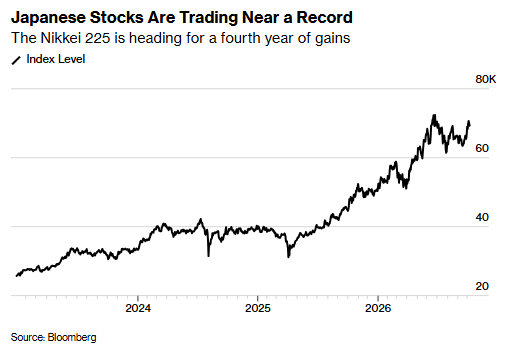
The two executives' unwavering bullish outlook on Japanese equities rests on a historic bull market that has now lasted nearly four years. At present, Japan's stock market is approaching all-time highs, propelled by three powerful forces: the AI‑driven investment wave, corporate governance reforms, and the enhanced investment appeal brought about by the return of inflation.
The continued inflow of foreign capital has emerged as the most significant source of liquidity underpinning this market rally. According to data from Japan's Ministry of Finance, in the first half of 2026, net purchases of Japanese equities by overseas investors exceeded 10 trillion yen—five times the level recorded during the same period last year—marking a record high on a six-month basis.
Corporate governance reform has provided institutional support for the revaluation of Japanese equities. In July 2026, Japan's Financial Services Agency and the Tokyo Stock Exchange jointly issued a revised version of the Corporate Governance Code after a five-year hiatus, mandating that Boards of Directors more actively manage and disclose the use of cash reserves and capital efficiency. This reform builds on the TSE's "below‑net‑asset‑value" governance campaign launched in 2023, continuing to guide Japanese companies in enhancing shareholder returns.
Meanwhile, Japan's economy is experiencing its strongest wage‑growth cycle in decades. In the 2026 "shunto" wage negotiations, average pay increases reached 5.01%, surpassing the 5% target for the third consecutive year and marking the first three‑year winning streak since 1989–1991. This sustained rise in wages provides a solid foundation for the Bank of Japan to unwind its ultra‑easy monetary policy and bolsters consumption‑driven economic growth.
Meanwhile, the risk of a reversal in AI investment warned about by Kentaro Okuda and Akihiko Ogino is set against the backdrop of an unprecedented global wave of capital spending. Goldman Sachs projects that between 2026 and 2031, worldwide AI-related capital expenditures on computing, data centers, and power will total approximately $7.6 trillion, with annual outlays rising from $765 billion in 2026 to $1.64 trillion in 2031. Among just five hyperscale cloud providers—Microsoft (MSFT.US), Alphabet (GOOGL.US), Amazon (AMZN.US), Meta (META.US), and Oracle (ORCL.US)—capital spending is expected to reach roughly $795 billion in 2026, and approach $1.08 trillion by 2027.
This round of capital market prosperity has also translated directly into a surge in performance for the two major brokerage firms, with both posting record profits in the last fiscal year.
Yen exchange rate trends
On the outlook for the yen, the two executives also hold divergent views. Akihiko Ogino expects the USD/JPY exchange rate to hover around 160 throughout the forecast period through the end of 2027. By contrast, Kentaro Okuda projects the pair to settle near 156 by year-end, before gradually strengthening as geopolitical concerns ease.
Akihiko Ogino attributed the yen's recent rebound from excessive weakness to coordinated intervention, U.S. Treasury Secretary Bessent's call for the Bank of Japan to raise interest rates, and the central bank's rate hike in September. He also described the rate hike as a "positive signal" reflecting economic growth.
Kentaro Okuda stated that overseas investors continue to show strong interest in Japan, and the negative impacts of interest-rate hikes to date have been relatively modest. He added that the conflicts in the Middle East and between Russia and Ukraine could drag on, potentially driving up energy prices and disrupting supply chains.
Editor/Deng