
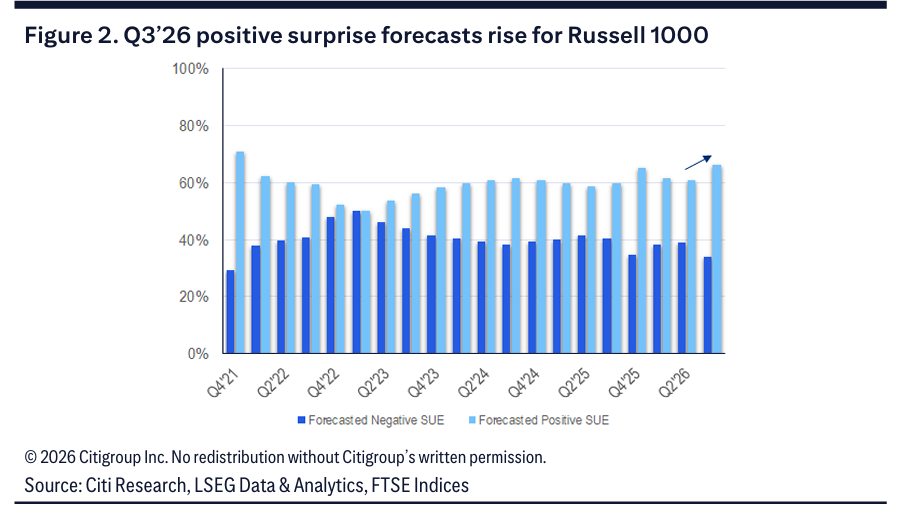
Citigroup's latest earnings-season quantitative research provides concrete evidence for this earnings-driven narrative: the model forecasts that 66.2% of Russell 1000 constituents will deliver positive earnings surprises—meaning earnings exceed the market consensus—and corresponding positive stock-price return trajectories—specifically, the Citi model also predicts a positive direction for related stock-price returns—significantly higher than last quarter's already robust 60.9%, reaching the highest level since the fourth quarter of 2021.
The Zhitong Finance app has learned that, in$Nasdaq Composite Index (.IXIC.US)$It hit a record high in one fell swoop, and also captured the Nasdaq and…$S&P 500 Index (.SPX.US)$The "AI chip super‑dominant player" with higher market share$NVIDIA (NVDA.US)$Following record‑high levels, the U.S. stock market is poised to kick off its third‑quarter earnings season with a bang. Global investors' enthusiasm has once again surged, as they anticipate that U.S. companies will post revenue and profits that exceed expectations—particularly among tech giants whose performance is closely tied to AI‑related computing power, which are expected to outpace analysts' consensus forecasts.
On October 6, covering NVIDIA,$Advanced Micro Devices (AMD.US)$and also$Micron Technology (MU.US)$Meanwhile, the Nasdaq Composite Index, which tracks the world's hottest tech stocks, rose 0.45% to 27,599.79 points, hitting a new all-time closing high in tandem with the S&P 500—the benchmark for the broader U.S. stock market—while the Nasdaq even reached an intraday record high; it is known as "the global bellwether for AI computing power and the semiconductor sector."$PHLX Semiconductor Index (.SOX.US)$As a result, the index has rebounded by roughly 4.7% since the end of September, bringing it ever closer to a record high. Despite a pullback the following day, global equity markets are increasingly shifting their focus to earnings season, with investors closely watching whether the better-than-expected core results reported by U.S. tech firms can sustain the upward momentum and propel the market to new highs.
 Wall Street financial giant Citigroup's latest earnings-season quantitative research provides concrete evidence for this earnings theme—namely, that technology companies are driving S&P 500 and Nasdaq constituent revenue and profit figures to exceed expectations: According to Citigroup's proprietary model, 66.2% of Russell 1000 constituents are expected to deliver positive earnings surprises (i.e., earnings surpassing the consensus market estimate) along with corresponding positive stock-price return trajectories (with the model also forecasting positive stock-price returns), significantly up from last quarter's already strong 60.9% and reaching the highest level since the fourth quarter of 2021. In the U.S. equity market, the information technology, healthcare, and industrial sectors lead the pack, with 88.1%, 75.9%, and 73.8% respectively forecast to post positive earnings surprises and positive stock-price returns. Moreover, Citigroup emphasizes that investment opportunities remain increasingly tilted toward NVIDIA, AMD,$Intel (INTC.US)$ 、 $Texas Instruments (TXN.US)$ 、 $Applied Materials (AMAT.US)$ 、 $KLA Corp (KLAC.US)$Large-cap companies focused on building AI computing infrastructure are likely to be among the first to benefit as the next bull market cycle shifts toward the healthcare and industrial sectors.
Meanwhile, Citi's strategist team noted that Wall Street analysts' consensus estimate for S&P 500 earnings growth in the third quarter has been significantly revised upward from 26.7% at the start of the quarter to 29.6%, with energy and AI‑related sectors accounting for the bulk of this upward revision. All 11 sectors are expected to post year‑over‑year earnings growth. Citi also combined earnings forecasts with stock‑specific fundamental ratings and long‑position crowdedness to identify candidates such as NVIDIA, AMD, Intel, Applied Materials, and KLA Corp—stocks that meet both "positive earnings‑season surprise expectations" and the most bullish "buy" rating—and pointed out that healthcare and industrials also offer broad opportunities for earnings realization.
The most investment‑relevant conclusion in Citigroup's latest research report is that, while overall U.S. equity earnings support remains concentrated among a handful of tech leaders closely tied to the AI‑computing infrastructure boom, opportunities to exceed market expectations are rapidly spreading and penetrating the healthcare and industrial sectors. In the next phase, the benchmark for outperformance will hinge on the specifics of earnings growth and its realization, as well as how much optimism investors have already priced in and whether bullish positions in the market have become overly crowded.
The current AI‑driven super‑bull market sweeping global equity markets appears to be seeking a "profit‑growth inflection point"—that is, as valuation compression driven by 10‑year U.S. Treasury yields repeatedly hitting more than two‑decade highs pushes the denominator in DCF models higher, equities can continue to advance without relying on P/E ratios returning to elevated levels, provided earnings per share keep expanding. Moreover, if interest‑rate and Treasury‑yield pressures ease going forward, stable valuations could further broaden the upside potential.
Another Wall Street financial giant, JPMorgan, stated that its team of strategists sees a re‑allocation opportunity arising from the easing of crowded positions, declining valuations, and resilient earnings—particularly favoring the semiconductor sector. According to the firm's latest research report, since June, forecasts for semiconductor earnings per share over the next 12 months have been raised by roughly 30% to 40%, while global software‑sector earnings expectations have not seen a corresponding improvement. The firm's most recent projections for capital expenditures among ultra‑large cloud computing providers estimate approximately $950 billion in 2026, about $1.4 trillion in 2027, and at least around $3 trillion by 2030. Moreover, it anticipates that AI‑related revenue growth will accelerate dramatically starting in 2027.
The most significant shift brought about by Meta Muse AI, which has recently taken the world by storm, and OpenAI's Astra large model/AI agent—often described as "on par with AGI"—is that a single user command can now trigger continuous, multi‑stage computational workflows. A research task, a programming assignment, or an office‑related job may sequentially involve planning, information retrieval, document reading, tool invocation, code execution, result validation, and error correction; many of these steps require repeated model calls. For complex tasks, parallel exploration and verification may also be employed. Such virtually limitless and increasingly intricate AI workloads are accelerating the expansion of opportunities beyond GPUs, driving demand for full‑stack AI inference‑optimized computing systems.
From the perspective of AI inference system architecture, more complex AI tasks led by Meta Muse typically involve longer context lengths, multi‑turn model invocations, tool execution, and result validation. Prefill processes the input, Decode continuously generates output, and the Key‑Value (KV) Cache consumes increasing amounts of memory as context length and concurrency scale grow, necessitating coordinated improvements in computational throughput, memory bandwidth, and capacity. Consequently, as cutting‑edge agents like Meta Muse further drive explosive demand for AI compute, the core implication for the AI‑compute industry is that GPUs and TPUs handle model inference, while high‑performance datacenter CPUs manage tool execution and task orchestration. Meanwhile, HBM, server DRAM, storage, high‑performance networking infrastructure, and datacenter optical interconnects collectively enable efficient data transport and state management. Ultimately, a fully integrated, ever‑expanding AI‑compute server cluster must deliver services that can operate sustainably at scale.
After the Nasdaq hit a new record high: technology leads Citi's "earnings surprise" list, with healthcare and industrials poised to join the super bull market rotation.
Citigroup's strategist team noted that the positive signals from the U.S. earnings season are reflected in the steadily expanding coverage of the "positive forecast" list, while large-cap companies such as NVIDIA, AMD, and Broadcom have further strengthened their advantages. Citigroup expects that among Russell 1000 companies, the proportion of stocks with positive earnings surprises and positive return prospects will rise from 60.9% to 66.2%, a significant increase of 5.3 percentage points. When divided into five groups by market capitalization, the largest-cap group has a positive forecast share of 77.0%, followed by 68.3%, 66.7%, and 60.7%, while the smallest-cap group stands at only 46.6%, down 3.4 percentage points from the previous quarter.
From an industry‑level perspective, the share of positive forecasts for healthcare has risen by roughly 18 percentage points compared with the previous quarter, while materials and consumer discretionary have each increased by about 10 percentage points, and industrials by approximately 9 percentage points. By contrast, consumer staples and utilities have each declined by around 6 percentage points, with utilities' negative forecast share reaching 72.2%. Citi notes that these model‑based estimates suggest the market is shaping a earnings‑reporting landscape characterized by "tech maintaining its lead, healthcare and industrials improving, and large caps outperforming," rather than all sectors strengthening in tandem. Consequently, for market‑cap‑weighted benchmark indices, the earnings realization of large companies exerts a stronger index‑driving effect; meanwhile, the improvement in healthcare and industrials provides a crucial foundation for extending upward momentum from a handful of AI‑related tech firms to a broader range of industries.
In the U.S. equity market, the investment appeal of earnings season is shaped by both the pace of corporate profit growth and the ability to exceed expectations. The contrast between the healthcare and energy sectors offers particularly instructive insights for global equity‑investment strategies. For the third quarter, S&P 500 earnings are expected to grow 29.6% year over year, up 2.9 percentage points from the start of the quarter. Specifically, the projected growth rate for energy earnings has been revised upward from 79.3% to 118.6%, while technology earnings are now forecast to expand at a 65.0% annualized rate, compared with 57.1% earlier. Communications services are expected to grow 51.5%, and industrials 14.5%.
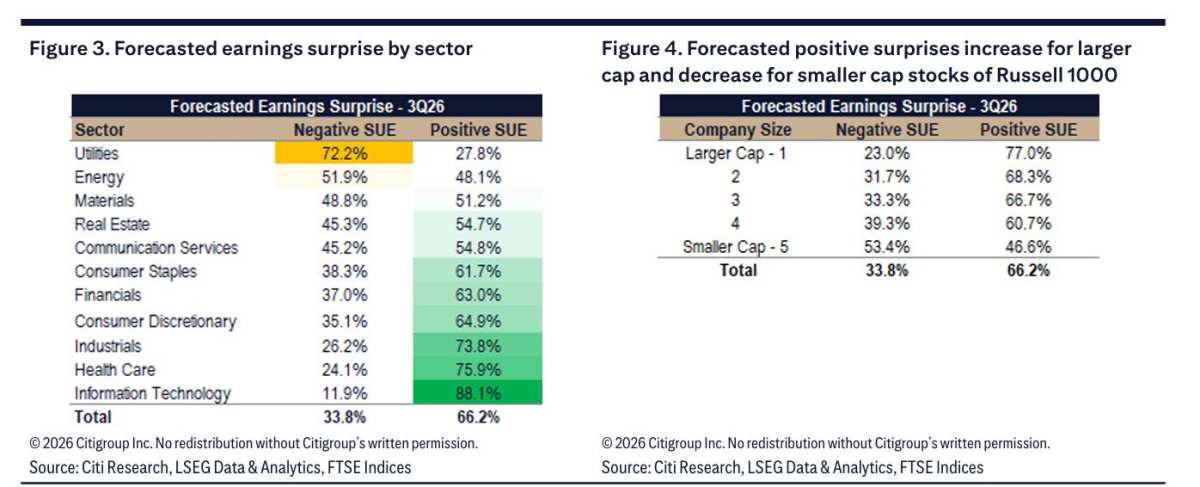
However, Citi's forecast data and model calculations show that the healthcare sector's earnings growth outlook has been revised down from 8.7% to 5.1%, yet the proportion of stocks with upside surprises stands at 75.9%; meanwhile, although energy boasts the highest expected earnings growth, the share of stocks delivering upside surprises is only 48.1%. The underlying logic behind Citi's quantitative model is that stock price reactions hinge on the gap between actual results and prior expectations: after downward revisions to forecasts, the healthcare sector is more likely to see companies whose fundamentals outperform market consensus; by contrast, the energy sector must clear a significantly higher earnings threshold.
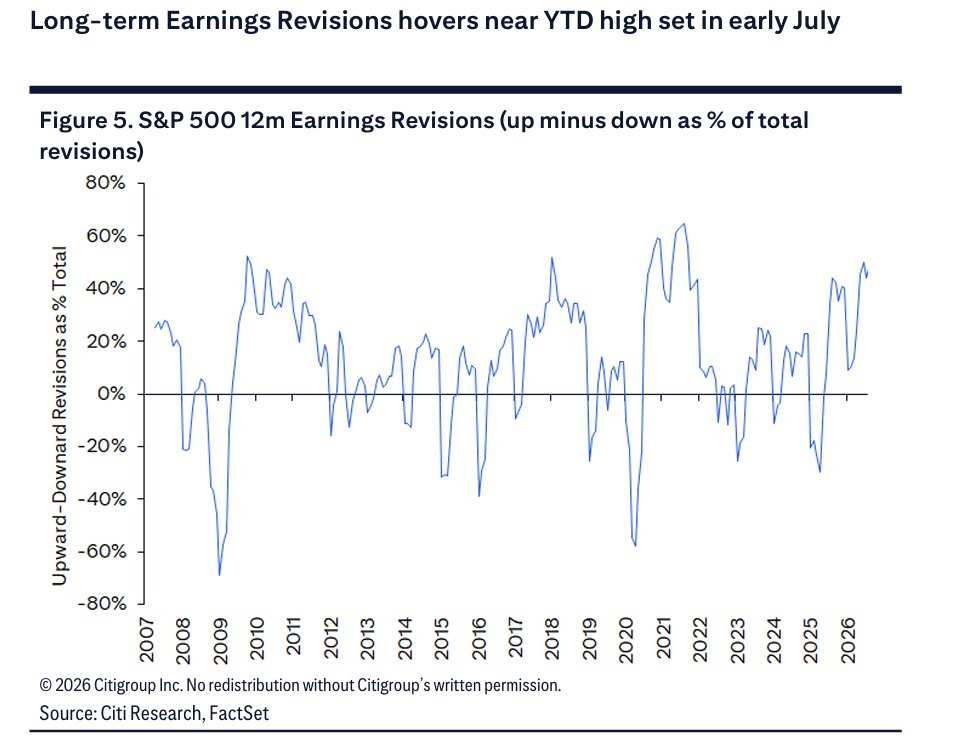
The Citi‑compiled 12‑month earnings‑estimate revision indicator for the entire U.S. stock market remains near the year‑to‑date high reached in early July, indicating that analysts' upward revisions to earnings forecasts remain robust. However, the third‑quarter growth forecast of 29.6% is significantly lower than the 52.4% reported for the second quarter; thus, the positive shift this quarter is largely driven by upward revisions to earnings estimates and a broader coverage of positive surprises.
The Citi model seeks to identify combinations where "earnings exceed expectations and translate into a rise in the stock price." The report measures earnings surprises using standardized unexpected earnings—SUE, defined as the difference between actual quarterly earnings per share and the mean of analysts' consensus estimates, divided by the standard deviation of those estimates—and notes that, in historical samples, about 38% of companies have experienced situations where the direction of the earnings surprise diverged from the direction of stock-price returns, which explains why "better-than-expected earnings reports" can still be accompanied by a decline in stock prices.
To enhance the specificity of earnings‑event screening, Citi employs logistic regression, calibrating the model using data from the past 24 quarters. The analysis incorporates the SUE of the most recent four quarters, the direction of surprises over the preceding two quarters, nine‑week momentum in earnings expectations, total returns relative to the market over the past 20 trading days, analysts' consensus ratings, and changes in ratings over the same nine‑week period, while excluding cases where earnings surprises are offset by opposite‑direction stock‑price reactions. Citi's strategy team's investment rationale is to simultaneously seek continuity in earnings performance, improvement in analyst expectations, and confirmation in market pricing. Accordingly, the figure of 88.1% for the technology sector specifically measures the proportion of companies within the industry that the model classifies as "positive forecasters," reflecting the breadth of positive signals.
From robust AI chip orders to sector‑wide rotation: uncovering the "expectation‑gap dividend" of earnings season.
According to reports, the positive‑candidate list released by Citi covers the semiconductor sector's most critical areas amid the AI computing‑infrastructure boom—namely, AI GPUs, AI ASICs, and data‑center CPUs—while also encompassing analog and power‑management chips, manufacturing equipment, testing, and materials, thus offering a comprehensive view of the semiconductor industry chain that highlights the tech sector's robust earnings exceeding expectations.
NVIDIA, AMD, Intel, Texas Instruments, Analog Devices, ASML, Microchip Technology, Applied Materials, KLA Corp, Teradyne, Entegris, and MKS all simultaneously meet both the "model‑predicted positive earnings surprise and positive return" criteria and Citi's fundamental "buy" rating. From an engineering and industry‑logic perspective, these companies correspond respectively to the most essential links in the semiconductor value chain: computing power supply, chip power delivery and signal processing, semiconductor manufacturing processes and control—including etching and thin‑film deposition—advanced semiconductor packaging and testing, and material purity. To transform AI computing infrastructure into usable computational capacity, the entire supply chain must work together to deliver; meanwhile, each company's earnings elasticity depends on its product mix, capacity utilization, and cost structure.
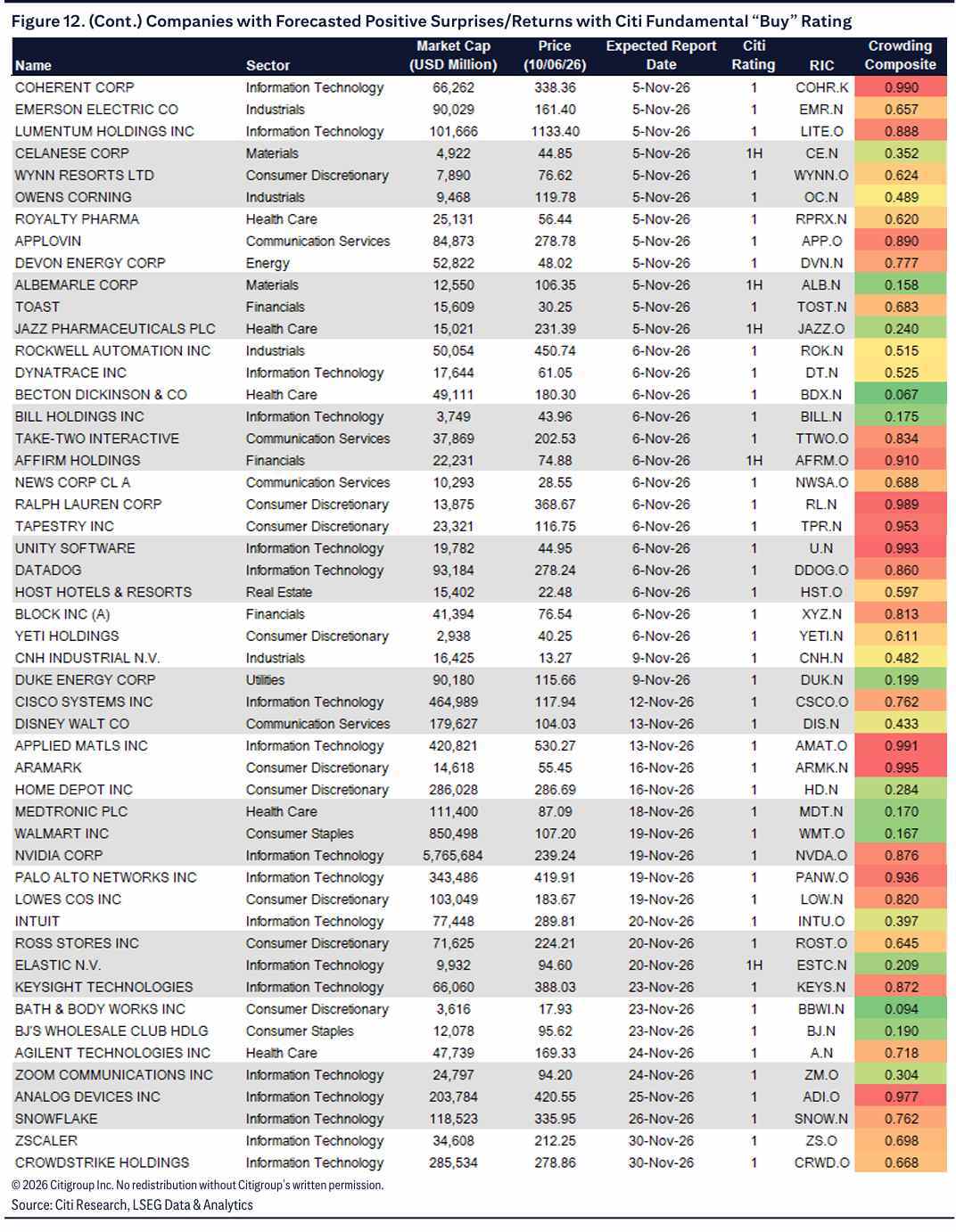
Citi's list of bullish forecasts, which covers numerous U.S.-listed companies, also includes chipmakers serving traditional industries and other end markets, thereby providing notable candidates for observing the semiconductor cycle's broad expansion into additional sub‑sectors and areas. Other positive picks include optical‑communication firms—namely Coherent and Lumentum, leaders in the data‑center optical interconnect value chain on the U.S. stock market—as well as Western Digital, a leading U.S. storage‑device company, along with software firms such as Cadence and ServiceNow. The prices cited in the report are based on share prices as of October 6, 2026, and no specific price targets or expected upside percentages were provided.
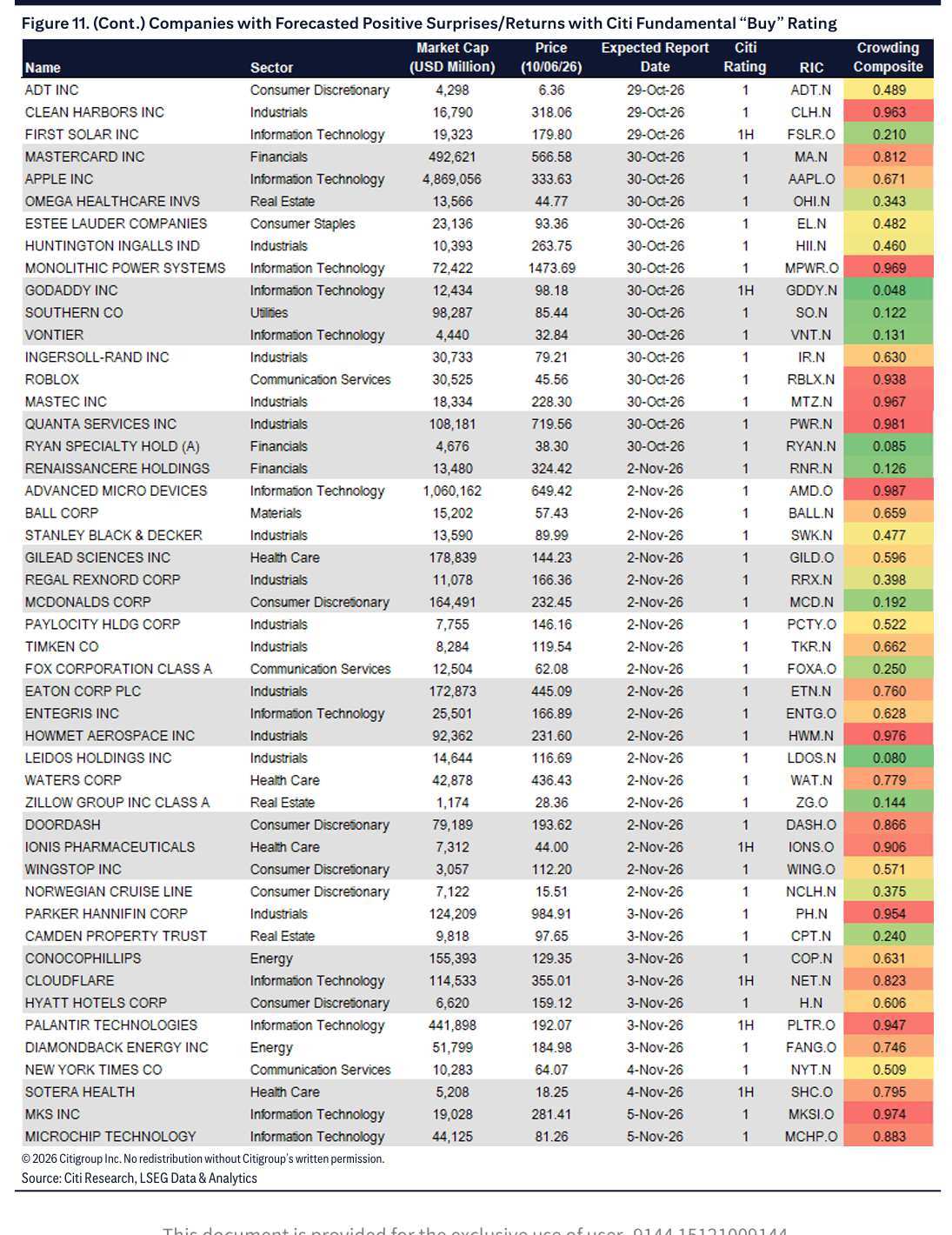
Healthcare, along with the broader industrial sector, is poised to deliver earnings surprises and positive investment returns from diverse sources this earnings season, extending investment opportunities beyond the hot computing‑related trades to encompass a wider range of corporate operational improvements. Citi's strategy team notes that favorable buy candidates in healthcare include Johnson & Johnson, Abbott Laboratories, Intuitive Surgical, Danaher, Thermo Fisher Scientific, Dexcom, Edwards Lifesciences, and Medtronic, spanning pharmaceuticals, medical devices, surgical robotics, diagnostics, and life‑science tools; while industrial picks comprise GE Aerospace, RTX, Caterpillar, as well as Vertiv, Eaton, Quanta Services, Carrier, Emerson, and Rockwell Automation.
From a supply-chain perspective, companies such as Vertiv and Eaton provide concrete examples of how global AI computing‑infrastructure investment is increasingly spreading and cascading into power distribution, thermal management, and data‑center infrastructure revenues; meanwhile, aerospace, machinery, and automation firms represent other sources of profitability within the industrial sector. Thus, technology and industry are linked through AI‑infrastructure investment, while healthcare offers a earnings‑reporting narrative driven by its own operating performance and expectations. According to Citi's model estimates, the crowdedness levels of certain healthcare candidates are also markedly lower than those of popular computing‑power stocks—for instance, Medtronic at 0.170, Intuitive Surgical at 0.266, and Decon Medical at 0.287—whereas Vertiv stands at 0.970 and GE Aerospace at 0.980. This combination of "significantly enhanced positive forecasts plus relatively low trading crowdedness for some companies" makes the healthcare sector an incremental opportunity worth watching in Citi's research report.
Another genuine, substantive "positive" stock-picking divergence during earnings season hinges on whether the good news has already been fully priced in; accordingly, Citi places crowd levels on par with earnings forecasts. Among the seven major U.S. tech giants—the Magnificent Seven—Alphabet, Microsoft, Apple, and NVIDIA all receive positive model‑based signals, while Tesla, Meta, and Amazon register negative signals. Notably, Meta and Amazon still carry a buy rating on their fundamentals, highlighting the stark contrast between short‑term earnings expectations and mid‑to‑long‑term investment ratings as reflected in Citi's model. Meta's long‑position crowd level stands at 0.955, NVIDIA at 0.876, Microsoft at 0.684, and Apple at 0.671; Microsoft's crowd level has risen since the start of the quarter, whereas Tesla's has declined markedly. Based on this, Citi underscores that companies with highly crowded trades are more likely to face concentrated downside pressure if they deliver negative surprises, while less‑crowded stocks may attract additional investors if they post significant positive earnings beats.
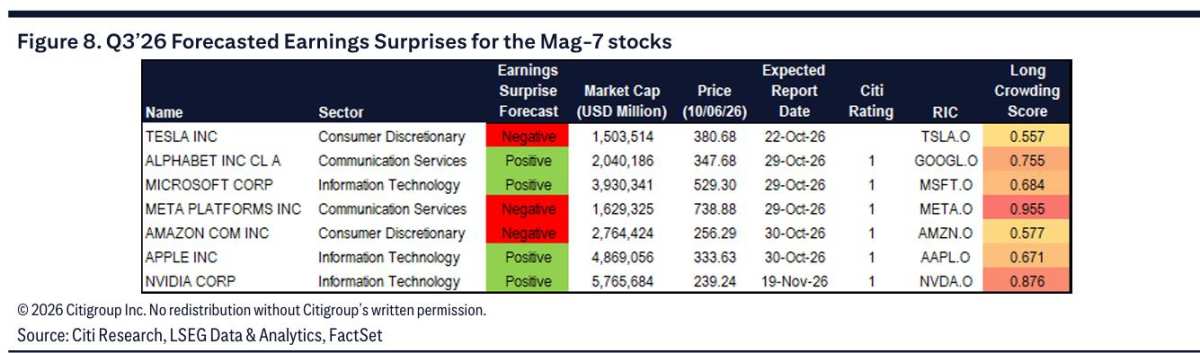
Citi's strategy team has therefore specifically identified low‑crowded, positively biased buy candidates such as GoDaddy, Becton Dickinson & Co, Leidos, and Procter & Gamble, as well as high‑crowded, negatively biased neutral or sell candidates like Phillips 66, Vornado, and PPL. The subsequent negative list also includes Qualcomm and AbbVie, which carry a neutral rating, along with Moderna and The Trade Desk, rated sell/high risk. Citi's research outlines an earnings‑season investment approach that centers on the strong, better‑than‑expected earnings performance of AI‑computing‑related tech leaders, while seeking additional sources of returns from healthcare, industrial, and low‑crowded positive‑bias candidates, and leveraging expectation‑gap‑based strategies to differentiate opportunities among companies within the same industry or sector.