
①A Goldman Sachs report notes that the overall earnings expectations for this earnings season are quite high; ②In the current market, beating expectations does not necessarily translate into a stock price rally. If leading companies fall short of sky-high expectations, heavily skewed positioning could amplify market volatility; conversely, if earnings growth begins to spread to more companies, the foundation for U.S. equity gains will become even more solid.
Cailian Press, October 12 (Editor: Li Ying) — As the third-quarter earnings season for U.S. stocks is about to kick off, behind the steady performance of major U.S. stock indices, capital remains heavily concentrated among a handful of tech giants. With lofty profit expectations on the horizon, can these tech leaders steer the broader market forward smoothly? The market awaits with both anticipation and trepidation…
In its latest report, Goldman Sachs pointed out that behind the index's stability, capital is highly concentrated among a handful of Mag 7. Hedge funds' holdings in U.S. tech stocks from the Mag 7 have risen from 14% in June to 22%, reaching an all-time high.
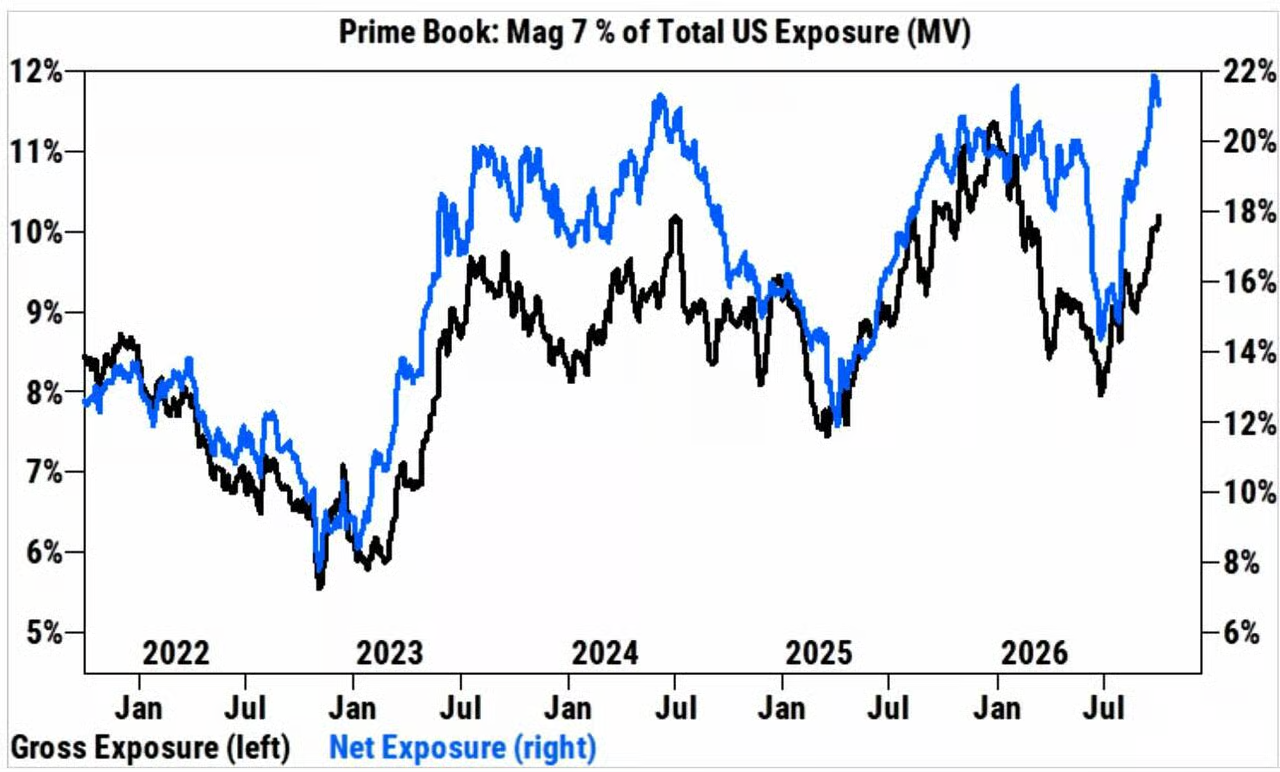
 Mag7's U.S. equity exposure as a percentage of total exposure (black line), and net exposure (blue line).
But heavy positioning does not necessarily reflect strong confidence. Goldman Sachs data show that hedge funds' net long positions in U.S. equities remain near their lowest levels over the past year.
A Goldman Sachs trader even said that, at present, the market believes the probability of the VIX index breaking above 25 is almost higher than the probability of the S&P 500 falling by 2%. The higher the VIX value, the stronger the market's fear.
This "heavily invested yet uneasy" sentiment was laid bare last week. According to media reports on October 8, local time, OpenAI, the developer of ChatGPT, posted disappointing revenue results, sending the Nasdaq sharply lower that day.
For four of the past five weeks, the technology sector had been the top net-buying U.S. equity sector among hedge funds; however, last week it reversed course and became the sector with the largest net sales.
A single piece of news can trigger a broad sell-off in tech stocks, underscoring the market's heightened sensitivity to AI‑related earnings. With the earnings season about to begin, it will serve as a critical test of these sky-high expectations.
Earnings season has kicked off.
The U.S. stock market's third-quarter earnings season will kick off this Tuesday with the major banks. Goldman Sachs bluntly stated that the overall earnings expectations for this quarter are quite high.
Goldman Sachs, citing consensus market expectations, said that S&P 500 constituent companies' third-quarter earnings per share are expected to grow 27% year over year, the highest forecast since 2021; however, the median growth rate of these companies' earnings is projected at only 9%, down from 14% in the second quarter.
This means that profit growth is highly concentrated among a small number of companies. Furthermore, according to earlier estimates by the media, only…$NVIDIA (NVDA.US)$and$Micron Technology (MU.US)$The two companies are expected to account for roughly one-third of the S&P 500's earnings growth in the third quarter.
Even more challenging is that earnings that exceed expectations do not necessarily translate into a rise in stock prices. During this year's second-quarter earnings season, the stock performance of companies reporting better-than-expected results outperformed the broader market by just 0.35 percentage points—among the lowest levels on record, compared with a historical average of 0.95 percentage points.
Micron Technology announced on September 30, local time, its fiscal fourth-quarter results for the year ending September 3. Adjusted earnings per share surged more than tenfold year over year, and all key metrics exceeded expectations; however, the stock price reacted tepidly.
Goldman Sachs raises the question: Is this "high-barrier" effect looming over the entire AI sector? As the U.S. midterm elections on November 3 approach, are investors hesitant to ramp up their AI-related trades?
Each asset class has its own unique appeal.
Bank stocks that were the first to report earnings have drawn close attention. According to Morgan Stanley, hedge funds' holdings of financial stocks have risen to a one-year high, yet financial-sector shares have already fallen 6.5% from their recent peaks, contrasting with the S&P 500's repeated record highs.
Among them, according to Goldman Sachs, as of last week, Morgan Stanley's stock price had fallen about 20% from its recent peak, while Bank of America's had dropped roughly 19%. However, the options market indicates that investors expect the two banks' stock prices to fluctuate by only about 3.7% and 3.4%, respectively, on the day their earnings reports are released—significantly less than their recent declines—suggesting the market does not anticipate substantial volatility from the reports.
Goldman Sachs financial industry expert Christian DeGrasse said that market sentiment toward bank stocks has clearly turned cautious, with the debate centering on whether the third-quarter slowdown is merely a temporary pause or the beginning of a more prolonged downturn.
Morgan Stanley analyst Nick Savone noted that bank stocks in the U.S. have experienced the most severe sell-off relative to the S&P 500 since 1993, and sector valuations have also fallen below their 10-year median.
In contrast to financial stocks, hedge funds' holdings in the healthcare sector have fallen to near one-year lows, while recent reductions in biotech positions represent the largest since more than five years ago.
Gold rose 1.3% last week, holding above $4,100 per ounce. Goldman Sachs believes that related positions have declined significantly, and the appeal of increasing gold holdings is now rising.
In the bond market, since Federal Reserve Chairman Walsh delivered a hawkish speech at the Jackson Hole symposium on August 28, U.S. long-term Treasury bonds have been steadily sold off; however, Goldman Sachs believes that the decline may have bottomed out last week.
Goldman Sachs noted that news regarding OpenAI's revenue triggered a rally in Treasury futures on October 8. This corroborates the view that the market expects AI companies to issue bonds on a large scale to raise capital, competing with governments for the same pool of funds, thereby pushing up long-term Treasury yields.
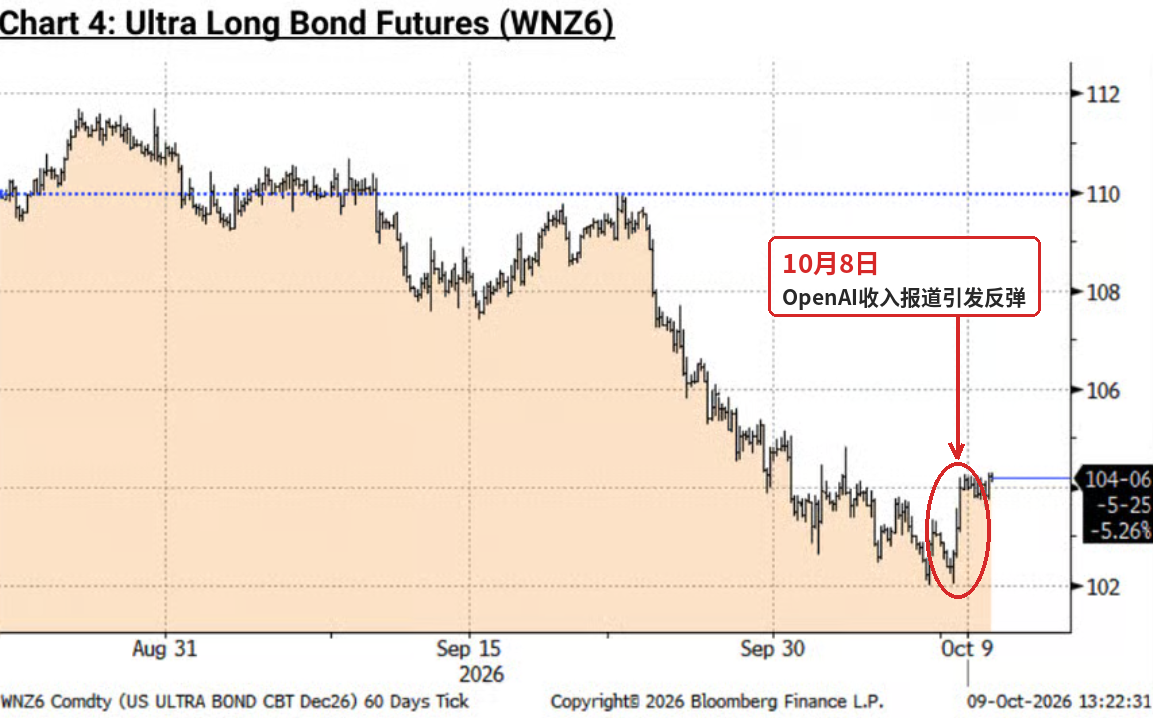
U.S. 30-year Treasury bond futures rebounded sharply after reports on October 8 regarding OpenAI's revenue were released.
In addition, Goldman Sachs is bullish on the AI‑related power infrastructure sector, noting that electricity is the most undervalued bottleneck for AI. Currently, market holdings in this sector are at a roughly two-year low, and valuations have also declined, yet fundamentals remain solid.
Last week, Goldman Sachs' portfolio of power‑related stocks rose 4.9%, with the independent power producer sector surging 12.7%. Goldman Sachs forecasts that by 2030, one in four data centers will be powered by self‑generated electricity.
Goldman Sachs noted that the U.S. Federal Energy Regulatory Commission will issue a ruling on October 12, local time, regarding the grid‑access rules for large electricity consumers under the PJM power‑grid operator, which could serve as a near‑term catalyst for the sector. Goldman Sachs also pointed out that, as power generators enter into long‑term power‑supply agreements with tech giants, industry earnings expectations are likely to be revised upward.
Overall, the Goldman Sachs report paints a picture of a market that appears calm on the surface but is highly fragmented internally.
Bulls argue that, despite the combined pressures of elevated 10-year Treasury yields, the Federal Reserve's resumption of rate hikes in September, and the fallout from the OpenAI controversy, U.S. stocks have nonetheless reached new record highs, signaling that upward momentum remains robust.
However, some argue that AI has become the most crowded trade in the market, with its massive funding needs driving up overall capital costs. Even a single report on OpenAI's revenue can send Treasury yields higher, underscoring that AI has emerged as one of the market's biggest risk factors.
As earnings season fully unfolds, the market's focus will extend beyond whether results beat expectations to whether the profits of a handful of AI giants can continue to underpin such concentrated bets. If leading companies fall short of sky-high forecasts, heavily skewed positioning could amplify market volatility; conversely, if profit growth begins to spread across a broader set of firms, the foundation for U.S. equity gains will become more robust.
Editor/Deng