① Beth Hammack, President of the Federal Reserve Bank of Cleveland, stated that monetary policy may need to be tightened to bring down inflation, and that the central bank should implement gradual adjustments in a timely manner. ② She believes that a restrictive monetary policy stance is appropriate to ensure a prompt return to a 2% inflation rate. ③ Moreover, given the broad-based nature of inflationary pressures, even with an appropriately calibrated monetary policy, it will take some time for inflation to revert to the 2% target.
Beth Hammack, president of the Federal Reserve Bank of Cleveland, took a hawkish stance on Monday, stating that monetary policy may need to be tightened to bring down inflation and that the central bank should implement swift, gradual adjustments.
Harker is a voting member of the FOMC this year. Speaking at the National Association for Business Economics (NABE) annual conference in Cleveland, Ohio, she said, "When conditions permit, I generally believe that smaller, more gradual adjustments—and acting relatively swiftly—are preferable to waiting and risking the need for much larger corrective moves later."
 "Taking into account all the factors that influence my reaction function, a restrictive monetary policy stance is appropriate to ensure a timely return to a 2% inflation rate," she added.
Harker's remarks suggest that further rate hikes may be on the horizon, though she did not explicitly signal support for another increase at the October meeting. In the minutes of the September meeting, Fed officials hinted they might vote to raise rates again—though they likewise refrained from specifying when such a decision would be made.
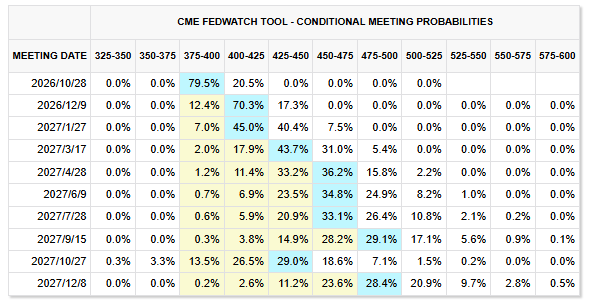
According to the CME FedWatch Tool, the market currently assigns nearly an 80% probability to the Federal Reserve holding rates steady this month, while the likelihood of a rate hike at the December meeting has risen above 70%.
Inflationary pressures are widespread.
Harmark stated, "I believe inflationary pressures are relatively broad-based, rather than concentrated in any single area."
According to her, rising energy prices, higher tariffs, and the advancement of artificial intelligence have all fueled inflation. "Moreover, this is not merely a supply-side issue. The rapid development of AI has also exerted demand‑side pressure, driving prices upward."
Hamaker points out that while a one-time tariff hike may be viewed as a one-off increase in price levels, multiple rounds of tariff increases have instead triggered a series of cost shocks.
She also noted that the development of artificial intelligence is driving up prices for critical computer, electronic, and high‑tech components, which not only increases costs for data centers but also raises expenses for projects in sectors such as aviation, power generation, and construction that rely on similar components. Furthermore, during discussions with stakeholders across various sectors within her jurisdiction, she learned that industries including health insurance, plastics, metals, food, and electricity are all facing additional cost pressures.
Harmak warned that persistently above-target inflation could gradually give rise to a deeply entrenched inflationary mindset, leading businesses and consumers to view higher inflation as the new normal. She stated that this risk is growing as high inflation persists.
She stated, "Given the broad-based nature of inflationary pressures, my baseline forecast is that, even with appropriate monetary policy, it will take some time for the inflation rate to return to 2%."
Harmak argues that while falling energy prices help steer inflation in the right direction, demand-side pressures will not "correct themselves."
"They may be more intransigent and typically require stricter policies to rein them in," she added.
Editor/lambor