The stellar start to U.S. equities' third-quarter earnings season masks underlying headwinds: while the tech giants are on a tear, mid‑cap stocks have seen growth all but stall; the market has grown desensitized to "better-than-expected" results, and a regime of "more rewards than penalties" has become the new norm.
Bank of America warns that the focus is shifting back to the sustainability of earnings, and investors should be on guard against three "hidden threats": rising costs, uncertainties surrounding the monetization of AI, and overly optimistic future expectations.
The U.S. stock market's third-quarter earnings season has officially kicked off. While the overall figures appear robust, beneath the surface of this prosperity lie undercurrents: profits are highly concentrated, cost pressures are mounting, and the market's tolerance for "better-than-expected" results has declined sharply.
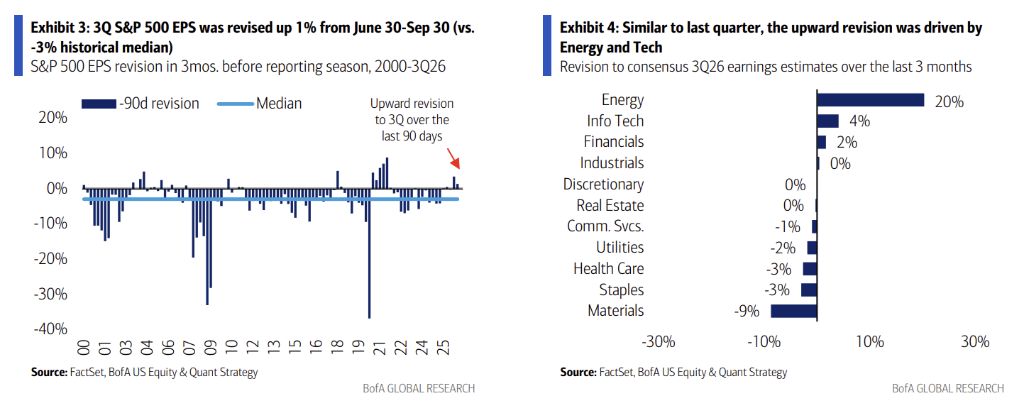
 According to the latest report from Bank of America Securities, the market consensus forecast for this quarter is…$S&P 500 Index (.SPX.US)$Third-quarter earnings per share rose 27% year over year, with Bank of America's own forecast even higher at 32% (equivalent to $93.50 per share). Among the early‑reporting companies, 85% beat earnings-per-share estimates, up from the historical average of 71%, and the broader macroeconomic backdrop remains broadly supportive.
However, as large banks…$JPMorgan (JPM.US)$、$Goldman Sachs (GS.US)$、$Wells Fargo & Co (WFC.US)$、$Citigroup (C.US)$Having debuted one after another this week, the central tension of this earnings season is gradually coming to the fore: after two consecutive quarters of significantly better-than-expected results, "better-than-expected" itself has become the new market norm—can it still drive stock prices higher?
According to Bank of America data, in the second quarter of 2026, 77% of S&P 500 constituents beat earnings-per-share estimates—marking the highest beat rate since 2021. However, market reactions have noticeably weakened: among companies that exceed both earnings and revenue expectations, their next-day outperformance relative to the S&P 500 averages just 0.7 percentage points, roughly half the historical average of 1.4 percentage points; by contrast, when a company misses both metrics, its stock typically underperforms the index by an average of 3.3 percentage points the following day, slightly above the historical penalty. This asymmetry sends a clear signal: the market has grown increasingly reluctant to reward good news, while its punishment for bad news remains undiminished.
Bank of America warns that, for investors, the real risks this earnings season may lie not in the results themselves, but in three hidden threats: rising commodity costs eroding margins, uncertainty over the realization of AI‑related narratives, and overly optimistic expectations for 2027.
Profit concentration has reached a historical high, while median‑stock growth has nearly stalled.
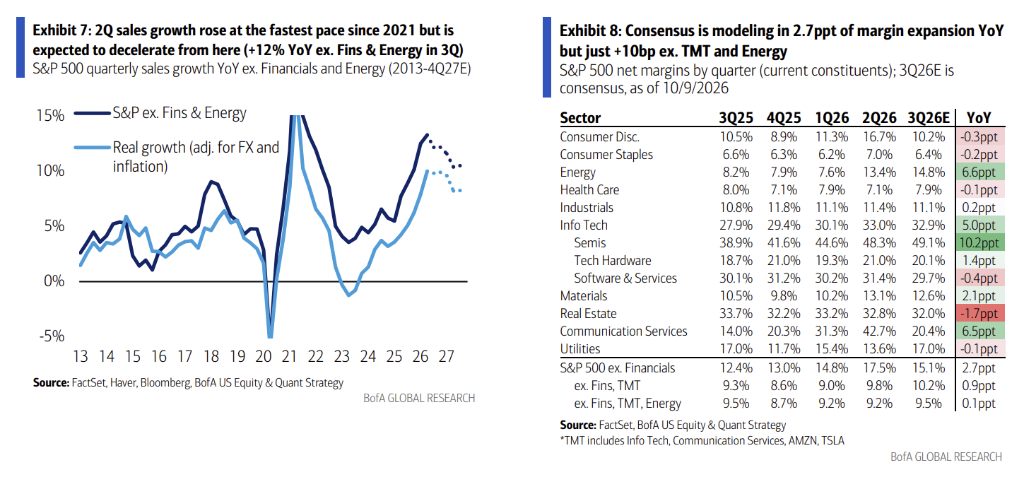
On the surface, this quarter's earnings season has been quite strong: consensus estimates project positive growth across all 11 sectors, a feat that has occurred only twice in history. However, when the index is broken down, the picture looks markedly different.
According to Goldman Sachs data,$S&P 500 Index (.SPX.US)$The top 10 earnings-contributing stocks are expected to account for 68% of the index's total earnings growth this quarter, a substantial increase from 47% in the first quarter and 48% in the second quarter.
Among them,$Micron Technology (MU.US)$The standalone contribution index increased by 19%,$NVIDIA (NVDA.US)$Accounting for 15%, these two companies alone contributed 34% of the index's earnings growth in the third quarter. The remaining contributors, in order, are:$Meta Platforms (META.US)$(7%)、$Alphabet-A (GOOGL.US)$(6%) and$Broadcom (AVGO.US)$(5%), in addition to those that have benefited from the oil price shock caused by Middle East conflicts.$Exxon Mobil (XOM.US)$、$Chevron (CVX.US)$and$Marathon Petroleum (MPC.US)$。
For most other companies, the boom is fading. Consensus estimates project that median S&P 500 earnings per share will grow by just 9% in the third quarter, down from 14% in the second quarter, with analysts expecting "quarter-over-quarter deceleration across all sectors except information technology and communication services." On the margin front, analysts have trimmed their third-quarter profit-margin forecasts for the median S&P 500 by 11 basis points since the start of the quarter, with "every sector revised lower except information technology."
Goldman Sachs's market breadth data likewise confirms this divergence: although the S&P 500 is just 2% below its all-time high, mid-cap stocks remain 17% below their peaks, and market breadth has fallen to its lowest level since the dot-com bubble.
The Three Major "Invisible Profit Killers": Costs, Exchange Rates, and Earnings Quality
Top Killer: Commodity and energy costs are eroding profit margins.
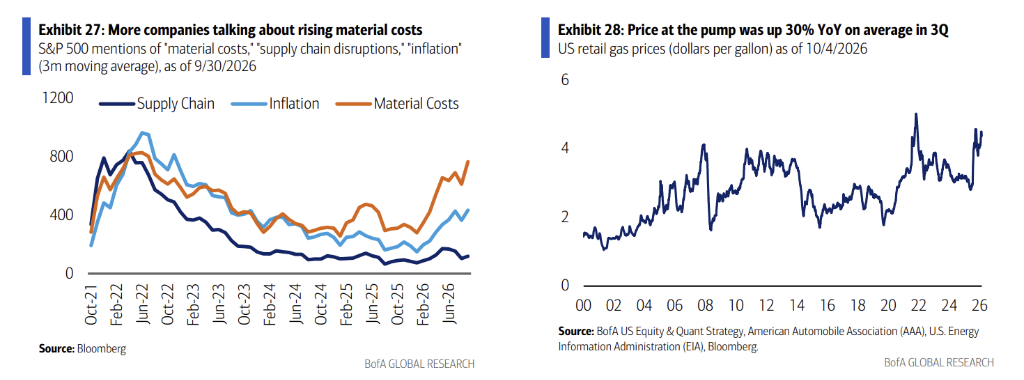
The frequency with which S&P 500 companies mention "raw material costs" during earnings calls has risen to its highest level since mid-2022. Bank of America analysts note that commodity‑driven inflation will constrain profit margins in certain sectors more than expected. In the third quarter, U.S. retail gasoline prices surged roughly 30% year over year, placing direct cost pressures on industries such as retail, transportation, and industrial goods. Chris Nardone, an analyst covering consumer discretionary stocks, points out that if oil prices remain elevated for an extended period, profit margins will face sustained risks, and retailers may be forced to make difficult trade-offs between passing on price increases and preserving customer value.
Notably, labor costs are the single most influential factor affecting overall index profit margins—labor expenses account for roughly 40% of U.S. companies' operating costs, while energy costs represent less than 5%. Bank of America believes that wage inflation is currently on a downward trajectory, providing an important buffer for overall profitability. However, if energy prices continue to rise and eventually pass through to consumers, the downside risks in the fourth quarter and into 2027 would become significant.
The second killer: The AI capital‑expenditure narrative remains unresolved, and the path to realization remains unclear.
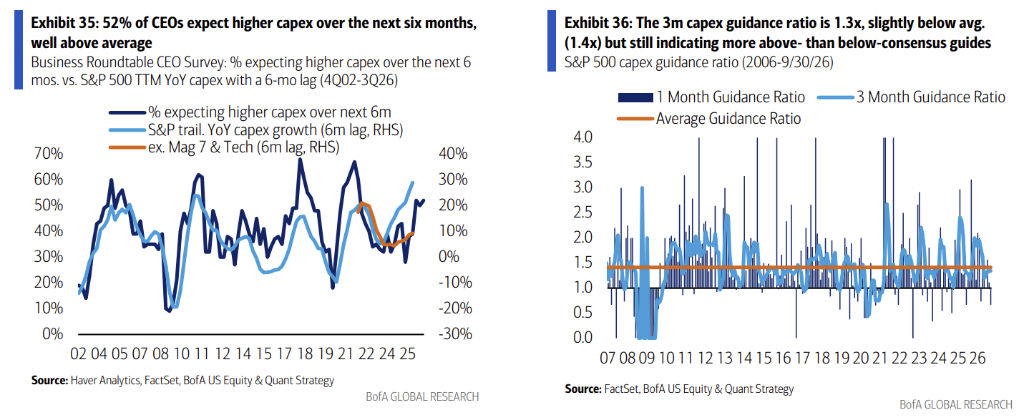
Ultra-large cloud computing vendors ($Microsoft (MSFT.US)$、$Amazon (AMZN.US)$、$Alphabet-C (GOOG.US)$、$Meta Platforms (META.US)$、$Oracle (ORCL.US)$) Capital expenditures in 2026 are projected to grow by more than 90% year over year, far surpassing any previous period, and the corresponding 2026 capital expenditure forecast has been revised upward by 70% over the past year.
However, for this group of companies, capital expenditures as a share of operating cash flow have already exceeded 100% by 2026, and the divergence between free cash flow and net profit is widening. Bank of America warns that the successful monetization of AI investments is a key determinant of the sustainability of earnings growth, while "the interplay among geopolitics, interest rates, and the technology sector may be underappreciated by the market."
Tal Liani, a senior software analyst, noted that as the third-quarter earnings season kicks off, market attention is focused on whether software vendors can translate customer adoption of AI into meaningful revenue growth. "Demand continues to outpace supply, and pricing trends remain favorable," he said. However, Koji Ikeda cautioned that the market will increasingly distinguish between companies that can genuinely drive revenue growth through AI and those that are merely riding the AI hype—"a clear divergence is emerging."
Third Killer: Profit Quality in Doubt, with One-Time Gains Masking the True Level.
Second quarter$S&P 500 Index (.SPX.US)$Earnings per share increased by 50% year over year, but excluding$Amazon (AMZN.US)$and$Alphabet-C (GOOG.US)$After accounting for revaluation gains on private‑equity investments, the underlying growth rate has moderated to 32%. Bank of America notes that such revaluation gains "can also inflict damage when valuations reverse," making them a key factor that investors must scrutinize beyond the numbers on the financial statements. At the index level, the ratio of free cash flow to net profit has fallen to historically low levels, largely because mega‑cap companies are seeing their free cash flow under pressure due to substantial capital expenditures.
2027 Outlook: Consensus Optimism, with Bank of America Offering a More Cautious Forecast
The market's true stress test lies in its pricing of the future. Consensus estimates project S&P 500 earnings per share to grow 16% year over year in 2027, markedly slower than the 33% expected for 2026, while Bank of America's forecast is even more conservative, at just 12%.
Bank of America strategists note that "historical data show that equity returns have historically been weakest when earnings growth per share exceeds its trend level but begins to decelerate"—a situation that precisely describes the current market environment. Meanwhile, the 2027 consensus forecast assumes that "all sectors except energy will avoid a contraction in EBIT margins," an assumption whose vulnerability is readily apparent given the high degree of uncertainty surrounding commodity prices.
At the sector level, information technology—particularly semiconductors—is expected to remain the primary driver of earnings growth in the index through 2027, accounting for roughly 80% of the total increase, while the communications services sector will face year-over-year negative growth pressures due to a high base effect. On the banking front, Bank of America analyst Ebrahim Poonawala notes that the BKX banking index has already declined 12% from its mid-August peak, with rising interest rates, lingering uncertainty about the sustainability of AI‑related capital spending, and concerns over AI‑driven disruption serving as key headwinds. "If visibility on these issues improves, there is room for valuation recovery before year-end," he added.
Overall, the fundamental backdrop of this earnings season remains solid, but the market premium for "better-than-expected" results has been significantly pared back. For investors, the focus should shift from "whether results can exceed expectations" to "whether those outperformance levels can be sustained"—with cost pressures, the path to AI monetization, and the 2027 earnings assumption serving as the three key pillars that will determine the answer.
Edited by melody