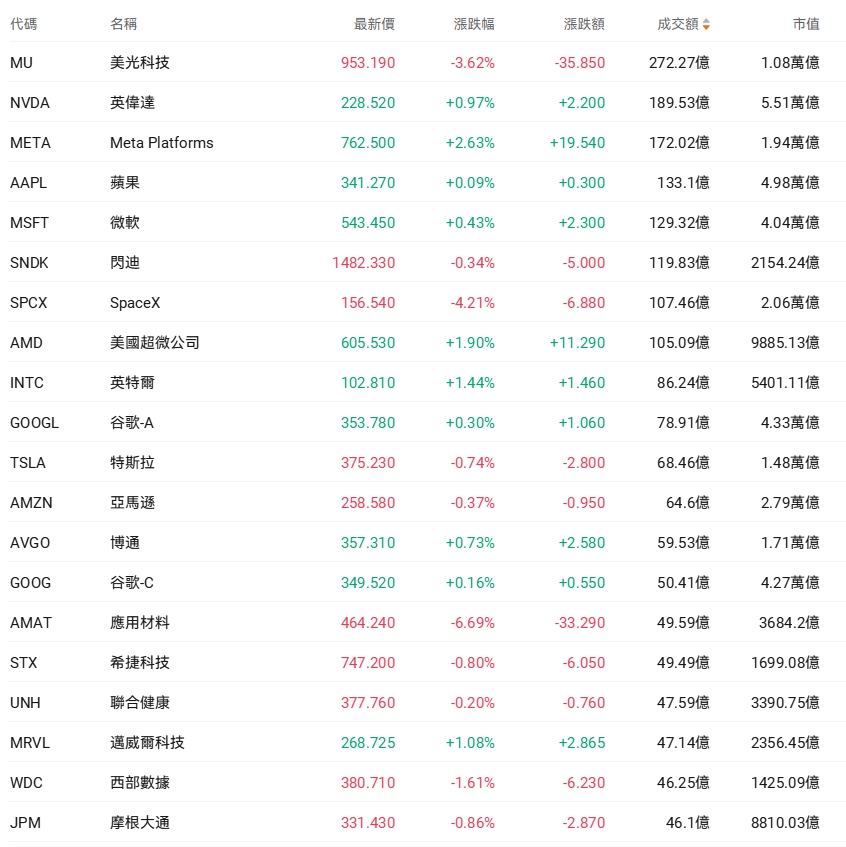
On Tuesday, it was the No. 1 stock by trading volume on the U.S. market.$Micron Technology (MU.US)$It closed down 3.62%, with trading volume at $27.227 billion.
In the South Korean domestic market,$SK Hynix (000660.KR)$and$Samsung Electronics (005930.KR)$They fell 10% and 7%, respectively, marking the fifth consecutive trading day of declines for both companies. Together, these two chipmakers account for more than half of the total market capitalization of the South Korean stock market. Market participants are concerned that the upcycle in memory‑chip prices has peaked, with expectations of a subsequent pullback in pricing and a slowdown in corporate earnings growth.
2nd place$NVIDIA (NVDA.US)$It closed up 0.97%, with trading volume at $18.953 billion.
 NVIDIA CEO Jensen Huang is on a high-intensity visit to Europe and will announce an investment plan of over $2 billion in Europe within the next week.
On Tuesday, October 13, Jensen Huang revealed at an event in Paris that the aforementioned $2 billion investment will be announced in stages over the next week. Combined with NVIDIA's $8 billion already invested on the European continent over the past year, its strategic footprint in Europe continues to deepen.
He also announced a new round of funding for the French startups Doctolib, Genesis AI, Pigment, and Entalpic. Following this stop in Paris, Jensen Huang will head to London and Berlin as well.
3rd place$Meta Platforms (META.US)$It closed up 2.63%, with trading volume at $17.202 billion.
Meta is rolling out a suite of AI-powered customization tools on Facebook, enabling users to use natural language to directly tell the algorithm what they'd like to see in their News Feed and Reels. Users can access the new "Your Algorithm" feature via the three-dot menu on posts; after selecting "Interested" or "Not Interested," the system will prompt follow-up questions to gather more granular preference data. Powered by large language models, this feature can recognize and process user intent and contextual cues embedded in free-form text inputs.
In addition, Meta Platforms' stock has risen 35% since September. Pivotal Research has sharply raised its price target for Meta Platforms from $790 to $930, while maintaining a "Buy" rating, implying about 25% upside. Analyst Jeffrey Wlodarczak's core rationale is that Meta's returns on investment in the AI field are "coming into view"—early adoption of the Muse personal AI assistant has been strong, and following the launch of the Muse Wonder model, it has already positioned itself among the industry leaders.
4th place$Apple (AAPL.US)$It closed up 0.09%, with trading volume at $13.31 billion.
On Tuesday, October 13, Eastern Time, Apple unveiled its first smart home display, the HomeView, while also updating the Apple TV 4K and the HomePod mini. Additionally, in collaboration with LG Electronics and Schneider Electric, Apple launched the Apple Home Collection—a lineup of accessories that includes cameras, thermostats, smart doorbells, and smart locks—demonstrating its ambition to further capture the smart home market through hardware, Siri AI, and ecosystem integration.
Among them, the HomeView, priced at $299, is the centerpiece of this launch. The device features a 7-inch square touchscreen, supports both tabletop placement and wall mounting, and uses facial recognition to deliver personalized interfaces for up to six household users, curating tailored content based on individual preferences. It integrates Siri AI, calendar management, music playback, and smart-home control into a single device, while emphasizing privacy and data security. Pre-orders open this Tuesday, with shipments scheduled for November 13.
In addition, Apple rose more than 1% during the session, hitting an intraday record high. Although it later pulled back somewhat, it still closed at a new all-time high.
5th place$Microsoft (MSFT.US)$It closed up 0.43%, with trading volume at $12.932 billion.
It marked the first record closing high since October 2025.
6th place$SanDisk (SNDK.US)$It closed down 0.34%, with trading volume at $11.983 billion.
7th place$SpaceX (SPCX.US)$It closed down 4.21%, with trading volume at $10.746 billion.
After weeks of standoff over the subpoena, SpaceX (SPCX.US), owned by Elon Musk, has finally agreed to appear before the New York City Council's Technology Committee this Friday to answer questions about the safety risks of artificial intelligence. This belated testimony has thrust SpaceX's AI division into the global regulatory spotlight, while also highlighting the predicament of the space‑industry giant—valued at over $2 trillion—as it navigates between a frenzy of capital and mounting compliance pressures.
In addition, SpaceX plans to significantly increase the number of Starship rocket launches and landings at its Starbase facility in South Texas, expanding its annual launch cadence to several hundred flights.
8th place$Advanced Micro Devices (AMD.US)$It closed up 1.90%, with trading volume at $10.509 billion.
9th place$Intel (INTC.US)$It closed up 1.44%, with trading volume at $8.624 billion.
10th place$Alphabet-A (GOOGL.US)$It closed up 0.30%, with trading volume at $7.891 billion.
Google has officially launched its flagship large model, Gemini 4 Argon, making it available to paid subscribers and API users, where it has demonstrated leading performance in specialized tasks such as finance and law. The inaugural API offering is priced at just one-fifth of GPT‑6 Astra and Claude Fable 5.1. With Meta and Google successively unveiling new flagship models, competition at the cutting edge of AI continues to intensify.
11th place$Tesla (TSLA.US)$It closed down 0.74%, with trading volume at $6.846 billion.
Musk unveiled his vision for the Terafab chip factory, stating that Tesla and SpaceX aim to manufacture and test approximately 10 chip designs annually at Terafab's Giga Texas research facility in Texas, USA, to accelerate the development process.
12th place$Amazon (AMZN.US)$It closed down 0.37%, with trading volume at $6.46 billion.
13th place$Broadcom (AVGO.US)$It closed up 0.73%, with trading volume at $5.953 billion.
On October 13, Broadcom CEO Hock Tan stated at the DBS Asia Future Forward Conference held in Singapore that many investors betting on the AI and chip sectors adopt investment strategies akin to those of casino gamblers, with some even lacking a clear understanding of what they are wagering on.
Chen Fuyang cited OpenAI as an example, noting that the company achieved $50 billion in annualized revenue in September, demonstrating the viability of its business model—though long-term profitability remains uncertain.
15th place$Applied Materials (AMAT.US)$It closed down 6.69%, with trading volume at $4.959 billion.
Gary Dickerson, CEO of U.S. semiconductor equipment manufacturer Applied Materials, stated that the company expects its revenue to double over the next few years, though its workforce will not grow at the same pace. The company is applying artificial intelligence to product development, quality control, and on-site semiconductor manufacturing processes to improve wafer yield and production efficiency. Dickerson noted that, with AI assistance, productivity in some business units has increased by about 50%, and the company will continue hiring in these related fields.
20th place$JPMorgan (JPM.US)$It closed down 0.86%, with trading volume at $4.61 billion.
JPMorgan's third-quarter adjusted revenue came in at $50.91 billion, below the market's expectation of $51.37 billion. Fixed-income trading revenue fell 4% year over year, marking the first decline in more than two years; equity trading revenue rose 49% to $4.95 billion, delivering the best third-quarter performance on record. Net interest income exceeded expectations, but expenses were higher than anticipated, and the bank also reported a net loss of $658 million on investment securities.
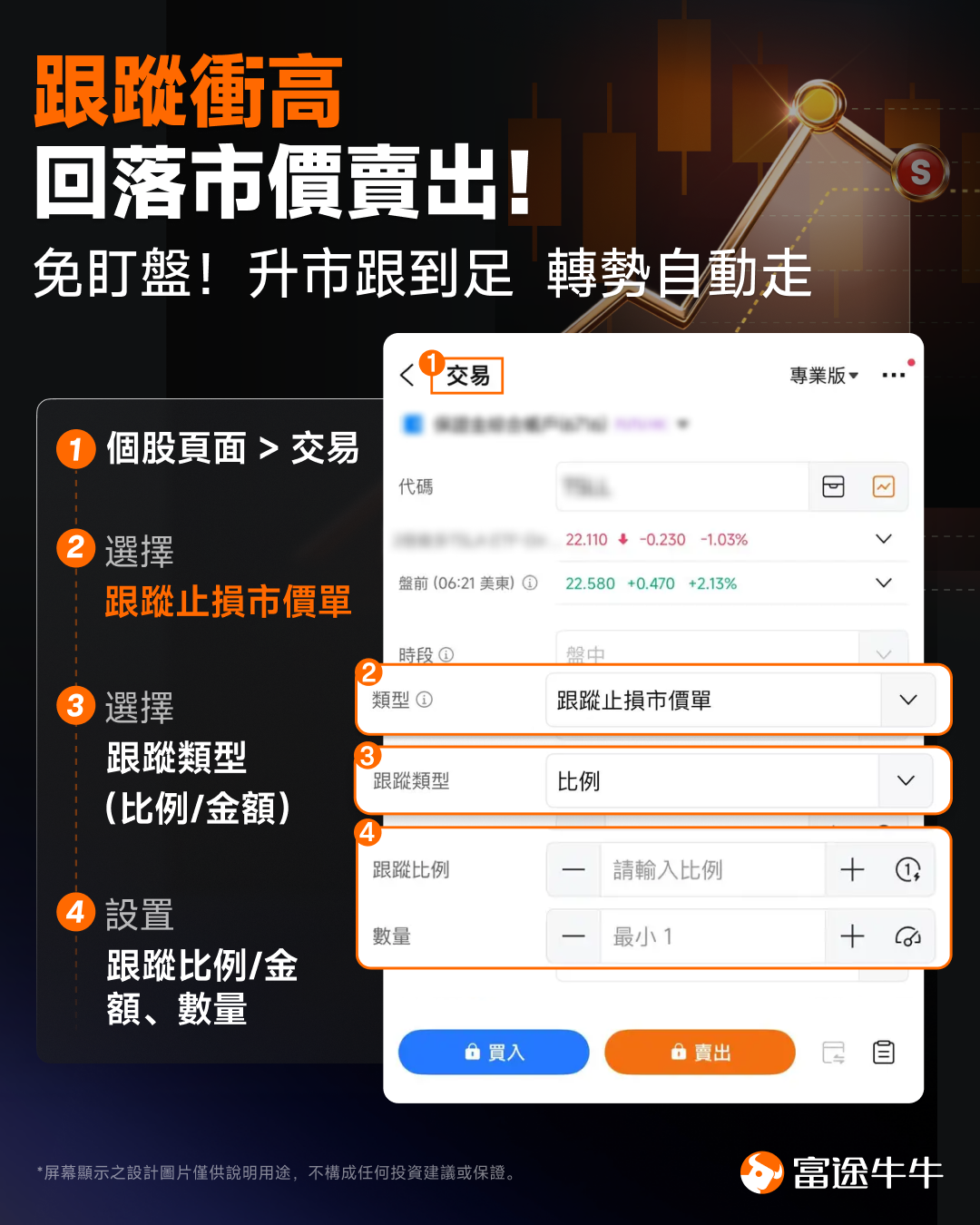
No need to watch the market—ride the rally all the way, and let the trend run on its own! Futu's trailing stop-loss market order lets you dynamically monitor stock prices based on a preset amount or percentage, helping you capture gains while managing potential pullbacks. When the price hits your stop-loss level, the system instantly places a market order to execute the trade.
Note that sharp price swings may lead to slippage; and if the trailing stop is set too tightly, you could be forced out of your position prematurely due to minor short-term volatility. Experience our trailing stop order feature now—automatically sell at the peak!
Editor/stephen