
Williams pointed out that the current level is "not far" from the U.S. neutral interest rate. In the short term, AI is creating a supply gap; in the long run, capacity expansion and productivity gains "will serve as a disinflationary force." He also noted that the U.S. economy is not overheating across the board and does not believe that the sharp rise in long-term interest rates is effectively doing the Fed's tightening work. Furthermore, he emphasized that his remarks reflect his own views and are not intended to manage market expectations at the behest of Walsh. Meanwhile, the presidents of the Chicago and Richmond Federal Reserve Banks indicated that AI is driving short-term inflation, while the president of the Boston Federal Reserve stated that additional rate hikes are still needed this year. On Tuesday, the probability of a December rate hike by the Fed rose to nearly 90%.
Williams, the Fed's third-ranking official and president of the New York Fed, recently stated that although the AI infrastructure boom and energy shocks have introduced new inflationary factors in the short term, the U.S. economy is not overheating across the board. He expects that, after one more rate hike this year, no further increases will be needed by 2027.
On Tuesday, John Williams, president of the New York Fed and a permanent voter on the Federal Open Market Committee (FOMC) who is often referred to as the Fed's "number three," granted an in-depth interview to Bloomberg at the New York Fed's headquarters.
 Williams meticulously dissected the underlying rationale behind his support for a September rate hike and provided clear answers to market‑wide concerns regarding interest-rate guidance, changes in the neutral rate (R-star), and the true impact of the "AI infrastructure boom" on macroeconomic inflation.
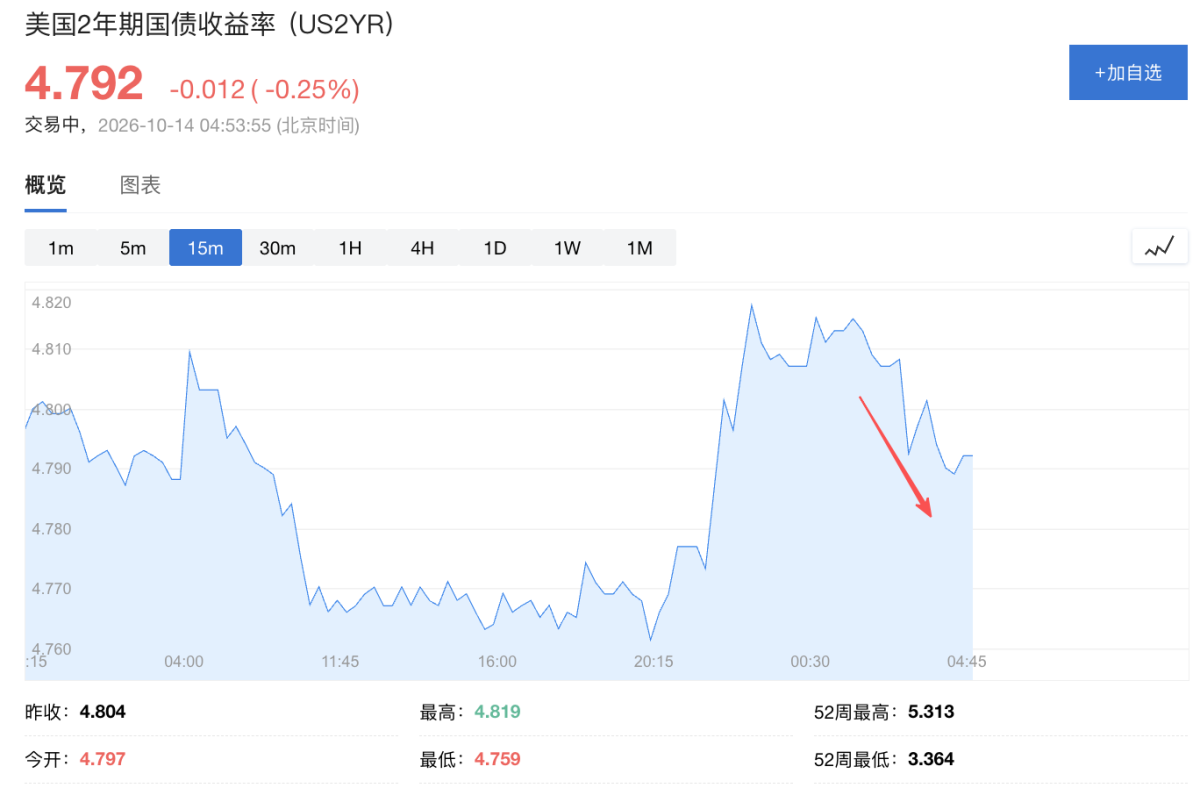
Before Williams spoke, the yield on the U.S. two-year Treasury note rose by 2 basis points on Tuesday; after his remarks, the two-year Treasury yield fell, down 1 basis point at press time, to 4.792%.
Meanwhile, on Tuesday, Chicago Fed President Goolsbee stated that price pressures have spread beyond data centers and related industries, adding, "I'm increasingly concerned—this is nothing more than old-fashioned demand overheating." Richmond Fed President Barkin noted that the Federal Reserve is already able to observe the impact of AI-related investment on U.S. inflation.
On Monday, Boston Fed President Susan Collins said that interest rates may need to rise further before the end of the year, though the exact path will depend on incoming economic data. The key will be to assess whether inflation remains concentrated in energy and AI‑related sectors or spreads more broadly to other areas. She also noted that the Fed's economic models already factor in government debt levels.
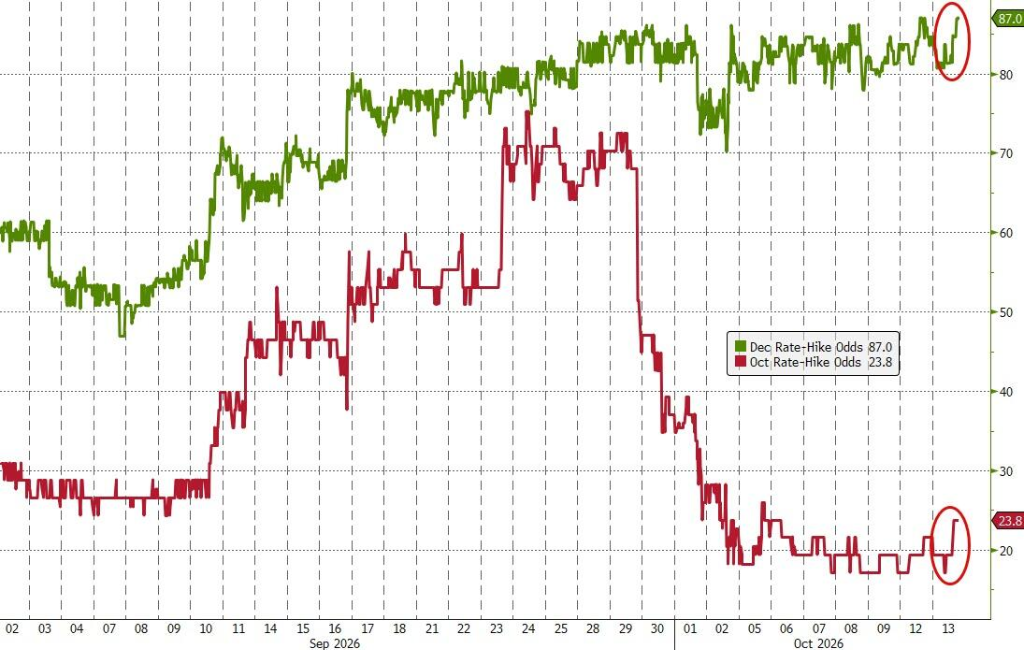
On Tuesday, the probability of a December rate hike by the Federal Reserve rose to near its peak for this cycle, approaching 90%; the odds of a September hike also rebounded to around 25%.
Another rate hike this year, with the neutral rate edging up slightly.
Regarding the market's primary concern—the terminal interest rate—Williams outlined a relatively clear roadmap in his interview. He reiterated his views on near-term monetary policy but also sent a clear long-term "dovish" signal. Williams stated:
"I have not yet changed my view that another rate hike may be appropriate. I see no reason at this point to believe that we would need to do more after that."
When asked about the medium-term interest-rate path—say, through 2027—he believes that further rate hikes at that point would be unnecessary. However, he underscored the "data-dependent" nature of monetary policy:
"It's only mid-October. The economy is being influenced by a variety of factors, and we can only continue to monitor the data."
The neutral rate—the level of the real interest rate that neither stimulates nor restrains the economy—has been a key focus of this interview. As a co-author of a classic model for estimating the neutral rate, Williams revealed that, driven by fiscal policy and robust economic growth, the neutral rate has risen moderately by roughly 25 to 50 basis points over the past few years.
"I believe the long-run neutral interest rate remains quite low, around 1% or slightly above. From this perspective, if the economy performs as I expect over the next year, we will be close to the neutral rate."
AI infrastructure is driving up short-term costs, but in the long run it will act as a disinflationary force.
In this interview, Williams placed "AI" alongside tariffs and energy prices, viewing it as one of the three key factors currently shaping the trajectory of U.S. inflation.
Williams pointed out that the upward trend in goods and costs related to AI development has already become apparent:
"We are indeed seeing rising costs for AI‑related goods and other inputs—data centers, surging demand for semiconductors. Prices in AI‑driven subsectors have increased quite abruptly and substantially. We are also observing some spillover effects on construction labor costs."
In response to market concerns that overheated AI investment could lead to broad-based inflation, Williams offered a reassuring assessment. He argued that although the AI subsector is operating at full speed, the U.S. boasts a massive economy exceeding $30 trillion, and tightening monetary policy and financial conditions are cooling other sectors. Williams stated:
"This is an unusual situation: we have an economic subsector that appears to be operating at full capacity, and it's likely to remain so for some time. But I believe the real focus should be on the broader economy. As for chip prices, I don't expect them to decline; they may even continue to rise. However, we need to look beyond just those prices and assess what's happening with overall inflation."
More importantly, Williams is optimistic about AI's positive long-term impact on the supply side. He believes that although "demand is certainly winning" in the short term, extremely high-profit price signals will eventually spur capacity expansion, while the substantial productivity gains brought by AI "will, in fact, act as a disinflationary force."
September Rate-Hike Logic: The energy shock has reshaped the near-term inflation outlook, and the economy is not overheating across the board.
Williams firmly defended the Federal Reserve's decision to raise interest rates in September during an interview. He stated, "I strongly supported that decision. I believe it was the right decision—absolutely the right decision."
The core reason underpinning his decision is the recent, unexpected volatility in energy prices triggered by geopolitical factors, coupled with widening refining margins. He noted that these developments have imposed an "additional shock" in the form of sharply higher fuel costs. Moreover, the supplementary demand driven by AI suggests that the economy can absorb slightly higher interest rates.
Nevertheless, he remains confident that inflation will return to the 2% target. He has used several key indicators to demonstrate the current health of the macroeconomy:
"This is not an economy experiencing broad-based overheating. Nor is it an economy in which inflationary pressures are mounting beyond the specific shocks we are currently facing."
He noted that, at present, there are no indications that labor market imbalances are generating broad-based cost pressures, while both the U.S. economy's potential output and GDP growth remain at a healthy pace slightly above 2%, underscoring its strong resilience.
He does not endorse the notion that "the market is doing the Fed's job"; the speech was not dictated by Warsh and reflects only his personal views.
Recently, as the yield on the 10-year U.S. Treasury bond has approached 5%, some market voices have argued that "the sharp rise in long-term interest rates is doing the Fed's tightening work for it," thereby reducing the need for further rate hikes. In response, Williams offered a straightforward reply.
"Personally, I don't like the notion that 'the market does the work for us,' because we have to do the work ourselves."
Williams emphasized that the 10-year yield reflects not only monetary policy but also a variety of factors, including fiscal policy, productivity expectations driven by the AI boom, and energy uncertainty.
Williams also addressed the controversy surrounding the market's interpretation of his remarks on September 29. At the time, he stated that, following the Fed's rate hike in September, there was no need to rush into another move. This comment, coupled with similar remarks later made by Federal Reserve Vice Chair Philip Jefferson, effectively dampened market expectations for a rate increase in October. Some observers have speculated that the two speeches were coordinated, possibly with input from Fed Chair Jerome Powell.
In response, Williams clarified that this merely reflected his personal judgment:
"I'm speaking for myself… I'm expressing my own views. I'm in regular contact with him [Wash]. We meet frequently, but I won't say any more about it."
Federal Reserve officials will hold their monetary policy meeting on October 27–28, at which they will take into account the September CPI data due on Wednesday—the last inflation report before the meeting.
Two Federal Reserve officials emphasized that AI is driving short-term inflation, while the president of the Boston Fed stated that further rate hikes are still needed this year.
On Tuesday, Chicago Fed President Charles Evans said that if the path back to the 2% inflation target becomes clearer and the labor market remains at full employment, there would be room for interest-rate cuts.
However, he also cautioned, "If service-sector inflation continues to rise and AI‑related investment spillovers trigger broader economic overheating, the situation will become even more challenging."
Goolsbee further noted that price pressures have spread beyond data centers and directly related industries, adding, "I'm increasingly concerned—this is nothing more than a classic, old‑school demand surge."
Richmond Fed President Barkin noted that the Federal Reserve has already been able to observe the impact of AI-related investment on U.S. inflation.
On Monday, Boston Fed President Susan Collins stated at a banking conference that, to ensure inflation returns promptly and sustainably to the Federal Reserve's 2% target, interest rates may need to rise further by the end of this year. However, the specific magnitude and timing of such moves will depend on incoming economic data.
Collins expects the U.S. economy to continue expanding, with a stable labor market, while rising productivity will help balance supply and demand and bring inflation down.
She emphasized that the key lies in determining whether inflation remains concentrated primarily in energy and AI‑related infrastructure sectors, or whether it will spread further into other parts of the economy.
Full text translation of Federal Reserve's Williams' interview with Bloomberg News on Tuesday:
Bloomberg: Governor Williams, thank you for hosting us at the New York Fed. Based on your public remarks, it appears that your inflation projections this summer—particularly for headline inflation—are shifting upward to above 3%. I'd like to know what the main drivers are, and whether your projections for core inflation have also begun to shift significantly in the same direction.
Williams: Yes, I believe a series of developments have shaped our outlook on inflation. I mentioned tariffs, then the Middle East conflict and broader energy price trends, and thirdly, AI. Over the past six months or so, we've seen that the tariff effects have largely unfolded as many models and analyses predicted. That is to say, they have impacted import prices but have not transmitted to broader price pressures across the economy. As a result, these effects are mostly behind us, though over the past year to a year and a half they have had a notable impact on core inflation.
Regarding energy prices, I believe they are the more important story for the near-term inflation outlook this year, as energy prices have risen sharply and remain elevated. This is already weighing on inflation within the current month. We are then seeing, as expected, these increases being passed through from energy prices into core inflation. The most obvious example is airfare, but there are many others, since energy is a key input across a wide range of goods and services in the economy, including food and other items. As a result, we are observing these effects, which have influenced my overall inflation forecast and, to some extent, core inflation—at least in the short term—through 2026.
Finally, there's the AI story—perhaps the most recent development. We are indeed seeing rising costs across a range of AI‑related inputs and other expenses: data centers, and surging demand for semiconductors. This is reflected in specific product categories, with prices in AI‑driven subsectors experiencing fairly abrupt and substantial increases. So far, these effects have been concentrated in commodities and chip‑intensive goods, including consumer products. We're also observing some spillover into construction labor costs. Thus, this represents a third area—AI‑demand‑driven inflation—that I'm watching closely.
However, I believe the broader picture also holds some positive signs. While certain factors have pushed this year's inflation slightly above expectations, we continue to see inflation expectations well anchored, and wage growth remains moderate. As a result, unit labor costs are decelerating, consistent with inflation at 2% or lower, and several measures we use to gauge underlying inflation have declined noticeably. For instance, the New York Fed's multivariate inflation gauge and its trend‑inflation measure both stand around 2.3%. Similarly, the Dallas Fed's trimmed mean inflation has remained broadly in line with that level over the past six months.
So I believe these indicators tell us that, over time, we have indeed been affected by tariffs, energy prices, and now AI—but some of them do not suggest that underlying inflation is rising. In fact, these measures of core inflation have already declined. No single indicator is perfect; these are simply the ones I'm watching closely. Overall, there are indeed several factors this year pushing inflation higher, which has led me to slightly revise my inflation outlook upward. Right now, I'm paying the closest attention to AI-driven demand and how it might evolve. But I don't see any other inflationary pressures emerging at this point.
Bloomberg: We've been hearing from you for several months now, and the prevailing narrative seems to be this: despite the risks, an anti-inflation story is on the horizon. In fact, from after the July meeting through August, that's exactly what you were saying—though we may have misread it—suggesting you were inclined to oppose a rate hike in September, even though you ultimately supported one. So I'm wondering: was it something in the data that made you more concerned about upside risks, or do you believe the Committee's core is shifting in that direction? And, frankly, consensus matters a great deal at the FOMC. In your vote in favor of the rate hike, was there some element of aligning with the Committee's prevailing orientation?
Williams: Well, I firmly supported that decision. I believe it was the right decision—absolutely the right decision. I think the data you mentioned, and the way the data has evolved, leads me to conclude that that decision was appropriate.
So I think the two pieces of data I've already mentioned are: first, the issue of energy prices. If you look at earlier this year, futures markets were pricing in a sharp drop in oil prices—though that may have been overly optimistic. At the time, there was probably more optimism that the conflict would be resolved, and I believe that outlook has since shifted. Today, energy prices remain quite high. While futures contracts still anticipate some decline in energy or oil prices, the expected降幅 is no longer as substantial.
Second, I think a very important point is the price spread we're seeing between oil prices and other fuel costs—such as gasoline, and of course diesel—which reflects not only the Middle East conflict reducing refining capacity, but also the conflict between Russia and Ukraine. So we're witnessing an additional shock, if you will, or rather, an extra manifestation of these developments: a sharp rise in fuel costs. Therefore, I believe this data suggests that energy prices are higher and may remain elevated for a longer period, which aligns with my view that inflation won't decline as quickly as I had previously hoped. Second, I still believe that energy prices won't push up inflation next year or beyond; I'm simply assessing the current situation.
I believe there is clear, substantial, and potentially enduring evidence that the shift in AI demand is real—and that it will take time for supply to catch up. From my perspective, this has become even more apparent. To me, this resembles a classic policy challenge: using monetary policy to bring supply and demand into balance. With AI driving stronger demand and fueling faster economic growth—at least in the short term—this suggests that adjusting monetary policy not only helps manage inflation but also allows the economy to comfortably absorb slightly higher interest rates. These are the factors shaping my thinking.
So, regarding your premise, I still believe that disinflationary forces are at work. I don't think these have fundamentally changed. In fact, my forecast for next year is that inflation will decline significantly—full-year headline inflation will approach our 2% target, reflecting some of the factors I mentioned, namely that tariffs will be completely a thing of the past. Even looking at the 12-month change, energy prices are unlikely to continue pushing inflation higher next year—they could instead become a disinflationary force. I do expect the overall supply-and-demand balance in the economy to remain well‑balanced, and we should see inflation continue to fall.
Bloomberg: In that sense, the minutes of that meeting also indicate that one group believed a rate hike was indeed necessary, while another viewed it more as a risk-management decision. I'd like to know, in your view, which camp you align with. Do you see this as a genuinely needed rate increase, or as a precautionary measure to guard against impending inflation risks?
Williams: Fundamentally, I believe monetary policy is always about risk management. It's always about assessing the economic outlook, the uncertainties surrounding it, and the risks to achieving our dual mandate—maximum employment and price stability. It's inherently a matter of probabilities and perspectives. So my answer is yes. Yes, I think that, given the downside risks to our maximum‑employment goal appear to be receding, raising interest rates is appropriate. The economy has proven resilient. If anything, it seems to have strengthened at the margin, so the risks to maximum employment feel somewhat lower. However, inflation risks—due to the factors I've mentioned, particularly those related to energy prices and AI—are tilted slightly higher. I would use the terms "slightly higher" and "slightly lower."
I do not believe the data indicate, in any way, a fundamental shift in the economic outlook; rather, they reflect a qualitative reassessment of the uncertainties and risks at play. From my perspective, the appropriate course is to begin with risk management—assessing the risks to our objectives and determining which monetary policy stance best serves those goals—and that is the right decision.
Bloomberg: Tomorrow you will release the CPI, which will be the last inflation data available before your next meeting. I'd like to know what you'll be watching to assess whether your outlook remains valid, and, in your view, what kind of core readings would align with your 2% target?
Williams: Well, I think the answer to your first question is that we'll look at all the data. More importantly, my colleagues at the Federal Reserve will scrutinize the data, carefully examining every detail—seasonal factors, one-off events—everything that can cause monthly figures to fluctuate for various reasons. My second point is that I firmly believe in relying on the data, but not on any single data point from a given month. The data can be influenced by a variety of factors, including seasonality, which in some cases is quite idiosyncratic. So what you really want to focus on is the underlying trend. That's my view.
You obtain another piece of data, which is part of the puzzle and, together with all the other information we have, forms the bigger picture. When I'm looking at the underlying trend in inflation, what am I seeking? Energy prices fluctuate for reasons we understand—namely, geopolitical conflicts. There are also other factors on the AI front, and I expect this trend to persist. But what really matters is a broader view: what do we observe across services, housing, and goods, excluding certain categories?
What matters to me is continuing to monitor whether underlying inflation is moving in the direction of the 2% target. I don't expect it to reach 2% immediately, but we are progressing in a way that suggests it is heading in the right direction along a sustained trend. I believe this is precisely what we have observed over the past few months. However, we need more data to carefully assess what this implies for next year. Monetary policy does not deliver results overnight or within a single week; it typically takes one to two years to fully exert its effects on the economy. Therefore, what truly matters is what this tells us about what may unfold over the coming year or so.
Bloomberg: But do you have a key metric that worries you more than others?
Williams: Well, I'd prefer it to be lower rather than higher, but I don't have any specific figures. Again, after adjusting for some of the factors I mentioned, let's look at these underlying trends.
Bloomberg: One more question about AI-driven inflation. You've reiterated that it's the primary factor you're watching. What makes you believe that the supply‑demand imbalances caused by construction will be resolved in the short term? Investment activity hasn't slowed, and it's unlikely to be significantly dampened by higher interest rates. Without a correction in equity valuations—which could temper the pace—why do you think supply will catch up, preventing broader inflationary pressures from continuing to spread across the economy?
Williams: So that's exactly the issue I'm watching and analyzing. I think there are several reasons. First, minor adjustments in monetary policy won't fundamentally alter AI's underlying trajectory—absolutely not. I believe investors there are relatively insensitive to relative prices. They see this as a massive opportunity that will deliver substantial productivity gains and transformative change. While it's not entirely immune to interest rates, I don't expect monetary policy to have a profound impact on it.
But in the rest of the economy—by which I mean, I know we've been talking about AI—America's economy exceeds $30 trillion. It's far more than just AI. So I expect to see—and I believe we are already seeing—the effects of changes in monetary policy and other financial conditions on the broader economy: whether in housing, business investment in sectors beyond AI, or other rate‑sensitive decisions, including financial conditions, as well as their impact on long-term interest rates and the value of the U.S. dollar. In short, I think all these other channels are certainly at work.
This is an unusual situation: we have an economic subsector that appears to be operating at full capacity—and it's likely to remain so for some time. However, I believe the real focus should be on the broader economy. As for chip prices, I don't expect them to decline; they may even continue to rise. But what matters isn't just their trajectory—it's how overall inflation is evolving.
Let me cite a few data points that I believe may support this argument. First, there is indeed no evidence of a broad-based imbalance in the labor market. The unemployment rate has remained fairly stable, hovering just above 4 percent. In my view, the labor market exhibits some slack, but not much; others would argue that it is broadly balanced. Accordingly, I do not see labor-market imbalances imposing additional cost pressures on firms across the broader economy. We also observe this pattern in wage data. As I noted, whether you look at the Employment Cost Index (ECI), hourly compensation, or other measures, we are not seeing inflationary pressures emanating from that front.
So when I step back and consider what could go wrong if AI is driving inflation in this sector, it's that other factors in the economy might simultaneously be adding to inflationary pressures—whether through strong wage growth in the labor market, compensation increases outpacing productivity, or persistent, large‑scale import‑cost pressures.
Of course, we've already seen this in the energy sector. That's an undeniable fact. But beyond energy and AI, we haven't observed these broad-based pressures driving up corporate costs.
What we experienced in 2021 and 2022 was that companies in the United States and elsewhere found themselves in a difficult position as they faced across-the-board cost increases—whether in import prices, labor costs, or other input expenses. They were unable to offset these rising costs by substituting one input for another or by adjusting their production processes. As a result, they largely had to raise their prices. Consequently, we are not currently seeing the same broad-based inflationary pressures.
Another point I'd like to highlight is GDP growth. As I mentioned with regard to the labor market, GDP growth has been picking up, and over the past four quarters it may have averaged slightly above what I consider to be potential output.
For example, with growth slightly above 2%, I believe potential output may also be slightly above 2%. Therefore, despite the significant boost from AI and all its implications, the overall economy is not overheating. That's what I'm focusing on. Moreover, monetary policy does not alter the relative prices or relative investment levels of AI compared to other factors; rather, it affects the broader economy.
Bloomberg: So you're not saying that AI will no longer be a driver of excess inflation, but rather that, on the whole, it will remain balanced.
Williams: That is precisely my goal as I consider two matters that are critical to our monetary policy: first, maintaining overall balance between supply and demand; and second, ensuring that the price pressures we observe—whether stemming from energy, earlier tariffs, or AI—do not spill over into broader or more persistent inflation.
So these are the issues I'm keeping an eye on—namely, that chip prices tend to move according to market forces.
Now, there's one point you raised that I should add: I do believe AI‑driven investment will ultimately generate supply‑side effects in two key ways. First, the price signals will be extremely strong, incentivizing increased supply. Prices are very high—producing chips is highly profitable—so we're already seeing substantial investment in building new fabs to ramp up output. Of course, this takes time; it won't happen overnight, but supply will eventually catch up. Second, I think we'll see an even more pronounced supply‑side impact from AI, as it boosts productivity across the board. We're already observing this at the firm and industry level: companies leveraging AI are experiencing dramatic gains in efficiency. By contrast, the broader economy has only begun to feel the first faint ripples. So the challenge ahead lies in timing: how long will it take for these effects to fully materialize? In the near term, demand is clearly prevailing—but over time, I expect the supply side not only to respond but to become a powerful force against inflation.
Bloomberg: But even before you see those productivity gains—gains that are arguably harder to pin down precisely in terms of timing—in your model's outlook, I believe inflation remains at 3.5% this year, then moderates to 2% and reaches the target by 2028, correct? At what point within that time frame do you expect AI supply and demand to become more balanced?
Williams: Inside AI?
Bloomberg: Yes, within AI. Is it within the next two-year timeframe, or longer?
Williams: I think it will take longer. That's a big assumption, assuming the demand surge continues as expected. It could change depending on how these investment returns are viewed. But given my baseline outlook, I expect demand in the AI sector to remain very strong. I believe supply will respond, but it will take some time to catch up. However, by then you'll also likely see a productivity boost—call it that—if you like—and we're starting to see that.
Productivity growth has been quite strong lately. With the latest revisions to the national income accounts, I'd say that productivity since 2019 has certainly exceeded 2 percent. I'm increasingly convinced that we're on a solid or robust productivity trajectory—and this is likely not driven primarily by AI. That, in turn, gives me some confidence that disinflationary dynamics are taking hold. We're seeing healthy productivity gains, and as I've noted, unit labor costs remain fairly moderate. So, over the medium term—not the near term, but the medium term—I believe these are encouraging signs that inflation should return to close to 2 percent by the end of next year.
Bloomberg: Let's talk about interest rates. In your speech in Buffalo, you said you still expect one more rate hike this year, which would bring the target policy rate to between 4% and 4.25%. Will that be enough to get the job done? Given what you said yesterday, there are certain effects—such as chip prices, chip supply, and oil—that you can't really manage with interest rates alone.
Williams: Well, again, we can't control those things, nor should we. I mean, I think these price signals coming from AI investment—whether it's chip prices or something else—we want those price signals to work, guiding people to allocate resources where they'll deliver the highest value and encouraging producers to increase output. But if you look at what's happening with overall financial conditions, it's clear that the stock market remains very active. People are very optimistic about the U.S. economy—I am, too—and they're also extremely optimistic about AI investment. However, we've already seen long-term yields rise, which I believe translates into higher mortgage rates and higher borrowing costs—for other businesses as well, including those in the AI sector, and for the broader economy.
So, have we done enough? Time will tell. We'll gather more data to assess the situation. But my view is that this is not an economy overheating across the board. Nor is it one in which inflationary pressures are mounting beyond the specific shocks we're currently experiencing. That brings us back to the key risk: managing inflation so that the economy remains on a solid path close to trend growth, without allowing inflation to spill over into broader, more persistent increases. What really matters, therefore, is maintaining overall balance between supply and demand—and I believe that hinges on whether the economy is overheating, which, in my view, it is not.
Earlier this year, and even more recently—up to the latest employment report—you've been hearing the argument that the labor market is picking up steam again. I believe the labor market as a whole is performing quite well: it's solid, consistently stable, and resilient. However, we're not seeing broad-based signs of overheating. To be sure, we do see some indicators in certain sectors—employers I've spoken with do report tightness in specific skill sets or supply constraints. But I think this simply reflects an economy in which some industries are running very strongly while others are slowing down.
Bloomberg: So, let's try again to assess your outlook on interest rates. You still expect another rate hike sometime later this year. Is that enough? What about 2027?
Williams: I want to return to data dependency. I believe that, driven by robust demand and bolstered by the national income account revisions released since then, this points to an economy with fairly strong growth. It also suggests a supply-side performance that's quite solid. As a result, I've revised my estimate of potential economic growth upward by roughly a few tenths of a percentage point—so that's good news. I favor a strong economy, especially one with a resilient supply side. The labor market, in my view, has once again proven to be stable and sound. So the question is whether, as more data come in, the narrative of a well‑balanced economy—where demand is slightly stronger and, frankly, supply is also somewhat stronger—holds up. That, in turn, informs our assessment of what interest rates can sustain such a balance and, of course, help ensure inflation…
Bloomberg: I understand you still rely on data, but you'll have to make a projection for 2027…
Williams: If you ask me at the most fundamental level whether I've changed my view—that is, if the outlook broadly aligns with my expectations—I haven't yet altered my stance that another rate hike might be appropriate. At this point, I see no reason to believe we need to do more. But when you ask about 2027, we'll have to wait and see. After all, it's only mid-October. The economy is being shaped by many different factors, so we can only keep monitoring the data. Again, the key isn't any single data point or whatever you happen to know; it's really about looking at the underlying trends we're observing in the labor market, employment, and inflation.
Bloomberg: Many of your colleagues also see this disinflationary narrative unfolding, and even some of the more hawkish FOMC members share that view to some extent. However, they remain divided over the appropriate path for interest rates. I'm not asking you to speak on behalf of any individual. Do you think these differences stem from divergent expectations about how the economy will evolve, or from differing estimates of the neutral rate? In other words, what level of interest rates would be needed to bring inflation down to 2% over time? Is this really a question of the neutral rate?
Williams: Well, thank you for bringing up r-star—it took a while to get to that. As you said, I won't speak for my colleagues, but I do closely follow the SEP and, of course, listen to my colleagues' comments. I think the most important thing is that we are absolutely in full agreement about our determination and commitment to achieving the 2% target—and doing so in a timely manner. On this point, there is no disagreement whatsoever, and it's also clear that we remain committed to both aspects of our dual mandate.
So I believe that when you bring 19 people together and begin by aligning on the goals we're trying to achieve and the strategies for reaching them, that's a solid starting point. After that comes the hard part: implementing those strategies—assessing the factors that could influence inflation or inflation expectations, as well as supply and demand, and weighing competing pieces of information. As for many of the arguments that, frankly, lean more hawkish—as you noted—there are scenarios in which the economy evolves in a way that would require a steeper path of interest rates to best achieve our objectives. Conversely, there are also scenarios—in my view equally plausible—in which the future trajectory of the economy suggests that such a course of action isn't necessary. We simply don't know which scenario we're living through.
The overarching theme in global central banking and monetary policy is scenario analysis, and we at the Federal Reserve conduct extensive scenario analyses internally. We do not publicly release these scenarios as part of our communications, but we do carry out such analyses. I believe my 18 colleagues all embody this approach to scenario analysis. Working with their teams, they review every briefing, every piece of material and data, and then arrive at what I would call my baseline scenario, along with a set of alternative risks. So I think this—captured in my colleagues' remarks—fairly well reflects the range of possible outcomes that we need to consider and prepare for. I have already laid out my personal views and my baseline scenario. Again, speaking not on behalf of my colleagues, I believe we must all closely monitor how the data evolve and how these various risks unfold, and then make our best judgments.
Now, regarding the neutral interest rate, I can address this question quite readily, because my colleagues—indeed, most of them—have reported their estimates of the terminal rate in the SEP. As you can see, there is a range of views, and these have evolved over time. From 2012 to 2020, the projections also shifted. You know, initially, they declined as the evidence pointed to a level below our estimate of the neutral rate. Over the past few years, we've observed a moderate to modest upward move, reflecting the economy's resilience and underlying strength, along with other factors. So I believe that the divergence in neutral-rate estimates has played a role in how we think about the overall path of policy rates needed to achieve our objectives, since that is, after all, the definition of the neutral rate—or r-star. For me, it helps shape our outlook on where rates should be headed in the longer term—say, in 2027, 2028, 2029, and beyond—rather than dictating what we need to do at any given meeting.
Bloomberg: Do you still believe we are currently at a moderately restrictive level?
Williams: There are many different versions of this question, and you can look at various indicators. I think if you ask me specifically about the R minus R-star issue—not considering all the factors that might be included in assessing financial conditions—based on my inflation forecast, assuming it holds true, I do believe we're in a world where the neutral rate isn't as low as it was in 2019. I think the neutral rate may have risen by a quarter to half a percentage point, because both fiscal policy and fiscal factors, or stronger growth, have pushed it up slightly—which is good news. But my view is that the long-run neutral rate may still be fairly low, around 1% or slightly above, so from that perspective, if the economy performs over the next year as I expect, I don't think we're far from neutrality.
Bloomberg: I'd like to touch briefly on your recent speeches. Right now, you occupy a special position on the FOMC. Historically, there has been what's known as the "troika"—comprising the president of the New York Fed, the vice chair, and the chair—and most seasoned Fed watchers and economists we've spoken with—some of whom have served at the Fed—hardly anyone would dispute that you and Vice Chair Jefferson received no explicit instructions about what to say. At the same time, most assume that each of you briefed the chair in advance about the message you intended to convey, and that the two speeches were delivered two days apart. That's a fairly clear signal that both of you believe there is no pressing need for another rate hike after September. So the question is: Is it reasonable to conclude that the chair was informed in advance—and that he clearly did not intervene to prevent this information from being communicated?
Williams: So I'm speaking for myself. I won't speak on behalf of others, but as I've done over the years, I've shared my own views on the economy, the risks to achieving our goals, and how I see monetary policy positioned in light of that. Now, obviously, I agree with my colleagues. This is not the time for us to try to spell out in the FOMC statement, "Well, this is definitely the future path of interest rates"—that kind of forward guidance. But as far as my remarks go, my own view is where we are, and I think it's really important to look at the underlying trend in inflation, because we're being hit by a variety of shocks—whether it's energy prices, AI, or something else.
So I'm sharing my own perspective on how I think about data collection, and frankly, I'm quite satisfied with how the Committee has handled this over the past few meetings—collecting data and thinking through it carefully. In July, we refrained from taking action; we wanted to gather more evidence. By September, we had two months of data, which provided an opportunity to assess what those underlying trends were telling us—not by fixating on individual data points, but by responding to the broader patterns. That's exactly how I walked away from the September meeting. Let's do it again. Given our current circumstances, that's the right approach. The economy is proving resilient. I believe there are emerging disinflationary trends; let's watch how they unfold, while also keeping an eye on these other factors.
So that's how I handle the comments in my speech. As for the chairman, it's clear that I'm in regular contact with him. We meet frequently, but I won't say any more about that.
Bloomberg: What exactly does "often" mean? When was the most recent instance?
Williams: We meet regularly—you can see it on my calendar—and we meet whenever the opportunity arises. This has been standard practice since I arrived here. It's really about me communicating as effectively as possible how I view the economy and where monetary policy stands.
Bloomberg: But can we say this: while you're articulating your views, the choice of your wording is sending a clear signal to a market that appears to be at odds with your expectations? Isn't that, at least in part, the crux of your remarks—namely, signaling to the market not about multiple future meetings, but rather about just one? Perhaps you've strayed slightly from that path.
Williams: Clearly, an important part of my job is observing what the market is doing. When we talk about the market—of course, we're talking about prices—there are countless people trading and thinking about these issues. So I'm obviously watching how the market is pricing things and what information is being reflected there. I've learned not to try to guess the market. The market forms its own views, its own sense of the uncertainties surrounding what will happen to the economy and what that means for monetary policy. So I look at this and observe. I believe this is valuable information.
But when I deliver speeches, and when I reflect on my remarks, they are not about the markets. Rather, they focus on my assessment of the economy, the risks to achieving our objectives, and how monetary policy should be calibrated in that context. So I believe the best approach for me is to reiterate my views once again—and to do so as clearly as possible.
Bloomberg: Turning to the markets, with the 10-year Treasury yield hovering around 5%, I'd like to know how you view this. Is the market, at least in part, already pricing in some of the Fed's tightening? And do these yield levels at least allow for a pause in the rate-hiking cycle? If we are indeed in a hiking cycle, perhaps we don't need to stack rate hikes meeting after meeting.
Williams: So I personally don't like the phrase "the market is doing the work for us," because we have to do the work ourselves. The market, as I mentioned, clearly has participants who are watching all the data we're watching. They're looking at all the factors and making their own decisions. Ten-year yields aren't just about monetary policy. Ten-year yields reflect many long-term factors—supply and demand, the AI boom and the resulting productivity gains, fiscal policy, and uncertainties surrounding energy prices. So beyond monetary policy, there are numerous factors that influence long-term yields.
From my perspective, it is clear that these factors influence real‑world decision‑making. Whether you're trying to buy a home, make an investment, or expand your business, they shape your financing costs and other interest rates. Thus, they are crucial for understanding how financial conditions affect various sectors of the economy.
The stock market is signaling a very bullish economic outlook, yet at the same time, borrowing costs are rising. These factors inform my assessment of the economic outlook and its associated risks. Ultimately, however, we must come together to discuss how best to calibrate monetary policy to support the economy—this is part of the broader narrative—and to manage risks. So I don't believe they are working against us. Rather, I do think that when monetary policy communication is clear, consistent, and focused on achieving our objectives, market participants understand this and accordingly anticipate our actions.
I believe this is a hallmark of how monetary policy operates, but it's really not about them doing the work for us. Ultimately, we must make the right decisions to get it done. I also don't like the term "pause." I don't think I've ever been on pause—I'm working every single day. Throughout my years in this role, I've never felt that I was pausing. But as I mentioned earlier, I see an economy that has proven remarkably resilient. I think we need to understand the various factors influencing supply, demand, and inflation—this means carefully analyzing and assessing the incoming data, which encompasses all the information at our disposal, gathering that information, engaging in robust discussions, and making informed decisions. That's how we conduct sound monetary policy and lay the groundwork for success in the months ahead and into next year.
Bloomberg: Now, turning to your work—this is your second term in office, you're approaching 65, and you still have some time ahead. But I'd like to know: Have you given any thought to retiring early, or do you plan to serve out your full term?
Williams: Well, as you can tell from this conversation, my day-to-day work involves a lot of things—economics and monetary policy. That's where I'm 100% focused. Beyond all the tasks we at the New York Fed handle—implementing monetary policy and fulfilling other responsibilities—I absolutely love this job. I've always enjoyed working with the people I collaborate with. So when I started here in June 2018, my intention was to serve out my full term and keep doing what I'm doing—that's my stance. I'm not thinking about what comes next.
Bloomberg: To clarify, a full term would be 10 years starting after June 2018.
Williams: Again, when I accepted this job, that was my understanding. It was my commitment to the bank's Board of Directors, and also my promise to my family when we moved to New York—we would stay here for 10 years.
Editor/Liam