
Rabobank strategist Marey breaks down the 10-year U.S. Treasury yield's breach of 5% into a two‑act drama: Fed rate‑hike expectations pushed it to 5%, while a record‑low‑yielding, lackluster Treasury auction drove up the term premium, pushing the yield as high as 5.31%. Markets are no longer just worried about the Fed; they are beginning to question U.S. fiscal policy itself—and Rabobank warns that public debt will be the most persistent force behind rising interest rates in the years ahead.
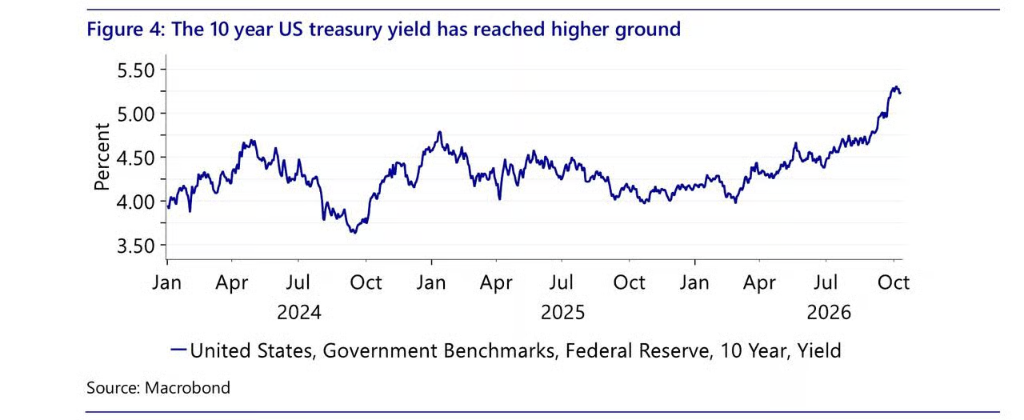
$U.S. 10-Year Treasury Notes Yield (US10Y.BD)$On September 23, it broke through 5% for the first time, then surged to 5.31%. Wall Street offered a variety of explanations—oil prices, AI, Japan, and France.
However, in his latest report, "Higher Ground," Philip Marey, Senior U.S. Strategist at Rabobank, breaks the rise in the 10-year U.S. Treasury yield into two distinct phases. He argues that the Federal Reserve pushed yields to 5%, while U.S. debt pushed them further to 5.31%.
 Marey wrote in the report: "The sustained rise in the 10-year U.S. Treasury yield through 2026 largely reflects the Federal Reserve's shift from contemplating rate cuts to actually beginning to raise rates in September… However, the recent sharp breach of 5% is primarily attributable to a surge in the term premium, which in turn stems from market concerns about public debt."
First Story: The Federal Reserve Drives U.S. Treasury Yields Higher
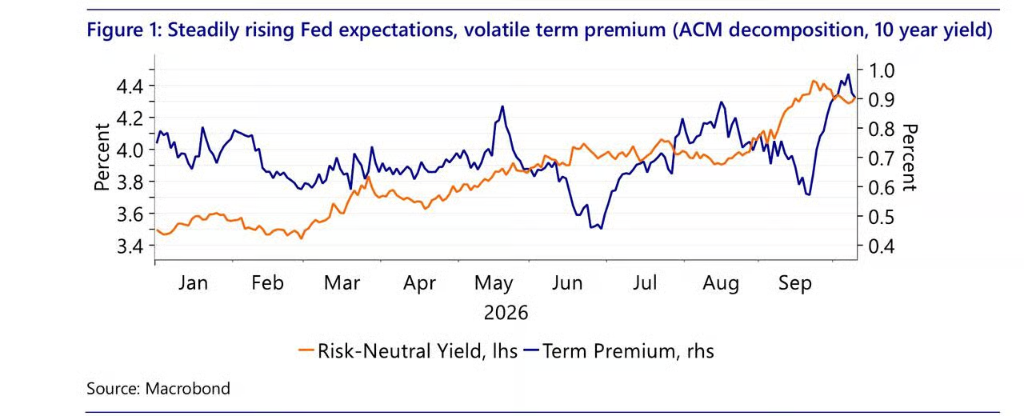
Marey employs the New York Fed's ACM model to decompose the 10-year yield into two components: the risk-neutral yield and the term premium.
Data show that, during the first three weeks of September, the 10-year yield rose from 4.80% to 4.96%, while the term premium declined from 0.78% to 0.57%, and the risk-neutral yield jumped from 4.09% to 4.43%. The risk-neutral yield roughly equals the market's average expectation for the federal funds rate over the next decade, reflecting expectations about the path of monetary policy. The term premium, by contrast, represents the additional compensation investors demand for holding long-term bonds relative to rolling over short-term bonds. A rise in the term premium suggests that investors perceive increasing risks associated with holding long-term bonds, prompting them to require higher yields in order to do so.
During this period, the Federal Reserve raised interest rates by 25 basis points and, via its dot plot, signaled another rate hike within the year. Marey's assessment is: "This implies that the Fed's projected path for policy rates is the primary driver behind the 10-year Treasury yield's climb toward 5%."
Second story: After September 23, debt takeovers and U.S. Treasury yields
On September 23, the script was flipped.
The term premium surged from a low of 0.57% to 0.98% by October 7, while the risk-neutral yield, conversely, edged down slightly from 4.43% to 4.39%.
The bond market has stopped worrying about the Federal Reserve and is now concerned about the borrowers themselves.
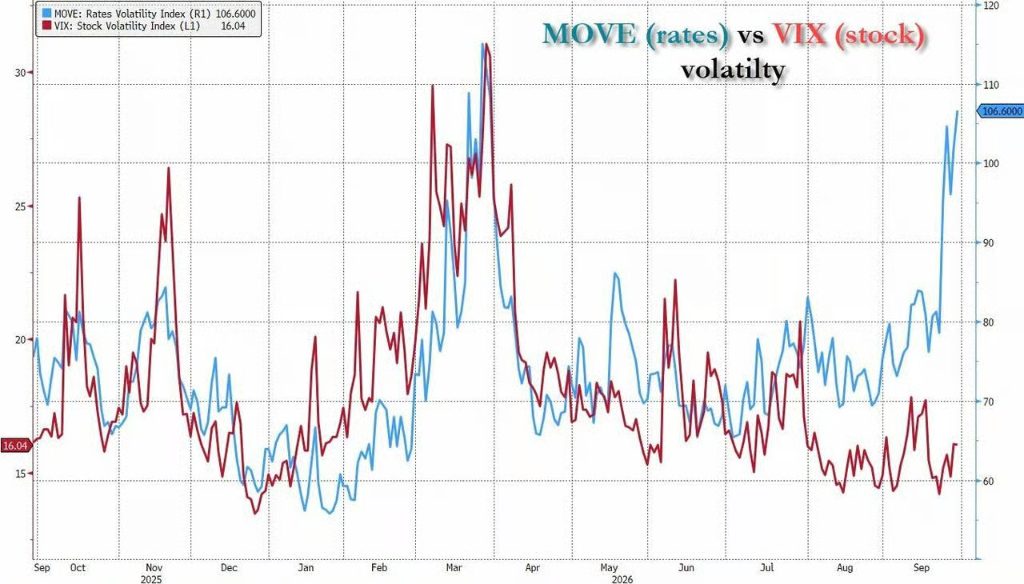
Marey pinpointed the turning point to a Treasury auction held on September 23. On that day, the U.S. Treasury sold $70 billion of five-year notes at a winning yield of 5.033%, the first time the yield has exceeded 5% since 2007. The tail—the difference between the highest and lowest bids—stood at 3.1 basis points, the second-largest on record. Subscriptions from indirect bidders—typically representing overseas central banks and other institutions—fell to their lowest level since March 2020, while primary dealers were forced to take up 15.8% of the offering.
This marks the bond market's worst single-day performance since "Liberation Day."
Rabobank's analysis states: "This suggests that concerns about public debt played a key role in the sharp surge of the 10-year U.S. Treasury yield above 5%. The synchronized movement between the term premium and the MOVE Index— which measures implied volatility in the U.S. Treasury market—indicates that the unsettling auction of 5-year Treasuries on that day was the primary catalyst."
Inflation expectations remain stable, while real interest rates are rising.
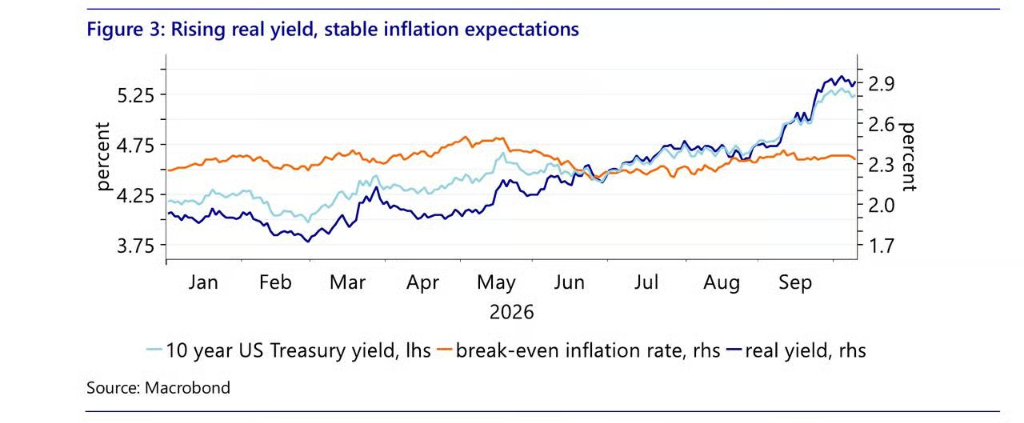
Marey uses another set of tools—TIPS (Treasury Inflation-Protected Securities)—to decompose the 10-year yield into the breakeven inflation rate and the real yield.
The outcome was not favorable to those who argue that the Federal Reserve is out of control.
From September 1 to October 5, the real yield rose from 2.44% to 2.95%, while the breakeven inflation rate remained virtually unchanged, edging up only slightly from 2.35% to 2.36%.
Rabobank's analysis is: "The surge in energy prices triggered by the Middle East conflict, coupled with a resilient U.S. economy, has pushed up the Federal Reserve's (real) policy rate path and 10-year real yields. At the same time, the Fed's hawkish response has kept inflation expectations anchored."
In other words, the market believes the Federal Reserve can tame inflation, but confidence in fiscal sustainability is waning.
Goldman Sachs: Mostly the Federal Reserve, with a small portion "unclear"
In a report titled "Factors Behind the Rise in U.S. Treasury Yields" released on the same day, Goldman Sachs interest-rate strategist William Marshall reached a conclusion that was similar but not entirely identical.
Goldman Sachs's macro model shows that since the eve of the Iran war, the 10-year yield has risen by a cumulative 130 basis points, with about 70% attributable to the Federal Reserve's hawkish repricing. Marshall wrote:
Since the beginning of this year, the market's consensus expectation for short-term interest rates one year out has risen by roughly 125 basis points, contributing about 55 basis points to long-end forward rates—accounting for 70% of the cumulative increase… Overall, approximately 10 to 15 basis points of the year-to-date yield rise cannot be explained by fundamental factors.
Goldman Sachs likewise acknowledged that the latest round of sell-offs has been concentrated at the long end, and its own estimates of term premiums tell the same story as Rabobank's MOVE chart.
The disagreement lies in: why is the term premium rising?
Rabobank's answer is: fiscal debt.
Goldman Sachs's answer is more diversified: rising macroeconomic uncertainty, coupled with the fact that U.S. Treasuries are no longer an effective hedge against equities—"bonds have become a poor diversification tool for stocks."
On fiscal matters, Marshall's wording was almost understated:
Despite the U.S. fiscal trajectory being unsustainable, there has been no substantial shift this year, and the share of U.S. Treasury debt held by the private sector has remained broadly stable as a percentage of GDP. The real change this year has been in market expectations regarding AI‑related spending and borrowing.
Market分歧: Is it a new bottom, or a buying opportunity?
The two banks have diverged markedly in their outlook for the market going forward.
Rabobank: Yields Have Found a New Floor
Marey's logic is this: before the war, the Federal Reserve had projected one rate cut this year and another in 2027; now, it has shifted to a September rate hike followed by another at year-end, with the first rate cut pushed back to 2028, and its median estimate for the neutral rate has also been revised upward. He wrote:
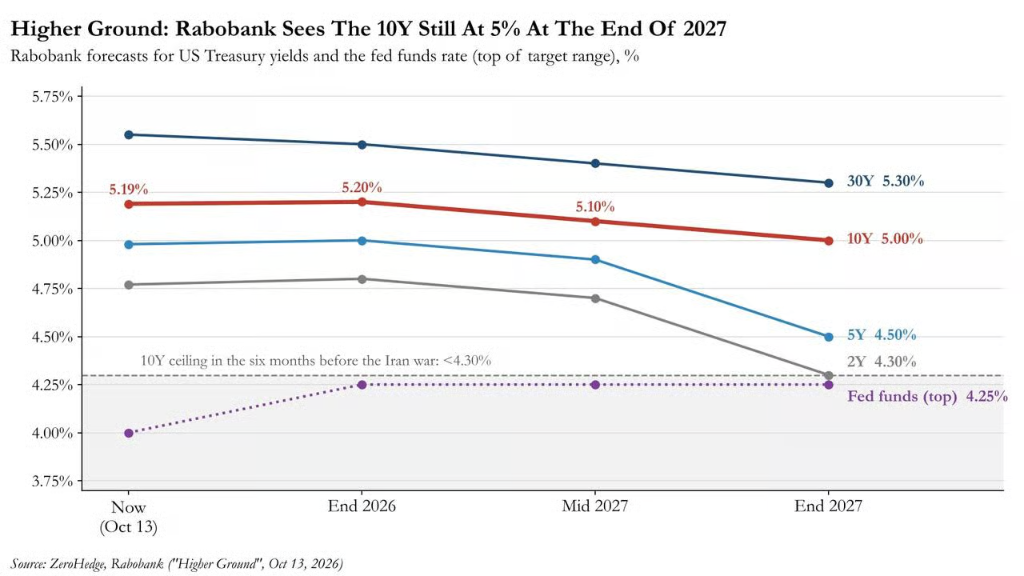
Given the transformative nature of the AI boom, it could continue to underpin economic growth beyond this year. Accordingly, we believe that the downward room stemming from revised monetary policy expectations is limited, and the 10-year U.S. Treasury yield is unlikely to return to its pre‑war level of below 4.30% seen over the past six months. Note that we are already a full percentage point above that level.
On the subject of term premiums, Rabobank's warning is even more direct: "Given that recent peaks in term premiums have been linked to public debt—and with no progress on that front in sight—term premiums may occasionally ease when concerns about public debt or geopolitical risks abate. However, they are likely to remain on an upward trajectory. Consequently, even if market expectations for Fed rate hikes were to moderate, the downward pressure on 10-year yields would be limited, as the public‑debt issue is far from resolved. Indeed, it could become the most persistent driver of rising interest rates over the coming years."
Rabobank forecasts that the 10-year yield will remain at 5.20% by year-end, decline to 5.10% by mid-2027, and further fall to 5.00% by the end of 2027. Even under its "optimistic scenario," the yield at the end of 2027 would still be roughly 70 basis points higher than pre‑war levels.
Goldman Sachs: It's time to build a long-duration position.
Marshall believes that now is the time to "establish a foothold in duration positions." He calculates that the 5y5y forward rate—i.e., the five-year interest rate five years from now—is in the 5.5% to 5.6% range, which is 40 to 50 basis points above fair value and roughly one standard deviation below its historical average.
Goldman Sachs's bond fund duration indicator has slipped to -2, indicating an underweight position. "Historically, such an underweight level has often been followed by a decline in yields over the subsequent 3 to 6 months."
In addition, Goldman Sachs estimates that the negative convexity effect of MBS (mortgage-backed securities) has already forced roughly $60 billion in 10-year equivalent sell-offs since early September, and MBS overall convexity is now close to zero, effectively exhausting this amplifying factor.
Goldman Sachs' year-end 10-year target: 4.75%, a full 45 basis points lower than Rabobank's 5.20%.
This Week's Focus: CPI, Retail Sales, and Remarks by Mr. Warsh
Bond markets reopened after the Columbus Day holiday, with 10-year Treasury yields falling as much as 6 basis points to 5.18%, according to Bloomberg—after briefly climbing to 5.36% the previous week, the highest level since 2002.
Key events this week:
CPI (Wednesday): Goldman Sachs forecasts core CPI at 0.24% month-over-month, above the market consensus of 0.2%; JPMorgan economist Feroli predicts 0.18%. Goldman Sachs' mortgage division warns, "If the data slightly exceeds expectations, it could pose challenges for the interest-rate market."
Retail Sales and PPI (Thursday): JPMorgan's Market Intelligence team said that if both core inflation and retail sales decline, "it could be enough to trigger a tactical rally in the bond market," while noting that some clients believe the 10-year yield is on a "relentlessly heading toward 5.50%" trajectory—5.50% being the level JPMorgan has flagged as "extremely unfavorable for equities."
Wash's remarks (Thursday): The market is currently pricing in roughly 5 basis points of rate hikes for October, with the bulk of bets focused on the next move in December.
Meanwhile, Apollo's chief economist, Torsten Slok, using another Federal Reserve term premium model—the D'Amico–Kim–Wei model—arrived at the same two key drivers identified by Rabobank: an upward shift in the expected path of real short-term interest rates and "investors demanding greater compensation for holding duration."
IMF official Athanasios Vamvakidis told Bloomberg that the sharp rise in government bond yields has become "the biggest emerging risk to the global financial system."
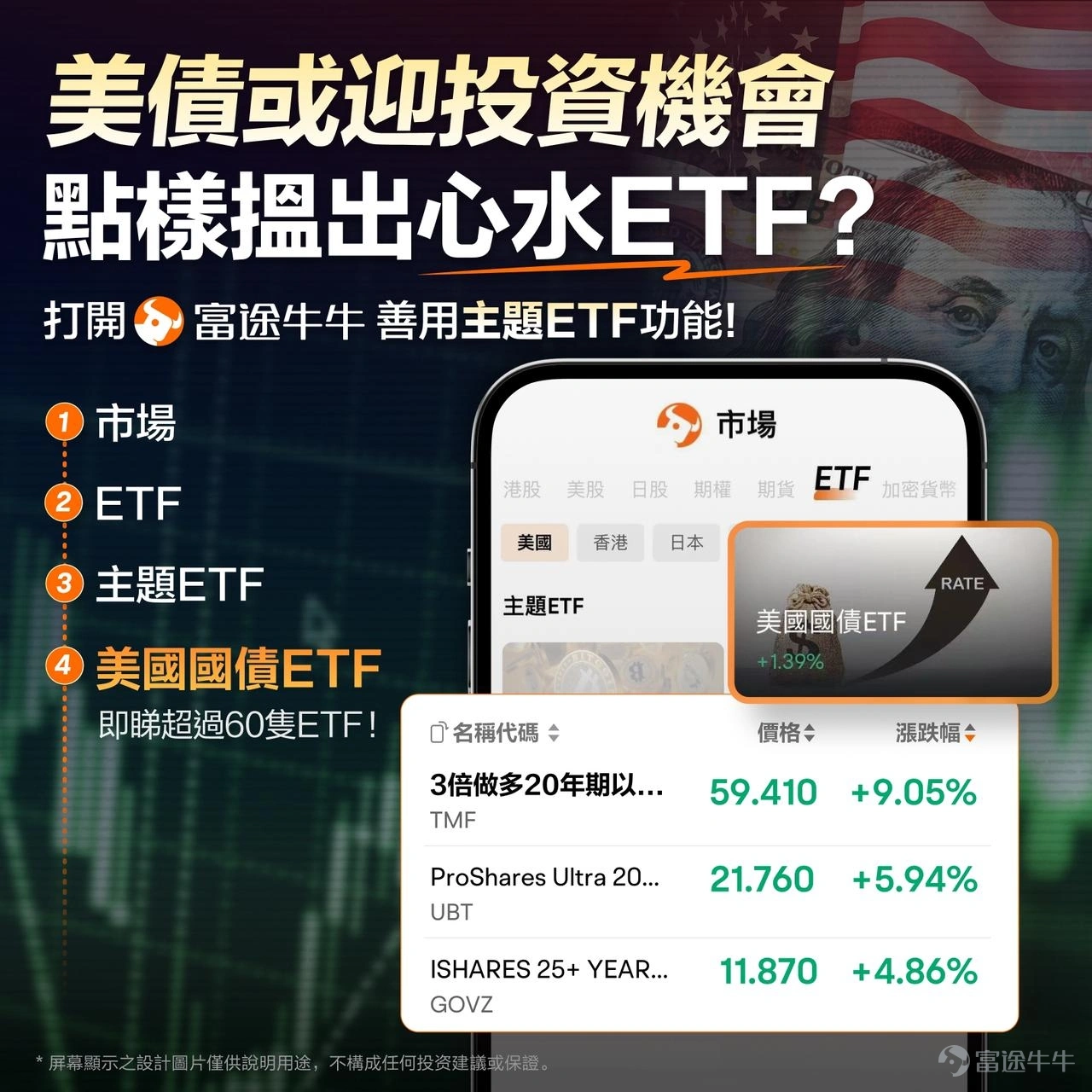
 How do you find the U.S. Treasury ETFs you're interested in? Open the Niuniu App, go to Market > ETFs > Thematic ETFs > U.S. Treasury ETFs, and instantly browse over 60 ETFs!
Editor/lambor