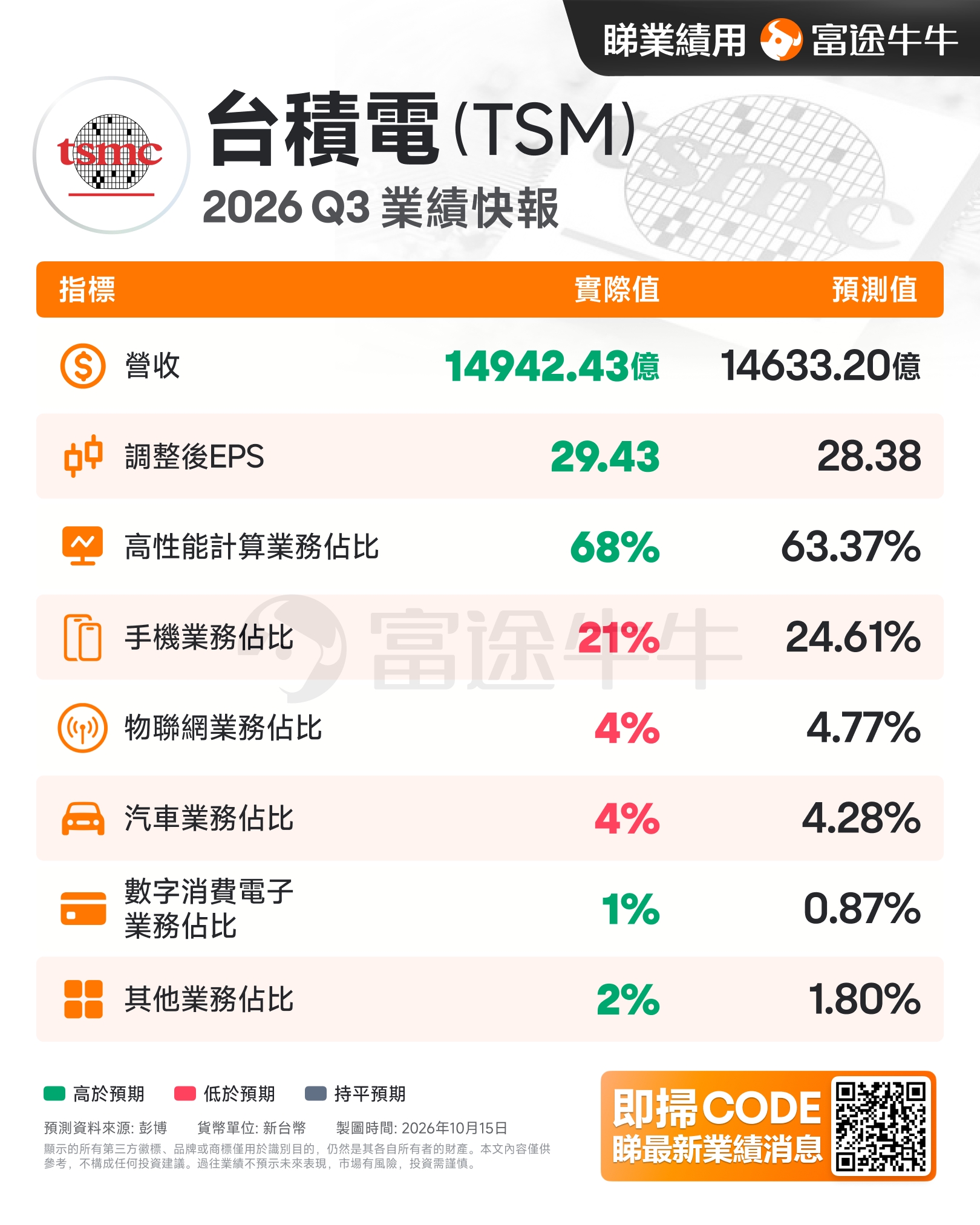
Taiwan Semiconductor's third-quarter revenue and net profit both significantly exceeded expectations, rising 50.9% and 68.7% year over year, respectively, driven by robust demand for advanced processes and HPC, underscoring the continued strong global demand for AI chips. Affected by the initial ramp-up of 2-nanometer production, the gross margin edged down to 66.4%.
$Taiwan Semiconductor (TSM.US)$The company reported strong quarterly results, with both revenue and profit significantly exceeding market expectations, underscoring the continued surge in global demand for AI chips.
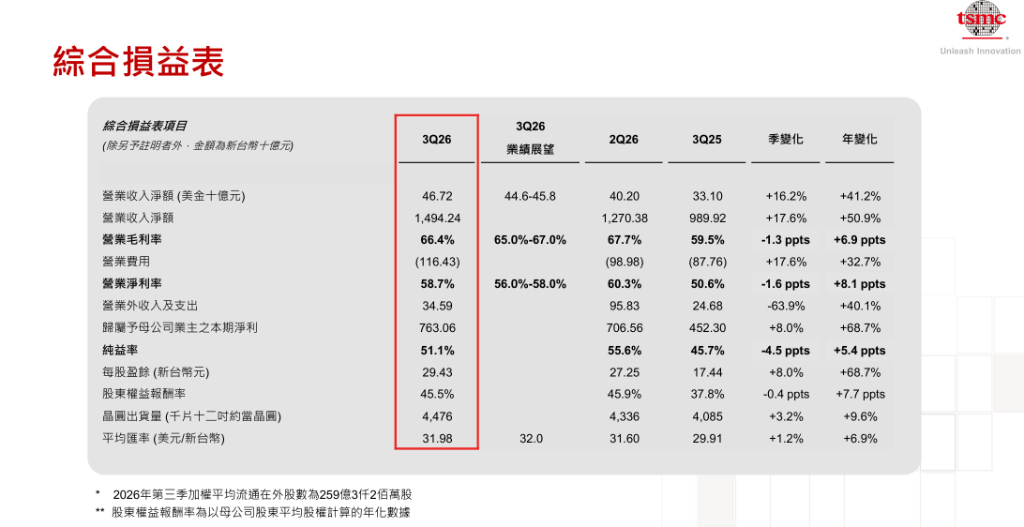
The company announced on Wednesday that its net profit reached NT$763.1 billion (approximately US$23.6 billion), up 68.7% year over year, surpassing analysts' average estimate of NT$739.5 billion. Revenue for the same period totaled NT$1.49 trillion (about US$46.7 billion), a 50.9% increase from the prior year, also exceeding market expectations. The company lowered its gross margin guidance to 66.4%, slightly below the expected 66.5%, primarily due to the initial ramp-up of 2-nanometer process production, which weighed on margins.
 At a time when this better-than-expected earnings report was released, market concerns about the return on AI capital expenditures and the long-term sustainability of financing are mounting. NVIDIA's major customer and cloud service provider, CoreWeave Inc., suffered a double whammy on Wednesday, with both its stock and bonds plunging sharply. Taiwan Semiconductor's robust performance has sent a starkly different signal to the upstream end of the industry chain, indicating that demand for AI chips remains strong for now.
Taiwan Semiconductor's U.S. stock fell more than 2.7% at one point during after-hours trading and is now down over 2.4%.
Advanced process technologies drive revenue, with the HPC platform serving as the core growth engine.
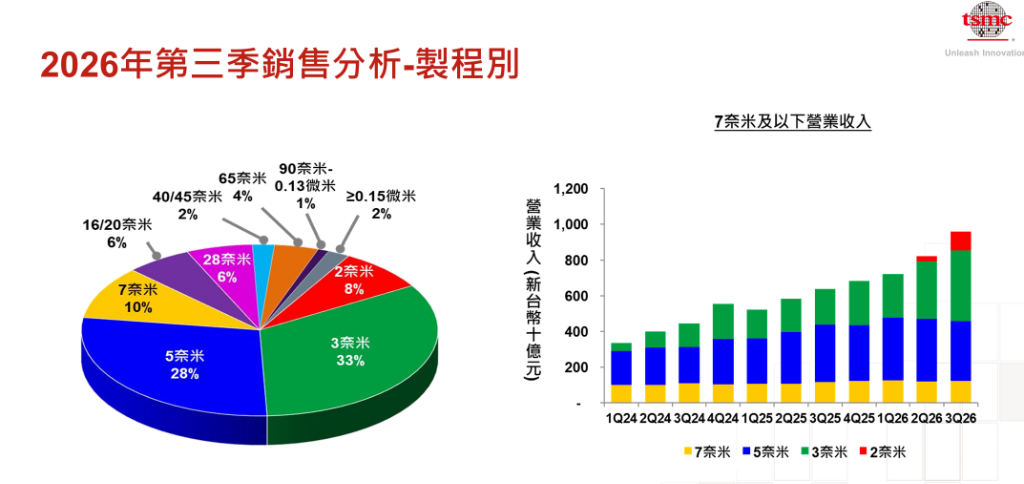
From a process‑node perspective, advanced nodes (7 nm and below) accounted for 79% of wafer sales this quarter. Specifically, the 3 nm node represented 33%, the 5 nm node 28%, and the 7 nm node 10%, while the 2 nm node made its first significant contribution this quarter, accounting for 8%.
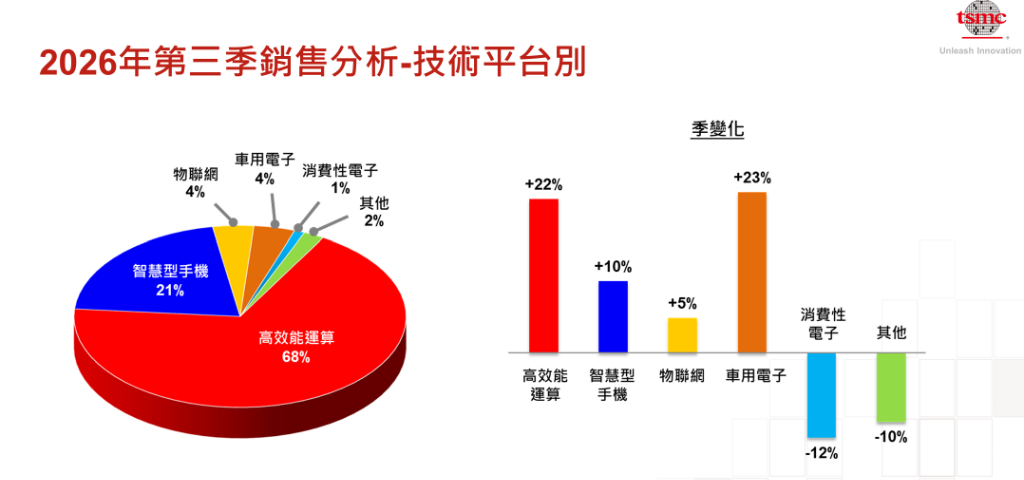
By platform, the high-performance computing (HPC) segment accounted for 68% of revenue, up 22% quarter over quarter, and served as the primary driver of growth this quarter; the smartphone segment represented 21%, with a 10% quarter-over-quarter increase. The automotive segment posted a robust 23% quarter-over-quarter growth, also delivering strong results.
From a geographical perspective, revenue from North American customers accounted for 79% of total revenue, up from 78% in the previous quarter, highlighting the heavy reliance of U.S. tech giants such as NVIDIA, AMD, and Google under Alphabet on Taiwan Semiconductor. Taiwan Semiconductor is also the exclusive contract manufacturer of Apple's most advanced chips.
Gross margin is under slight pressure, with early-stage mass production of the 2-nanometer process diluting profits.
Despite revenue and net profit both exceeding expectations, Taiwan Semiconductor's gross margin for this quarter stood at 66.4%, down 1.3 percentage points from the previous quarter and lower than last quarter's 67.7%. In its financial report, the company noted that the decline in gross margin was primarily due to the profit dilution effect stemming from the initial mass production of its 2-nanometer process technology.
Operating profit margin stood at 58.7%, down 1.6 percentage points from the previous quarter. Operating expenses increased to NT$116.43 billion, accounting for 7.8% of revenue. Net non-operating income totaled NT$34.59 billion, a significant decline from NT$95.83 billion in the prior quarter, primarily because the prior quarter included a one-time gain from the sale and mark-to-market revaluation of Winbond Electronics shares, a factor that did not recur this quarter.
Diluted earnings per share for the quarter were NT$29.43 (equivalent to US$4.60 per American Depositary Receipt).
Capital expenditures hit a record high, and the pace of expansion is unprecedented.
Taiwan Semiconductor's capital expenditure for the third quarter was US$13.84 billion, with cumulative capital spending for the first three quarters reaching US$40.64 billion. The company previously stated that its full-year capital expenditure would total as much as US$64 billion, a record high.
According to Bloomberg, Goldman Sachs currently forecasts Taiwan Semiconductor's capital expenditures for 2027 at US$85 billion, while UBS Group projects US$90 billion—both exceeding the market's average expectation of US$75 billion derived from a Bloomberg survey. The trajectory of capital spending in 2027 has become a key metric for gauging the investment climate in the global AI industry.
Taiwan Semiconductor is currently simultaneously advancing the construction and equipment installation of approximately 20 fabs, far exceeding its usual pace of building four to five new facilities at a time. In addition to its already committed $265 billion investment in an industrial park in Arizona, Taiwan Semiconductor is reportedly considering establishing a second U.S. manufacturing base in Texas to meet the robust demand driven by the surge in data center construction in the United States.
Cash flow has improved, and the financial position remains sound.
Free cash flow improved significantly this quarter, rising by NT$189.2 billion to NT$476.56 billion, primarily driven by higher operating cash flow and a quarter-over-quarter decline in capital expenditures.
The year-end cash balance increased to NT$3,621.89 billion. After deducting interest-bearing liabilities, net cash reserves stood at approximately NT$2,985.4 billion, up NT$499.1 billion from the previous quarter. Days of inventory declined by 5 days to 82 days, and days sales outstanding fell by 1 day to 28 days, reflecting improved operational efficiency.
Taiwan Semiconductor's Board of Directors has approved a cash dividend of NT$7 per share for the second quarter of 2026, with the ex-dividend date set for December 10, 2026, and the payment date on January 7, 2027.
Editor/lambor