Taiwan Semiconductor projects fourth-quarter sales to range between $52.3 billion and $54.3 billion, raising its full-year 2026 revenue growth forecast from the previous "slightly above 40%" to approximately 44%. The CEO revealed that the company has entered into discussions with Elon Musk's Terafab regarding capacity cooperation. The company is considering further expanding its U.S. production capacity beyond Arizona, with Texas currently under evaluation for site selection.
$Taiwan Semiconductor (TSM.US)$ The release of a strong fourth-quarter performance outlook, with revenue guidance significantly exceeding market expectations, has once again bolstered market confidence in the sustainability of the global AI infrastructure investment boom.
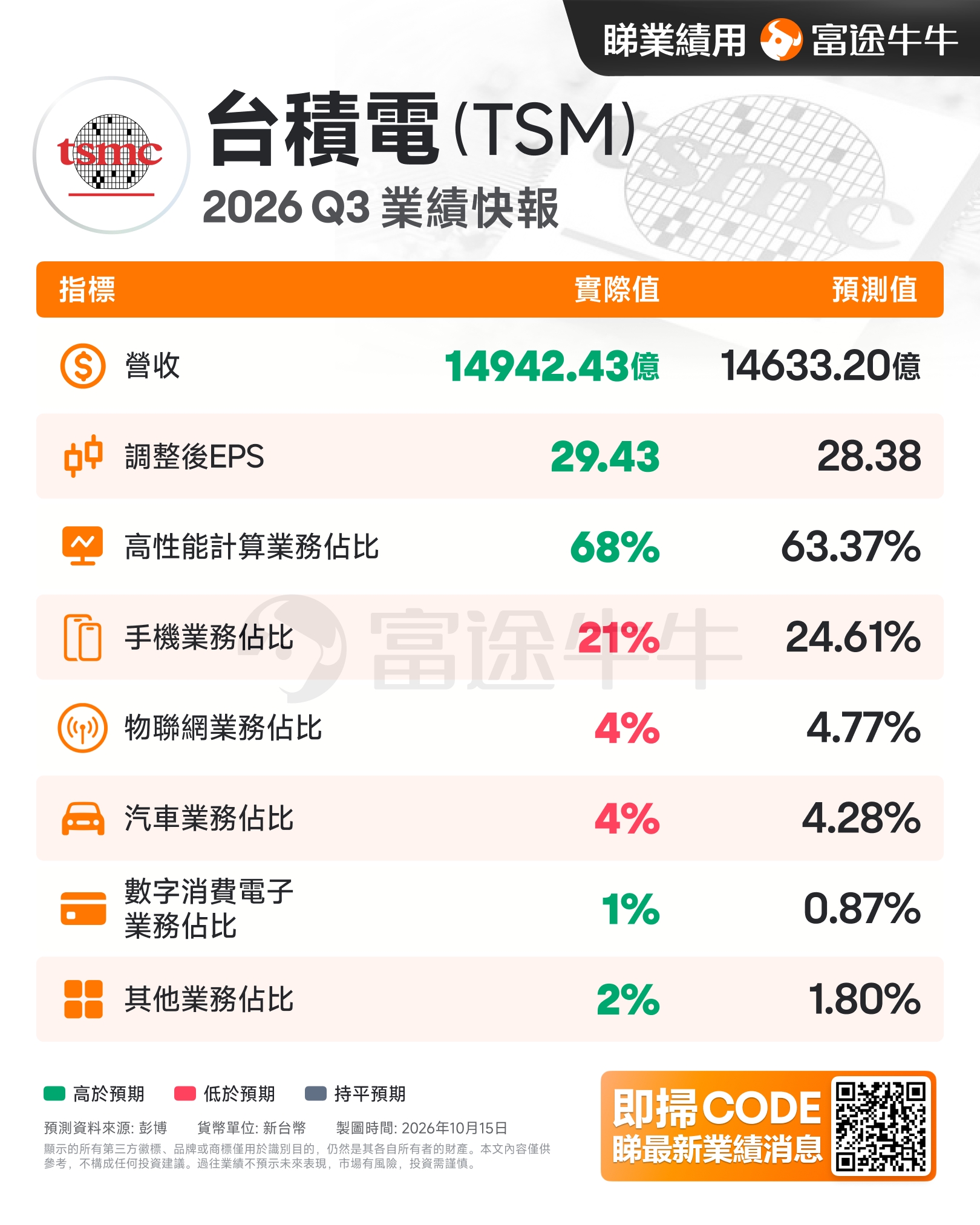
During the Q3 2026 earnings conference call, Taiwan Semiconductor projected fourth-quarter sales to range between $52.3 billion and $54.3 billion. Based on the midpoint of $53.3 billion, this figure is approximately 6% higher than the market's previous estimate of $50.35 billion, indicating that demand momentum remains robust. The company simultaneously raised its full-year 2026 revenue growth forecast from the previous "slightly above 40%" to approximately 44%, following a 69% year-on-year increase in net profit for the third quarter.
 In terms of profitability, Taiwan Semiconductor expects fourth-quarter gross margins to be between 65% and 67%, and operating margins to be between 56.5% and 58.5%. The company maintained its original capital expenditure plan for 2026 at $60 billion to $64 billion.
The CEO of Taiwan Semiconductor revealed that the company has initiated discussions with Elon Musk's Terafab regarding capacity cooperation. The Chairman also stated that they are exploring the possibility of utilizing Terafab's idle capacity, but emphasized that any factory collaboration must be led by Taiwan Semiconductor. Meanwhile, Taiwan Semiconductor indicated it is considering further expanding its U.S. production capacity beyond Arizona, with Texas included in the site selection assessment.
Taiwan Semiconductor's U.S.-listed shares fell nearly 3% during after-hours trading, but the decline narrowed significantly to 0.6% as details of the earnings results were disclosed.
Q4 guidance comprehensively exceeded expectations; full-year capital expenditure remains at high levels.
Taiwan Semiconductor expects fourth-quarter gross margins to be between 65% and 67%, compared to the market estimate of 66.1%; operating margins are projected at 56.5% to 58.5%, against a market estimate of 58%. These forecasts are based on an exchange rate assumption of USD 1 to TWD 31.8.
Regarding capital expenditure, Taiwan Semiconductor confirmed its 2026 capex range at $60 billion to $64 billion, maintaining the previous guidance unchanged and setting a new historical high. The company stated that it is premature to disclose capital expenditure figures for periods beyond 2026 at this stage.
According to Bloomberg, the consensus expectation for Taiwan Semiconductor's 2027 capital expenditure continues to be revised upward, serving as an important leading indicator for the semiconductor industry's sentiment. Goldman Sachs currently forecasts this figure at $85 billion, UBS Group at $90 billion, while the average estimate from Bloomberg survey institutions stands at $75 billion.
Unprecedented capacity expansion: Nearly 25 projects under construction globally, with Texas confirmed as a site under evaluation
Taiwan Semiconductor's capacity expansion was another major focus of the conference call. CEO C. C. Wei stated:
Taiwan Semiconductor is expanding at an unprecedented pace, with nearly 25 projects currently under construction worldwide.
Specifically, over the next few years, Taiwan Semiconductor will build 13 advanced process and advanced packaging factories in Taiwan, and another five to six factories overseas.
Regarding N3 capacity, in addition to existing plans in Tainan, driven by strong customer demand, Taiwan Semiconductor announced the construction of an additional 3nm wafer fab in Tainan, scheduled for mass production in the first half of 2028. The second wafer fab in Arizona has completed construction and is undergoing equipment installation, with mass production advanced to the third quarter of 2027, ahead of the original schedule.
Regarding expansion in the United States, C. C. Wei publicly confirmed for the first time that sites outside Arizona are being evaluated:
Recently, we have indeed begun evaluating expansion opportunities outside Arizona, with Texas being one of them. We have dispatched a team to conduct a comprehensive assessment on-site.
Meanwhile, he also revealed that Taiwan Semiconductor is discussing cooperation with a client planning to build a factory—namely, the widely watched Terafab project:
We are also in discussions with a client planning to build a factory, specifically regarding the Terafab project, to explore whether relevant capacity can be utilized. These discussions are still ongoing.
When analysts pressed on whether these factories would be owned and operated by Taiwan Semiconductor, C. C. Wei stated:
Discussions are ongoing, and various cooperation models are possible, but the facility must be operated by Taiwan Semiconductor.
Regarding capacity planning logic, C. C. Wei stated clearly:
We have no intention of ceding business opportunities to others; we aim to seize every opportunity within our reach.
High-NA EUV and A14: Clear Technology Node Roadmap
C. C. Wei clarified Taiwan Semiconductor's timeline for adopting High-NA EUV lithography machines: adoption is planned to begin in 2030, with the introduction of 12-inch masks in 2031. When analysts questioned whether Taiwan Semiconductor was lagging behind some competitors, C. C. Wei responded:
Does adopting the technology later than competitors put Taiwan Semiconductor at a disadvantage? The answer is no. We are confident that we can still provide customers with the most advanced technology.
He explained that the 2030 introduction date was chosen because the technology will be "maturing" by then, and costs will have reached a level suitable for mass production.
For the A14 node, C. C. Wei stated that the number of customers participating in development has exceeded that of N2 at the same stage. He expects A14 to become a "larger process node than the current N2," with risk production trials proceeding as scheduled, starting in 2027 and reaching mass production in 2028.
Advanced Packaging: First to Achieve Mass Production with 5x Reticle Size, 14x Solution Under Development
In the field of advanced packaging, C. C. Wei provided a set of significant data:
Currently, we have achieved mass production of advanced packaging with a reticle size five times the standard. I believe that, apart from Taiwan Semiconductor, no other company is currently capable of this. Our yield rates are excellent, and our customers are highly satisfied with the results.
Taiwan Semiconductor is developing solutions for reticle sizes nine and fourteen times the standard, and advancing CoPoS technology to control future costs. When analysts pressed on whether Taiwan Semiconductor would take on orders if competitors failed to deliver, C. C. Wei did not answer directly but stated:
Ensuring that Taiwan Semiconductor's customers can successfully bring their products to market is our top priority.
The following is the transcript of the conference call:
Jeff Su, Head of Investor Relations:
Good afternoon, everyone, and welcome to Taiwan Semiconductor's earnings conference call for the third quarter of 2026. I am Jeff Su, Head of Investor Relations at Taiwan Semiconductor, and your host for today.
This conference call is being live-streamed via audio on Taiwan Semiconductor's official website, where you can also download the earnings release materials. Participants joining by phone are currently in listen-only mode.
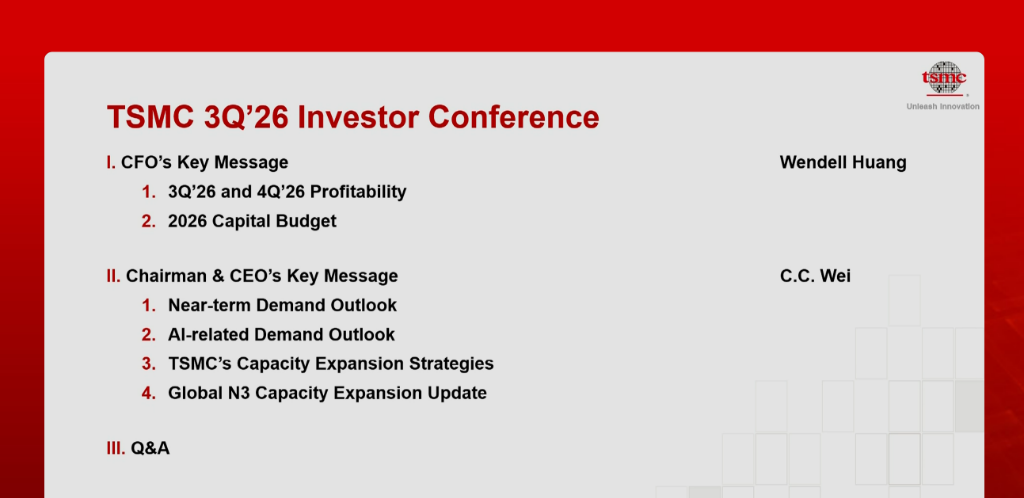
Today's agenda is as follows: First, Mr. Wendell Huang, Senior Vice President and Chief Financial Officer of Taiwan Semiconductor, will introduce the operational results for the third quarter of 2026 and provide guidance for the fourth quarter. Subsequently, Mr. Huang and Dr. C. C. Wei, Chairman and CEO of Taiwan Semiconductor, will jointly highlight key company information, followed by a Q&A session.
As per our usual practice, please note that today's discussion may contain forward-looking statements. These statements are subject to significant risks and uncertainties that could cause actual results to differ materially from those expressed in the forward-looking statements. Please refer to the safe harbor statement in the press release.
Now, let us invite Mr. Wendell Huang to present the operational results and performance guidance for this quarter.
Huang Renzhao, Chief Financial Officer:
Thank you, Jeff. Good afternoon, everyone. Thank you for joining today’s conference call. I will first present the financial highlights for the third quarter of 2026, followed by the performance guidance for the fourth quarter.
Supported by strong demand for advanced process technologies, revenue in New Taiwan Dollars increased by 17.6% quarter-over-quarter in the third quarter; revenue in U.S. Dollars rose by 16.2% quarter-over-quarter to USD 46.7 billion, exceeding the upper end of the third-quarter performance guidance.
Gross margin decreased by 1.3 percentage points quarter-over-quarter to 66.4%, primarily due to the dilutive effect of the production ramp-up of the 2nm process. Operating expenses accounted for 7.8% of net revenue, and the operating margin was 58.7%. Earnings per share for the third quarter were NT$ 29.43, and return on equity was 45.5%.
Next, I will outline the revenue contribution by process technology. In the third quarter, the 2nm process accounted for 8% of wafer revenue; the 3nm, 5nm, and 7nm processes accounted for 33%, 28%, and 10%, respectively. Advanced processes at 7nm and below collectively accounted for 79% of wafer revenue.
By application platform, High-Performance Computing (HPC) revenue grew by 22% quarter-over-quarter, accounting for 68% of third-quarter revenue; smartphone revenue increased by 10%, representing 21%; Internet of Things (IoT) revenue rose by 5%, accounting for 4%; automotive business revenue grew by 23%, representing 4%; and Digital Consumer Electronics (DCE) revenue declined by 12%, accounting for 1%.
Regarding the balance sheet, cash and marketable securities totaled NT$ 4 trillion (approximately USD 126 billion) at the end of the third quarter.
On the liabilities side, current liabilities increased by NT$ 110 billion quarter-over-quarter, mainly driven by a NT$ 46 billion increase in corporate bonds and bank loans maturing within one year, as well as a NT$ 26 billion increase in dividends payable.
In terms of financial ratios, days sales outstanding decreased by 1 day to 28 days; days inventory outstanding decreased by 5 days to 82 days, primarily due to increased wafer shipments.
Regarding cash flow and capital expenditures, operating cash flow generated in the third quarter was approximately NT$ 920 billion, capital expenditures amounted to NT$ 443 billion, and cash dividends for the fourth quarter of 2025 totaling NT$ 156 billion were paid. The cash balance increased by NT$ 488 billion during the quarter to reach NT$ 3.6 trillion at quarter-end. In U.S. Dollar terms, capital expenditures for the third quarter were USD 13.8 billion.
The above concludes the financial overview. We will now present the performance guidance for this quarter.
Based on current business outlook, we project fourth-quarter revenue to range from USD 52.3 billion to USD 54.3 billion, with the midpoint representing a 14% quarter-on-quarter increase and a 58% year-on-year increase. Assuming an exchange rate of USD 1 to TWD 31.8, gross margin is expected to be between 65% and 67%, and operating margin between 56.5% and 58.5%.
This concludes the financial report. We will now highlight several key points.
First, let us address profitability in the third and fourth quarters of 2026.
Gross margin in the third quarter declined by 130 basis points to 66.4% compared to the second quarter, primarily due to the dilutive impact of the initial production ramp-up of 2nm technology.
The midpoint of the gross margin guidance for the fourth quarter provided earlier is 66%, representing a 40-basis-point sequential decline. This is mainly attributed to the continued dilutive effect of the rapid production ramp-up of 2nm technology, as well as the dilutive impact from overseas fabs. Cost improvement measures, including enhanced production efficiency and capacity optimization across process nodes, are expected to partially offset these effects.
Although costs at overseas fabs remain relatively high, benefiting from the company's overall scale expansion and cost improvement initiatives, we currently estimate that the dilutive impact of the production ramp-up at overseas fabs on gross margin for the full year 2026 will approach 2 percentage points.
As we intensify efforts to support strong structural demand from customers, more fabs in the United States will enter the production ramp-up phase. Consequently, the dilutive impact of overseas fabs on gross margin is expected to expand to 3–4 percentage points in the coming years.
We will leverage the expanding production scale in Arizona and optimize our cost structure through operational improvements. Meanwhile, we will continue to work closely with customers and suppliers to manage related impacts.
Overall, supported by core competitive advantages such as leadership in manufacturing technology and large-scale production bases, Taiwan Semiconductor is confident in maintaining the most cost-effective manufacturing capabilities across all operational regions.
Next, let us discuss the capital expenditure budget for 2026.
For Taiwan Semiconductor, higher capital expenditures have always corresponded to greater growth opportunities in the coming years. Given the sustained strong demand from customers over the next several years, including the emerging Agentic AI market, we reaffirm our full-year 2026 capital expenditure budget of USD 60 billion to USD 64 billion.
We will continue to invest heavily to support customer growth, and we expect total capital expenditures from 2026 to 2028 to be significantly higher than those of the past three years.
Furthermore, despite tight equipment supply, we have been working closely with equipment suppliers well in advance to prepare capacity, just as our customers collaborate with us early on for capacity planning.
In the coming years, we will invest in future growth at this scale of capital expenditure while continuing to strive for earnings-supported growth for our shareholders. We will also continue to promote sustainable and steady growth in cash dividends per share on both an annual and quarterly basis.
I will now invite Mr. C. C. Wei to continue.
C. C. Wei, Chief Executive Officer:
Thank you, Renzhao. Good afternoon, everyone. I will begin by outlining the recent demand outlook.
Third-quarter revenue amounted to USD 46.7 billion, exceeding our previous USD-denominated guidance, primarily driven by strong demand for advanced process technologies.
Entering the fourth quarter of 2026, we expect that sustained strong demand for advanced process technologies, including the rapid production ramp-up of 2-nanometer technology, will continue to support business growth.
Looking ahead, we observe that consumer and price-sensitive end markets remain affected by rising component costs and macroeconomic uncertainties. Therefore, in formulating our 2027 business plan, we are maintaining a prudent approach while focusing on business fundamentals to further solidify our competitive position.
Nevertheless, demand for our advanced process technologies remains extremely strong, driven by clear technological differentiation and a broader customer base. Consequently, we currently project full-year 2026 revenue in U.S. dollars to increase by approximately 44% year-on-year.
Next, let us discuss the outlook for AI-related demand.
The AI market continues to show robust strength, with recent developments highly favorable to the long-term demand outlook for AI. As applications evolve from chatbots to AI assistants, the adoption rate of agentic AI is rising, driving sustained growth in AI demand.
Furthermore, we are seeing wider application of open-source AI models. This will enhance efficiency, lower the barrier to future AI usage, and stimulate greater demand for advanced chips.
Strong underlying demand for AI accelerators continues to support AI-related businesses. Meanwhile, the emerging demand for CPUs tailored for agentic AI, coupled with sustained growth in networking chip demand, is further driving overall chip demand.
Therefore, semiconductors will continue to play a pivotal role in the long-term trend of AI. We believe that the value of semiconductors within the global supply chain will continue to rise, creating more value-capture opportunities for both customers and Taiwan Semiconductor.
Regardless of the technological path chosen, the most advanced semiconductor process technologies are required. Leveraging our technological leadership, superior manufacturing capabilities, global capacity expansion, and customer trust, we are well-positioned to fully capture the structural AI-related demand in the coming years. As a result, all participants in the AI sector are collaborating with Taiwan Semiconductor.
Next, we will introduce Taiwan Semiconductor's capacity expansion strategy.
As a pure-play foundry, our primary responsibility is to provide customers with the best technology and effective capacity support to help them achieve innovation.
To address the structural growth in long-term demand for the semiconductor market, Taiwan Semiconductor works closely with its customers and their end clients to plan capacity. Furthermore, we have dispatched our own teams to verify the construction progress and power supply status of data centers in the United States. Current feedback has been positive, and cloud service providers (CSPs) are well prepared.
Internally, Taiwan Semiconductor employs a rigorous capacity planning system that assesses market demand from both top-down and bottom-up perspectives. This is an ongoing process. Given the inherent complexity of advanced process technologies, as well as design-in cycles and related lead times, we have gained a clear understanding of our customers' product roadmaps and production plans for the coming years.
Therefore, we remain firmly confident in the long-term trend of AI. We are fully expanding capacity to meet internally assessed demand and increasing capital expenditure to support our customers' future growth.
Taiwan Semiconductor is expanding at an unprecedented pace, with nearly 20 fabs currently under construction globally. In the coming years, we will build 13 advanced process and advanced packaging fabs in Taiwan, and an additional five to six fabs overseas.
The new process node N2 entered high-volume production in the fourth quarter of 2025, with strong yield performance. Currently, multiple phases at our Hsinchu and Kaohsiung sites are successfully ramping up N2 mass production.
Supported by robust demand from smartphones and HPC/AI applications, we expect the annual capacity of the N2 technology series to more than double by 2027. Meanwhile, we are leveraging our manufacturing advantages to increase N2 wafer output, further enhancing capacity support for our customers.
In addition, we have begun preparing capacity for the A14 technology. Risk production is proceeding as planned, with start-up expected in 2027 and mass production in 2028.
Taiwan Semiconductor's semiconductor technology and manufacturing capabilities will continue to play a pivotal role in supporting the global semiconductor industry and driving customer innovation.
Next, we will provide an update on the latest progress in global N3 capacity expansion.
As previously stated, we typically do not add capacity to a process node once it has reached its target capacity. However, based on our assessment, to meet the strong demand for 3-nanometer technology over the coming years, we are smoothly advancing plans to add three new fabs globally.
In Taiwan, China, the new 3-nanometer fab at the Tainan Science Park is on schedule to begin mass production in the first half of 2027. Furthermore, driven by strong customer demand, we have decided to build an additional 3-nanometer fab in Tainan, with mass production planned for the first half of 2028.
In Arizona, construction of the second fab has been completed, and equipment installation is currently underway. Mass production is expected to commence in the third quarter of 2027, slightly ahead of the previous schedule.
In Japan, plans for the second fab utilizing 3-nanometer technology are progressing smoothly, with mass production anticipated in 2028.
In addition to constructing new facilities, we are continuing to convert 5-nanometer equipment in Taiwan, China, to support 3-nanometer capacity. Meanwhile, we are leveraging our manufacturing advantages to enhance production efficiency and increase wafer output across our fabs globally.
We are also advancing capacity optimization across process nodes, including flexible capacity allocation among N7, N5, and N3.
Consequently, we are implementing various measures to seize all viable opportunities and act swiftly to maximize support for our customers. We have no intention of leaving business opportunities to competitors and aim to capitalize on every available opportunity.
These conclude our key remarks. Thank you for your attention.
Jeff Su:
Thank you, Mr. Wei. That concludes our prepared remarks for today.
Before we begin the Q&A session, please note that each participant may ask up to two questions per round to allow more attendees the opportunity to participate. If you wish to ask a question in Chinese, I will translate it into English before inviting management to respond.
We will now begin the Q&A session. Please connect the first questioner.
Operator:
The first questioner is Laura Chen. Please proceed with your question.
Laura Chen, Analyst:
Good afternoon, everyone. Thank you, Mr. Wei, for introducing Taiwan Semiconductor's capacity expansion strategy. I would like to ask some follow-up questions.
As demand for AI semiconductors continues to strengthen, how does Taiwan Semiconductor currently view the compound annual growth rate (CAGR) of revenue from its AI business?
Furthermore, how does Taiwan Semiconductor comprehensively assess customer capacity requirements against potential constraints? These factors include power supply for data centers, recent funding issues, and critical links such as HBM, ABF substrates, and advanced packaging. We have also observed tight supply of lasers in the networking sector.
If these constraints lead to a mismatch between semiconductor supply and the actual pace of AI development, how will Taiwan Semiconductor adjust its capacity allocation and related strategies to mitigate the risk of overbuilding in the supply chain?
Huang Renzhao:
Laura's first question covers several aspects, with the core issue being our outlook on AI demand.
Mr. Wei mentioned that AI demand is very strong. However, her concern is how we comprehensively consider the robust demand for AI chips alongside risks such as power supply limitations and bottlenecks across various supply chain segments, in order to determine the appropriate level of capital expenditure and capacity preparation.
Laura, is this understanding correct?
Laura Chen:
Yes, thank you.
C. C. Wei:
We have a robust capacity planning process and exercise great prudence in our assessments. We take into account various factors to the fullest extent possible, including capital expenditure by cloud service providers, data center construction, funding, power supply, and the availability of other components.
These factors are incorporated into our judgment. Based on our internal assessment of demand, current demand still exceeds supply, and we are striving to narrow this gap.
Does this answer your question?
Laura Chen:
Yes, thank you. In other words, following a comprehensive review of the supply chain, we remain quite optimistic about long-term demand.
Could you provide a further update on the outlook for the AI business's compound annual growth rate? I recall the previous guidance was in the high 50% range.
Huang Renzhao:
Our previous guidance indicated that the AI accelerator business, defined under a narrower scope, would achieve a compound annual growth rate (CAGR) in the mid-to-high fifties percent range from 2024 to 2029. Laura would like to know if this figure will be updated today.
C. C. Wei:
At present, I can state that demand remains extremely robust, with no signs of slowdown. Whether the CAGR falls within the higher end of the fifties percent range is not the key point; actual growth could be even higher.
Laura Chen:
Thank you. My second question is: given the very strong demand, the scale of this capital expenditure cycle is expected to be significantly larger than in previous cycles. Taiwan Semiconductor has also previously announced that it will adopt High-NA EUV lithography technology around 2030.
Will this further enhance production efficiency and provide a more pronounced boost to long-term revenue growth? Meanwhile, as capital intensity increases, how should we view Taiwan Semiconductor’s pricing power, long-term gross margin, capital efficiency, and return on investment?
Huang Renzhao:
This actually comprises two questions. First, how do we view the adoption of High-NA EUV in 2030 amid strong demand and increased capital expenditure? Second, how do we assess long-term profitability?
C. C. Wei:
We will continue to enhance long-term production efficiency. High-NA EUV is indeed a powerful tool, and we currently plan to adopt it by 2030. At that time, our capital expenditures will be significantly higher than current levels.
Regarding whether gross margins and profitability can continue to rise, I would say that Taiwan Semiconductor's profitability has no ceiling, but substantial improvements will not happen overnight.
Our philosophy and strategy have always been to collaborate with customers to help them succeed, thereby earning returns commensurate with the value we create.
Laura Chen:
Very helpful, thank you. Congratulations to the company on its outstanding performance.
C. C. Wei:
Thank you.
Jeff Su:
Please connect the next questioner.
Operator:
The next questioner is Gokul Hariharan from JPMorgan. Please proceed with your question.
Gokul Hariharan, Analyst:
Good afternoon, Mr. Wei, Mr. Huang, and Jeff.
The first question still concerns capacity expansion. It appears that the supply shortage next year could be more severe than in 2026. We would like to hear Mr. Wei’s views on this.
Taiwan Semiconductor’s annual capacity growth has not exceeded 10% for a long time. According to its annual reports, it has been approximately ten years since the last time capacity growth surpassed 10%.
With construction accelerating, is there an opportunity for capacity growth to approach or even exceed 10% in the coming years? Could you outline the capacity expansion plans for the next few years?
Jeff Su:
Gokul’s first question relates to capacity expansion and demand. He would first like to know whether wafer supply will be tighter in 2027 than in 2026, and secondly, how we view overall capacity growth.
Regarding the 10% figure, the capacity growth rate we disclose annually in our reports is typically in the mid-to-high single digits, and sometimes even lower.
So, starting with the demand and supply outlook, will conditions be tighter next year compared to this year?
C. C. Wei:
As I mentioned earlier, demand is extremely strong and continues to rise.
We will make judgments from multiple perspectives, including communications with clients and their end customers, and further verify the construction status of data centers. All this information will be incorporated into our assessment.
Our current conclusion is that demand remains very high, and the supply-demand gap is still significant; therefore, we are making every effort to increase capacity.
As for whether the gap will widen or narrow, we are striving to address it, but we cannot provide a definitive answer at this stage because client demand continues to be revised upward.
Huang Renzhao:
Gokul, it is premature to discuss specific percentage increases in future capacity growth. However, it is worth noting that even if the overall annual capacity expansion appears modest, advanced process nodes remain the primary driver of capacity growth.
Gokul Hariharan:
Understood, thank you.
My second question concerns your mention of more aggressively pursuing overseas expansion, particularly in the United States. There has been considerable recent discussion about potential new wafer fab clusters in Texas, and one client mentioned ongoing negotiations with Taiwan Semiconductor.
Could you elaborate on plans to accelerate overseas capacity building, as well as any engagements with SpaceX or Tesla? Clients referenced contacts between these parties last week. What might the general framework for such collaborations look like? Would it resemble the cooperative models Taiwan Semiconductor has established with certain clients in Japan, or the ESMC partnership model?
Jeff Su:
Gokul noted that Mr. Wei mentioned we are expanding at an unprecedented pace and doing everything possible to accelerate capacity additions.
His questions primarily focused on the United States. There have been reports that we are considering expansion in Texas and are discussing collaboration with a customer. He wished to understand the progress on both fronts, as well as the framework or principles for potential cooperation.
C. C. Wei:
We are striving to expand our capacity in the United States. This is necessary because most of our major customers are located in the U.S., and they have also requested Taiwan Semiconductor to increase local capacity. The U.S. government has provided significant support, making the United States a key region for our expansion plans.
Recently, we have indeed begun evaluating expansion opportunities beyond Arizona, with Texas being one of them. We have dispatched a team to conduct a comprehensive assessment on the ground.
At the same time, we are in discussions with a customer planning to build a factory—specifically regarding the Terafab project—to explore whether we can utilize the relevant capacity.
The matter remains under discussion. We will share any definitive conclusions with you once they are reached. At this stage, this is all we can disclose, namely our expansion from Arizona into Texas.
Gokul Hariharan:
Understood. However, these facilities will all be operated by Taiwan Semiconductor, correct? My understanding is that Taiwan Semiconductor is not involved in the Terafab project through other means. Could you clarify the relevant principles? Are they similar to those applied in JASM or ESMC?
Jeff Su:
Regarding the potential collaboration with this client, Gokul would like to further understand whether the fab will be owned by Taiwan Semiconductor and what principles we are adopting.
C. C. Wei:
Discussions are still ongoing. Various cooperation models are possible, but the fab must be operated by Taiwan Semiconductor.
Gokul Hariharan:
Understood, thank you.
Jeff Su:
Please connect the next questioner.
Operator:
The next question is from Krish Sankar of TD Cowen. Please proceed.
Krish Sankar, Analyst:
Thank you for taking my question. I have two questions.
First, some clients have mentioned a secondary market for wafer allocations, where one client transfers its wafer capacity allocation to another. Does this represent only a small proportion of the business, or does it involve only specific clients?
Or is it becoming a trend for customers with weaker demand to transfer part of their quotas to those with stronger demand? I have a brief follow-up question after this.
Jeff Su:
Krish’s first question is that some customers have mentioned a secondary market where wafer quotas can be transferred. Is this just a small-scale, isolated occurrence, or is it forming a trend? Do we allow customers to do this?
Huang Renzhao:
Let me address this question.
C. C. Wei:
This is neither a new strategy nor a new practice.
Taiwan Semiconductor’s principle is not to allow customers to sublease or auction production capacity. However, in certain cases, customers may collaborate through mask licensing agreements. This is not a common practice and involves very small scales.
Krish, does this answer your question?
Krish Sankar:
Yes, thank you.
I have a brief follow-up question. You previously mentioned the arrangements reached with ASML regarding the adoption of High-NA EUV starting in 2030.
In the past, Taiwan Semiconductor was a leader in adopting EUV technology. It now appears that Taiwan Semiconductor will adopt High-NA EUV around 2030–2031, while some competitors may have already been using it for some time by then.
Do you believe this will result in a competitive disadvantage? Are you concerned that competitors might gain an advantage by adopting High-NA EUV earlier?
Jeff Su:
Krish noted that some competitors have already adopted, or plan to adopt, High-NA EUV earlier than Taiwan Semiconductor. He would like to know whether this poses a competitive disadvantage or risk to our technological leadership.
C. C. Wei:
We consistently evaluate new equipment. For mass production deployment, it must offer superior technology, reasonable cost, and, most importantly, maturity.
We plan to begin adopting High-NA EUV in 2030 because we expect the technology to reach maturity by then. Meanwhile, we are working closely with ASML to build 12-inch mask-related capabilities before 2031. We believe that by that time, the cost of High-NA EUV will be at a reasonable level, making it suitable for Taiwan Semiconductor’s mass production introduction.
I want to emphasize that this is an excellent tool that indeed offers advantages at smaller process nodes.
But does adopting later than competitors mean Taiwan Semiconductor is at a disadvantage? The answer is no. We are confident that we remain the best company to provide customers with the most advanced technology.
Jeff Su:
Krish, did that answer your question?
Krish Sankar:
Thank you, Mr. Wei, and thank you, Jeff.
Jeff Su:
Please bring in the next questioner.
Operator:
Next up is Charlie Chan from Morgan Stanley. Please go ahead with your question.
Charlie Chan, Analyst:
Thank you for taking my question. Against the backdrop of the recent stock market correction, it is encouraging to hear that demand for AI semiconductors remains strong.
The first question concerns your capacity expansion strategy for advanced process nodes. To my knowledge, an IDM customer is aggressively increasing capital expenditure, leading to market concerns that this customer may boost internal production and reduce outsourcing to Taiwan Semiconductor.
First, how will Taiwan Semiconductor respond to such shifts in business opportunities? Second, Mr. Wei previously mentioned that the scale of A14 might exceed that of N2. Does this assessment assume that this large IDM customer will outsource more CPUs, particularly server CPUs, at the A14 node?
Jeff Su:
Charlie’s question relates to an IDM competitor. If this company increases its internal production, does our previous projection that A14 scale will surpass N2 include this company’s server CPU business?
C. C. Wei:
We treat every customer fairly, whether they are IDM enterprises or pure-play fabless design companies.
Of course, we also take into account customers’ internal capacity and plan our support and capacity construction based on our own assessments.
Currently, an increasing number of customers are participating in A14, with related development activities already exceeding those for N2. Therefore, we expect A14 to become a larger process node than the current N2.
Charlie Chan:
In other words, even without assuming that this IDM customer increases outsourcing, A14 can still surpass N2. Is this understanding correct?
Jeff Su:
Charlie would like to understand the specifics of this client's outsourcing plan, which may require inquiries directed to the client.
C. C. Wei:
Charlie, I do not comment on specific clients, but I can assure you that we have taken various factors into consideration.
Charlie Chan:
Understood.
Jeff Su:
Please proceed with the second question.
Charlie Chan:
The second question concerns advanced packaging.
I have observed that package sizes are continuously increasing. In a meeting one or two quarters ago, Mr. Wei mentioned solutions such as SoW 3.5D, and significant progress is currently being made on related initiatives.
Can these solutions keep pace with the rapidly evolving demands of customers, such as supporting larger-scale chips with up to 14 times the mask exposure area?
Furthermore, if some customers ultimately choose Intel's EMIB-T solution but are unable to secure sufficient supply for certain reasons, would Taiwan Semiconductor be willing to assist these customers by providing the necessary CoWoS capacity?
Jeff Su:
Charlie's second question primarily concerns advanced packaging. Customers are moving toward larger dimensions, such as 14 times the mask exposure area.
He seeks to understand Taiwan Semiconductor's technology roadmap and solutions, as well as their competitiveness relative to competitors' EMIB-T solutions. This constitutes the first part of the question.
C. C. Wei:
I believe Taiwan Semiconductor's advanced packaging technologies are highly competitive. However, the most critical objective is leveraging these technologies to facilitate our customers' successful market entry. This is our top priority; therefore, we must provide superior technology and sufficient capacity.
Currently, we have achieved mass production of advanced packaging with five times the mask exposure area. To my knowledge, no other company besides Taiwan Semiconductor has accomplished this. Our yields are excellent, and our customers are highly satisfied with the results.
We are developing solutions for nine times the mask exposure area and further advancing those for 14 times. Meanwhile, we continue to optimize CoWoS to ensure reasonable cost reductions in the future.
Currently, CoWoS remains the preferred choice for customers. Over time, competitors will also offer competitive solutions. However, I must reiterate that, as of now, we are the only company capable of mass-producing advanced packaging with a five-fold increase in mask exposure area, maintaining a strong competitive position.
Jeff Su:
Charlie would also like to ask: If competitors fail to deliver their solutions, would Taiwan Semiconductor be willing to serve as a backup option for customers?
C. C. Wei:
I will not answer this question directly, but I can state that, as emphasized earlier, ensuring the smooth market entry of products for Taiwan Semiconductor's customers is our top priority.
This response should provide sufficient information.
Charlie Chan:
Yes, thank you for the clarification. We hope that Taiwan Semiconductor will not leave business opportunities in the field of advanced packaging to others.
Jeff Su:
Thank you. Please connect to the next questioner.
Operator:
Next up is Sunny Lin from UBS Group. Please proceed with your question.
Sunny Lin, Analyst:
Good afternoon. Thank you for taking my question.
My first question is: How should we view capital expenditure beyond 2026?
A few quarters ago, you mentioned that, if executed properly, the growth rate of capital expenditure might be slightly lower than revenue growth. However, overall demand has strengthened further, and you are now willing to support customers with larger-scale expansion.
Looking ahead to the next two years, will the growth of capital expenditure accelerate to match revenue growth, or even exceed it, as seen in 2026?
Additionally, equipment supply is very tight, and equipment prices are rising. Entering 2027, will rising equipment prices also become a driving factor for increased capital expenditure?
Jeff Su:
Sunny, could you clarify the last part of your question? You are referring to the rise in equipment prices...
Sunny Lin:
Yes. I would like to ask whether rising equipment prices should be considered a significant variable when assessing capital expenditure for 2027, potentially leading to capex levels significantly higher than this year’s?
Jeff Su:
Understood. Sunny’s first question pertains to capital expenditure beyond 2026, primarily focusing on 2027 and 2028.
Against the backdrop of extremely strong demand as described by Mr. Wei, how will capital intensity evolve over the next two years—specifically, what will be the relationship between revenue growth and capital expenditure growth? Another aspect is the impact of rising equipment prices on the capital expenditure outlook.
Jensen Huang:
Sunny, it is premature to disclose specific capital expenditure figures for periods beyond this year at this time.
As stated in our prepared remarks, we remain firmly confident in the long-term trend of AI. Consequently, we expect capital expenditure from 2026 to 2028 to be significantly higher than that of the past three years. This reflects our increased investment to support customer growth, as we have no intention of ceding business opportunities to competitors.
While there is indeed an increase in equipment prices, along with rising costs for materials and labor, the primary component of capital expenditure remains tied to long-term demand, and this will continue to be the case in the future.
Regarding capital intensity, we have consistently emphasized that revenue growth will outpace capital expenditure growth if execution is effective. Based on current assessments, this view remains unchanged.
Sunny Lin:
Thank you. I would like to ask a quick follow-up question regarding capital expenditure.
You mentioned earlier that as overseas expansion accelerates, the dilutive impact of overseas fabs on gross margin will increase by 3 to 4 percentage points. My understanding is that this will begin in 2027.
The current U.S. expansion is still primarily concentrated in Arizona. Does this imply that Phase 2 will be accelerated? Or are Phase 3 and subsequent phases also being expedited, thereby increasing the gross margin dilution next year?
Jeff Su:
Sunny wishes to understand the various factors affecting next year's gross margin.
In his prepared remarks, Mr. Huang mentioned that the dilutive impact of overseas fabs on gross margin will expand to 3–4 percentage points in the coming years. Mr. Wei also noted that the second fab utilizing 3-nanometer technology is being advanced ahead of schedule.
She would like to know whether the third fab is also being expedited, and the specific reasons for the increased dilution.
As we have stated, we are making every effort to increase capacity wherever feasible to meet strong customer demand, including accelerating our expansion in the United States.
We previously indicated that in the latter half of this five-year period, the dilutive impact of overseas fabs on gross margin will reach 3–4 percentage points. This assessment remains unchanged.
Therefore, this refers to the latter half of the five-year period, with a dilution of 3–4 percentage points.
Sunny Lin:
Understood, thank you for the clarification. I would like to follow up on my second question...
Host:
Apologies, Sunny, but you have already asked two questions. To allow more participants the opportunity to ask questions, we need to move on to the next person.
Sunny Lin:
Okay.
Host:
Thank you for your understanding. Please proceed to the next questioner.
Operator:
The next questioner is Haas Liu from Bank of America. Please go ahead with your question.
Haas Liu, Analyst:
Good afternoon, Mr. Wei, Mr. Huang, and Jeff. Thank you for taking my question, and congratulations on the company's outstanding performance.
My first question is: How do you view the potential changes in the structure of AI demand?
In your prepared remarks, you mentioned that AI demand is expanding from accelerator chips to agent AI-related applications, including CPUs and network switching chips. We understand that overall AI investment remains robust, with further strengthening across various sectors.
However, as commercial monetization becomes increasingly important, are you observing a shift in customer demand toward more efficient computing solutions? What incremental opportunities does this present for Taiwan Semiconductor's manufacturing and packaging businesses?
Jeff Su:
Haas's first question relates to AI-related demand. Are we seeing demand increasingly shift toward CPUs or network switching chips, moving away from AI accelerators? What are your views on this?
C. C. Wei:
At present, I can say that AI demand is extremely strong.
I am not in a position to comment on whether demand is coming more from accelerators or CPUs. However, we do see that CPU demand for agentic AI is continuing to rise, which is the current trend.
Beyond that, demand across all segments remains very robust. I would like to reiterate that we have taken various factors into account in our assessments, and demand still significantly exceeds current supply capacity. We are working hard to narrow this gap.
Haas Liu:
Thank you, that is very clear.
The second question concerns the future yield learning curve under the dual-technology roadmap strategy.
In the past, Taiwan Semiconductor typically accumulated experience by producing smaller chips with relatively simple designs, gradually improving yields at new process nodes.
Future process families will need to support two types of technologies simultaneously: traditional power delivery technologies for mobile devices and consumer applications, and Super Power Rail technologies for HPC and AI chips.
Will running two process architectures simultaneously make the learning curve more challenging or increase manufacturing complexity? From the perspectives of yield and cost control, how will this affect gross margins?
Jeff Su:
Haas's second question mainly concerns the yield learning curve, costs, and impact on gross margins during the production ramp-up of new processes.
In the past, new nodes typically began mass production with smaller, simpler-designed chips. Now, with the simultaneous introduction of smartphones, AI, and HPC applications, will this increase the complexity of process architecture, make the learning process more difficult, and affect gross margins?
C. C. Wei:
The current situation is indeed different from the past. Demand for smartphones, AI, and HPC applications is strong, so smaller chips and larger accelerator chips are being introduced concurrently.
This is an advantage for Taiwan Semiconductor. We have the relevant capabilities and are well prepared for this scenario. Current results are very positive, and customers are eager to collaborate with us.
A learning curve certainly exists, but we are performing well in this area, and our customers are satisfied.
Haas Liu:
Thank you.
Jeff Su:
Please connect the next questioner.
Operator:
The next question is from Arthur Lai at Macquarie. Please proceed with your question.
Arthur Lai, Analyst:
Thank you for taking my question.
My first question concerns whether power supply constitutes a constraint. In the past, have grid supply limitations ever led to downward revisions in customer demand forecasts?
On the other hand, as power supply becomes increasingly tight, will this encourage customers to accelerate the adoption of Super Power Rail technology to achieve better performance per watt?
Jeff Su:
Arthur is asking whether power supply is a constraining factor and whether we have seen this lead customers to lower their forecasts.
On the other hand, as power supply tightens, are we seeing more customers adopt Super Power Rail technology?
C. C. Wei:
Power supply conditions are indeed one of the factors we evaluate. Therefore, we have further examined the power supply situation in the United States. The relevant studies have been completed, and the current situation is favorable.
As for whether this situation changes customer behavior, leading to greater adoption of backside power delivery technology, the answer is no.
The adoption of backside power delivery, along with the corresponding metal interconnect solutions, depends on the specific requirements of the product. Some accelerators may adopt this technology, while certain products such as mobile phones may not, depending on the customer's product specifications.
Does this answer your question?
Arthur Lai:
Yes, thank you, Mr. Wei.
Jeff Su:
Please proceed with the second question.
Arthur Lai:
The second question follows up on the earlier discussion regarding AI agents driving CPU demand.
In our previous AI demand forecasting framework, did the mid-to-high growth rate of over 50% include CPUs? If customers significantly raise their CPU demand forecasts, when will we next update the AI demand growth figures?
Jeff Su:
Arthur’s question primarily concerns our definition of AI accelerators. He wants to know whether this definition includes CPUs given the rise of AI agents and related CPU demand, and when such inclusion might occur.
C. C. Wei:
No. CPUs are not included in our AI demand calculations.
The reason is simple: we cannot clearly distinguish which CPUs are used for traditional servers and which are used for AI servers, as this depends on customers’ specific applications and allocation methods.
Therefore, we continue to use the initial, narrower definition of AI demand.
Arthur Lai:
Understood. If demand from CPUs remains very strong, when will there be a corresponding upward adjustment...
Jeff Su:
Arthur, we have clarified that CPUs fall outside the narrow definition of AI accelerators, but they are certainly part of our business.
Arthur Lai:
Understood.
Jeff Su:
Due to time constraints, please connect with the final questioner.
Operator:
The next question is from Sahej Singh of Stifel Financial. Please proceed.
Sahej Singh, Analyst:
Thank you.
Entering 2027, N3 has passed its inflection point and begun to contribute positively to gross margins; N2 remains in the production ramp-up phase, which is diluting gross margins, while the dilutive impact from overseas factories is also expanding.
Regarding factors that may offset these impacts, there are reports that Taiwan Semiconductor is implementing significant price increases for both mature and advanced process technologies. Could you provide some context on this situation?
If prices are adjusted, would they generally apply to existing contracted orders, or primarily to new capacity additions beyond customers' original commitments?
Jeff Su:
Are you mainly interested in the factors influencing gross margins for next year, or are you specifically asking about pricing?
Sahej Singh:
Specifically about pricing.
Jeff Su:
So, the question is: Regarding the reported price increases, do the adjustments apply to customers' existing contractual commitments, or are they primarily targeted at new capacity?
C. C. Wei:
As we have discussed previously, pricing is part of our strategy and varies depending on factors such as market segment, production location, and technology.
When we offer customers flexible options for production locations, such as manufacturing in the United States versus Taiwan, pricing will differ accordingly.
In any case, we strive to ensure that the value we create is recognized and to deliver the maximum possible value from technology to our shareholders.
Sahej Singh:
Understood, thank you.
My second question concerns your opening remarks, where you mentioned that you would not leave business opportunities to others, which I found particularly impressive.
About one or two weeks ago, GlobalFoundries announced that it would supply silicon interposers to Taiwan Semiconductor. Could you elaborate on how Taiwan Semiconductor makes strategic choices between procuring from specialized foundry partners and in-house production?
Jeff Su:
The second question relates to the recent collaboration with GlobalFoundries on silicon interposers. How do we view this type of partnership and the associated strategy?
C. C. Wei:
We have indeed signed an agreement with GlobalFoundries, which is part of our overall back-end supply strategy.
Our primary mission is to help our customers succeed in their respective markets. We aim to provide comprehensive supply chain support, covering both front-end manufacturing and back-end packaging.
Currently, there is indeed a certain gap in back-end supply capacity. Therefore, we hope to collaborate with partners such as GlobalFoundries to support Taiwan Semiconductor's customers, ensuring they have sufficient capacity support when launching their products.
Sahej Singh:
Understood. Thank you for the clarification.
Jeff Su:
Thank you all for your questions, and thanks to everyone for participating. This concludes today's Q&A session.
Before we adjourn, please note that the replay of this conference will be available within 30 minutes, and the transcript will be provided within 24 hours. Both can be accessed on the Taiwan Semiconductor official website.
Thank you once again for attending today's conference. We wish you good health and a pleasant autumn, and we look forward to meeting with you again next quarter. Thank you, and have a wonderful day.
Edited by lambor