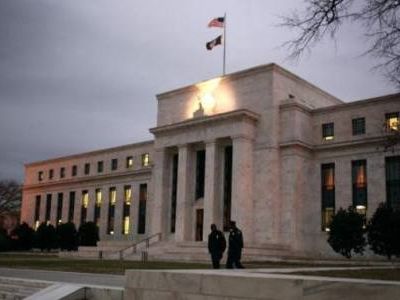
Federal Reserve Chair Jerome Powell has advocated for a "more muted" central-bank approach, seeking to phase out forward guidance and the dot plot, but has encountered public resistance within the Fed. With inflation data remaining volatile and the outlook for interest-rate hikes uncertain, his colleagues have been vocal in efforts to temper market expectations. Maintaining complete silence risks amplifying market volatility, leaving Powell to weigh policy transparency against the need for clear communication in his upcoming remarks.
Federal Reserve Chair Ben Bernanke has been vigorously advocating a "more muted" central-bank style, yet he is facing increasingly overt resistance within the Fed. Meanwhile, the high degree of uncertainty surrounding the interest-rate outlook is putting the costs of this silent‑policy approach to the test.
Since the Federal Reserve raised interest rates in September, Mr. Wash's colleagues have made more than 40 public appearances—via television, podcasts, interviews, social media, and various forums—to articulate their policy stance, effectively tempering market expectations for further rate hikes. Inflation data released on Wednesday showed that consumer prices rose 3.7% year over year in September, once again shaking up market forecasts for the Fed's policy trajectory; a rate hike in October is now seen as roughly 50‑50. This unusual level of uncertainty has made the cost of Mr. Wash's preference for silence all the more apparent.
 On Friday in Bangkok, Wash will address the International Monetary Fund's annual meeting, marking the Fed's final opportunity to publicly guide market expectations ahead of its interest-rate decision in less than two weeks.
Wash's Philosophy of Silence: Let the Data Speak
Warsh's communication philosophy follows an internal logic: the less Fed officials discuss the path of interest rates, the more the market relies on economic data to form its judgments, thereby providing higher‑quality signals for the Fed's own policy decisions.
At the central bank's annual conferences held in Sintra, Portugal, and Jackson Hole, Wyoming, as well as at congressional hearings and during press Q&A sessions, Mr. Wash has consistently maintained this position. He has already removed the relevant language on "forward guidance" from the Fed's post-meeting statement and convened a working group—widely expected to recommend scrapping the Fed's long-standing quarterly interest-rate projections, commonly known as the "dot plot."
This shift entails overturning decades of effort—efforts during which the Federal Reserve painstakingly established its current communication framework as it gradually moved away from the opaque style of its former chair, Alan Greenspan. Greenspan's approach was one that Warsh publicly admired. Notably, U.S. economists Robert Hall and Michael Woodford were just awarded the 2026 Nobel Prize in Economics; their groundbreaking research has provided a crucial theoretical foundation for the Fed and other central banks to adopt more transparent policy communication.
Internal resistance: Colleagues speak out publicly
Nevertheless, several officials within the Federal Reserve have made it clear that they will not be silenced on this issue.
Beth Hammack, president of the Federal Reserve Bank of Cleveland, spoke plainly in a Reuters interview on Monday:
"If anyone seeks to argue that refraining from speaking can help the public, families, and businesses make better decisions and enhance our institution's credibility, I am all ears. However, I believe this argument is hard to sustain."
The language used by New York Fed President John Williams and Federal Reserve Vice Chair Philip Jefferson was particularly forceful, and their unusually clear statements played a key role in tempering market expectations of rate hikes. Richard Clarida, Global Economic Advisor at investment firm PIMCO, remarked of the two: "The market has taken note that two members of the 'troika' have been sending a highly consistent message." — The Fed's vice chair, the president of the New York Fed, and the Fed chair are generally regarded as the three most influential policymakers.
Clarida, who previously served as Vice Chair of the Federal Reserve, stated that at the time he viewed chairing the communications committee as part of his duties. However, he also noted, "The environment we are in calls for listening to all members of the committee."
The Risks of Silence: Volatility or Amplification
Federal Reserve Governor Christopher Waller offered another layer of caution in remarks delivered in Turkey last week. While he echoed Warsh's view that committing to a specific interest-rate path could hinder the Fed's ability to respond flexibly to new information, he also warned that failing to provide any guidance at all "could catch markets off guard and spark volatility," leading investors to price in an加息 trajectory that imposes monetary tightening far stronger or far weaker than the Fed anticipates.
This concern is far from unfounded. In August this year, Richard Fisher offered no detailed explanation for the Fed's decision in July to keep interest rates unchanged, merely stating that he maintained a "zero-tolerance" stance on inflation, which prompted the market to heavily bet against any near-term rate hikes. Ultimately, Fisher was forced to break his silence and signal that a rate hike was indeed imminent—though he once again reiterated his preference for a "more dovish Fed."
Earlier this year, public statements by Williams and Jefferson likewise helped to correct market expectations at a time when they diverged sharply from the Federal Reserve's September dot plot—where officials' projected path of rate hikes was far more moderate than market consensus.
The Value of Communication: A Balance Yet to Be Clarified
Former Chicago Fed President Charles Evans told economists in Cleveland this week, "Transparency is essential to how central banks seek to achieve their objectives." Following the 2007–2009 financial crisis, Evans strongly advocated for a robust form of forward guidance to support economic recovery.
Wellington Management's macro strategist, Juhi Dhawan, offers an alternative interpretation: the remarks by Jefferson and Williams may have precisely enabled Wash to "convey his message without having to be the one to deliver it himself."
"I'm willing to give him some time to find that ideal form of communication," Dhawan said. "Over the past few months, as the Federal Reserve has worked to recalibrate its interest-rate trajectory, the value of communication—if anything—has become quite clear."
Wash's silence experiment remains inconclusive. His speech in Bangkok on Friday may offer new insights to this ongoing debate.
Editor/rice