
In its announcement, the company stated that, due to the high price base in the prior period, the growth rates of DRAM and NAND Flash prices have narrowed significantly compared with earlier periods. Consequently, the marginal contribution of rising memory prices to the company's earnings has slowed markedly, as the memory industry transitions from a consumer‑driven price cycle to an AI‑powered technology cycle.
Memory chip module manufacturer$LONGSYS (09976.HK)$The company released a strong earnings forecast, but also cautioned that the price-driven tailwinds in the memory sector—key to this round of soaring profits—are gradually fading, and the industry's underlying growth dynamics have quietly shifted.
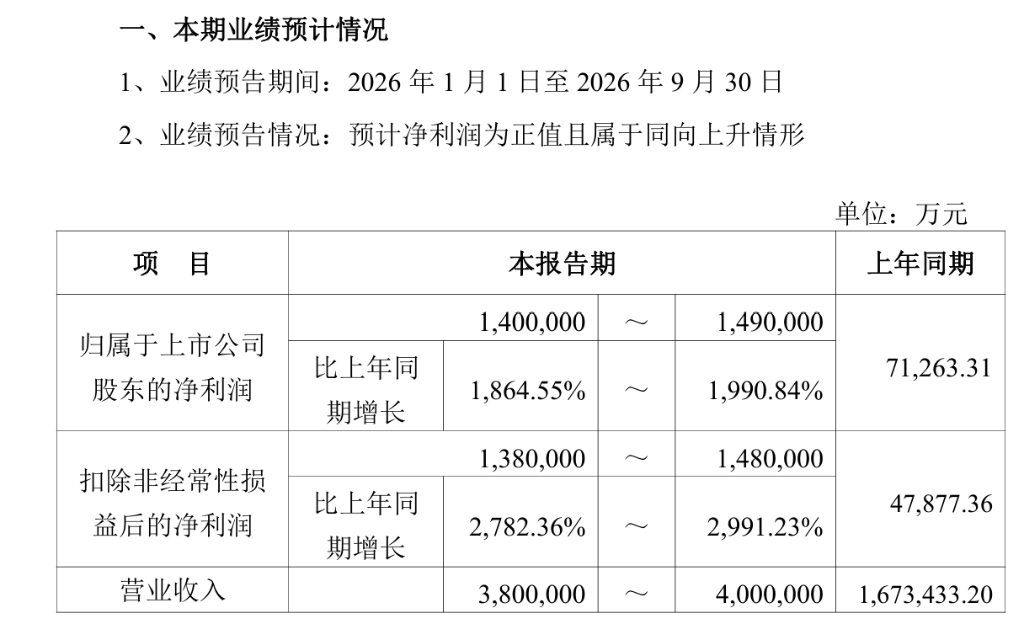
On Wednesday, Jiangbolong issued an announcement projecting that its net profit attributable to shareholders for the first three quarters of 2026 will range from RMB 14.0 billion to RMB 14.9 billion, representing a year-on-year increase of 1,864.55% to 1,990.84%. Revenue is expected to reach RMB 38.0 billion to RMB 40.0 billion, more than doubling compared with RMB 16.734 billion in the same period last year.
 In the third quarter, non‑GAAP net profit ranged from RMB 3.753 billion to RMB 4.753 billion, representing a year‑over‑year increase of 740.33% to 964.26%. The company also disclosed that its operating cash flow turned positive in the third quarter and that its year‑end debt-to‑asset ratio fell below 50%, reflecting a marked improvement in financial health.
In its announcement, the company explicitly stated that the price increases for DRAM and NAND flash memory have narrowed significantly compared to earlier periods, owing to the high base effect, and that "the marginal contribution of rising storage prices to the company's earnings has slowed markedly." This statement suggests that the price cycle that has fueled above‑expectation profitability over the past several quarters is now receding, and investors may need to adjust their expectations for future profit growth accordingly.
Price margins are narrowing, signaling a cyclical shift in the storage industry.
In the third quarter, the global memory market remained broadly supply-constrained, but headwinds on the price front have eased significantly.$LONGSYS (09976.HK)$In its announcement, the company characterized the current industry cycle as shifting "from a consumer‑price‑driven cycle to an AI‑powered technology cycle," a judgment that directly points to a structural shift in the sources of future industry profitability: the profit elasticity derived solely from price hikes is set to narrow, and whether firms can capture market share in high‑end AI‑related products will become a key determinant of valuation divergence.
This trend is also corroborated by the data. In the first three quarters, non‑recurring net profit grew year over year by roughly 2,782% to 2,991%, but in the third quarter alone, the growth rate had already moderated to a range of 740% to 964%. Although the absolute figures remain impressive, the deceleration in quarter‑over‑quarter growth is clearly evident.
Customer and product mix upgrades underpin earnings resilience.
Faced with weakening price-driven forces,$LONGSYS (09976.HK)$The source of the company's earnings resilience is attributed to the ongoing optimization of its customer and product mix. The company notes that the share of major, high-end, and global customers continues to grow, with technology-driven differentiation anchored in proprietary chips and a self-developed software architecture.
On the product front, high-end new products such as UFS 4.1, mSSD, and ePOP5x have already achieved large-scale commercial deployment with several well-known major customers, while the global operations of international brands Lexar and Zilia continue to grow at a rapid pace. The company also disclosed that its collaborations in edge-side AI technology have further expanded to include AMD, Qualcomm, Unisoc, and other leading global CPU manufacturers, with the scope of its strategic footprint continuing to broaden.
Positive cash flow and deleveraging send favorable financial signals.
In addition to its profit figures, Longsys' latest earnings forecast highlights two key measures of financial health: positive operating cash flow in the third quarter and a year-end debt-to-asset ratio below 50%.
For companies in the storage industry, operating cash flow is a key metric for assessing their true ability to generate cash. Previously, high profitability coupled with strained cash flow had raised concerns among some investors. The improvement in these two metrics indicates, to a certain extent, that the company has made substantial progress in repairing its balance sheet following a period of rapid expansion.
The company stated that the preliminary earnings forecast figures are based on initial calculations by the finance department and have not yet been audited by an external auditing firm. The final, audited financial data will be disclosed in the third-quarter report for 2026.
Edited by melody