Retail sales growth of 0.8% was entirely driven by gas stations, while the PPI posted its largest increase in more than four years: energy inflation is now permeating the U.S. economy, sharply heightening pressure on the Federal Reserve to raise interest rates in December.
On Thursday, the U.S. Department of Commerce and the Bureau of Labor Statistics released two sets of data that shed clearer light than Wednesday's CPI on how the energy shock is rippling through the U.S. economy.
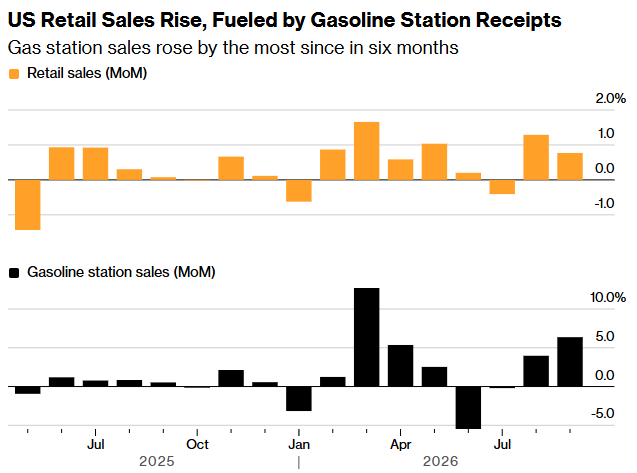
On the retail front, September retail sales rose 0.8% month-over-month, beating economists' expectations of 0.3%. However, the August figure was revised up to 1.3%. Excluding automobiles and gasoline, growth slowed to just 0.2%, while a "core" measure—stripping out food services, auto dealers, home‑improvement stores, and gas stations—increased by only 0.1%, well below the expected 0.3%. Among 13 categories, eight posted gains, led by gas stations, whose sales surged 6.4%.
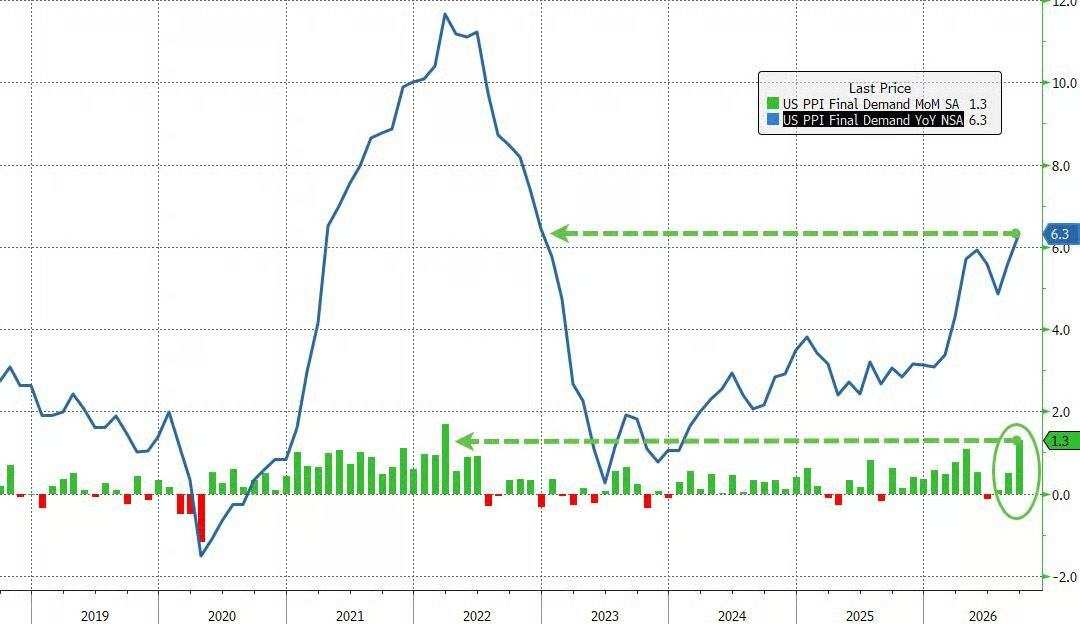
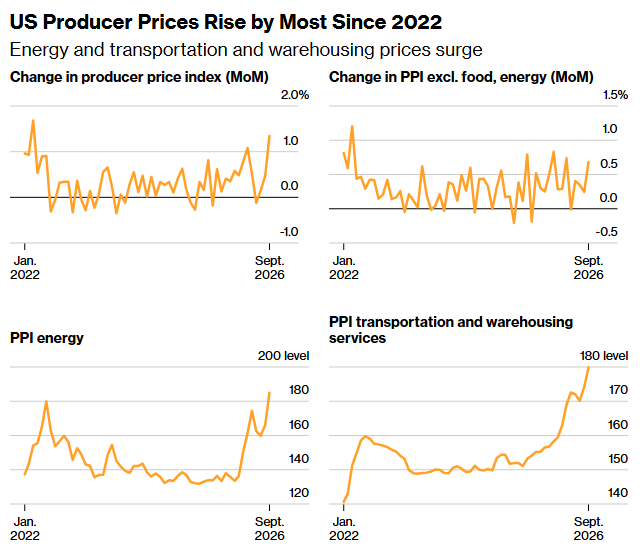
 On the other hand, inflation remains a concern: In September, the Producer Price Index (PPI) rose 1.3% month-on-month and 6.3% year-on-year, marking the largest monthly increase since March 2022 and the highest annual rise since December 2022—both significantly exceeding expectations. Excluding food and energy, the core PPI increased 0.7% month-on-month and 5.0% year-on-year, up sharply from 0.2% and 4.6%, respectively, in August.
From the Oilfield to the Checkout Counter: A Fully Established Supply Chain
The first link in this chain is crude oil.$Brent Last Day Financial Futures (DEC6) (BZmain.US)$On Wednesday, prices rose 0.35% to $106.06 per barrel, as two vessels were attacked in the Strait of Hormuz and Iranian officials announced they are deploying new tactics to target shipping, reigniting concerns about supply disruptions. Since the U.S.-Iran conflict erupted in February, this geopolitical flashpoint has been a key driver of U.S. inflation.
The second factor is gasoline prices. In September, gasoline prices surged 7.1% month-on-month, pushing the monthly CPI to a year-on-year increase of 3.7% (compared with 3.4% in August), above the expected 3.6%. From August to September, gasoline prices rose by 9.1%, accounting for more than half of the overall CPI increase.
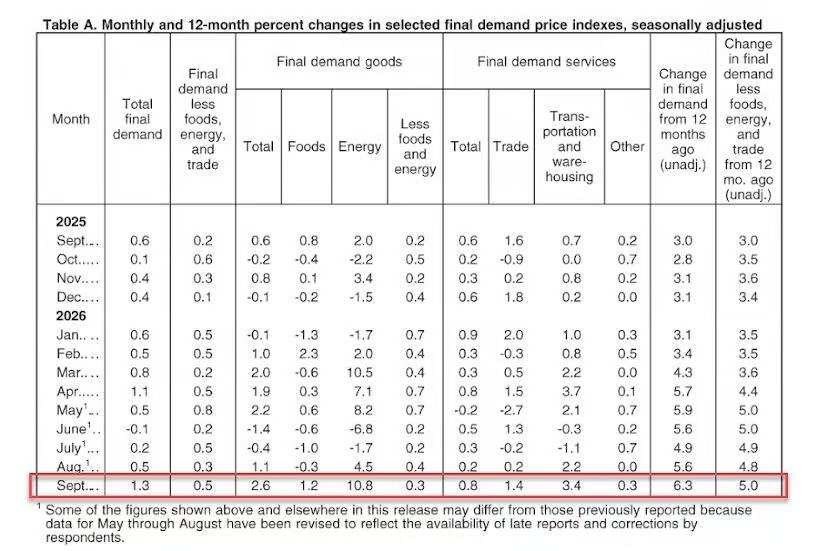
The third link is the corporate sector, which is precisely what Thursday's PPI report highlighted: energy prices rose 10.8% month-over-month, transportation and warehousing costs increased by 3.4%, and food prices climbed 1.2%. A noteworthy transmission channel is airfares—listed as one of the components of the PCE price index—which surged 5% on a monthly basis, indicating that fuel costs are being passed along through the transportation segment into service-sector pricing. In September, half of the increase in the PPI's final‑demand goods index was attributable to higher gasoline prices, which jumped 20.3%. Price indices for diesel, fresh and dried vegetables, jet fuel, residential electricity, and crude oil also all posted gains.
Another clue is that the profit margin for wholesale and retail trade services jumped 1.4% month-over-month, marking the largest increase since April; this indicator has long been used by the market to gauge whether companies are absorbing tariff costs themselves or passing them on to customers. Earlier this year, the Supreme Court overturned most of Trump's tariffs, but the administration is invoking other authorities to keep imposing additional duties, and following the collapse of August negotiations, the trade war with Canada is also escalating.
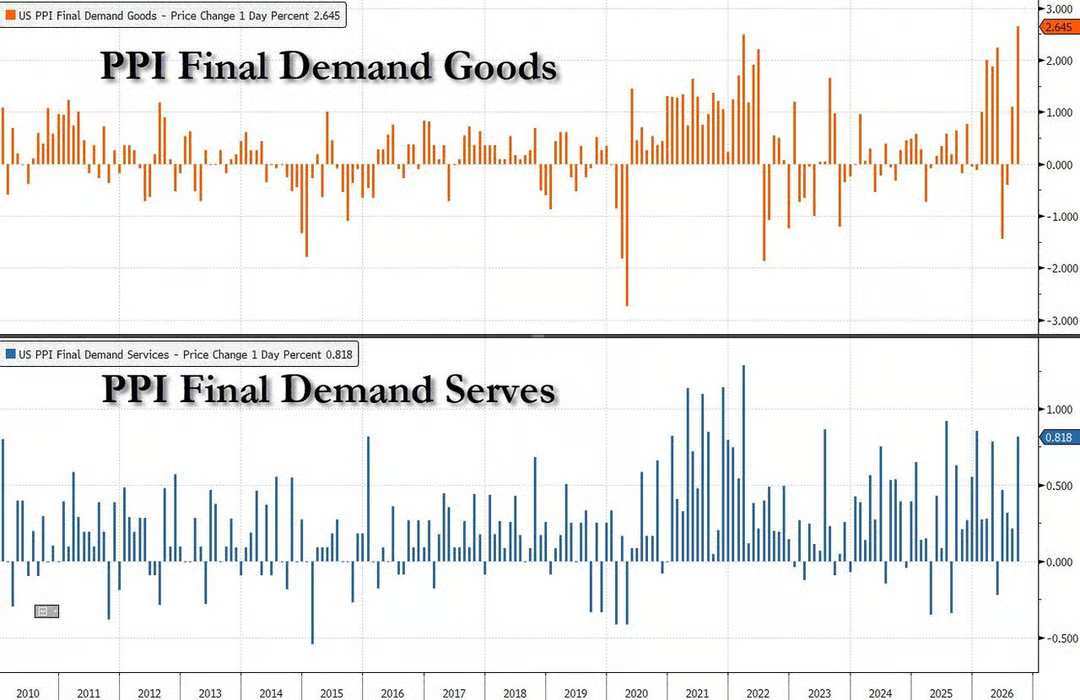
However, the transmission of price pressures is not uniform. Among the components of the PPI, prices related to data-center construction have instead eased: electronic components and accessories fell 0.3% month-on-month, while prices for computers and computer equipment rose slightly by 0.1%, and the broad construction‑cost index remained broadly unchanged; several healthcare categories also showed relative weakness. These figures suggest that current inflationary pressures are concentrated in energy and its immediate downstream sectors, rather than spreading across the board—at least as of September.
Consumption: The numbers haven't collapsed, but purchasing power is being eroded.
Total retail sales exceeded expectations, which can easily be interpreted as "consumption remains robust." However, a disaggregated analysis yields a much more cautious conclusion. First, the 0.8% increase is heavily weighted by the gasoline stations category; excluding it leaves just 0.2%. Further stripping out automobiles, building materials, and food services narrows the figure to 0.1%. While the retail data are seasonally adjusted, they are not adjusted for inflation; factoring in September's 0.6% month‑over‑month rise in prices, real retail sales are "even flatter than flat."
Secondly, real purchasing power is declining. The report notes that inflation-adjusted wages fell again in September; consumers continue to spend largely thanks to the high-income households whose incomes are bolstered by stock market gains—a phenomenon often referred to as a "K-shaped" economy. The Federal Reserve's Beige Book, released on Wednesday, corroborates this: from late August to early October, most districts reported consumer spending as "little changed or unchanged"; even in Dallas, where businesses reported robust retail sales, there were "some reports of more cautious spending among lower-income customers."
Another set of data from the Bank of America Institute this week provides more granular evidence: the use of buy-now, pay-later (BNPL) services is on the rise. The institute described this trend as "not yet overly concerning," but also noted that "nearly one in five households using BNPL has outstanding balances exceeding $500." Both the CEOs of Domino's Pizza and Albertsons acknowledged during their recent earnings calls that many consumers are still navigating a challenging economic environment.
Moody's chief economist, Mark Zandi, presented a more striking quantitative assessment on October 12: since the U.S.-Iraq war erupted in February, the cumulative cost borne by each U.S. household has risen to nearly $2,000, totaling approximately $265 billion nationwide. Among these, the average price of gasoline has climbed from under $3 before the war to $4.37 per gallon, diesel has surpassed $6, and aviation fuel has nearly doubled. Energy expenses alone have increased by nearly $1,100 per household—covering both direct payments at gas stations and higher commodity prices driven by rising trucking and air transport costs—and "at current fuel prices, household energy expenditures are still rising by an additional $50 per week." He also noted that interest rate hikes have pushed mortgage costs to 7.5%, adding roughly another $540 in annual burdens per household, while military spending amounts to about $360 per household—meaning the total cost of the war has already offset roughly half of the income gains enjoyed by typical American households over the past eight months.
On the other side of the ledger lies unexpected resilience: a robust labor market, larger-than-usual tax rebates, and strong equity‑market gains have collectively underpinned consumer demand for much of this year. Economists project that third‑quarter consumer spending will grow at an annualized rate of about 3.4% (compared with 3.8% in the second quarter), while GDP growth is forecast around 3.0% (versus 2.2% in the second quarter). On Thursday, another set of data also came in stronger than expected: the New York Fed's October manufacturing index surged 17.9 points to 25.5, topping all economists' forecasts in a Bloomberg survey and marking the strongest reading in nearly five years, with notable increases in new orders and shipments. Yet in the same report, the six‑month price‑paid expectations index climbed to its highest level since 2022, signaling that firms themselves anticipate inflationary pressures will persist.
The Fed's helplessness in the face of supply-driven inflation: October is highly likely to see a pause, with the pressure now shifting to December.
The two inflation reports have put the Federal Reserve in an even tougher spot. Inflation has remained above the 2% target for five and a half years. Currently, the federal funds rate stands at 3.75%–4.00%; last month, the Fed raised rates for the first time in three years, with the next policy meeting scheduled for October 27–28. According to CME FedWatch, following Wednesday's CPI release, the probability of a rate hike this month surged from around 22% to as high as 50%, before easing back and settling at roughly 30%; meanwhile, bets on a December rate hike remain firmly anchored, with Citi forecasting a December increase and market expectations for that month once approaching 90%.
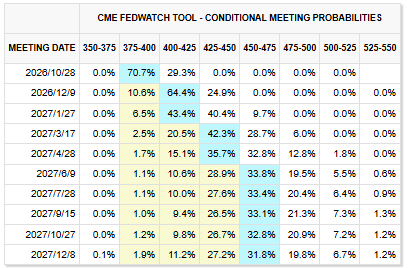
The divergence on Wall Street is almost entirely centered on "October or December."
TD Securities strategists Oscar Munoz and Gennadiy Goldberg: Today's report has increased the likelihood of a rate hike in October, "but we still expect the Fed to hold steady and opt for December, as the market has already done part of the heavy lifting for them."
Skyler Weinand of Regan Capital: "Inflation is stubborn and moving in the wrong direction—this couldn't be clearer," forecasting a pause in October and a resumption of rate hikes in December.
Seema Shah of Principal Asset Management: The question is whether stronger core inflation will be enough to alter the Fed's trajectory; markets are clearly uneasy, "but this report still falls short of providing a compelling case for resuming rate hikes in October."
Jeff Roach of LPL Financial: Inflationary pressures are spreading beyond energy, suggesting that the final stretch toward the target could be bumpy and that interest rates will remain elevated. This report has made the Fed's decision this month more complicated.
Chicago Fed President Austan Goolsbee's remarks last month underscore the current policy dilemma: supply-driven inflation may be easier to tame than post-pandemic demand-driven inflation, but "it won't be painless either."
Beth Ann Bovino, Chief Economist at U.S. Bank: "Inflation is the illness, and the remedy the Federal Reserve is administering now is higher interest rates—I'm not sure which hurts more, because both do."
This may well be the "policy trap of 2026": the Federal Reserve cannot produce an extra barrel of oil or bring an end to a war, nor can it conjure up more semiconductor chips out of thin air. All it can do is slow down the rest of the economy—sectors unrelated to oil drilling or data-center construction—and those most likely to feel the impact will be precisely the people who are already paying more. Walsh has pledged not to let his short-term policy outlook guide market expectations; on Friday, he will join IMF Managing Director Kristalina Georgieva for a fireside chat in Bangkok, a speech whose tone will be under particularly close scrutiny.
U.S. stocks face a test: high yields pose a hurdle.
Following Wednesday's CPI,$S&P 500 Index (.SPX.US)$It fell 1.11% to 7,718 points, ending the longest streak in six years without a single-day decline of at least 1%, and marking its worst daily performance since July.$Nasdaq Composite Index (.IXIC.US)$Fell 1.88% to 26,692 points;$Russell 2000 Index (.RUT.US)$Entering correction territory; a major chip‑industry index fell 4.3%, with cumulative losses of about 12% over six trading days.$U.S. 10-Year Treasury Notes Yield (US10Y.BD)$It briefly jumped above 5.32% from below 5.17%, then gave back most of its gains; the U.S. dollar reached its highest level since May 2025.
Following the release of Thursday's PPI and retail sales data, U.S. Treasury yields extended their decline, while the Nasdaq and S&P 500 opened lower. However, safe-haven demand pushed the 10-year yield down 11 basis points to 5.08%, Nasdaq 100 futures fell 1.1%, and Brent crude retreated to around $104—markets did not react along the straightforward path of "higher inflation → more aggressive rate hikes," but instead reflected the ongoing rout in AI‑related stocks (Anthropic's latest investor disclosure indicated a slowdown in growth,$Korea Composite Index (.KOSPI.KR)$At one point, it plunged 7.6%,$Samsung Electronics (005930.KR)$and$SK hynix (SKHY.US)$(Down more than 9%) serves as the primary safe-haven theme.
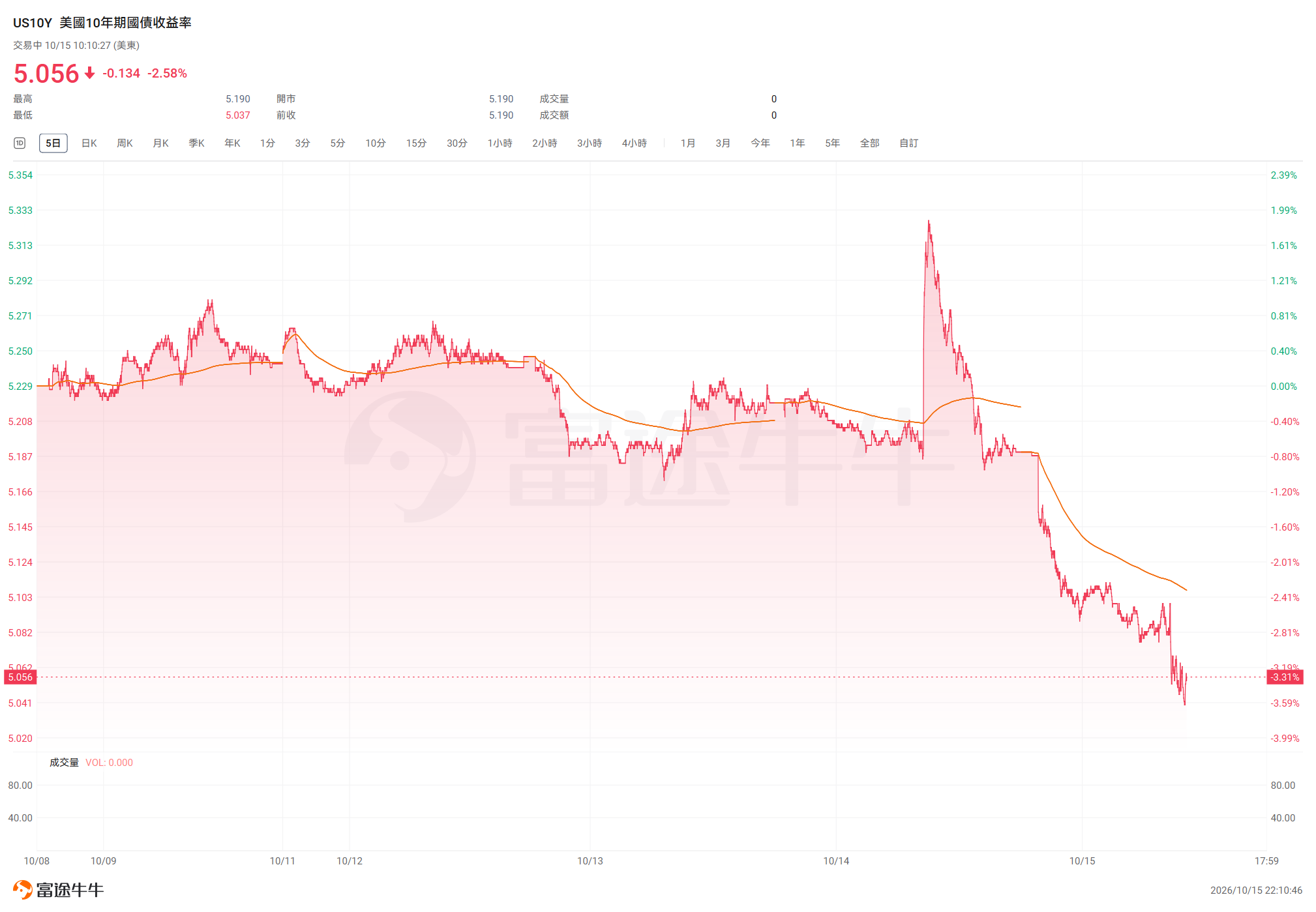
At the structural level, high yields exert downward pressure on U.S. equities through two channels: first, rising discount rates directly depress the valuations of overvalued assets; second, the massive capital expenditures required for data centers and AI chips are heavily reliant on financing, so higher borrowing costs directly raise the hurdle rate for such projects—this is also why, this week, concerns in the AI sector have broadened from "valuation worries" to "corporate‑debt anxieties." As macro strategist Tatiana Darie put it: "The specter of high yields returned to the market after Wednesday's inflation data, weighing on equities and prompting traders to flock to value stocks and low‑beta sectors."
However, there are also opposing views. Ulrike Hoffmann-Burchardi of UBS Group's Chief Investment Office believes that intensifying competition in the AI sector, rising financing needs, and higher interest rates may temporarily amplify volatility, but "we view this correction as an anticipated recalibration rather than a fundamental breakdown of the AI investment narrative"; meanwhile, Adam Schickling, a senior economist at Vanguard, points out that as Americans become more "price-sensitive" and the economy benefits from productivity gains, inflation should ease, though "patience is required."
 Want to pick stocks or analyze them? Looking to understand your portfolio's opportunities and risks? For all your investment questions,Just ask Futubull AI!

Edited by melody