
Author: Ryan Yoon, Tiger Research
Compiled by: DeepTech Flow
DeepTech Insight: While coin prices have rebounded, funding in the primary market has become even more selective. Tiger Research's Q3 2026 crypto‑industry investment report, drawing on RootData, highlights that M&A activity has shifted from acquiring entire companies to targeting licenses and core capabilities; lead‑investing VCs are ceding ground to CEX‑affiliated ecosystem funds, and only a handful of sectors endorsed by institutional players are still able to secure capital.
Key Takeaways
 The number of M&A deals remained broadly stable, but large‑scale acquisitions have given way to smaller transactions aimed at acquiring specific capabilities, such as licenses, payment solutions, and institutional trading expertise.
Veteran lead VCs are losing influence over deal terms, while strategic investors are becoming more active—among them, CEX‑affiliated VCs seeking to bolster their own exchange and public‑chain ecosystems.
In the early rounds, such as Seed, funding has contracted, with capital concentrating on Series A to Series C companies that have already validated their business models through revenue and regulatory approvals.
Venture capital equity is declining, while financing expansion based on cash flow—such as bond issuance, credit lines, and SPAC listings—is on the rise.
Capital is concentrating in sectors that are closely tied to traditional finance and real-world use cases—such as payments, stablecoins, tokenized securities, and AI‑related infrastructure—rather than in standalone blockchain ecosystems.
1. The market is recovering, with opportunities tilting in favor of institutional investors.
In the third quarter of 2026, crypto market sentiment shifted from fear to greed.
Bitcoin, which fell for two consecutive quarters in the first half of the year, surged 43% in the third quarter—the strongest Q3 performance since 2017—while U.S. spot Bitcoin ETFs recorded net inflows of $6.34 billion. The Crypto Fear & Greed Index, which had remained in the extreme fear zone throughout the first half, moved into the greed zone on August 20 and stayed there for most of September.
However, the disclosed deal values indicate that this round of market recovery has not translated into increased investment in crypto firms.
Funds returning to the market as prices rebounded were channeled directly into crypto assets, whereas corporate‑side investments—often locked up for years—did not follow short‑term sentiment. The following sections examine the key developments of the third quarter.
2. The Five Major Switches in the Third Quarter
M&A: Shifting from Growth‑Driven Acquisitions to Capability‑Driven Acquisitions
VC Market: Lead Investors Lose Influence, Strategic Capital Gains Momentum
Funding Stage: Cautious in the early stages, with capital focused on validated business models.
Financing methods: IPOs and debt expansion—more than just equity.
Track: Capital is concentrating on infrastructure that interfaces with traditional finance.
2.1. Mergers and Acquisitions: Shifting from Expansion‑Driven Acquisitions to Capability‑Driven Acquisitions
In the third quarter, the number of M&A deals remained on par with the first-half pace, but deal sizes declined significantly.
In the first quarter, there were 39 M&A deals; in the second quarter, 36; and in the third quarter, 37—yet the overall deal volume appears to be shrinking. According to data from Architect Partners, a consultancy that independently tracks crypto‑related M&A, the number of crypto M&A transactions fell 7% quarter over quarter in the third quarter, while the total deal value declined by 83% compared with the previous quarter.
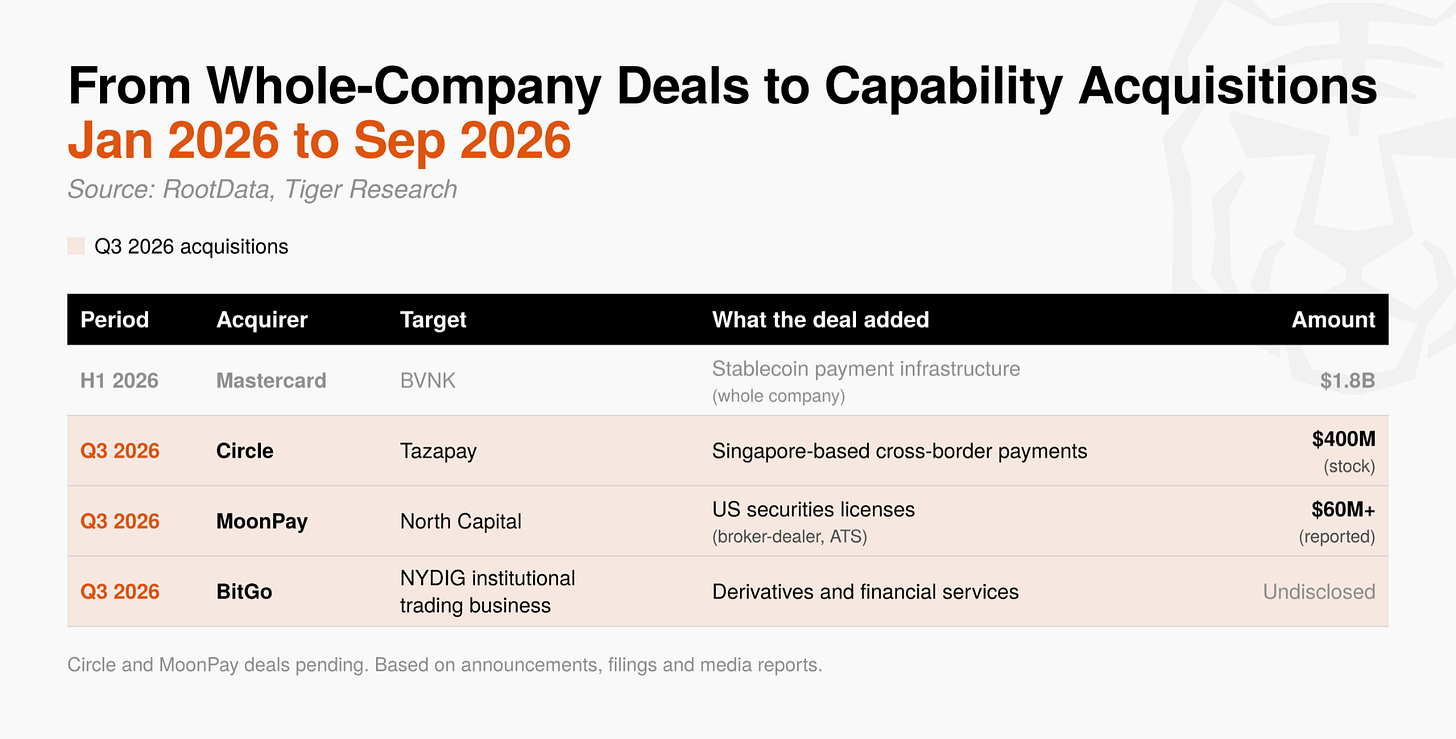
The decline in deal volume reflects a shift in the types of targets being acquired. In the first half of the year, the market was driven by transactions involving the acquisition of entire companies to launch new business lines—for example, Mastercard's $1.8 billion purchase of BVNK. By contrast, third-quarter M&A activity was more focused on filling gaps in buyers' existing portfolios.
Circle agreed to acquire the Singapore-based cross-border payments company Tazapay, MoonPay agreed to acquire North Capital, which holds a U.S. securities license, and BitGo acquired NYDIG's institutional trading business.
Developing licenses and building capabilities in-house takes a long time, whereas acquisitions can deliver both almost immediately. As the industry's competitive landscape continues to take shape, that time saved itself becomes a key source of competitive advantage. M&A activity is rapidly shifting from expanding into new lines of business to acquiring firms that fill critical capability gaps.
2.2. VC Market: Lead Investors Lose Influence, Strategic Capital Gains Momentum
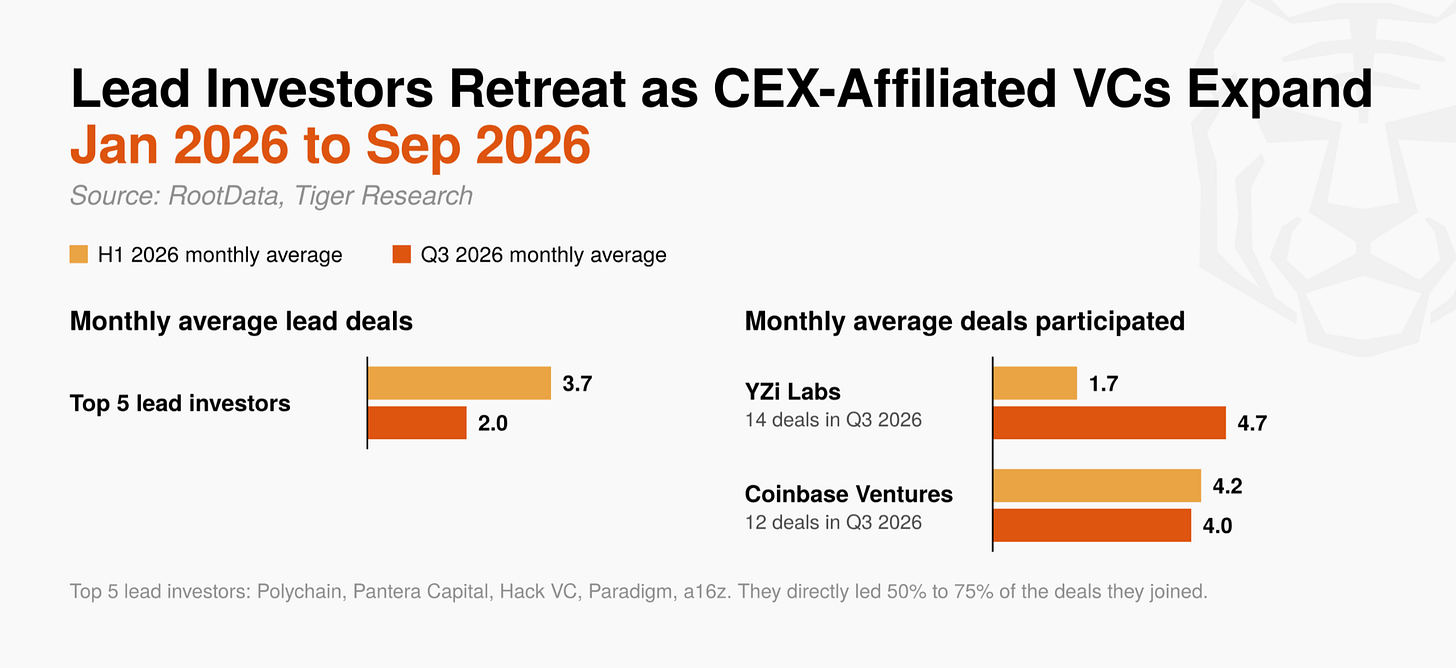
The influence of the leading investors has declined markedly. Since 2024, the five most active lead investors—Polychain, Pantera Capital, Hack VC, Paradigm, and a16z—have averaged 2.0 lead investments per month in the third quarter, down from 3.7 in the first half of the year.
These institutions previously led 50% to 75% of the deals they participated in and set market valuations; their influence over deal rounds is now waning.
By contrast, YZi Labs (formerly Binance Labs) participated in 14 deals, nearly three times its average monthly pace for the first half of the year; following it was Coinbase Ventures, which participated in 12 deals.
CEX‑focused VCs are stepping up because their investment objectives differ structurally. Financial‑oriented VCs seek capital gains from equity or asset appreciation, whereas CEX‑focused VCs can also reap additional benefits—such as higher trading volumes and new users—when portfolio projects launch on the exchange itself or on public blockchains like BNB Chain or Base.
Accordingly, even in the face of price and valuation uncertainties, these institutions still have compelling reasons to keep investing. As a result, the third‑quarter funding rounds more closely reflect the influence of strategic investors seeking to strengthen their own platforms, rather than that of financial investors focused on pricing.
In the third quarter, the VC market underwent a shift: moving from financially driven investments focused on high returns to strategic investments aimed at fostering business‑ecosystem synergies.
2.3. Financing Stage: Exercise Caution in the Early Stages, with Funding Aligned to Proven Business Models
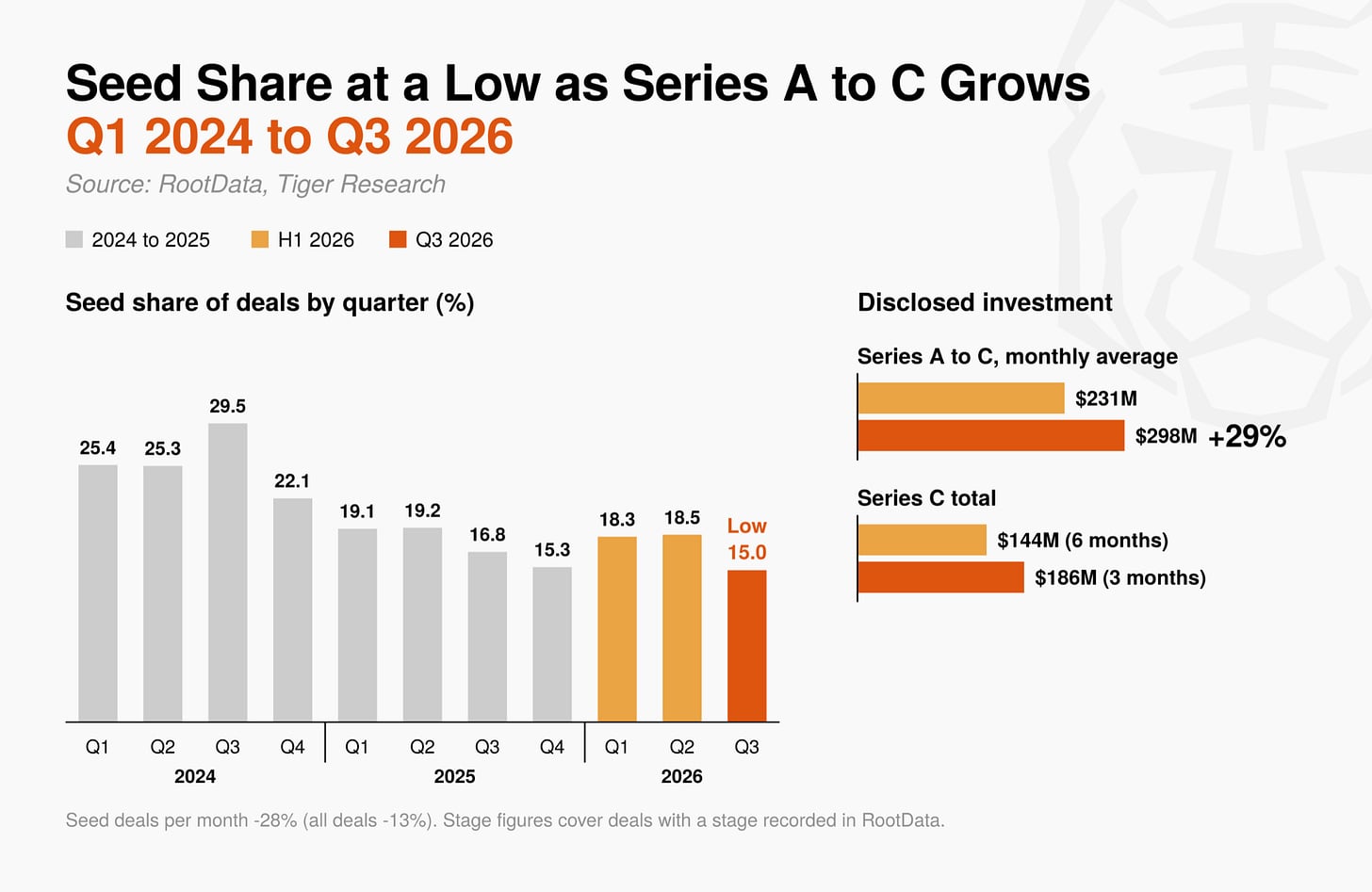
Investors are reluctant to take on unproven risks. Seed‑stage deals account for 15.0% of all transactions, the lowest quarterly share since 2024; the average monthly number of seed‑stage deals has fallen by 28%, more than twice the 13% decline seen across all deal types.
The disclosed investment amounts across Series A to Series C rounds have risen by an average of 29% month over month, with Series C funding in the third quarter alone surpassing the total for the first half of the year.
Early-stage investing spreads capital across numerous small projects, relying on a handful of successful ventures to generate high returns. For this model to work, follow-on investors must continue to acquire equity or tokens at increasingly higher valuations.
In the third quarter, corporate‑side investment overall became more cautious, and expectations for co‑investment in this space appear to be waning. Investors are instead concentrating their capital on expansion rounds for businesses that have already validated their revenue streams and licensing frameworks.
Jeeves and EDX Markets, which closed their Series C rounds in the third quarter, are both payment and trading‑infrastructure firms, reflecting the same trend. Market investment criteria are shifting from token‑issuance roadmaps to evidence of a viable, operating business.
2.4. Financing Methods: Going Public and Debt Expansion—Beyond Equity
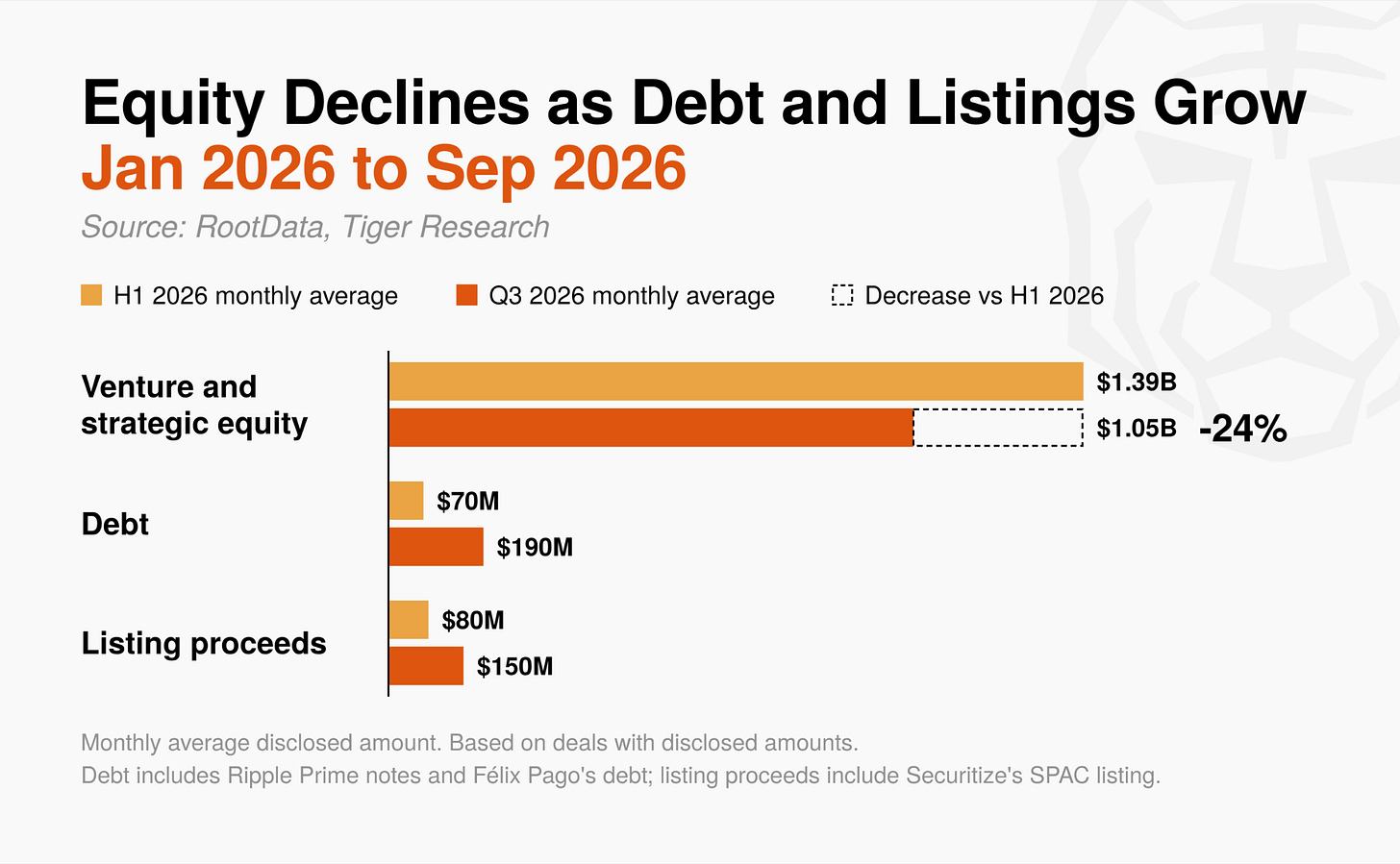
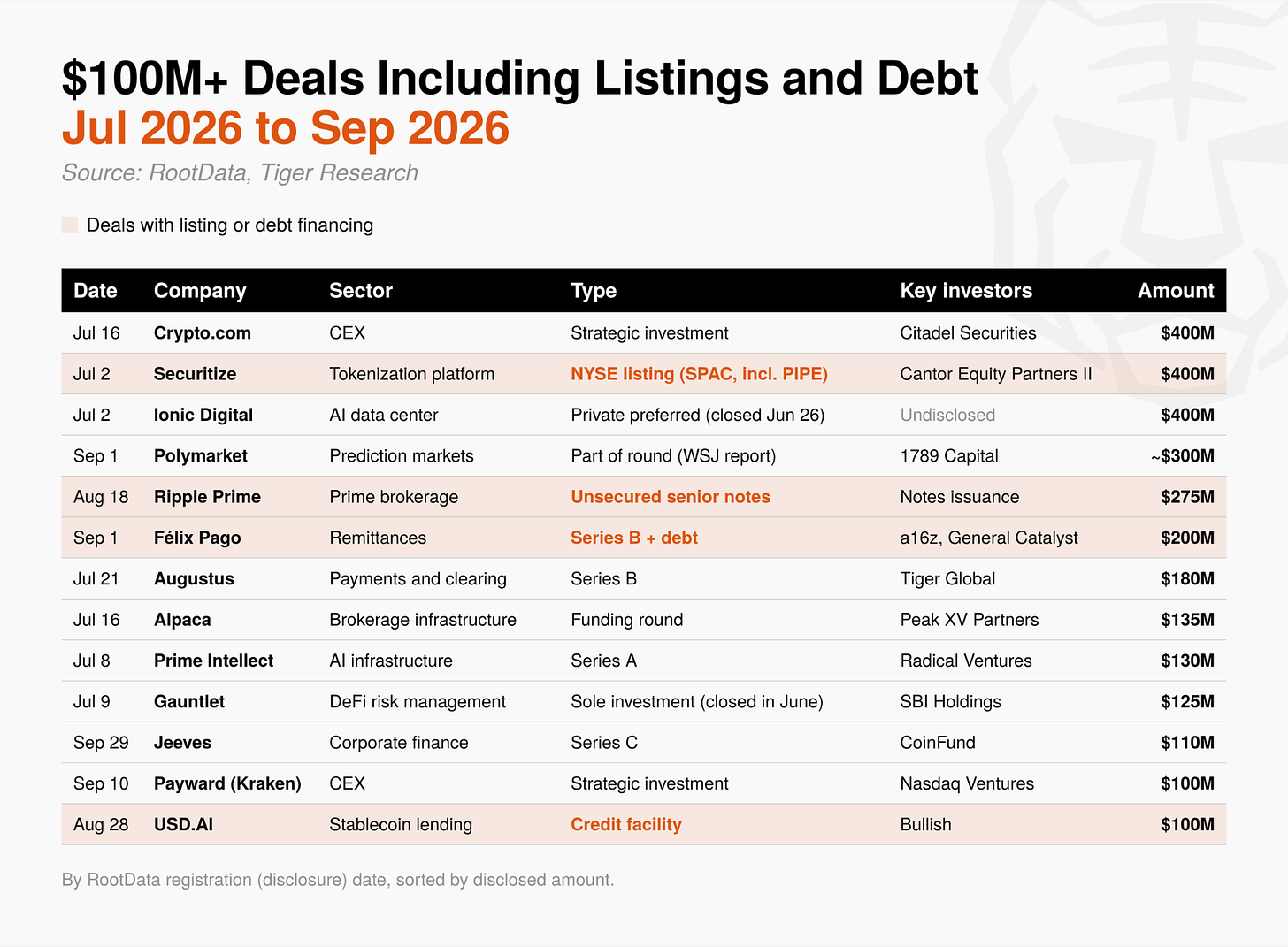
In the third quarter, substantial capital also flowed from sources other than venture‑capital equity. Among 13 deals valued at $100 million or more, four involved public listings or debt financing.
Securitize listed on the NYSE via a SPAC merger, while Ripple Prime issued $275 million in unsecured senior notes. On a monthly average basis, venture capital and strategic equity investments declined by 24%, debt financing rose from $70 million to $190 million, and IPO proceeds increased from $80 million to $150 million.
Bonds and listings require borrowers to demonstrate repayment capacity or obtain a public-market valuation. In the first half of the year, debt financing primarily came from Bitcoin treasury firms like Metaplanet, which borrowed funds to purchase coins.
In the third quarter, businesses with cash flow—such as prime brokerage, remittances, and stablecoin lending—borrowed to expand operations. The basis for repayment shifted from Bitcoin prices to business cash flow. Some companies can now raise capital like ordinary enterprises, without relying on venture capital, which may further narrow VCs' role to the early stages.
2.5. The Track: Capital Concentration in Infrastructure Linking to Traditional Finance

From a sector‑by‑sector perspective, capital flows in the third quarter were directed toward areas that bridge traditional finance and the crypto ecosystem, rather than toward new layer‑1 or layer‑2 protocols.
The share of infrastructure deals among disclosed investments more than doubled, rising from 8.1% in the first half of the year to 18.2%. The increase was driven by AI‑related transactions rather than new blockchain mainnets, led by Ionic Digital, which is shifting its operations to AI‑powered data centers, and Prime Intellect, an AI training‑infrastructure company.
Approximately half of the capital categorized under "Other" flows to tokenized‑security infrastructure providers such as Securitize and Alpaca, while payments and stablecoins are the only segments whose share has remained broadly stable.
Sectors with little connection to traditional finance remain far quieter. In Q3 investment, Polymarket—accounting for roughly $300 million per deal—made up 91% of the total. DeFi investments fell by 71%, driven by a decline in deal volume, and now represent just 3.0% of the overall pool; the largest DeFi transaction was the Cari Network, a deposit‑token platform backed by U.S. regional banks. Meanwhile, the custody sector saw no new funding, with activity confined to consolidating existing players, such as BitGo's acquisition of NYDIG's trading business.
In the third quarter, capital flowed exclusively to established firms that already hold licenses and regulatory approvals, or to projects integrated with traditional financial institutions such as banks. Investment has clearly shifted away from projects building new crypto ecosystems, instead gravitating toward distribution channels and infrastructure that enable traditional financial capital to enter the crypto market.
3. The Meaning of Various Types of Market Participants
Despite the price recovery, capital inflows into crypto firms remained relatively tight in the third quarter. What has shifted is the nature of investment: small acquisitions that fill specific capability gaps have replaced large‑scale deals, and strategic investors seeking to strengthen their own platforms have become more prominent than purely financial lead investors.
Capital is also increasingly concentrated in companies that have already validated their revenue and licensing models, rather than in early-stage projects. As the "control and fundamentals" trend outlined in the previous report persists, the following sections enumerate the primary roles of various market participants.
3.1. Cryptocurrency Companies and Their Founders
Preparing for longer early-stage funding: In the third quarter, the number of seed‑stage deals declined faster than the market average. Before the next funding round, companies should conservatively recalculate their runway and focus on achieving concrete milestones—such as revenue generation, regulatory approvals, or major strategic partnerships—first.
Review strategic investment terms: While VC capital continues to flow into CEXs, such investments may come with conditions that tie the funds to specific exchanges or public blockchains. Companies should proactively assess whether these conditions could impose restrictions on future equity investments or on the sale of the company.
Building Regulatory and Licensing Capabilities: In the near term, acquirers are focusing on immediately deployable capabilities—such as securities licenses, payment networks, and trading infrastructure—rather than entire companies. Companies considering a sale or partnership should clearly define their core competencies and articulate how these align with the strategic objectives of potential partners.
Expand financing options: Companies with stable cash flows may consider traditional financing instruments such as bond issuance or credit lines to mitigate equity dilution.
3.2. Traditional Financial Institutions and Enterprises
Entering the market through acquisitions: For new crypto ventures, acquiring a licensed, experienced specialist firm is often more efficient than building infrastructure from scratch. M&A activity focused on infrastructure, licensing, and trading capabilities continues to grow.
Evaluate transactions based on their actual terms: Looking solely at the disclosed transaction amounts fails to reveal how the market values these businesses. Buyers should prioritize strategic fit with their own operations and, in collaboration with professional advisors, assess whether a deal can deliver value beyond price.
3.3. Investors and Retail Participants
Read financing news with caution: VC funding announcements should not be automatically interpreted as buy signals. The kind of large-scale token sell-offs and outsized trading gains seen in the past are much harder to expect in today's market; retail investors should recognize that the upside potential for early‑stage positions is limited.
Assess projects based on fundamentals: Evaluation should focus on revenue structure, regulatory compliance, and integration with traditional finance, rather than the token issuance schedule or short-term news.
The crypto market is moving beyond short-term expectations and toward demonstrating intrinsic value and real-world utility. While some investors may grumble about this shift, the market's transition into a more industrialized phase can also be viewed as a healthy evolution.
Market participants who recognize this structural shift and strengthen their core competencies and risk management will be better positioned to navigate the market's next phase.