
JPMorgan believes the market's concerns about CoreWeave are overblown, and debt-related worries reflect a certain sentiment regarding the timing of cash flows; this stands in stark contrast to robust contractual economics, attractive returns on investment, and exceptional execution leadership.
In the pre-market session on October 19, Eastern Time, Goldman Sachs upgraded CoreWeave's rating to Buy and set a price target of $106. Following the announcement,$CoreWeave (CRWV.US)$In pre-market trading, the stock surged in the short term, rising more than 6%.$NEBIUS (NBIS.US)$Follow the rise.
Earlier, in a research report dated October 16, JPMorgan reaffirmed its "overweight" rating on CoreWeave, authored by lead software industry analyst Samik Chatterjee.
 CoreWeave has already fallen by about 20% over the past week. The trigger for this decline was concerns triggered by rising bond yields, compounded by a forecast released this week by Gartner, which questioned whether AI revenues would be sufficient to support NeoCloud (a new cloud service provider) in achieving healthy returns. Together, these factors have amplified investors' worries about overcapacity and the sustainability of debt financing.
JPMorgan's position is clear: it acknowledges that CoreWeave's valuation multiples depend not only on its own fundamentals but also on investors' overall appetite for its data center debt; however, it believes that current concerns are "overblown" relative to the business's fundamentals.
Five Reasons: Why We Believe Concerns Are Being Exaggerated
The report presents five arguments:
First, demand for data centers remains robust and has continued to strengthen rather than cool off in recent months, leaving virtually no data points to support the notion that "long-term demand is in doubt."
Secondly, bringing actual production capacity online is far more challenging than making a linear projection based on the publicly announced contracted capacity—while it may seem straightforward to simply sum up the industry's announced planned capacity to arrive at the real-world figure, there remains a substantial implementation gap between "contracted" and "connected to the grid and operational," and CoreWeave's lead in this area has been repeatedly highlighted in its customer surveys.
Third, at the project level, economic performance remains robust, with the company consistently delivering healthy profit margins and strong cash flow returns, despite the initial heavy capital commitments that may temporarily weigh on both profitability and cash flow.
Fourth, in addition to the robust economics of a standard five-year contract, there is an additional monetization lever: GPUs can be re‑contracted beyond the five-year term.
Fifth, project-level returns (unlevered IRR) exceed the company's cost of capital, and any increase in the cost of capital is likely to be factored into the pricing of new projects.
The report also leaves room for interpretation: it acknowledges that recent concerns in the debt markets have driven up capital costs, potentially narrowing the margin for generating positive returns; however, it argues that the favorable backdrop for computing power demand gives the company pricing power, enabling it to pass on these costs to customers and thereby limiting any fundamental shifts in its revenue‑profit model.
Production capacity is sold on a pre‑sale basis, rather than being built in advance based on forecasted demand and then waiting for customers.
This is the most crucial sentence in the entire passage: CoreWeave's computing capacity was pre-sold under long-term "take-or-pay" contracts, rather than being built first and then matched to estimated demand.
Gartner's forecast reveals an industry-wide gap: by 2030, AI data center owners will need to generate a cumulative $8.5 trillion in revenue to cover their announced capital expenditures and financing costs while achieving a 12% return on invested capital (ROIC); meanwhile, the firm projects that corporate and consumer AI revenues attributable to AI data centers will total at most $3.6 trillion over the same period. Based on this, JPMorgan points out that this gap highlights the risk of "building capacity ahead of demand," rather than the risks associated with CoreWeave's "sign contracts first, then go live" model.
Moreover, contrary to Gartner's concerns, computing power demand has been accelerating rather than decelerating in recent months.
Even as investors remain concerned about the durability of demand and whether unsold capacity can be leased, the report offers a buffer: in a typical data center, more than two-thirds of capital expenditures are allocated to technology and short-cycle assets, rather than the physical infrastructure itself—meaning the window for cutting back on capital spending is quite narrow, thereby limiting the risk of prolonged cash outflows. In other words, even if demand were to weaken, CoreWeave could rein in its capital expenditures relatively quickly, since it primarily invests in short-cycle assets like chips, rather than committing upfront to costly physical infrastructure.
Execution Leadership: Nearly 500 MW of new capacity added in a single quarter, with total operating capacity now reaching 1.5 GW.
Turning planned capacity into operational capacity requires exceptional execution. CoreWeave added nearly 500 megawatts (MW) in the second quarter of fiscal year 2026 alone, bringing its operational power to 1.5 gigawatts (GW); as of August 11, its contracted power stood at 4.2 GW, while the company's target is at least 8 GW by 2030.
Contract Economics: Even after settling the asset‑level debt, the parent company still receives approximately 16% of the contract's total cash flows.
According to the company's illustrative contract cash flows: for a five-year contract, capital expenditures account for approximately 51% of the contract's total value, with about 80% financed through asset‑level debt. Once the asset‑level debt is fully repaid, the parent company will receive residual cash flows equal to roughly 16% of the contract's total value—funds that, even if the capacity is not renewed, would be sufficient to cover the data center obligations for approximately five years.
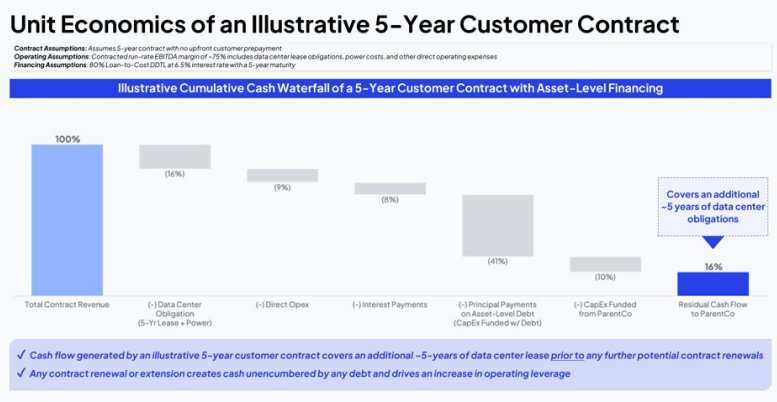
JPMorgan believes this illustrative economic model is on the conservative side, citing the fact that GPUs are now outlasting their six-year depreciation period and contract terms: V100s in use typically last around eight years, T4s about seven, and for the A100—introduced in 2020—the contracts have already been extended through 2029. This means that once the asset‑level debt is paid off, CoreWeave will only need to cover leasing and electricity costs, allowing it to continue generating cash flow beyond the contract term—making "renewal monetization" an additional option independent of the five-year contract.
Project Return: Unlevered IRR in the mid-teens, exceeding the blended cost of capital of 9%–11%.
According to the illustrative calculations provided in the report, the unlevered IRR for a typical five-year contract falls within the "mid-teens percentage" range, while the blended cost of capital stands at 9%–11% (assuming that the vast majority of capital expenditures are financed through a combination of parent‑company debt and asset‑backed debt). If the contract is renewed beyond the initial five-year term, the IRR would rise further.
The report does not shy away from the risk of rising capital costs, but it expects that pricing for new computing capacity will incorporate higher funding costs, thereby keeping the company's return fundamentals unchanged.
Burning cash isn't a sign of poor economics—it's just climbing the hill too fast.
Recent funding needs are high, primarily driven by a steep ramp-up in production capacity: operating capacity is set to increase from 1.85 GW at the end of this year to 8 GW by 2030, representing a fourfold expansion over four years and an annual addition of roughly 1.5 GW—by contrast, only 500 MW of new capacity is expected in 2025, with an additional 1 GW projected for 2026.
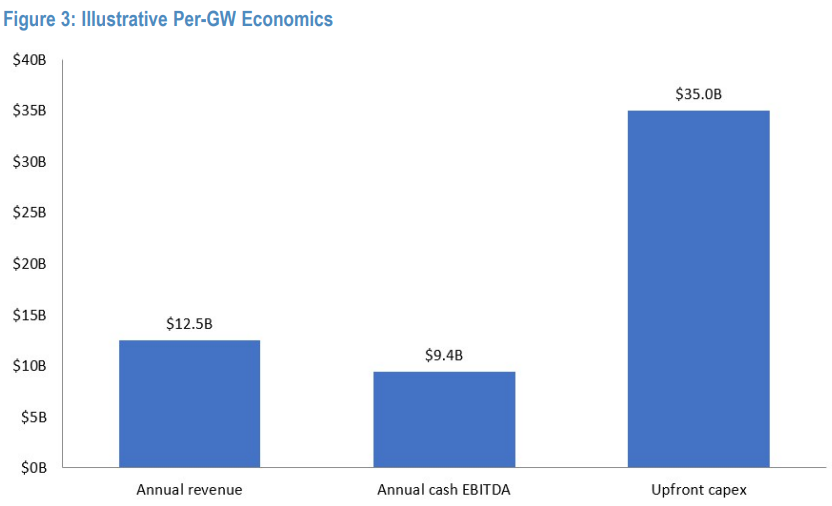
According to the report's simplified economics: once a project reaches full production, annual revenue per gigawatt ranges from $10 billion to $15 billion, corresponding to a cash EBITDA margin of roughly 75% at the contract level; meanwhile, during the ramp-up phase, capital expenditures exceed $35 billion per gigawatt. The crux of the issue lies in a mismatch of timing—revenue only begins to materialize gradually after full production is achieved, while capital spending is front-loaded in the ramp-up year. Based on this, the company would need its installed capacity from "stable‑operating projects" to be four to five times the size of the capacity currently ramping up in order for its cash flow to turn positive after covering the capital expenditures associated with the new capacity.
The current situation is that the ratio of in-service capacity to newly added capacity at the beginning of the year is currently around 1:1—CoreWeave, with approximately 0.85 GW of in-service capacity, will enter 2026, and the full year is expected to see about 1 GW of new additions; by 2027, this ratio is projected to remain around 1.2 times. According to the report's calculations, it won't reach approximately 4.5 times until 2030.
Therefore, JPMorgan concludes that the current cash burn is not due to poor project economics, but rather to the annual ramp-up capacity being too high relative to the existing operating capacity; the timing issue of free cash flow generation will largely be resolved as CoreWeave scales up.
From the other side of the market, this round of selling does indeed feel grounded in credit fundamentals. According to domestic media citing sources, CoreWeave's bond yields have already surpassed 15%, and rising capital costs will directly erode the safety margin of the aforementioned "residual cash flows"—which is precisely the crux of the current long–short divergence.
It should be noted that the disclosure page of the report indicates: Over the past 12 months, JPMorgan has provided investment banking services to CoreWeave and received compensation, and it is expected to continue seeking such compensation over the next three months; at the same time, it holds more than 1% of CoreWeave's common stock beneficial interests and serves as a market maker for the relevant securities. Investors are advised to regard this report as a factor to consider in their investment decisions.