
Value realization has no fixed timetable.
Between 1964 and 1981, the Dow Jones Industrial Average rose by only one point over a 17-year period, while U.S. GDP grew by 370% and sales of Fortune 500 companies nearly sextupled during the same timeframe. Viewed in retrospect, the U.S. stock market appeared to have stalled for millions of investors. However, it subsequently entered a prolonged bull market that lasted two decades.
Many investors focus entirely on market movements, but Buffett has stated that the market is there to serve you, not to instruct you. For genuine investors, the market is merely a quoting machine; you can either accept the current price or ignore it based on the discounted future cash flows of the assets you hold. However, if you are intimidated or tempted by market fluctuations, you may act against your own best interests.
Periods of irrationality can last longer than expected.
 People tend to judge fundamentals based on stock market trends: if the market performs well, they assume positive developments are imminent in the fundamentals; if the market deteriorates, they anticipate negative outcomes.
In reality, the stock market contains irrational elements, and such irrationality can persist for years. Economist John Maynard Keynes once remarked that markets can remain irrational longer than investors can remain solvent. This is because market prices are formed by tens of millions of investors through exchanges, driven by collective sentiment.
When skepticism wanes and uniform optimism prevails, bubbles form and can persist for years without bursting. Canadian economist John Kenneth Galbraith noted in A Short History of Financial Euphoria that after the great crash of 1929, many Americans suspected the stock market was essentially a mechanism to swindle them out of their money; this suspicion did not subside until the mid-1950s.
Galbraith observed that speculation resurged in the late 1950s and throughout the 1960s, with speculators’ enthusiasm intensifying further, eventually leading to a bust. "The speculative episodes of the 1960s and 1970s were relatively short-lived, but their severe consequences clearly demonstrated that financial dysfunction remains the norm. However, speculative fervor reached its peak in the 1980s, culminating in the major crash on October 19, 1987."
"What if it never rebounds?"
Similarly, even when the stock market is fundamentally undervalued, it may underperform for years and even trade at a further discount. Buffett exited the market at its peak in 1969 and returned in 1973, yet the U.S. stock market did not recover to its previous highs until 1981.
In November 1974, at the darkest hour of the major U.S. stock market bear market, the Dow Jones Industrial Average stood at just 580 points, still 40% below its early 1969 peak.
During an interview with Buffett, the media asked: What if the market never recognizes these high-quality assets at their low prices? What if the stock market never rebounds?
Buffett replied, "When I worked at Graham-Newman Corp. in my early years, I asked my boss, Graham, this very question. He simply shrugged and said that the market would eventually return to normal. He was right: In the short run, the market is a voting machine; in the long run, it is a weighing machine."
Buffett went on to explain that the prevailing view on Wall Street today—"stocks are indeed cheap, but they just won't rise"—is mistaken. Investors achieve success by holding shares in excellent companies over the long term. Sooner or later, the market will reflect the underlying operational performance of these businesses.
Market prices will eventually catch up with intrinsic value.
One of the core tenets of value investing is that although market prices may deviate from intrinsic value in the short term, or even for several years, they will ultimately reflect that value. Therefore, investors need only assess whether value exists at the current price, without needing to predict when that value will be realized; patient waiting is an inherent part of the investment process.
In 1955, Graham attended a U.S. Senate hearing and faced questioning. A senator asked: If I buy a stock with an intrinsic value of $30 for $10, I can only realize my profit when the majority agrees it is worth $30. What is the mechanism for this realization of value?
Graham responded with his characteristic wit: "This is a peculiar phenomenon in our industry, and like others, I find it somewhat mysterious. However, experience tells us that market prices will eventually catch up with value; this always happens, regardless of the specific mechanism."
In fact, there are many mechanisms that drive market prices toward intrinsic value, such as dividends, share buybacks, asset sales, mergers and acquisitions, and liquidations, all of which help align market prices with value.
Equity investment is fundamentally no different from direct business investment; the intrinsic value of stocks is perceptible. Buffett has used farmland investment to illustrate the essence of investing. In 1986, he purchased a 400-acre farm north of Omaha for $280,000. Although he knew little about farm management, he had a son who was passionate about agriculture.
Buffett learned from his son about the farm's corn and soybean yields as well as its operating expenses. Based on these estimates, Buffett calculated that the normalized return on the farm at the time was approximately 10%. He believed that this investment carried no risk and offered the potential for substantial returns.
Focus on the fundamentals of the companies you invest in, rather than on market fluctuations. If dividends alone can recover your principal within a few years, the investment likely carries lower risk and offers significant return potential. Guided by this philosophy, Buffett approaches each investment with such conviction that he would remain completely at ease even if the market were closed for several consecutive years, providing no price information.
Zhang Yao, a prominent value investor, adheres to the same approach, using the criterion of investing in companies that can recoup the initial capital through dividends within five to six years. From 1999 to 2018, Zhang Yao achieved a 2,190-fold return on his investments in A-shares and Hong Kong stocks.
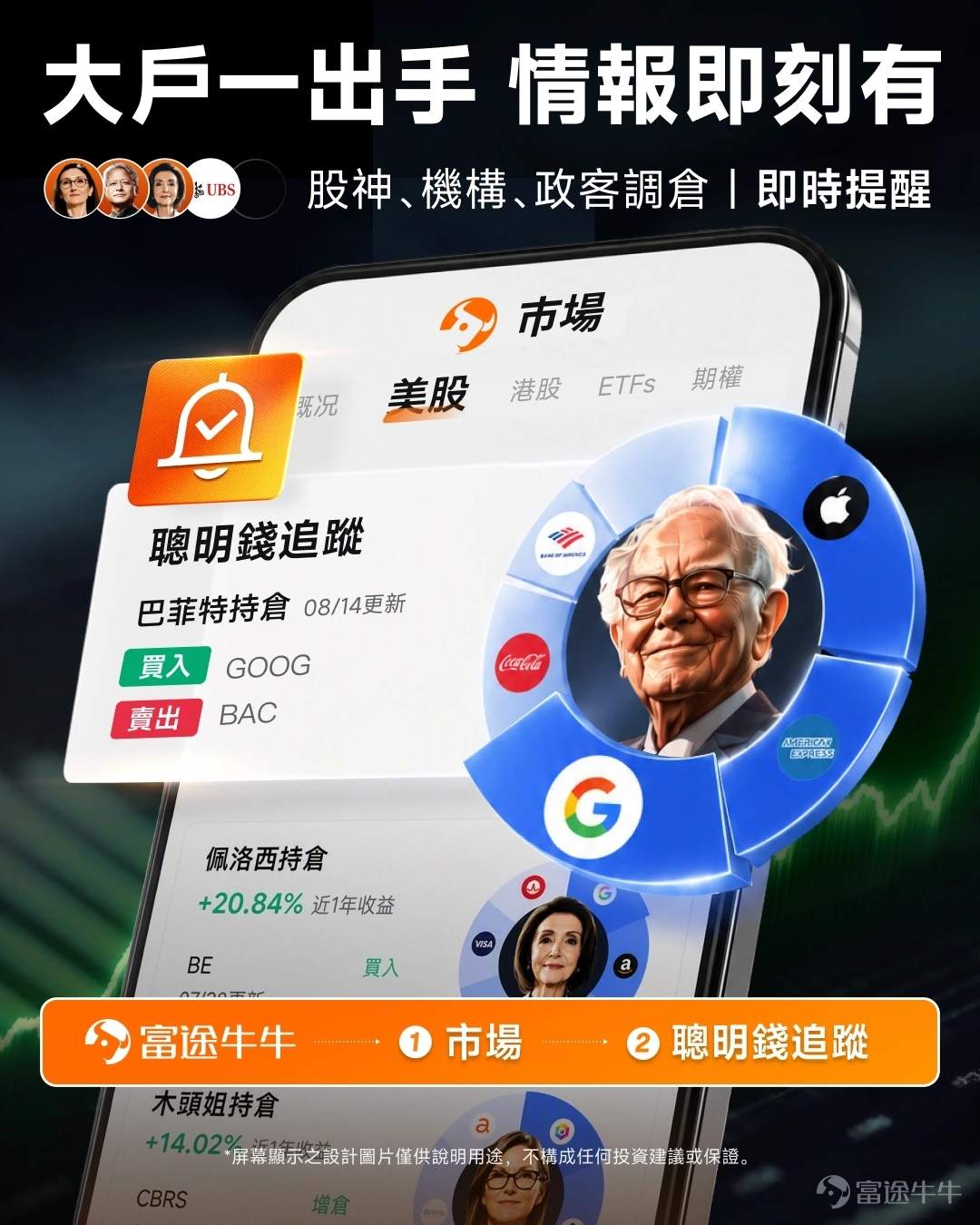
 When major players make moves, intelligence arrives instantly! Futubull’s “Smart Money Tracker” feature has been newly upgraded, providing immediate alerts on portfolio adjustments by legendary investors, institutions, and policymakers!
Edited by Rice