NVIDIA researchers used 8,192 of the company's GH200 GPUs, along with its cuQuantum software and the fault-tolerant logical computation layer of the CUDA-Q platform, to perform a fault-tolerant quantum computing simulation involving 104 qubits on Europe's largest supercomputer, "Jupiter." Their phased development process reduced the simulation runtime from several weeks to just a few days. Previously, Jupiter had completed a 50-qubit quantum computing simulation under ideal conditions; this study, however, accounted for the effects of real-world hardware noise and validated a fault-tolerant quantum computing approach known as "magic state distillation," which holds promise for significantly reducing resource requirements.
NVIDIA has set a new record in quantum computing simulation on Europe's largest supercomputer, using 8,192 GPUs to perform a fault-tolerant quantum computation simulation with 104 qubits, and validating a technical approach that could reduce the number of physical qubits required for such schemes by approximately 90%. This breakthrough is expected to help researchers lower the resource overhead of quantum error correction and accelerate the development of practical quantum computing systems.
On Monday, October 19, Eastern Time, NVIDIA announced that its researchers, leveraging the JUPITER supercomputer at Germany's Jülich Supercomputing Centre, conducted a record-breaking fault-tolerant quantum computing simulation. The focus of this research was not only to scale the simulation to a record-breaking 104 qubits, but also to model how a quantum processor performs fault-tolerant computation in real-world noisy environments, enabling researchers to evaluate and optimize designs before building actual hardware.
 This research also highlights another strategic direction for NVIDIA in the quantum computing industry: in addition to providing GPU infrastructure for artificial intelligence (AI) and high-performance computing, the company is advancing the collaboration between GPU-based supercomputers and quantum processors, leveraging classical computing systems to simulate, validate, and optimize future quantum hardware.
NVIDIA CEO Jensen Huang stated that understanding the behavior of complex fault-tolerant systems under large-scale operation is key to realizing practical quantum computing, and GPU supercomputing can help researchers tackle research problems that were previously beyond reach.
From idealized environments to real-world noise, the scale of simulations continues to expand.
The potential of quantum computing lies in leveraging the superposition and entanglement properties of qubits to tackle problems that classical computers struggle to solve efficiently. However, qubits are highly susceptible to external disturbances, and noise arising during control and manipulation can introduce errors. To enable quantum computers to reliably perform complex, long‑duration computations, it is essential to address the issue of error accumulation.
Fault-tolerant quantum computing is precisely the key approach to addressing this challenge. At its core, it leverages techniques such as quantum error correction to mitigate the impact of errors in physical qubits on computational outcomes, enabling the system to reliably perform more complex computations.
The significance of NVIDIA's latest simulation lies in the fact that it is no longer confined to quantum computing in ideal, noise-free environments; instead, it simulates the impact of real-world hardware noise on fault-tolerant computation.
According to the company's announcement, the Jülich Research Centre in Germany had previously conducted a full-scale simulation of a 50-qubit universal quantum computer on "Jupiter," though that simulation was performed under ideal, noise-free conditions. This latest 104-qubit simulation focuses on critical components of fault-tolerant quantum computing, with both the scale of the study and the range of simulated scenarios significantly expanded.
This distinction is of practical significance: a quantum computing scheme that is theoretically feasible may not necessarily operate reliably in the presence of noise on real hardware. By using classical supercomputers to simulate the behavior of quantum processors in advance, researchers can identify sources of errors earlier, evaluate the performance of error-correction schemes, and screen more promising designs before committing to the costly fabrication and experimentation with quantum hardware.
Magic-state distillation challenges conventional approaches, reducing the resource overhead of quantum error correction.
Another key achievement of this study is the validation of a fault-tolerant quantum computing approach known as "magic state preparation."
In fault-tolerant quantum computing, magic states are a special class of quantum states required for universal quantum computation. Since the relevant computational processes continuously consume magic states, the system must constantly prepare new ones. Consequently, the efficiency with which magic states can be generated—measured in terms of resource overhead—directly determines the hardware scale needed to build a practical quantum computer.
Traditional approaches typically employ "magic state distillation" to prepare high-quality magic states through a series of quantum operations, but this process can consume a large number of physical qubits. NVIDIA states that magic-state preparation is an alternative approach that holds promise for significantly reducing resource requirements; the technical route validated in this simulation requires approximately 90% fewer physical qubits than previous methods.
It should be noted that the "90% reduction" refers to the physical qubit requirements of the relevant magic‑state preparation schemes; it does not imply that all hardware requirements of an entire quantum computing system can be uniformly reduced by 90%, nor does it signify that practical quantum computers have yet been commercialized.
However, if this technological approach can continue to be validated across diverse quantum hardware architectures and practical operating conditions, its potential value should not be underestimated. The more abundant the physical qubit resources, the greater the system's ability to construct a sufficient number of logical qubits and execute increasingly complex algorithms. Reducing the resource overhead associated with magic‑state preparation means that more hardware resources can be devoted to actual computation, rather than being consumed solely by error correction and the maintenance of the quantum states required for computation.
8,192 GPUs working in concert compress a weeks-long simulation into just a few days.
Behind this achievement lies the synergy between NVIDIA's accelerated computing software and hardware ecosystem and Europe's supercomputing infrastructure.
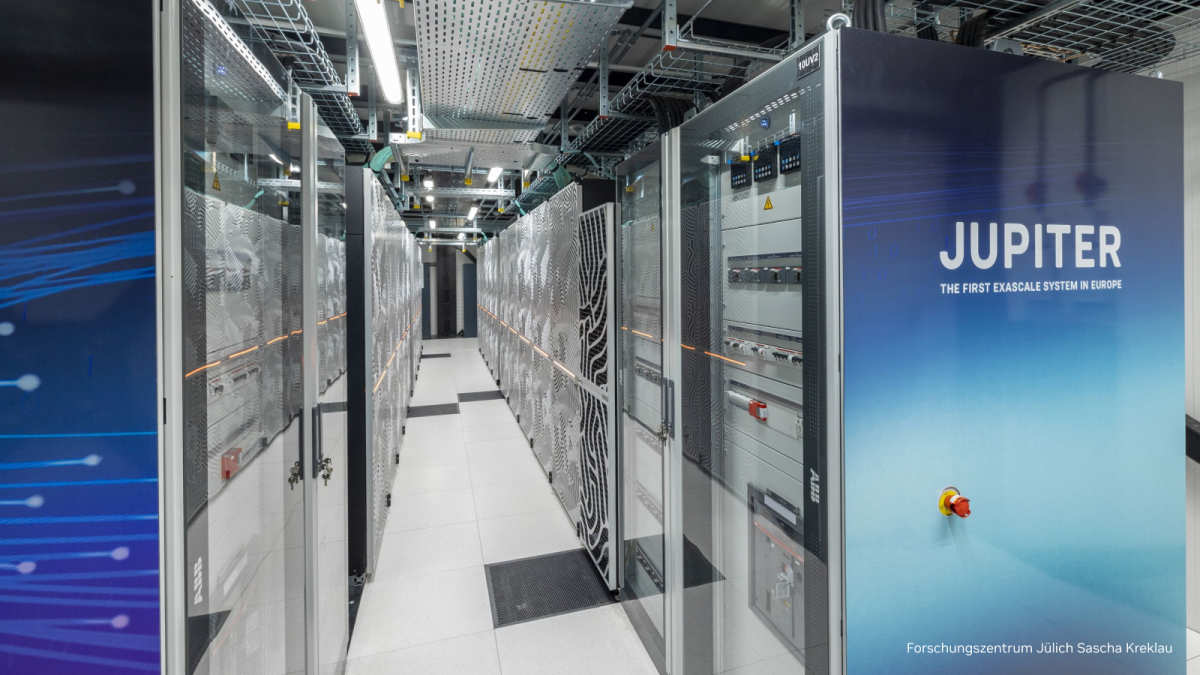
NVIDIA disclosed that this simulation was run on 8,192 NVIDIA GH200 GPUs of the "Jupiter" supercomputer. Located at the Jülich Supercomputing Centre in Germany, the system is Europe's first exascale supercomputer.
The research team did not carry out all development work directly on the full supercomputer. In the early stages of the project, they first conducted tests on NVIDIA's GB200 NVL72 system at the NVIDIA Quantum Computing Center (NVAQC), gradually scaling up from 4 GPUs to hundreds of GPUs to validate the relationship among simulation methods, accuracy, and computational resources, before expanding the workload to "Jupiter's" 8,192-GPU configuration.
NVIDIA stated that this phased development process has reduced the simulation work that originally took several weeks to just a few days.
On the software side, the research utilized NVIDIA's cuQuantum software and the fault-tolerant logical computation layer within the CUDA-Q platform. The former provides acceleration tools for quantum computing simulation, while the latter enables researchers to model and develop fault-tolerant quantum computing systems.
This also underscores NVIDIA's differentiated positioning in the quantum computing space: the company does not need to compete solely with its own proprietary quantum processors; instead, it can leverage its GPUs, interconnect networks, simulation software, and development platforms to serve as a critical infrastructure provider for quantum computing research and future hardware design.
As the complexity of quantum systems increases, the memory and computational requirements for simulating them on classical computers grow rapidly, making it increasingly difficult to perform large-scale, high-precision simulations using conventional computing resources alone. Combining GPU-accelerated computing with supercomputing holds promise for enabling researchers to carry out more validation work before real quantum hardware is available.
Applications such as drug discovery and materials science still await hardware validation.
NVIDIA stated that higher-fidelity simulations can help researchers predict the performance of future quantum processors before building hardware, reduce reliance on repeated hardware trials, and potentially shorten the development cycle of practical quantum computing systems.
Potential applications include drug discovery, financial modeling, and materials science. These fields involve complex molecules, physical systems, or optimization problems, which are among the reasons quantum computing has long attracted significant attention.
However, there remains a gap between achieving breakthroughs in simulation and realizing the true commercial value of quantum computing. This work demonstrates the performance of a specific fault-tolerant computing approach in a simulated setting, but it does not yet equate to the creation of a quantum computer capable of reliably executing general-purpose algorithms at the corresponding scale. Going forward, it will still be necessary to conduct hardware experiments on actual quantum processors to assess the applicability of these methods across different devices, noise levels, and computational tasks.
Kristel Michielsen, Director of the Jülich Supercomputing Centre, stated that JUPITER enables researchers to explore previously inaccessible questions, and collaboration with NVIDIA helps scientists make more informed decisions about which designs are most likely to yield practical applications.
From an industrial perspective, this breakthrough also underscores that the development of quantum computing does not amount to a simple substitution between classical and quantum computing. At least during the research and development phase, GPU‑based supercomputing can serve as a crucial collaborative tool for quantum hardware: classical computing handles simulation, validation, and optimization, while quantum processors, as they gradually mature, take on specific computational tasks.
For NVIDIA, this strategic move is expected to extend the company's competitive reach beyond AI training and inference and high-performance computing into quantum computing R&D infrastructure. However, its long-term commercial value will still depend on the pace of maturation in the quantum computing industry, the adoption of tools such as CUDA-Q and cuQuantum, and whether these technologies can be consistently translated into practical applications.
Editor/stephen