
Global central banks are still purchasing gold at nearly five times the historical average for 2022, prompting Goldman Sachs to set its gold price target at $5,400 per ounce. The firm notes that a more noteworthy shift is occurring in where gold is stored: substantial amounts of gold are moving from the New York Fed to the Bank of England, with countries like the Netherlands explicitly citing "crisis preparedness" as the reason for these transfers. This trend suggests that the landscape of central banks' trust in custodians is quietly being reshaped.
According to the latest monthly forecast report released by Goldman Sachs analyst Lina Thomas, global central banks' gold purchases in August are estimated at 79 tonnes, far exceeding the historical monthly average of 17 tonnes for the first seven months of 2022, as well as July's 44 tonnes. On a three-month seasonally adjusted basis, the current pace of gold purchases stands at 85 tonnes per month, equivalent to an annualized rate of roughly 1,000 tonnes—whereas prior to the freezing of Russia's foreign-exchange reserves in 2022, this figure was only about 200 tonnes.
China's central bank has continued to increase its gold reserves and remains the largest identifiable buyer in August. Goldman Sachs wrote in its report: "Emerging-market central banks, particularly China, still hold significantly less gold than their appropriate long-term allocation targets."
A more noteworthy signal: Where gold is located
 Lina Thomas notes that, after 2022, central banks in advanced economies largely stayed on the sidelines of the gold-buying wave, partly because they already held substantial historical reserves. However, the current discourse is shifting—from whether to hold gold to where to store it—reflecting deeper concerns about reserve security and cross-border trust.
Data corroborates this assessment. In August, foreign central banks' gold holdings at the New York Fed declined by 40 tonnes, while the Bank of England's custody holdings increased by 46 tonnes over the same period. In July, the Bank of England's custody holdings had already surged by 63 tonnes. In early September, the Dutch Central Bank disclosed that, citing "crisis preparedness," it had transferred nearly 90 tonnes of gold from New York and Ottawa to London.
Since the beginning of 2025, the New York Fed's holdings have declined by approximately 200 tonnes, while the Bank of England's holdings have increased by roughly 500 tonnes.
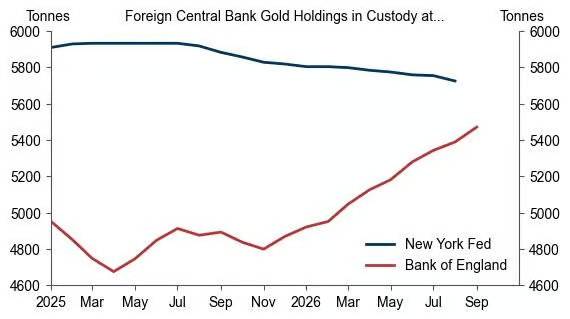
Goldman Sachs also pointed out a technical detail favorable to bulls: its London-based forecasting model does not account for changes in the Bank of England's holdings. When the Bank of England's increase in holdings exceeds the New York Fed's decrease, the actual official gold-buying volume could be larger than the forecasted figure. In August, the Bank of England added 46 tonnes, while the New York Fed reduced its holdings by 40 tonnes; although the gap has narrowed, the trend remains consistent.
Gold prices have yet to catch up, and Goldman Sachs is still holding its $5,400 target.
At the time of the aforementioned gold-buying spree, gold prices remained relatively subdued. According to data from Goldman Sachs' materials division,$XAU/USD (XAUUSD.CFD)$On that day, it stood at around $4,186 per ounce, below Goldman Sachs's level of approximately $4,350 when it lowered its year-end fair value last month, and is gradually approaching the firm's "near-term floor" of $4,070 under the Fed's hawkish scenario.
The Federal Reserve has initiated interest rate hikes, and Goldman Sachs economists expect another hike in October; rising rates are suppressing ETF demand.
Not everyone agrees with the logic of structural support. Last week, Bank of America analyst Lawson Winder said that a high‑interest‑rate environment should weigh on gold prices; he favors copper and uranium instead and downgraded Kinross to "underperform." Société Générale has also noted that, at current price levels, signs of demand destruction are already emerging, with global gold demand in the first half of 2026 expected to fall below its 10‑year average.
Goldman Sachs responded: The Federal Reserve is a short-term headwind, while central banks are the anchor for the price floor. Lina Thomas previously wrote: "Persistent central bank gold purchases should gradually lift the floor supporting gold prices, even under a significantly hawkish scenario."
Goldman Sachs maintains$XAU/USD (XAUUSD.CFD)$The year-end 2027 target price is set at $5,400 per ounce, with the central bank gold‑buying assumption revised upward to an average of 60 tonnes per month between 2026 and 2027. We believe official gold purchases account for the vast majority of the 23% price increase we forecast.
Hosted data is the real signal.
The headline is "Gold Purchases in Tons," but the real story lies in the custody data.
When central banks such as the Netherlands began transferring gold bars from Manhattan to London under the pretext of "crisis preparedness," this signaled less an opinion on gold itself than a judgment about their confidence in the custodian.
A monthly gold purchase of 79 tonnes is a buying signal. The outflow of 40 tonnes from the New York Fed in a single month is a confidence signal.
Goldman Sachs's conclusion is concise and straightforward: "Central bank demand remains a structural support for gold, and the underlying drivers—sanctions risks, geopolitics, and distrust of the G7 reserve currencies—have not abated."
Edited by melody