
Copper is quietly surpassing gold—and serving as a stress test for AI-driven narratives.
As artificial intelligence (AI), grid‑infrastructure investment, and defense spending drive demand for copper—a key industrial metal—copper is assuming growing strategic importance for governments and industries worldwide, and its performance this year has already outpaced gold, which has remained a standout performer in recent years.
At present, LME copper prices are hovering at a high level within a narrow range around $14,400 per tonne, trading at $14,350.88 as of press time. Yet this apparent calm masks a steep upward trend over the year: since the start of 2023, copper has accumulated a gain of 15.8%, while over the past 12 months the increase exceeds 30%. By contrast, gold futures have fallen 4.11% year-to-date and 4.52% over the past 12 months. Spot gold has declined 4.89% in the last 12 months and 4% year-to-date.
 A commodity long regarded as a "cyclical industrial metal" has systematically outperformed traditional safe-haven assets in terms of returns. This reversal is no mere cyclical asset rotation; rather, it is a clear signal that copper's pricing anchor is shifting from inventory cycles to geopolitics and structural demand.
The Redefined Metal: From "Economic Barometer" to "Strategic Infrastructure"
The traditional analytical framework for copper is built on construction starts, manufacturing output, and inventory cycles. Under this framework, copper prices serve as a barometer of economic activity, with price movements viewed as a reflection of aggregate demand. However, the 2026 copper market presents a paradox that challenges this conventional lens: in the first quarter, the global refined copper market briefly experienced a temporary supply surplus—estimated at around 396,000 tonnes by the International Copper Study Group (ICSG)—yet prices nonetheless reached new all-time highs.
The coexistence of oversupply and record-high prices points to a clear conclusion: copper's marginal pricing power has shifted from overall supply and demand to regional allocation and strategic expectations. During LME Week, the annual global metals industry event, Ivanhoe Electric CEO Taylor Melvin stated in an interview, "We now live in a world where commodities long regarded as critical metals are undergoing a comprehensive transformation into strategic metals."
At present, governments and industry players worldwide have shifted their focus from "whether prices are low" to "whether supply is reliable." The United States has added copper to its list of critical minerals, the Democratic Republic of Congo's copper officially entered the U.S. Strategic Mineral Reserve in mid-October, and Swiss commodity trader Mercuria has delivered the first batch of 12,000 tonnes of Congolese copper under its "Vault Program"—all concrete manifestations of this evolving logic. Copper's strategic significance is no longer confined to research report headlines; instead, it is directly influencing the available supply in the spot market through shifts in inventory geographies and the development of reserve systems.
The "inelastic" nature of the demand structure
Underpinning copper prices at elevated levels amid fluctuating macro sentiment is a cluster of demand that, in the short term, remains resistant to price‑driven adjustments.
First is AI‑related computing infrastructure, which has long been at the center of capital‑market discussions. In an interview, Melvin noted that the tech sector's demand for copper is "a new area of demand, and for copper it is almost inelastic." He added that when tech giants decide whether to build ultra‑large‑scale data centers, the cost of copper carries very little weight in their capital‑expenditure decisions, giving the industry's copper demand a nearly inelastic character. In other words, even if AI‑stock valuations swing sharply due to financing conditions or liquidity‑exit dynamics, data centers already under construction will not cancel their copper purchases as a result.
"It's hard to imagine that any of these major tech companies would base their decision to invest in hyperscale data centers on copper costs," Melvin said.
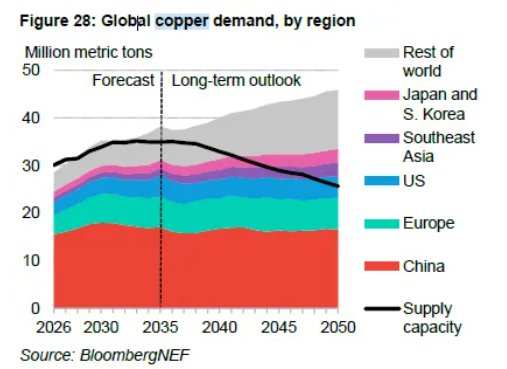
Secondly, copper remains the largest driver of grid modernization and electrification. According to statistics, the power sector accounts for over 40% of total copper consumption, firmly holding the top spot, with ultra-high-voltage infrastructure development, renewable‑energy integration, and distribution‑grid upgrades forming a sustained demand base. BNEF projects that copper demand linked to electrification will surge to 23.3 million tonnes by 2050—an 89% increase from current levels—accounting for more than half of total consumption.
The firm's analysts wrote: "Electric transportation is the fastest-growing segment in copper applications. The penetration of electric cars, electric trucks, and electric buses is expected to rise sharply between 2026 and 2050, and their motors, inverters, battery packs, high-voltage wiring harnesses, and charging infrastructure all require copper."
In addition, the structural expansion of defense spending has emerged as a new rigid demand segment for copper. Melvin noted: "Another rising demand segment that also exhibits rigidity is national security and defense budgets."
Steve Schoffstall, Managing Partner and Head of ETFs at Sprott Asset Management, has noted that global defense spending exceeds $2.6 trillion, with NATO aiming to allocate 5% of GDP to defense, while copper demand in the defense sector is projected to grow at an annual rate of approximately 7%. Notably, unlike AI‑related demand, defense procurement is driven by security priorities and exhibits very low sensitivity to price signals.
The simultaneous presence of these three demand drivers at elevated price levels explains why copper prices have not declined under the drag of traditional cyclical forces. BNEF's estimates also provide a long-term anchor for this assessment: without roughly $332 billion in new mining investment, the copper market would face a supply shortfall of 20 million tonnes by 2050; even with such investment, it takes an average of 17 years from discovery to production, meaning that the gap is unlikely to narrow systematically until at least 2043. This implies that supply-side rigidity is not a matter of one or two years, but rather a structural constraint measured in decades.
Tariff Halt and Inventory Siphoning: A Self-Reinforcing Mechanism of Supply Tightness
If the demand structure provides "bottom‑line support" for copper prices, then the uncertainty surrounding U.S. tariffs on refined copper acts as a short‑term amplifier of price volatility.
According to reports, the U.S. Department of Commerce has proposed imposing a 15% tariff on refined copper effective January 1, 2027, with a further increase to 30% in 2028. However, no final decision on these proposed tariffs has yet been publicly announced. It is the status of this pending measure—rather than any specific policy already enacted—that has become a key determinant in market dynamics.
This tariff policy is expected to influence copper price trends because, in anticipation of the 2027 tariff taking effect, traders have accelerated shipments of refined copper to the United States before the window closes. According to data, COMEX copper inventories surged from roughly 84,000 tonnes in February 2025 to over 650,000 tonnes by early August 2026, setting a new century‑long record since COMEX began maintaining comprehensive statistics; meanwhile, total copper stockpiles within the U.S. are widely estimated to have exceeded 1 million tonnes.
In June, Goldman Sachs sharply raised its 2026 U.S. copper inventory accumulation forecast from 550,000 tons to 900,000 tons, and subsequently noted that the copper supply gap in markets outside the United States has widened from the previously projected 640,000 tons to approximately 950,000 tons.
The geographic shift of inventories has created an asymmetric shortage. At the aggregate level, global copper supplies have not vanished; however, on the tradable‑supply side, visible inventories in non‑U.S. markets have been systematically depleted. According to analysts, LME copper inventories have fallen from a peak of roughly 400,000 tonnes in April 2026 to around 250,000 tonnes, while SHFE copper stocks plummeted from 359,100 tonnes at the end of March to just 47,100 tonnes by late September. Meanwhile, domestic social inventories briefly dipped to a recent low of 78,300 tonnes.
The analysis points out that even as the recent COMEX–LME price spread has narrowed due to a shrinking near‑month arbitrage window, the structural incentive for traders to ship copper to the United States will persist as long as the expectation of escalating tariffs in 2027–2028 remains unrevoked. The U.S. government need not allocate direct funds to build reserves; by simply maintaining the tariff outlook, it can continuously draw global copper supplies into domestic stockpiles, effectively converting private commercial inventories into de facto "quasi‑strategic reserves." Until the tariffs are formally implemented or explicitly rescinded, this mechanism will continue to impose a risk premium on copper prices—stemming from policy uncertainty itself.
"With the potential for U.S. tariffs, a significant portion of global copper is currently stored in the United States, and it remains unclear whether these inventories will be released to other markets," said Iain Pyle, Senior Investment Director at Aberdeen Investments and Co‑Manager of the abrdn Future Minerals Fund.
"At the same time, Chinese inventories appear unusually low, and local premiums are rising," Pyle added.
In a report dated October 15, Pyle also stated that copper is "the most obvious example" of a market where supply is failing to keep pace with demand, adding that "stronger price incentives will be needed to encourage increased production."
"There remains some downside risk before and after the tariff announcement, but we believe the fundamentals are decidedly bullish, and the likelihood of a sharp price surge has increased."
The Timing of AI Valuation Corrections: The Logic Behind Copper's "Decoupling"
The current backdrop that cannot be ignored in copper price analysis is a pronounced valuation correction underway across global AI‑related stocks.
As of the week ending October 16, the Nasdaq-100 index fell about 5.5% for the week, marking its largest weekly decline since April 2025; the Philadelphia Semiconductor Index declined for eight consecutive trading days, with a weekly pullback of roughly 11.5%, plunging directly into technical correction territory. NVIDIA (NVDA.US) has retraced more than 10% from its intraday high on October 6; CoreWeave (CRWV.US) tumbled over 25% in a single week, with its 2031 bond yield briefly climbing to 16% and its five-year CDS spread breaching 1,100 basis points, signaling a sharp rise in the market-implied probability of default.
The catalyst for the sell-off was not a debunking of AI‑computing demand, but rather tighter financing conditions and a reassessment of the commercialization timeline: some AI infrastructure firms have relied on high‑interest debt to fund their expansion, and when revenue growth fails to cover interest expenses, the fragility of their credit profiles becomes starkly apparent.
It is against this backdrop that a significant logical divergence has emerged between copper and AI‑related stocks. AI stock valuations hinge on the discounted present value of future cash flows, making them highly sensitive to interest rates, financing costs, and the competitive landscape; by contrast, copper's role in the AI demand chain lies in its function as a raw material input during the physical construction phase. While GPU clusters for data centers can have their orders deferred, the copper required for already‑designed power‑connection infrastructure, cooling systems, and busway assemblies faces a far more rigid procurement timeline.
Melvin of Ivanhoe Electric emphasized: "Valuations in the technology sector have indeed seen a modest pullback recently. However, both of these can coexist: equity market sentiment is subject to volatility, while the underlying industries continue to grow, which will keep driving incremental demand for copper."
Moreover, the demand narrative for copper is not anchored solely by AI. Grid modernization and defense spending constitute two distinct demand drivers with very low correlation to the AI capital cycle. Even if the pace of AI data‑center construction were to slow temporarily, the cyclical renewal of power infrastructure and multiyear defense procurement contracts would continue to underpin copper consumption at the lower end.
In fact, in BNEF's long-term outlook, data centers are explicitly described as a "drop in the bucket" for copper demand, with electrified transportation emerging as the fastest‑growing application. This suggests that viewing copper as an "AI‑themed asset" is inaccurate; the bullish case for copper rests not on AI‑related valuations, but on a broader foundation anchored in electrification, decarbonization, and supply‑chain regionalization.
Goldman Sachs recently raised its LME copper price target for the end of 2026 from $13,735 per tonne to $14,700 per tonne, an increase of about 7%, citing the "intensifying competition between the United States and China for copper resources" and weaker-than-expected mine supply.
Editor/Deng