Netflix reported Q3 revenue of $12.9 billion, up 11.8% year over year; net profit reached $3.66 billion, a 43.8% increase from the same period last year. The company forecasts Q4 revenue of $13.4 billion, with year-over-year growth slowing to 11.5%, marking the fourth consecutive quarter of deceleration. Net profit for the fourth quarter is expected to be $2.787 billion, below market expectations. The company has lowered its 2026 advertising revenue forecast from the previous $3 billion to $2.7 billion. Netflix's stock fell more than 5% in after-hours trading.
$Netflix (NFLX.US)$Netflix's third-quarter earnings exceeded market expectations, but revenue growth continued to slow, its advertising business fell short of projections, and its fourth-quarter guidance also missed analysts' forecasts. As the appeal of its content and user engagement come under scrutiny, Netflix is seeking new growth drivers through management reshuffles and by expanding into live streaming and gaming, among other areas.
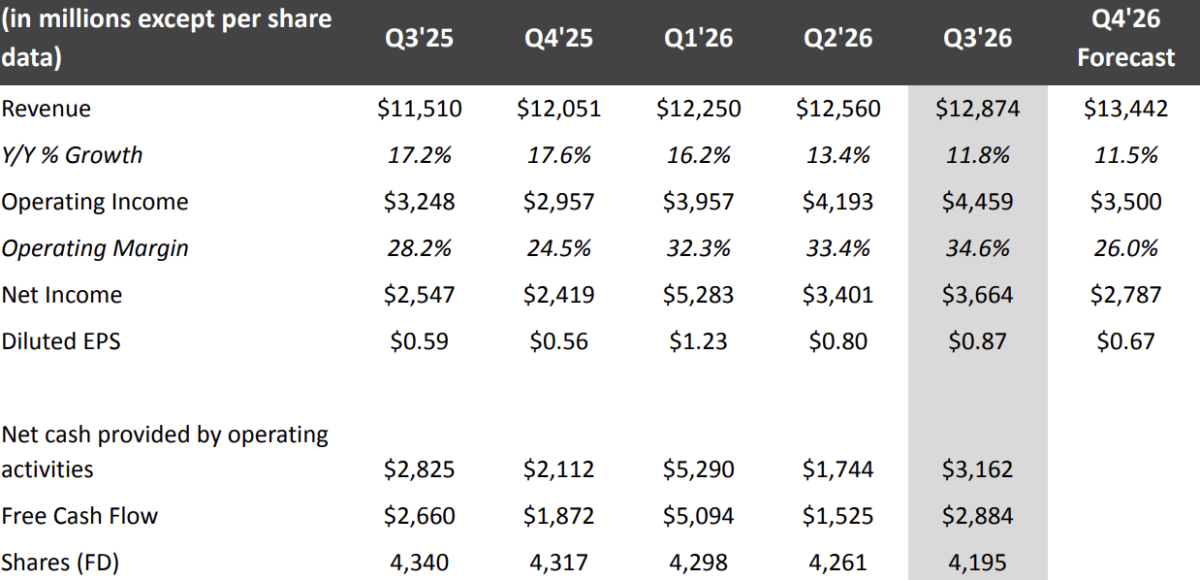
On Tuesday, Netflix reported its third-quarter 2026 results, with revenue rising 11.8% year over year to $12.874 billion, in line with the company's prior guidance; net profit increased by approximately 43.8% year over year to $3.664 billion, and diluted earnings per share came in at $0.87, surpassing analysts' average estimate of $0.82.
 However, the company expects fourth-quarter revenue to reach $13.4 billion, with year-over-year growth further decelerating to 11.5%—marking the fourth consecutive quarter of slowing growth. Net profit for the quarter is forecast at $2.787 billion, with diluted earnings per share of $0.67, both below analysts' average estimates of $3.07 billion and $0.73, respectively.
The company also lowered its 2026 advertising revenue forecast from approximately $3.0 billion to $2.7 billion, reflecting slower-than-expected progress in rolling out certain ad‑product features and further heightening market concerns.
The company expects a fourth-quarter operating margin of 26%, with restructuring-related costs also weighing on the quarter's profitability.
Netflix's stock fell as much as 7% in after-hours trading following the earnings release, and dropped nearly 6% in the evening session. Year-to-date, Netflix's share price has declined by about 25%, down more than 40% from a year ago. After failing to acquire Warner Bros. Discovery's streaming and production businesses, the company has faced ongoing investor skepticism about its independent growth strategy.
Co-CEOs Ted Sarandos and Greg Peters are restructuring the company's management framework to address concerns about content quality. Netflix recently announced it would lay off approximately 1,000 employees and subsequently reorganized its content‑related leadership team.
Faced with sluggish growth in user viewing hours, relentless competition for attention from rival platforms, and the failure of its plan to acquire Warner Bros. Discovery's streaming and production assets, Netflix needs to demonstrate to investors that its existing business still has the capacity for sustained growth.
With adjustments to its content management team, Netflix is attempting to address the issue of program appeal.
As revenue growth slows, Netflix is making adjustments to its content business.
Netflix recently laid off about 6% of its workforce, affecting roughly 1,000 employees. Subsequently, the company's content leadership also underwent significant changes, with Chief Content Officer Bela Bajaria and Head of Film Dan Lin stepping down. Co-CEOs Ted Sarandos and Greg Peters brought in veteran entertainment industry executive Peter Rice to succeed Bajaria.
This series of adjustments reflects management's emphasis on content performance. Netflix has gone several months without releasing a film or TV series with broad cultural impact, and its new shows as well as sequels to classic series have also struggled to attract audiences. The company's Emmy wins in 2026 fell to a ten-year low, further fueling external discussions about the quality of its content.
In its letter to shareholders, Netflix stated that, in an environment of intense competition and a growing volume of content vying for consumers' attention, a clear strategic direction and outstanding execution are essential. The company also acknowledged that there is still room for further improvement in implementing its established priorities.
Netflix's content strategy has also evolved. In its early years, the company built its brand with critically acclaimed series such as "House of Cards" and "The Crown," before gradually expanding into a platform that encompasses movies, reality shows, sports, and other forms of entertainment. During Bajaria's tenure, the company launched hit titles like "Squid Game" and "Wednesday," while also driving the growth of live‑streamed programming and unscripted content. However, recent content performance has fallen short of market expectations, putting pressure on management to realign resource allocation and creative direction.
For investors, a change in management does not necessarily mean that content quality will improve immediately. Netflix needs to demonstrate over the next few quarters that its organizational restructuring can deliver a more consistent supply of popular content and once again boost users' viewing time.
User engagement growth has stalled, as YouTube continues to vie for viewership time.
In addition to content quality, user engagement is also a major challenge facing Netflix.
According to Nielsen data cited by Bloomberg, Netflix accounts for 7.8% of U.S. TV viewing time, down from YouTube's roughly 14% share. In the first half of this year, the total viewing time of Netflix users increased by only 2% year over year.
These data indicate that, although Netflix remains the world's leading streaming platform, its dominance in the attention‑seeking market is under pressure. Platforms like YouTube offer a more diverse range of content formats, with short videos, user‑generated content, and traditional TV shows all vying for viewers' time.
Netflix co-CEO Ted Sarandos said in a Bloomberg interview last month that the company's current growth rate has not met his expectations, and he is working to accelerate it.
Netflix has over 325 million subscribers. The company says that, according to its estimates, these subscribers reach nearly one billion viewers, and the platform's viewing scale remains larger than that of other Hollywood streaming services. However, this massive user base has not automatically translated into faster growth in viewing hours, making how to boost engagement among existing users a question that management must address.
User engagement not only affects the subscription business but also impacts the commercialization potential of the advertising business. If viewing time growth remains limited, ad inventory, ad reach, and monetization opportunities may likewise be constrained. Netflix needs to maintain the appeal of its subscription service while increasing both the frequency and duration of content consumption on the platform.
Expand into live streaming, podcasts, and gaming to unlock new growth drivers.
Faced with growth pressures, Netflix is expanding its content formats and increasing its third-party programming offerings to boost user engagement on the platform.
The company plans to continue expanding into live sports events, podcasts, and video games, while also bringing in third-party film and television content. For example, Netflix is integrating movies and TV shows from partners such as France's TF1 to enrich its content offerings.
These moves reflect Netflix's transformation from a streaming service centered on original content to a platform that encompasses a wider range of entertainment formats. By offering live streaming, gaming, and third-party content, the company aims to attract more users and increase the viewing time of its existing subscribers.
However, business expansion also faces challenges at the execution level. Netflix not only needs to broaden its content offerings but also ensure that new additions effectively attract viewers and translate into sustained user engagement and revenue growth. The downward revision of its advertising business targets indicates that the commercialization progress of this new venture may not always meet previous expectations.
In addition, after its plan to acquire Warner Bros. Discovery's related businesses fell through, Netflix must also demonstrate to the market that it can sustain growth without relying on large-scale acquisitions. Investors have already questioned the company's growth strategy, and its future financial performance and content output will serve as key benchmarks for assessing whether that strategy is effective.
Layoff costs are weighing on short-term profitability, and management still needs to rebuild confidence in growth.
Netflix expects its fourth-quarter operating margin to be 26%, with restructuring-related costs expected to weigh on the quarter's profitability. This means that while the company is reshaping its organizational structure and striving to improve operational efficiency, it will also have to absorb certain short-term expenses.
Co-CEOs Ted Sarandos and Greg Peters face the task of convincing investors that Netflix still has a clear long-term growth trajectory, even as they acknowledge that there is room for improvement. The company continues to maintain a massive global subscriber base, but slowing revenue growth, limited increases in viewing hours, and advertising revenue below expectations all indicate that its growth model is facing new challenges.
Seaport Research Partners analyst David Joyce commented before the earnings release that investors need to see, as soon as possible, signs strong enough to boost confidence that Netflix, this global platform, can achieve its expected growth trajectory.
For Netflix, the key going forward lies in whether its content management team can translate adjustments into a more stable supply of hit titles, drive a recovery in user viewing hours, and accelerate the commercialization of its advertising business.
Third-quarter profits exceeded expectations, demonstrating that the company still possesses strong profitability. However, to regain market confidence, Netflix must also show that its revenue growth can stabilize, rather than relying solely on cost control to sustain its profit performance.
Editor/lambor