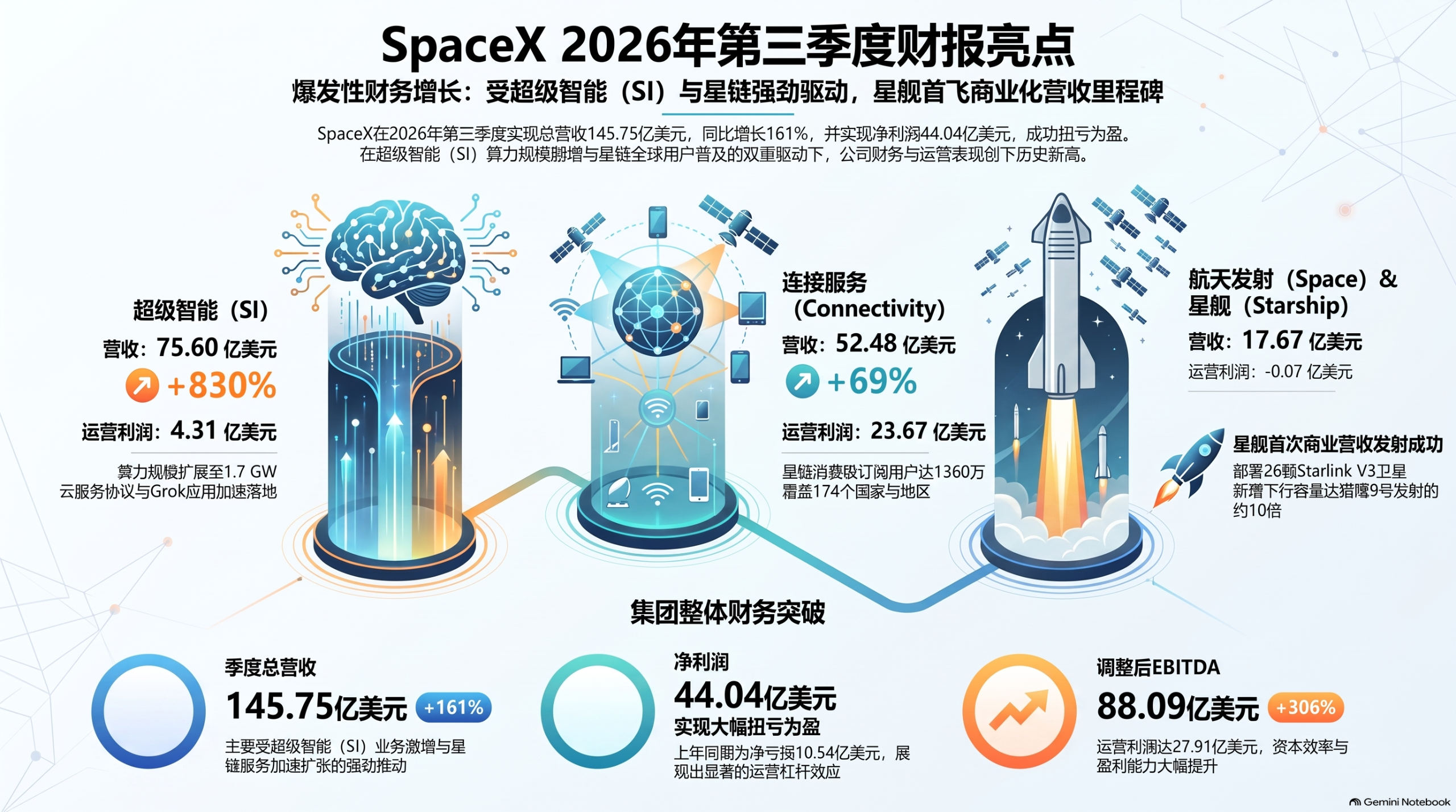
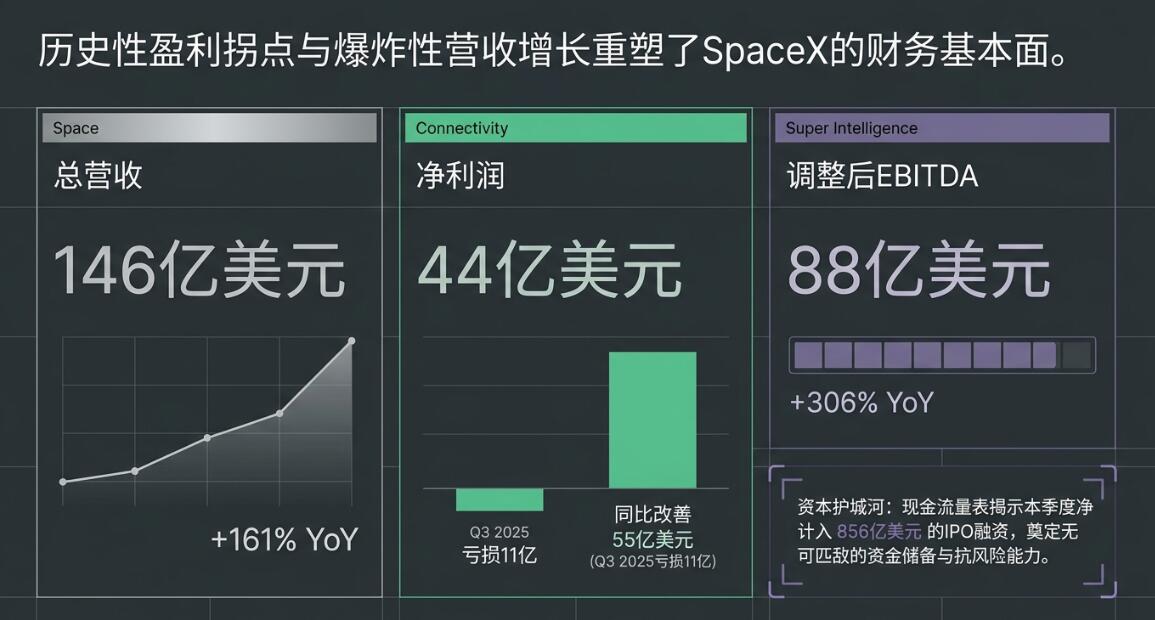
In the third quarter, SpaceX's total revenue surged 161% year over year to nearly $14.6 billion, with net profit of $4.4 billion—both exceeding analysts' estimates by 14% and 134%, respectively. Capital expenditures exceeded revenue by more than 30%, broadly in line with expectations. Growth in cloud services, along with acquisitions of Cursor and the Grok app, drove AI‑related Superintelligence (SI) revenue to $7.56 billion, making it the company's largest revenue stream for the first time—20% above consensus. SI business capital spending totaled $16.4 billion, accounting for 84% of total expenditures. Revenue from the connectivity segment rose 69% year over year, with Starlink subscribers climbing to 13.6 million. Aerospace revenue increased 6%, as Starship contributed for the first time; however, R&D spending continued to weigh on results, leaving the aerospace segment with an operating loss of $7 million. Following the earnings release, the stock rallied in after-hours trading, gaining more than 8%.
The second quarterly earnings report since its IPO shows that SpaceX, under Elon Musk, delivered stellar results in the third quarter of this year, handily surpassing Wall Street's expectations.
After the U.S. market closed on Tuesday, October 20, Eastern Time, SpaceX announced that for the third quarter of 2026, ending in September, its revenue grew 161% year over year to $14.58 billion—more than 10% above analysts' estimates of roughly $12.8 billion. Net profit came in at approximately $4.4 billion, 2.3 times the analysts' forecast of $1.88 billion. Adjusted EBITDA surged 306% year over year to $8.81 billion, exceeding expectations by more than 30%.
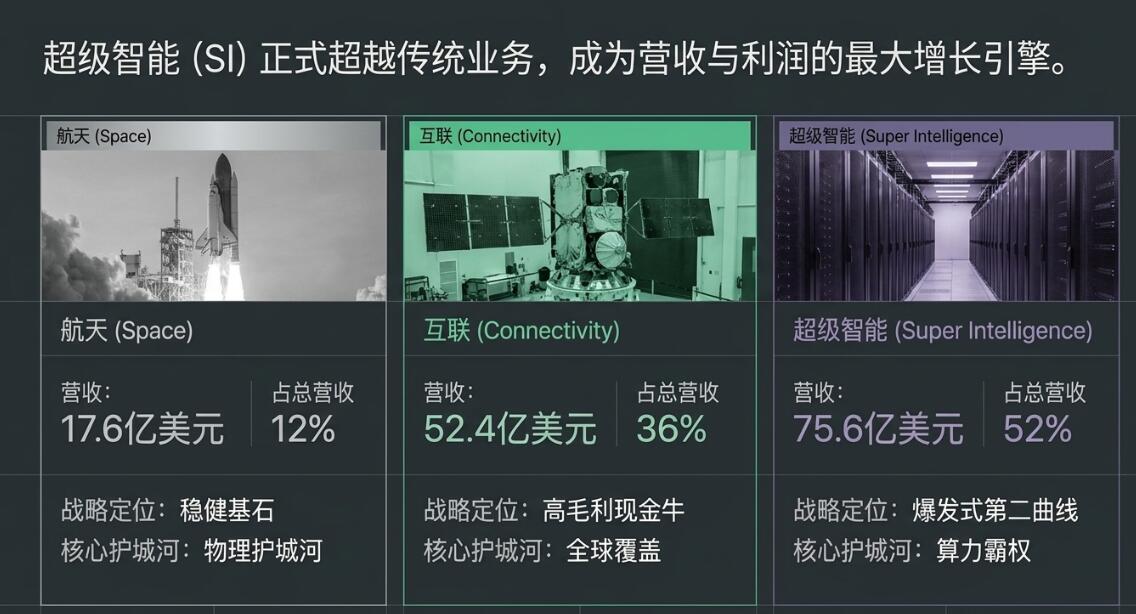
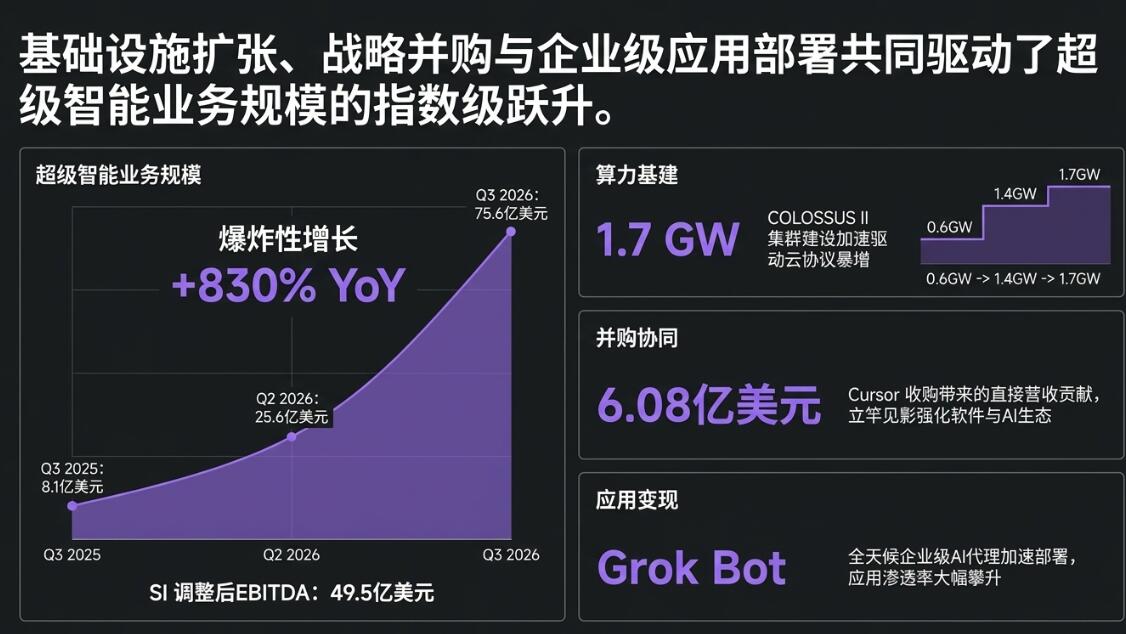
 The most notable shift in this earnings report is that SpaceX's growth engine has moved further from traditional rocket launches and its Starlink connectivity business to the AI‑driven "Superintelligence" (hereafter referred to as SI) segment. In the third quarter, SI revenue reached $7.56 billion, a staggering 830% year over year, surpassing analysts' estimates of $6.3 billion by 20% and becoming the company's largest revenue source for the first time.
Compared with the second quarter, SpaceX's growth trajectory has steepened markedly. In Q2, the company's revenue rose 92% year over year, while its net loss stood at $541 million—though this represented a significant narrowing from the $1 billion loss a year earlier, it still fell short of profitability. Adjusted EBITDA for the quarter reached $3.5 billion, up 191% year over year. By the third quarter, not only had revenue growth surged to 161% year over year, but the company also posted a net profit exceeding $4 billion, and adjusted EBITDA increased by roughly 149% quarter over quarter.
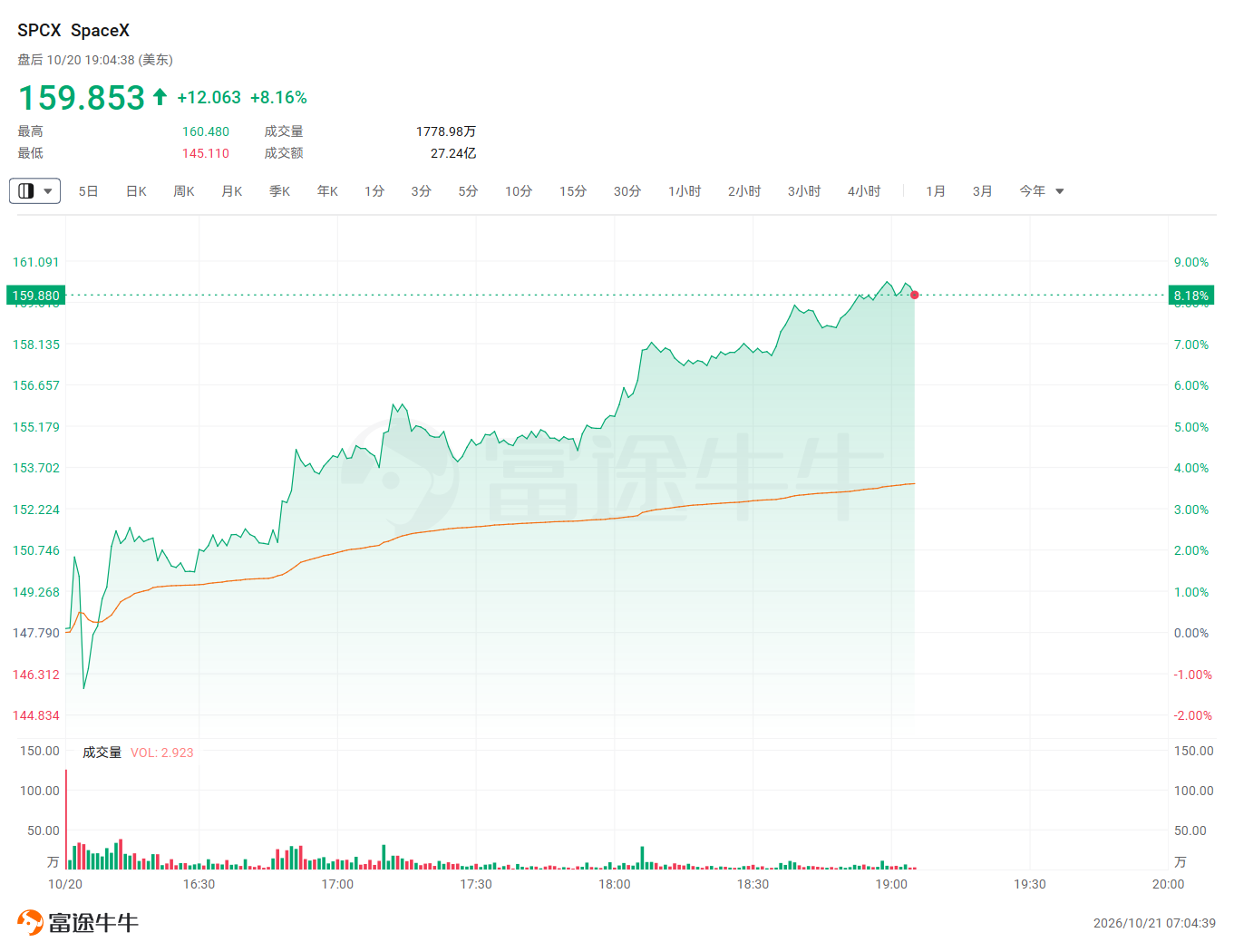
Ahead of the earnings release, on Tuesday, October 20 Eastern Time, SpaceX (SPCX) closed down about 0.1%. After the company reported its results after hours, the stock quickly reversed course and rose, at one point gaining more than 2% in after-hours trading. The market's reaction centered on the fact that revenue and profit growth exceeded expectations, offsetting the pressure from persistently high capital expenditures and costs.
During the earnings call, as Tesla executives including Elon Musk revealed targets or guidance such as achieving an annual recurring revenue (ARR) of up to $1 trillion next year and deploying 13 GW of AI computing power, and also confirmed that they are discussing a merger with Tesla, SpaceX's stock price surged further, rising more than 8% in after-hours trading.
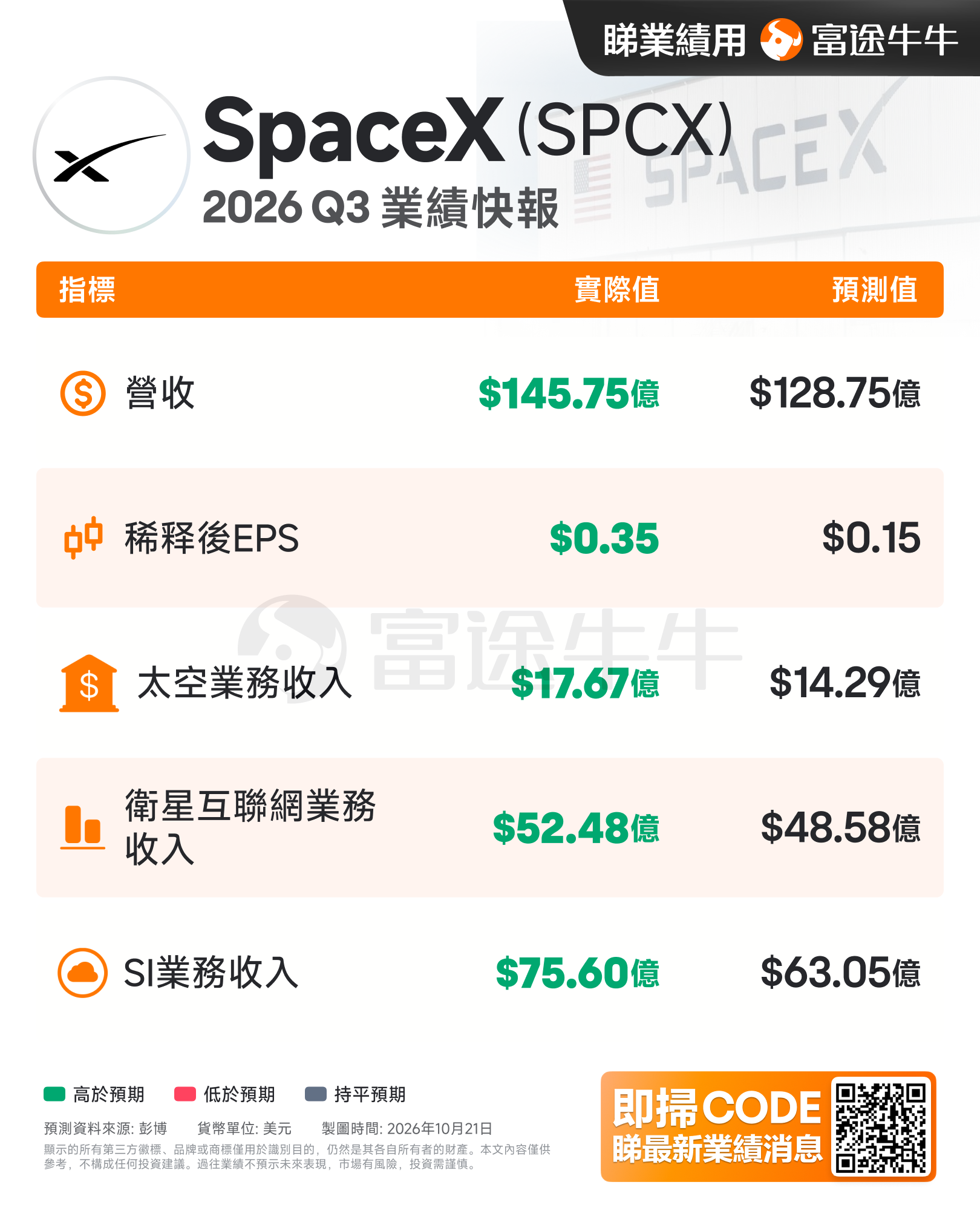
Key metrics: Revenue, profit, and EBITDA all exceeded expectations, but costs also came in higher than anticipated.
According to Bloomberg's analyst consensus, SpaceX significantly exceeded market expectations across both revenue and profitability in the third quarter.
Indicator | Actual for the third quarter | Analyst expectations | Comparison |
|---|---|---|---|
Revenue | US$14.58 billion | Approximately US$12.8 billion | About 14% above expectations |
SI/AI Revenue | US$7.56 billion | US$6.3 billion | About 20% above expectations |
Operating profit | US$2.79 billion | US$2.24 billion | About 25% above expectations |
Earnings per share (EPS) | 0.35 USD | 0.15 USD | More than double the expected amount |
Net profit | US$4.40 billion | US$1.88 billion | About 134% above expectations |
Adjusted EBITDA | US$8.81 billion | US$6.59 billion | About 34% above expectations |
Capital expenditure | US$19.59 billion | US$19.6 billion | Basically in line with expectations. |
SI Capital Expenditure | US$16.44 billion | US$16.9 billion | Slightly below expectations |
Total Costs and Expenses | US$11.78 billion | US$11.23 billion | About 5% above expectations |
In the third quarter, the company's total revenue increased from $5.58 billion in the same period last year to $14.58 billion, while total costs and expenses rose from $5.85 billion to $11.78 billion. Despite costs exceeding expectations, revenue grew at a faster pace, driving operating profit to turn from a loss of $273 million in the prior-year period to a profit of $2.79 billion, with an operating margin of approximately 19%.
Adjusted EBITDA totaled $8.81 billion, corresponding to an adjusted EBITDA margin of approximately 60%. It should be noted that adjusted EBITDA is a non-GAAP measure that excludes items such as depreciation and amortization, share-based compensation, and acquisition-related expenses; accordingly, its improvement significantly exceeds the year-over-year change in operating profit under GAAP.
SI has become the largest revenue driver: cloud services, Cursor, and Grok are fueling an AI business boom.
The most critical variable in SpaceX's financial report is its SI business. The company notes that SI refers to the Artificial Intelligence (AI) business previously disclosed.
In the third quarter, SpaceX's Starlink revenue reached $7.56 billion, up 195% quarter over quarter and 830% year over year, surpassing the Connectivity segment's $5.25 billion and making it SpaceX's largest business segment. Specifically:
Advertising revenue reached $538 million, up approximately 19% year over year.
SI solutions and infrastructure revenue totaled $7.022 billion, compared with just $359 million in the same period last year.
The company stated that revenue from SI solutions and infrastructure increased by $6.7 billion year over year, driven primarily by new cloud service agreements, the Cursor acquisition, and growth in the Grok model and software applications.
Profitability has also reached an inflection point. In the third quarter, SI reported operating profit of $431 million, compared with a loss of $1.257 billion in the second quarter and a loss of $1.722 billion in the same period last year. The company disclosed that the third-quarter operating profit included $1.2 billion in stock-based compensation expenses related to the Cursor acquisition. On an adjusted basis, SI's EBITDA came in at $4.953 billion, versus a loss of $428 million in the same period last year.
Expanding computing power remains the cornerstone of the SI business. By the end of the third quarter, SpaceX's nominal computing capacity reached 1.7 GW, up from 1.4 GW at the end of the second quarter and well above last year's 0.6 GW. The company stated that this growth stems from the ongoing deployment of COLOSSUS II and the signing of additional cloud‑service agreements during the quarter, which have bolstered its SI infrastructure capacity reserves for third‑party customers.
Cursor was also a key focus of this quarter's financial results. On August 14, SpaceX completed its acquisition of Cursor, valuing the equity at $60 billion, with a GAAP purchase price of $42.5 billion and the issuance of $23.4 billion in equity awards tied to future services. From the date of consolidation through September 30, Cursor contributed $608 million in revenue to SpaceX.
Connectivity: Starlink subscribers have grown to 13.6 million, with revenue from enterprises and governments expanding at a faster pace.
Connectivity remains SpaceX's most reliable source of revenue. In the third quarter, connectivity revenue reached $5.248 billion, up 22% quarter over quarter and 69% year over year; operating profit totaled $2.367 billion, a 99% year-over-year increase; and adjusted EBITDA stood at $3.499 billion, up 82% year over year.
Breaking it down, Starlink's consumer‑side business continues to expand:
Consumer revenue reached US$3.121 billion, up 57% year over year;
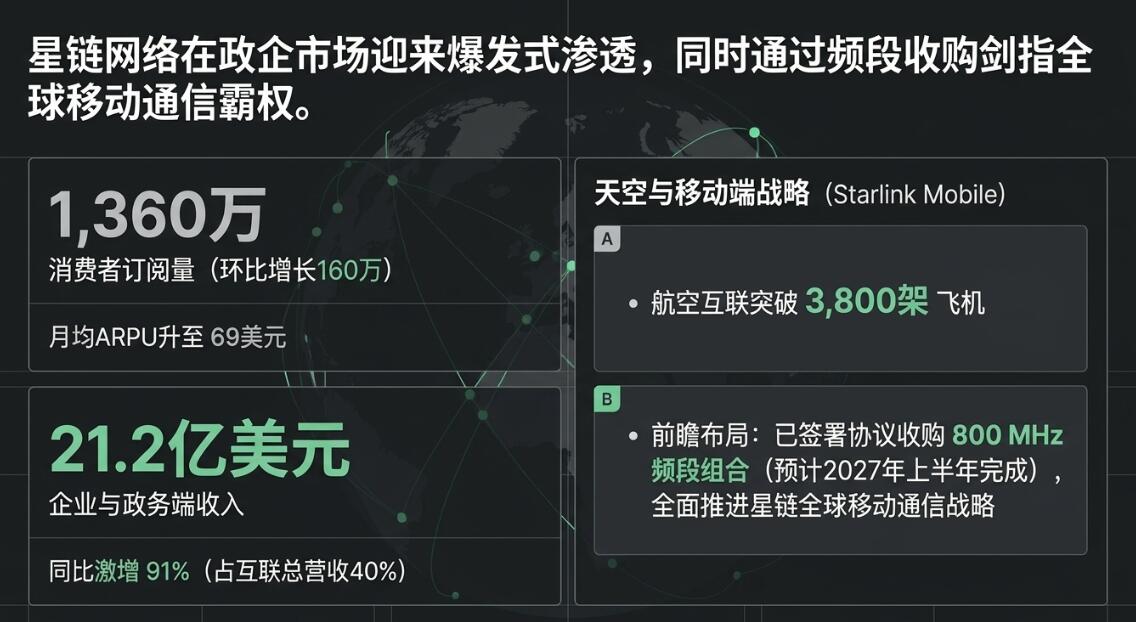
Corporate and government revenue totaled US$2.127 billion, up 91% year over year.
Starlink's consumer subscription base reached 13.6 million, up 1.6 million from the previous quarter and compared to 7.2 million in the same period last year.
The monthly ARPU on the consumer side stood at $69, up roughly 5% quarter over quarter from $66 in the second quarter, but below last year's level of $83.
This means that Starlink's user base continues to grow rapidly, though average revenue per user remains below last year's level. The company is offsetting the decline in consumer‑side ARPU by targeting high‑value segments such as enterprise, government, aviation, and maritime markets. As of the end of the third quarter, more than 3,800 aircraft had already been equipped with Starlink services.
The cost of the connectivity business is also rising. Total costs and expenses in this segment increased by $974 million year over year, primarily due to the expansion of the satellite constellation, deliveries of Starlink terminals, and marketing investments supporting revenue growth. However, with revenue growing even faster, the segment's operating margin reached approximately 45%, making it SpaceX's most mature source of cash‑generating profit to date.
Aerospace: Revenue growth was more moderate compared to other business segments; Starship generated revenue for the first time, but R&D spending continued to weigh on profitability.
In the third quarter, traditional space‑related revenue totaled $1.767 billion, up 84% quarter over quarter and 6% year over year, broadly in line with analysts' estimates of approximately $1.8 billion.
However, according to operational data, the number of launches has not increased. In the third quarter, SpaceX completed:
The customer launched 12 times, compared to 15 times during the same period last year.
Internal launches totaled 23, compared with 29 in the same period last year;
A total of 35 launches were conducted, compared with 44 during the same period last year.
The orbital insertion mass was 476 tons, compared with 525 tons during the same period last year.
In other words, the growth in aerospace revenue is not driven by an increase in launch frequency, but rather by changes in the composition of launch services, development-related income, and advancements related to Starship.
The most significant business milestone of the third quarter was Starship's first revenue‑generating mission. During the quarter, SpaceX conducted Starship's 14th flight—the first orbital‑class Starship mission—placing 26 Starlink V3 satellites into the broadband constellation. The company stated that this mission increased downlink capacity by roughly ten times that of a single Falcon 9 Starlink launch.
However, Starship development continues to erode the aerospace segment's profitability. In the third quarter, the aerospace segment posted an operating loss of $7 million, compared with a $542 million loss in the second quarter and a $259 million profit in the same period last year. The company stated that total costs and expenses for the aerospace segment increased by $367 million year over year, primarily due to continued accelerated R&D investment in the Starship program.
Profit Quality: Net profit exceeds operating profit, with non-operating items making a significant contribution.
SpaceX's operating profit for the third quarter was $2.791 billion, yet its net profit reached $4.404 billion—exceeding its operating profit. This indicates that net profit was bolstered not only by improvements in its core business but also by significant contributions from non‑operating items and tax effects.
In the third quarter, the company recorded:
Interest income of US$873 million;
Interest expense of US$675 million;
Net other income amounted to US$1.025 billion;
Income tax revenue totaled $390 million.
These projects collectively contributed positively to net profit. Consequently, although net profit under GAAP significantly exceeded expectations, investors should still distinguish between the contributions of "improved core‑business performance" and "financial and tax‑related factors" to net profit.
In addition, equity‑based compensation expenses remain substantial. In the third quarter, the company recorded $1.146 billion in ordinary equity‑based compensation and $1.217 billion in M&A‑related equity‑based compensation, for a combined total exceeding $2.3 billion. These expenses are excluded from adjusted EBITDA but impact GAAP net income and diluted earnings per share.
In the third quarter, the diluted weighted-average shares outstanding totaled 12.475 billion, compared with 2.941 billion in the same period last year, reflecting significant dilution resulting from the IPO, equity financings, acquisition consideration, and employee incentive programs. Against this backdrop, the company's diluted EPS still reached $0.35, exceeding the expected $0.15.
Capital expenditures exceed revenue by more than 30%, and SI's computing infrastructure development remains the primary driver of cash consumption.
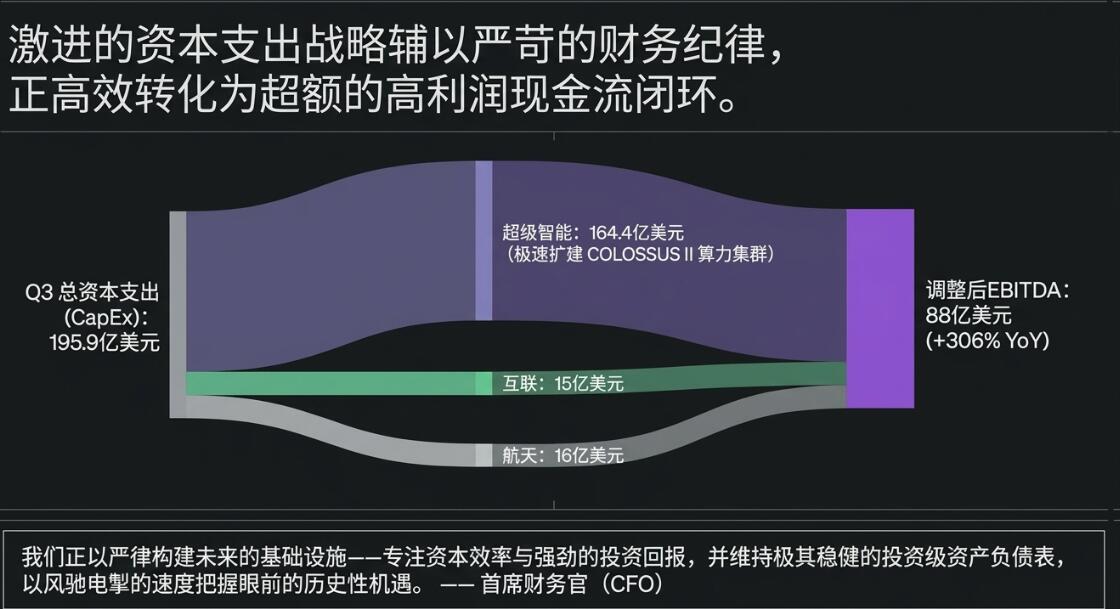
SpaceX's capital expenditures for the third quarter totaled $19.593 billion, nearly in line with analysts' estimates of $19.6 billion, but at an exceptionally high level—about 34% above the quarter's revenue. Of this, capital spending on its Starlink business accounted for roughly 84% of total capex, slightly below analysts' expectations of $16.9 billion.
By business segment:
Capital expenditures for the aerospace business totaled US$1.606 billion;
Capital expenditures for the connectivity business totaled US$1.543 billion;
SI's capital expenditures totaled US$16.444 billion.
This indicates that SpaceX's current capital expenditures are almost entirely focused on AI and SI computing infrastructure. While SI generated $7.56 billion in quarterly revenue, its capital spending reached $16.44 billion, suggesting the company remains firmly in an early-stage capacity‑building phase.
Looking at the first three quarters, SpaceX's operating cash flow totaled $13.097 billion, while capital expenditures for the same period reached $48.069 billion, resulting in a free cash flow of approximately negative $34.97 billion on a simple calculation. The company's growth continues to rely on support from equity markets and debt financing.
On the balance sheet, as of the end of the third quarter, SpaceX held $51.294 billion in cash and cash equivalents, along with $38.561 billion in marketable securities, for a combined total approaching $89.9 billion. Total debt and finance leases amounted to approximately $38.8 billion, yet the company remains in a net-cash position. In the first three quarters, the company raised a net $85.675 billion from its IPOs, which has been a key source of funding to support its current high‑intensity capital expenditures.
Starlink's mobile business: The acquisition of 800 MHz spectrum paves the way for the next phase.
Following the third quarter, on October 8, SpaceX reached an agreement to acquire a nationwide portfolio of low‑frequency spectrum licenses in the United States, encompassing up to 14 MHz of paired spectrum in the 800 MHz band.
SpaceX stated that the deal will advance Starlink Mobile's strategy.
Low-frequency spectrum offers superior coverage and penetration, making it strategically valuable for satellite‑to‑phone direct connectivity, mobile networking, and serving remote areas.
The transaction is expected to close in the first half of 2027, subject to regulatory approvals and other customary closing conditions.
 Earnings Flash: AI Insights into Key Points, Build an Options Strategy in Three Steps! Open Futubull > Stock Page > Tap [Company] >Earnings Flash Report