
J.P. Morgan Asset Management has included Bitcoin in its long-term capital market assumptions for the first time, predicting that its returns over the next decade could outperform those of equities, bonds, and gold. This move is regarded as a milestone in Bitcoin's acceptance on Wall Street.
According to Zhitong Finance APP, JPMorgan Asset Management has included Bitcoin in its long-term capital market assumptions for the first time, predicting that its returns over the next decade may outperform equities, bonds, and gold. This is viewed as a milestone in Bitcoin's acceptance on Wall Street. However, the issue remains that Bitcoin's extreme volatility may undermine its appeal on a risk-adjusted basis.
JPMorgan AM’s base-case scenario projects an annualized return of 10% for Bitcoin over the next decade, while assuming an annualized volatility as high as 55%, more than three times that of U.S. large-cap stocks. The firm stated in its report this week that it has not yet incorporated Bitcoin into its primary portfolio models due to the unstable correlation between Bitcoin and other assets.
 High volatility erodes compounded returns, as significant losses require larger gains to break even. Investors in Bitcoin ETFs are familiar with this dynamic: those who bought near the peak of slightly above $126,000 in 2025 saw their positions lose up to 50% as prices retreated.
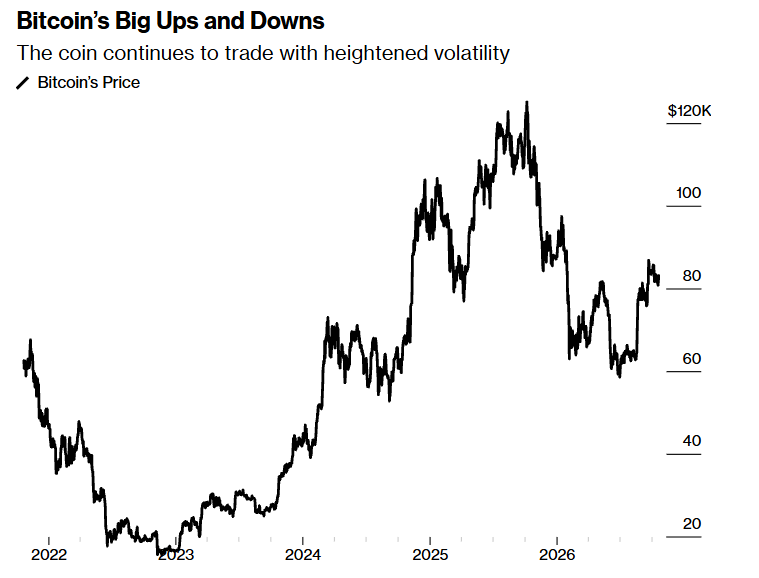
The JPMorgan AM team, including Tim Lintern, Thushka Maharaj, and Sean Daly, wrote: “We believe it is premature to view Bitcoin as a diversification tool within a balanced portfolio. However, the situation could change in the future if volatility continues to decline and correlations with other assets stabilize, particularly as regulation becomes clearer and liquidity and price discovery continue to improve.”
Since the pandemic, several Wall Street institutions have increased their exposure to the cryptocurrency sector, shifting from cautious inquiry to more substantive experimentation, including offering trading services for certain currencies, launching crypto-themed funds, and exploring tokenization.
Analysts at JPMorgan AM noted that although many investors still regard Bitcoin as a speculative asset, they continue to explore cryptocurrencies. Recent surveys indicate that one in ten clients holds cryptocurrencies in their portfolios, and approximately 17% of clients plan to “prioritize cryptocurrency allocations.” This trend is partly driven by a more mature and clear regulatory framework.
Nevertheless, researchers at the bank maintain that Bitcoin is not yet sufficient to serve as a diversification tool in a balanced portfolio due to its “unstable correlation” with other assets. They wrote: “If correlations stabilize and volatility declines, the portfolio utility of Bitcoin may improve in the future.”
More broadly, the researchers explored in their report how “economic nationalism, technology adoption, and capital reallocation” might drive asset returns over the next decade. They concluded that government investments in “national resilience” and corporate competition to deploy new innovations will influence capital allocation patterns. They stated that a $15 trillion “global capital expenditure supernova” will drive growth and robust asset returns.
The report stated: “While technology adoption today is nearly synonymous with artificial intelligence, breakthroughs in other fields—from pharmaceuticals to robotics and space—over the next decade may further support trend growth through investment and productivity enhancements.”