
Recently, a key Middle Eastern crude oil benchmark has fallen to its lowest level in nearly three months. This appears to signal a development more significant than the oil price itself: while geopolitical risks continue to inflate futures pricing, the logistical resilience of physical Gulf crude has substantially undermined the ability to weaponize the Strait of Hormuz in the event of a U.S.-Iran conflict.
Zhitong Finance APP has learned that a key crude oil benchmark in the Middle East recently fell to a three-month low. This appears to signal a development more significant than the oil price itself: while geopolitical risks continue to inflate futures pricing, the logistical resilience of physical crude in the Gulf has substantially undermined the ability to weaponize the Strait of Hormuz in a U.S.-Iran conflict.
Data from index provider General Index shows that the premium of Oman crude over Dubai crude—the most direct indicator of the strength of the Gulf’s spot crude market—dropped to around $4 per barrel this week, its lowest level since late July. In the early stages of the conflict, when the Strait of Hormuz was nearly closed, this spread once surged to over $60 per barrel.
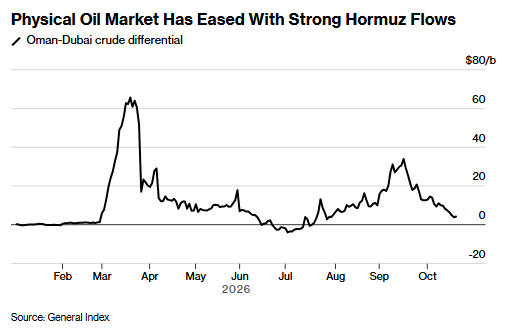
 The magnitude of this spread’s collapse undoubtedly raises a question: Why did the Gulf’s physical crude market “desensitize” first, even as U.S.-Iran tensions remained unabated?
The answer may lie not in de-escalating tensions, but in a bypass barrier constructed by Gulf oil producers through logistics and commercial strategies. This barrier is systematically diluting the marginal effectiveness of the Strait of Hormuz as a tool for energy coercion, reclaiming pricing power in the global crude market from “chokepoint control” and returning it to the combined forces of freight rates, differentials, and market share competition.
Why Did the Premium Disappear First in the Physical Market?
The Strait of Hormuz carries approximately 20% of global crude oil and liquefied natural gas supplies. A U.S.-Iran blockade or partial blockade of this waterway would be sufficient to push energy prices to levels high enough to force adversaries to concede. The surge in the Oman-Dubai spread to over $60 in the early stages of the conflict was a direct reflection of the spot market’s response to this risk.
However, pricing signals in the physical market now convey the opposite message. Provisional data from Kpler showed that as of September 30, the seven-day moving average of crude exports from the Middle East reached 18.3 million barrels per day, exceeding pre-conflict levels on 14 days in September. Vortexa’s fourteen-day moving average touched 18.6 million barrels per day, also returning to near pre-conflict averages.
Wael Sawan, CEO of Shell, stated at the London Energy Intelligence Forum in early October that Middle Eastern oil flows had “recovered to more than 80% of pre-conflict levels.” Amin Nasser, CEO of Saudi Aramco, also noted at the time that Gulf oil producers had increased crude flows to near pre-conflict levels.
This recovery was not the result of a U.S.-Iran “green light,” but rather the product of active restructuring of transport routes by Gulf oil producers. During the conflict, the UAE deployed its own fleet and leased additional vessels, with some ships disabling their Automatic Identification System (AIS) transponders to traverse the strait and evade tracking and targeting. Iraq, after obtaining Iranian permission for its tankers to pass through the Strait of Hormuz, loaded Basra crude within the strait via the State Oil Marketing Organization (SOMO) and some refiners, then completed transshipment using shuttle tankers. Saudi Arabia simultaneously coordinated two export routes via the Red Sea’s Yanbu port and the Persian Gulf. Even though an attack on the East-West Pipeline on September 13 temporarily halted operations at Yanbu, more crude was redirected toward the Persian Gulf, maintaining the upward trajectory of total exports.
Logistical adaptations are transforming the “chokepoint leverage” brought by this conflict into a costly but manageable friction cost, rather than a decisive supply disruption. Analysts have previously pointed out that as producers increase output, alternative routes come online, and shipping patterns shift, the ability of the U.S. and Iran to weaponize the Strait of Hormuz is steadily weakening. While this escalation in conflict remains sufficient to trigger short-term price volatility, the structural efficacy of using the strait as a bargaining chip is tending to diminish.
June Goh, an oil analyst at Sparta Commodities SA, stated that the Gulf crude oil market has remained under pressure as multiple cargo parcels can be delivered with relatively short notice periods.
The divergence between physical and futures markets
If one looks solely at the Oman-Dubai spread, the conclusion appears to be that Middle East supply has normalized. However, the trajectory of Brent futures tells a different story.
After touching a five-month high of approximately $112 per barrel, Brent crude remains in an elevated range that is unsettling for physical traders. Goldman Sachs’ pricing model indicates that the average geopolitical risk premium implied in the September Brent term structure reached $22 per barrel, the second-highest monthly level on record, surpassed only by April this year and even exceeding the peak observed during the onset of the Russia-Ukraine conflict in 2022.
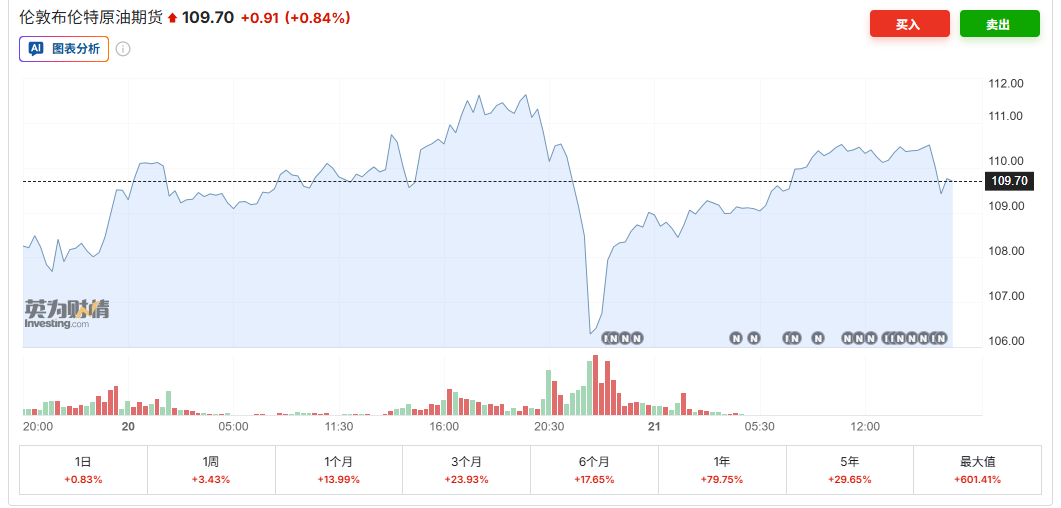
The divergence between weakening physical markets and strengthening futures is not a sign of market "failure," but rather reflects two parallel pricing logics currently in operation. The physical market trades barrels being loaded now; factors such as the resumption of Gulf exports, the availability of multiple cargoes on short notice, and Iraq’s aggressive discounting to secure buyers have collectively suppressed spot premiums and benchmark spreads.
The futures market, conversely, trades on concerns about a potentially tighter supply-demand balance in the future. According to reports from the International Energy Agency (IEA), global observable oil inventories have cumulatively decreased by approximately 507 million barrels since the end of February 2026, significantly depleting pre-war buffers and markedly thinning emergency stockpiles in OECD countries. In its October 20 report, Breakwave Advisors maintained its view of elevated near-term oil prices, citing the "persistence of geopolitical uncertainty" as a core supporting factor.
Crucially, freight and insurance costs have become an不可忽视 (non-negligible) factor internalized into physical pricing. According to Goldman Sachs estimates, the average global crude oil freight rate has risen to approximately $30 per barrel, up from just $4 per barrel a year ago; freight rates for Middle East routes are even higher, at around $35 per barrel. At their meeting on October 12, OPEC+ ministers warned that shipping and insurance costs now exceed one-third of the commodity's value.
This cost shock has left clear traces in grade spreads: the premium for Murban crude loaded in Fujairah (outside the Strait) relative to Basrah crude loaded within the Persian Gulf has surged from approximately $2 per barrel in February to around $43 per barrel. Goldman Sachs interprets this widening differential as the market repricing transport and geopolitical risks through the grade structure, rather than merely pricing in supply disruptions.
In other words, the risk associated with the Strait of Hormuz has not disappeared; it has merely been redistributed—shifting from the question of "whether oil is available" to "at what cost, via which route, and in what grade structure oil reaches refineries." The decline in physical benchmark spreads masks a structural rise in landed costs and a narrowing of globally accessible supply along logistical dimensions.
Matias Togni, an independent crude oil trading strategist, noted that while spot prices for Middle Eastern crude reflect an improvement in supply conditions, the pricing logic in the crude oil futures market remains primarily driven by concerns over potential tightening in forward supply.
Who is paying for "resilience"?
The recovery of Gulf exports does not follow a uniform narrative of producer unity; rather, it involves intense commercial competition, with the costs being redistributed through discounts and shifts in market share.
Iraq represents the most extreme case of this dynamic. The State Oil Marketing Organization (SOMO) has widened the discount on Basra Heavy crude for October shipments to $37 per barrel, deepening from the sub-$30 levels seen in August and September; the discount for Basra Medium crude stands at $34.50 per barrel. In absolute terms, this means Iraq earns nearly $40 less per barrel of Basra Heavy sold compared to the regional benchmark.
Furthermore, even after these discounts, freight costs remain a significant drain: spot freight rates from the Gulf to East Asia in October ranged from approximately $25 to $30 per barrel, while war risk insurance premiums surged from 1%-3% to 7.5%-10% of hull value. The cost for a Very Large Crude Carrier (VLCC) round trip through the Strait of Hormuz could reach as high as $20 million. Consequently, Iraq’s "export recovery" is largely a volume-driven gain achieved at the expense of profit margins, yielding fiscal returns far below what the barrel counts might suggest.
The United Arab Emirates (UAE) has taken a different path. Data from the International Energy Agency (IEA) shows that UAE crude oil production hit a historic record of 4.1 million barrels per day in June, surpassing the previous peak set during the brief Saudi-Russia price war in 2020. This surge is directly linked to Abu Dhabi’s exit from OPEC+ production caps in late April, allowing it to operate without volume constraints while maintaining Persian Gulf exports through its own fleet and dark fleet operations involving transponder shutdowns. Meanwhile, Saudi Arabia’s September production increased by approximately 744,000 barrels per day month-on-month, bringing total OPEC+ output to 25.097 million barrels per day for the fourth consecutive month of growth. Saudi Aramco further reduced the Official Selling Price (OSP) for Arab Light crude destined for Asia in November to a discount of $5 per barrel against the Dubai/Oman benchmark, a significant widening from the $2 discount in October and one of the lowest levels since 2020.
These moves collectively point to a structural shift accelerated by war: Gulf producers are redrawing the procurement map for Asian refineries using price and logistical capabilities. Analysts, including Xavier Tang, note that the rebound in Middle Eastern supply will help alleviate tightness in the oil market, particularly for Asian refineries. However, from the perspective of producer fiscals, the other side of this "relief" is that countries like Iraq and the UAE are sacrificing wartime revenue to preserve customer relationships and market share positions in the post-crisis era.
The Fragile Core Beneath the Resilience Narrative
However, interpreting the collapse of the Oman-Dubai price differential simply as "risk has passed" is a dangerous misreading. The resilience of the Gulf physical market is built on an highly inefficient logistical architecture that is highly sensitive to any further disruptions.
Ship-to-ship (STS) transfers represent the most obvious bottleneck in the current export chain. As more crude must be transferred via smaller tankers crossing the strait to locations near Oman before being loaded onto VLCCs for shipment to Asia, STS capacity in the Gulf of Oman has approached its limit, with the time required for a single transfer extending from the previous five to seven days to nearly ten days. In late September, the daily charter rate for a VLCC transporting crude from the Middle East to Asia rose to a record level of approximately $1.27 million.
This implies that current export flows are being achieved under conditions of severely compressed运力 turnover efficiency. Any successful targeted strike on transfer nodes or pipelines could create an equivalent supply shock by paralyzing the transfer chain, even without physically "closing" the Strait of Hormuz.
The depletion of inventory buffers constitutes a second layer of vulnerability. Global inventories have declined by approximately 507 million barrels since the onset of the war. Although the G7 has announced plans to release up to 100 million barrels from emergency crude oil and diesel reserves, this volume offers only marginal reassurance relative to the scale of the depleted buffers.
Shell CEO Wael Sawan stated, “We may have mitigated the most severe impacts of this crisis,” but noted that flows through the Strait of Hormuz “have not yet returned to normal.” He added that buffering factors such as declining demand and increased production in other regions are “unlikely to indefinitely offset the supply and transportation disruptions caused by the war.”
A more fundamental constraint is that Iran’s capacity to weaponize energy, while structurally diminished, has not disappeared. Intelligence assessments from the maritime intelligence firm Marisks suggest that recent shipping incidents are not necessarily deliberate, targeted attacks on specific commercial vessels, but rather reflect a pattern of behavior wherein Iranian forces launch missiles into pre-designated “combat zones,” with weapons automatically locking onto detectable radar signals within those areas. This implies that even as Iran’s strategic coercive effect wanes, its ability to create unpredictable, localized physical disruptions remains intact. The UK Maritime Trade Operations office has recorded at least one attack per day in the Strait of Hormuz or the Gulf of Aden since October 2, a frequency that itself provides sustained support for freight rates and insurance pricing.
Gulf oil producers have demonstrated their ability to maintain substantial export volumes despite Iranian harassment. However, the physical price differential also represents a conditional optimism—it implicitly assumes current transshipment efficiency, available shipping capacity, and existing inventory levels. Should any of these variables undergo a non-linear change, the “normalization” narrative implied by the Oman-Dubai price spread will reverse at an equally rapid pace.