Source: The Intelligent Investor
"Throughout my life, the Berkshire shares I've held have experienced three 50% declines."
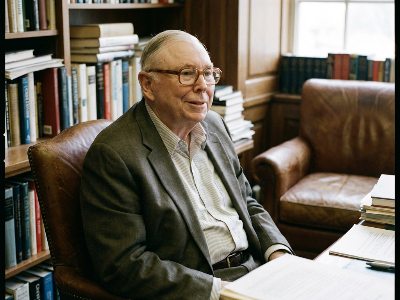
On April 19, 2022, at the Singleton CEO Excellence Awards event held at the Maybourne Hotel in Beverly Hills, California, 98-year-old Charlie Munger engaged in a conversation with Berkshire Hathaway investment manager Todd Combs (who will step down in December 2025), during which he casually recounted this experience.
 He then added, "And this is already one of my most successful investments."
Taken together, these two statements are truly worth pondering again and again. Even a well‑proven, time‑tested investment can subject its holder to such extreme price volatility. And yet, when Munger speaks of this, his tone remains remarkably calm.
For investors currently navigating the roller-coaster ride of the Chinese stock market, such experiences may carry more weight than any sermon on long-term investing.
We all know that investing requires a long-term perspective and rationality. Yet when markets experience sharp volatility, paper wealth shrinks dramatically, and conflicting opinions abound, maintaining this mindset is far from easy.
In particular, there is sometimes no clear dividing line between persistent perseverance and stubbornness.
Of course, Munger was not suggesting that once you buy a company, you should hold on no matter how much it falls. In fact, throughout this conversation, he repeatedly stressed that investors must be able to independently assess a company's value and remain rational at all times.
This trait ran almost throughout his entire life.
Munger recounted that he discovered a life‑long secret when he was just seven years old.
At the time, a respected elder of exceptional talent—whom he deeply admired—was driven nearly to madness by a leaking roof that required costly repairs.
At such a young age, Munger thought to himself, "Good heavens—how can even a genius like this go mad?" Then he suddenly realized: "If I'm living in a world where even geniuses can lose their minds, then I still have a chance."
But to seize these opportunities, you must first make sure you don't become part of the irrational.
In this conversation, Munger repeatedly spoke of Henry Singleton, whom he regarded as a rare business genius.
Back then, when the market was sluggish and the company's stock was undervalued, Singleton undertook large-scale share repurchases—unlike many later CEOs, who were eager to buy back shares regardless of the stock price.
Munger greatly admired his almost total, unconstrained-by-convention rationality.
In his view, Singleton's life demonstrates just how immense the power can be when one steadfastly and uncompromisingly upholds reason.
Turning to investing, Munger believes that those who consistently deliver outstanding investment results are often the ones who are almost obsessive in their pursuit of great companies.
However, he also cautions that great companies often become extremely expensive when everyone is bullish on them, with prices rising to the point where they ultimately cease to be a sound investment.
From identifying high-quality companies, to assessing the appropriate purchase price, to enduring the substantial volatility of the holding period, rationality remains the guiding principle throughout.
When Coombs asked what personal traits had contributed most to his and Buffett's investment success, Munger's answer was very straightforward: "I almost regard rationality as a kind of faith."
He also said, "The truly exceptional people I know all feel a sense of responsibility: they must keep learning and reflecting in order to become as wise as possible."
Beyond investment, the conversation also touched on his upbringing, his criteria for identifying exceptional leaders, the rise and fall of companies, the incentive structures within the financial industry, and his reflections on technological progress and human civilization.
Interestingly, Munger never considers himself a polymath. He says he has simply combined a healthy dose of passion with sustained focus, ultimately achieving respectable results.
He also shared another life lesson: stay away from problems you can't solve, choose those that are truly within your reach, and then commit your time and energy to them.
"If you're deeply obsessed with something—even if that obsession isn't constant—as long as you can sustain your focus over the long term and keep pondering the questions that truly matter, you'll likely stumble upon the answer at some point. That, in essence, is half the secret to life."
Many of Charlie Munger's remarks remain fresh and insightful with every read.
01. Singleton's life demonstrates the immense power of extreme rationality.
Munger: What happens if you encounter a genius and give them the full authority to unleash their talents?
It's like that guy who wins every swimming race. He's a towering giant, wears size‑16 shoes, and even has webbed toes. No wonder he's been sweeping up every damn swimming competition around the world.
Henry Singleton, co-founder of Teledyne, was just that kind of intellectual. He was like someone who wore size-16 shoes with webbed feet, competing against a group of ordinary people.
That's truly remarkable.
So watching Henry at work is a pleasure, because he's always so calm and rational.
Consider Berkshire Hathaway. Warren Buffett himself comes from an investment‑management background, so it's easy to see why Berkshire manages its businesses according to a long‑term strategic plan.
But the world Henry inhabited was entirely different. In those days, it was exceedingly rare for a company's CEO to be able to tell others, "Step aside—let me handle this."
And Henry truly did far better than they did. Back then, there were far too many rules and conventions, but Henry simply paid them no mind. Berkshire was the same.
He can enter an environment he doesn't fully control with ease.
Many CEOs simply cannot tolerate having anything around them that they cannot control. But Henry is not like that, nor is Warren Buffett.
So, there are many very similar aspects between them.
Interestingly, back then, when Henry undertook a large-scale share buyback of his own company's stock, it was an extremely rare occurrence. Today, share repurchases have become commonplace. You could say that Henry ultimately came out on top.
But today, many companies engage in share buybacks—something Henry would never do. These days, it's common for firms to keep repurchasing shares even when the stock price has already risen above its intrinsic value. They simply favor buybacks, paying little heed to what the stock is truly worth.
Meanwhile, people like Henry and Berkshire only buy back shares when they're cheap.
Surprisingly, after all these years, we have yet to see another Henry.
Stop and think: who else could possibly compare to Henry Singleton?
He has been dead for many years.
Of course, the United States is no shortage of smart people, but finding another one who makes you say, "There's another Henry Singleton," is exceedingly difficult.
Koomey, Tom Murphy (former Chairman and CEO of the American Broadcasting Company, whom Buffett called the person who taught him the most about business management), was also an outstanding CEO.
Munger: Yes, Tom is a very talented person. However, Tom can't play chess blindfolded.
Coombs: That's right, it really is.
Munger: By the way, I can't do it either.
Koomey and Tom have both served as CEOs for very long periods. Could you discuss the qualities that have made them such outstanding leaders?
Munger: Tom is truly remarkable. His approach is actually very simple: he delegates a great deal of work to others, but when it comes to matters that really matter, he handles them himself. It's that straightforward.
Henry's approach is also very simple.
In fact, one of the last conversations Henry and I had was when he already knew he did not have much time left. In the final stage of his life, he wanted to accomplish one thing: sell Teradyne to Berkshire in exchange for Berkshire shares.
I told him, "Henry, we're not going to issue stock and hand over a business we already know, like, and understand inside and out, just to acquire another company that we neither know nor understand. That simply won't happen."
Later, he continued to do things his own way.
But his ability to manage everything is truly astonishing.
In your entire life, you won't encounter many people like Henry Singleton.
He was the graduating class representative at MIT. In fact, wherever he went, he was always the top student.
02. Identify truly exceptional individuals and give them ample "court time."
Coombs, Charlie, you often speak of the power of the "fiduciary gene." It seems that the remarkable figures we just discussed all share this common trait.
This reminds me of something you once said: among all investors, your emphasis on outstanding—indeed, exceptional—management teams ranks at least in the top 10 percent. Yet you also told me that, even so, you've spent your entire career consistently underestimating the value of truly great management.
Could you elaborate on this point? In particular, how do you identify truly exceptional managers?
Munger: I believe that a very important lesson can be drawn from these individuals' careers.
I call it "The Wooden Lesson."
John Wooden, the legendary American college basketball coach, holds the world's most outstanding coaching record—no other coach can even begin to match it.
How did he pull it off? The answer is that he entrusted nearly all of his playing time to the team's seven best players. Naturally, as these players accumulated ample additional minutes, they grew even more exceptional.
When you entrust immense power to people like Wooden and Buffett, the same thing will happen.
That was Wooden's method, and it worked astonishingly well.
As an investor, if you can identify someone who is even just a "mini-Wooden," a "mini-Singleton," or a "mini-Buffett," and entrust them with opportunities to fully leverage their talents—while they deliver exceptionally outstanding results—that could very well be an excellent investment strategy.
Some people—you can tell at a glance—they're anything but ordinary.
Let me tell you another story about this extraordinary talent.
Caltech hosts a Rubik's Cube competition every year. One year, a man showed up at the event, picked up three or four scrambled cubes, and began juggling them in the air while simultaneously twisting them in his hands.
Those Rubik's Cubes were constantly in motion, yet he somehow managed to solve them all.
At the time, everyone believed that this record would probably never be broken.
As a result, the following year, a lady arrived.
People brought two scrambled Rubik's Cubes. She stared at them for a very long time, then picked one up in her left hand and the other in her right, slipped both hands behind her back, and began turning them.
After a while, she extended both hands. Both Rubik's Cubes were solved.
This is what really happened.
There really are people in this world who make you wonder if you were born on the wrong side of the species.
03. Acting with logical rationality can unleash tremendous power.
Kums, you grew up in Omaha.
I believe everyone here today knows your story: how you met Warren, how you transitioned from law to investing, and how you helped Warren recognize that investing in outstanding companies capable of generating long-term compounding returns is far more valuable than chasing what Benjamin Graham called "cigar‑butts."
If you hadn't become a lawyer back then and hadn't met Warren, what do you think you would have done?
Munger: I think I might open a law firm. After all, when I was practicing law, I knew very well how much revenue my legal practice could generate.
Although I didn't earn much at the time, I invested wisely and consistently saved. In fact, by the time I was around 35, I had already amassed a substantial sum of money.
I suppose I, too, would probably end up like Henry Singleton—watching the people around me go about their tasks and thinking to myself, "I could do this far better than they can. So why on earth am I still working for someone else?"
Many talented lawyers harbor this kind of thought.
Such is the case with the Pritzker family. Back then, there was a law firm called Pritzker & Pritzker.
Old Pritzker realized, "There isn't a single thing my clients are doing that I couldn't do just as well—and perhaps even better."
Accordingly, he retained the name of Pritzker & Sons Law Firm but no longer practiced law.
The Bing family was no different. Leo Bing was a genius. In his day, he handled the affairs of numerous real estate developers in Manhattan, and his firm was known as Bing & Bing.
Later, he retained the name but ceased providing legal services to his clients; instead, he let all his clients go and began doing what they had previously done—developing apartment buildings.
Moreover, he can act entirely according to his own abilities and judgment.
So, incidents like this will continue to occur, but very few people have the capacity to pull them off. Individuals like Singleton, Pritzker, and Bin are exceedingly rare.
Leo Bing was astonishingly clever. Each time he built a Bing‑style apartment building, he would purchase the four surrounding brownstone townhouses, ensuring that no one could ever erect a structure to obstruct the building's view.
How logical this is!
Singleton is the same. His rationality is so thorough that it remains unshaken by external distractions.
One might even say that Singleton's life demonstrates just how immense the power can be when a person steadfastly and uncompromisingly upholds reason.
04. Even at a very young age, I realized that there lies opportunity within "the irrationality of others."
Coomes, that brings me to my next question. The people I think of include Rockefeller, Henry, you, and Warren. You're all individuals with a remarkably strong capacity for independent thought. And I've heard you say that much of this independence stems from the Great Depression you experienced as a child.
Someone once asked you at what age you came to understand the secret of life. You replied, "Seven. That's when I realized that everyone is, in some way, a little off‑kilter, and that this world is full of irrationality."
You also said that you wanted to make money so you could live independently.
Munger: That's right.
Coomes: The Great Depression clearly left a profound mark on your character.
But interestingly, for many people, the Great Depression caused their world to shrink dramatically; for you, however, it seems to have opened up a much broader horizon and laid the groundwork for the various mental frameworks you would later develop.
During the Great Depression, what exactly did you experience when you were seven years old? Was there a particular event that left an indelible mark on your memory and ultimately shaped your entire life?
Munger: Of course, having personally witnessed the Great Depression is an advantage.
In the history of the civilized world, there has never been an economic depression that has lasted so long. It simply refuses to come to an end.
Of course, there were fluctuations along the way, but the bottom line was that we plunged into the Great Depression. The government exhausted every measure it could think of at the time, yet the depression persisted.
In the end, only the Second World War truly brought this depression to a close.
Germany is a particularly interesting case.
Following World War I, Germany endured hyperinflation during the Weimar Republic, which virtually wiped out its currency and plunged the population into profound hardship.
Later, Hitler ascended to power with his fanatical and paranoid ideas, resolved to rearm Germany, and thereby engineered a massive, man-made Keynesian stimulus.
Despite having previously thrown its monetary system into chaos, by around 1938 Germany had once again emerged as an economic powerhouse in Europe.
It can be said that this inadvertently implemented Keynesian policy enabled Germany to regain its economic strength. The mark was heavily allocated to war preparations, but this also made it an exceptionally strong currency.
By the way, I believe that currency issuance should be under government control, rather than being handed over to a bunch of people in private institutions.
Coombs, so what exactly happened when you were seven?
Munger, I've noticed something very interesting.
My father had a very close friend whose father once served as the chief mathematician at the University of Nebraska. He could also play the violin and was highly skilled with his hands—truly a person of exceptional talent.
But he remained poor, for in those days university mathematics professors earned pitifully little. Through years of dedicated scholarship and a grueling 90-hour workweek, he finally managed to escape poverty.
I like him very much and admire him greatly.
His house feels like a second home to me, because there are kids my own age there, so I often run back and forth between the two.
One day, the roof of his house leaked, and he had to spend some extra money on repairs. As a result, he nearly lost his mind.
Think about it: he has such a brilliant mind and always takes such meticulous care of his home, yet he can still go mad over something as trivial as a leak. Of course, surgeons might also be particularly sensitive to issues like leaks.
Anyway, he was truly on the verge of madness at the time. I thought to myself, "Good heavens—such a genius could actually go mad!"
I suddenly realized that, living in a world where even geniuses go mad, I still had a chance.
Coomes, I remember Warren telling a story—I'm not sure if you were there with him at the time.
He went to Las Vegas when he was young—probably around my age now. Witnessing the absurd, irrational things that unfolded in the casinos, he remarked, "It seems I could do quite well in this world."
Munger—it's exactly the same principle.
That's right—there must be opportunities in this world, because there are simply too many irrational things.
Of course, the world of investing is no different.
05. I'm not a polymath; I've simply combined a healthy dose of passion with sustained focus.
Kums, that's indeed the case.
You often say that each of us should find ways to learn from those outstanding figures who have already passed away. Your heroes include Lee Kuan Yew, Otto von Bismarck, ****, George Marshall, and of course, there are many others as well.
They seem to share a common trait: a strong sense of responsibility and honor. You've also noted how rare the "stewardship gene" is, yet they all appear to possess this quality.
Beyond that, what else do you see in these people that makes them heroes in your eyes?
Munger: I truly place great importance on this fiduciary‑responsibility gene.
Think about it: a man like George Washington voluntarily relinquished power, setting an example for generations to come.
Meanwhile, other paranoid rulers, once in power, begin to kill simply to maintain their grip on authority. They also go to great lengths to undermine the institutions themselves.
Clearly, people like Washington are far superior. I, too, have no idea how one might cultivate a figure such as George Washington.
Perhaps today the world is teaching us a lesson: when our founding fathers designed term limits, they truly understood human nature, seeking to avert grave divisions and calamities.
So far, this system has generally been functioning quite well.
Coomes: Of course, there are occasional exceptions…
Munger: Yes, of course there is.
We have encountered some individuals who have threatened this system.
Throughout U.S. history, there have been several attempts to seize national power, including the case of Aaron Burr—America's third vice president, who in 1807 was charged with treason for allegedly plotting to secede the western territories and establish an independent regime, but was ultimately acquitted due to insufficient evidence.
Kums, Charlie, beyond your independent thinking, you also possess an almost inexhaustible thirst for knowledge. I believe that is precisely why everyone has gathered here this morning and holds you in such high regard.
Your interests are extraordinarily broad. In an era that increasingly emphasizes specialized division of labor and sees experts delving ever deeper into their narrow fields, I often hear people call you a "polymath"—you're like a modern-day Benjamin Franklin.
The two of us often talk about Franklin, too. Have you seen that documentary about Franklin that Ken Burns produced for PBS?
Munger: I really like it. The documentary also mentions that Franklin once owned slaves and never freed them, among other things. Of course, he was far from perfect.
Coombs: No one is perfect.
Munger: That's right. But I really loved that film, "Benjamin Franklin." You should all go see it.
When Warren and I were together, he often used to say, "You don't have to be exceptionally smart to become a highly successful investor."
I think Warren is right.
Investment is a field that places great emphasis on mindset.
Of course, if you possess the extraordinary intellect of Henry Singleton, that would certainly be helpful.
But as long as you have the right mindset and persevere over the long term, even without a particularly high IQ, you can still achieve outstanding results.
You just called me a polymath—well, I don't think so. I'm merely someone who has managed to blend a healthy dose of passion with sustained focus, and in the end, achieved fairly respectable results.
Of course, if your intelligence is reasonably good, sustained focus will be of great help to you.
06. Stay away from problems I can't solve, and choose goals that are within reach to pursue.
Kums, among your wide-ranging interests, what currently captivates you the most? Is it still architecture, or…?
Munger: No. Right now, I'm far more interested in the investment activities taking place around the world.
Of course, I'm interested in other matters as well, but I don't spend much time on issues I can't resolve.
There are some problems that I simply don't know how to solve.
Of course, I wish I could simply wave my hand and solve every problem, but I don't believe humanity has the power to tackle them all. So I steer clear of those issues that are fundamentally unsolvable and focus on the ones we can actually address.
I don't like endless failure. I certainly don't want to spend my whole life sitting there fishing, yet not catch a single fish. I need to get at least some positive feedback.
So, I'll pick the things that are achievable and see them through to success.
However, I do believe that if you're sufficiently obsessed with something—even if that obsession isn't constant—as long as you can sustain your attention over the long term and keep pondering the truly important questions, you'll likely, at some point, stumble upon the answers.
This is half the secret to life.
Kums is awesome.
Munger: However, some of the buildings I designed have upset certain people, because some of the rooms inside have no windows.
The Munger Building at the University of Michigan has relatively few windows. Why? Because the building is so large that it simply doesn't have enough windows to go around.
So why did I design it this way? Because I know that housing students closer to one another is beneficial for them.
However, as soon as people are brought together, the problem of insufficient windows inevitably arises.
Completely unavoidable.
So I thought, "What on earth should I do?"
Later, I studied cruise ships to see how they address this issue. On many cruise ships, a significant — though not the majority — of cabins simply cannot accommodate real windows.
They use artificial windows and have designed an entire system that allows passengers to leave their rooms, step into areas with sunlight and fresh air, and enjoy a variety of communal spaces.
So, I simply took the design and innovation from cruise ships and applied them here.
Think about it: what kind of person, when designing a university dormitory, would go so far as to emulate a cruise ship? That's just how my mind works. And, in fact, it makes perfect sense.
Singleton is that kind of person too. He always approaches problems with a calm, rational mindset.
But if you didn't even think of the cruise ship example, you're very likely to arrive at the wrong answer.
Kooms, I remember you once told me a story. Those artificial windows on the cruise ship could even display real ocean views and more. I think you later applied that same design to the dormitories at the University of Michigan as well.
Munger is just like that.
Back in the day, Disney installed artificial windows on its cruise ships. Did you know that for a long time, cabins with artificial windows actually cost more than those with real windows?
Later, they finally stopped charging that way, but this situation persisted for many, many years.
Why? Because on a Disney cruise, there's a little starfish that swims up to the artificial window and winks at your child. A real window, of course, can't do that.
Kums, if I remember correctly, you also used prefabricated building materials in your project at the University of Michigan, didn't you?
Munger: To be precise, they are precast concrete components.
That's right— I was the one who advocated for the University of Michigan to adopt precast concrete; prior to that, they had hardly ever constructed buildings using this method.
There was indeed a building on campus, but it was so old that no one even remembered who had built it or why it had been designed that way.
Their initial idea was to construct using cast-in-place concrete, as that was the method they were familiar with and trusted.
They also believe that on-site casting can deliver superior results.
I told them, "You can't discuss this issue with me in that manner. You need to go talk to the manufacturers of precast concrete components in Michigan, hear what they can offer you first, and then we'll decide how this building should be constructed."
As it turned out, precast concrete was far superior. Moreover, construction coincided with the most severe winter in Michigan's history. Had they insisted on using cast-in-place concrete at the time, both construction quality and safety would have faced serious challenges.
Precast concrete is stronger and safer.
The building we designed for the University of California, Santa Barbara (UCSB) uses concrete that can withstand pressures far exceeding 1,000 pounds per square inch.
Moreover, the lifespan of this concrete could even exceed that of the pyramids. Now that's the right way to build.
On-site construction simply cannot achieve the same results, nor can it replicate the same performance in a confined space like a bedroom. Today, prefabricated construction has also developed methods to ensure highly secure connections between components.
Therefore, I believe that precast concrete construction is a remarkable achievement of human ingenuity.
07. Those who are obsessed with identifying great companies are more likely to achieve the best investment returns.
Coomes, you just mentioned the mind and nature; we'll return to that topic later.
But before that, I'd like to return to the issue of "cigarette‑butt stocks." This is crucial, because it was precisely the shift from cigarette‑butt stocks to high‑quality companies that gave rise to Berkshire Hathaway as we know it today.
Investment is often referred to as the last of the liberal arts, or, alternatively, as a social science.
Munger: Investing is a social science, of course.
Coomes, this also aligns very well with your broad interests.
So, let's return to the transformation you helped Warren achieve back then: from investing in penny stocks to investing in outstanding companies that can deliver sustained, compounding growth over the long term.
For you, did this realization come suddenly, or did it develop gradually? Was there a particular moment that suddenly made everything clear?
Munger: Frankly speaking, any intelligent person who seriously contemplates investing will ultimately undergo this transformation.
Of course, if you can invest in a great company and hold it for the long term, that may be the easiest—and largest—source of wealth you can achieve.
But achieving this is truly very difficult.
Because people drive the prices of truly great companies—or firms that merely appear to be great—so high that this investment strategy ultimately fails.
In the past, Morgan's investment management business charged only a 0.25 percentage point fee, but then the "Nifty Fifty" emerged.
People said, "We don't care what the price is; we must hold onto the Beautiful 50." Of course, for a time, this turned into a powerful self‑fulfilling prophecy. But when it all eventually collapsed, the fallout was extremely painful.
So, here's the crux of the matter: great companies are always sold at such high prices that it's hard to acquire them at a fair valuation.
But isn't that perfectly normal? Why do you think that for a truly great company—obvious to everyone—the stock price wouldn't keep rising?
Of course it will. Moreover, the price could rise to a level where it ceases to be a sound investment.
Coombs, do you still remember whether there's been any particular stock, company, or industry that truly made you realize this? After all, Warren entered the investment world even earlier than you did.
Munger, you should remember that Warren made a great deal of money in his early years by identifying companies that were severely undervalued.
He's like someone wielding a Geiger counter—essentially an instrument for detecting radiation—scouring the market. Whenever he spots a company whose stock price is only one-quarter of its liquidation value, he buys in bulk.
So, for a long time, he truly had an excellent hunting ground. He simply needed to pore over the list of publicly traded securities and gradually build positions, easily uncovering stocks that were unbelievably undervalued.
But later, these opportunities gradually disappeared.
So, he had to change.
Of course, it's not to say that such opportunities have completely disappeared. Some companies, though not particularly outstanding, can still make for very good investments.
I recall Ballard Petroleum, which was once one of the largest independent refiners in the United States. Back then, I personally purchased its shares at $17 per share.
It holds inventory, underground oil reserves, and other assets, yet its stock price is below book value. That's simply unbelievably cheap.
But essentially, it remains just an ordinary commodity‑based enterprise.
Later, the stock price tripled to my purchase price, so I sold. As it turned out, after I sold, it doubled again.
Of course, that was many years ago.
Therefore, investing in a company like Ballard Power Systems is perfectly fine.
But I believe that those who truly deliver outstanding investment results are often the ones who are almost obsessive in their pursuit of great companies. And the very best investors don't expect to find 10, 20, or even 30 such companies; they may end up identifying just one or two.
This is the right way to invest. After all, what you really need is just one or two companies at most.
I know an investor who invests alongside a banker.
That banker once backed a company similar to Costco—Home Depot—and invested in Eli Lilly and Co. very early on.
These two investments alone have netted him billions of dollars. He has no need for any further investments. Throughout his entire career in investment banking, he identified only these two opportunities.
In my view, this has already been a very successful life.
But that's not how our educational institutions teach. They insist on concocting some mysterious method, as if simply imparting it to you would turn you into an outstanding investor.
It's utter nonsense.
No one can simultaneously possess deep enough knowledge of 1,000 different stocks and still achieve outstanding investment performance.
If you insist on saying, "I'm going to buy 1,000 stocks," then go ahead and do it. But if you truly want to become an outstanding investor, you must focus on selecting just a handful of stocks.
This is what I call the "Wooden-style stock-picking method."
08. Why does an investment card that allows only 20 holes actually help investors earn more?
Coombs and Warren often tell the story of the "20 punch-card opportunities."
Munger: Oh, I really love this story.
He said that if people were limited, from a young age, to the number of investments they could make over their lifetimes, most would actually achieve better investment outcomes.
Suppose you have only 20 investment opportunities in your lifetime. Once those 20 are exhausted, you can no longer invest and must keep all your remaining funds in cash.
Warren said that if everyone were required to follow these rules, investment returns could improve across the board.
I think he's right. I believe the outcome will definitely be better.
But in today's system, many players make their living by collecting management fees and transaction commissions. They go to great lengths to generate all sorts of trading activity, so long as it keeps fees and commissions flowing steadily into their pockets. Over time, this has even come to be regarded as the industry standard.
Everyone does it that way. Of course, this shouldn't be the industry's standard at all.
Truly rational investors invest with the aim of managing their capital effectively over the long term.
But that's just how reality is.
What followed can be described as an accidental outcome of historical development.
We have a highly liquid stock market, yet this market simultaneously serves two entirely distinct functions.
On the one hand, it is a marketplace where rational long-term investors execute their trades.
On the other hand, it is also a place where a group of people gamble inside, much like in a casino.
We've completely muddled these two things together. It's nothing short of madness. If we could separate them, the entire system would function far more effectively.
Kooms: The incentive mechanism itself is flawed.
Munger: Yes, it's simply awful.
However, I have one more point to make. Poker tournaments are incredibly popular these days, and people are practically obsessed with poker. The same goes for bridge competitions. Human beings' gambling instinct is simply too strong.
Coombs: People just love to gamble.
Munger: Yes, people just love gambling too much.
The problem is that gambling is like heroin. A certain percentage of people, once they start, lose all control. It's simply that addictive.
Look at the kind of system we've ended up with—absolutely insane. Completely insane.
Without these things, human civilization could have developed much further.
Of course, the real estate market will also experience a certain degree of frenzy, though it lacks the ample liquidity of the stock market.
Therefore, even if the stock market were as illiquid as the real estate market, it would not follow that people would refrain from excessive speculation. At the very least, the situation would not be as dire as it is today.
The market has completely spiraled out of control.
When I was a student at Harvard Law School, it was extremely rare for the stock market to see 1 million shares traded in a single day—such an event might occur only once or twice a year.
What about now? Tens of billions of shares are traded every day.
Moreover, computers are trading with one another. One algorithm is desperately trying to outsmart another.
Tell me, what good does it do our country to make the casino‑like component of the capitalist system ever more efficient, more appealing, and more enticing?
This is a reckless public policy.
On the other hand, I believe the likelihood of changing it is virtually zero. Yet it would indeed bring about extremely dire consequences. One might even argue that it once precipitated the Great Depression, which in turn thrust Hitler onto the world stage and nearly plunged the entire civilized world into ruin.
So, I think this is a very serious matter, but I don't believe we can do much to change it.
Kums: It certainly also triggered the global financial crisis.
Munger: Yes, that's right—the global financial crisis. Absolutely.
I believe that, had we not undertaken that unprecedented, large-scale intervention at the time, we might have been plunged into an extremely severe financial catastrophe.
At the time, the entire situation was heading toward another Great Depression. The problem is that these processes tend to reinforce themselves. Whether in periods of prosperity or recession, the capitalist system possesses an intrinsic mechanism for self‑acceleration.
This process continues to self‑reinforce for a time, much like a "catalytic reaction" in chemistry. It unfolds spontaneously. Whether trending upward or downward, the momentum keeps accelerating.
Therefore, this mechanism is extremely, extremely dangerous. It poses a threat not only to individual investors but also to human civilization as a whole.
I'm not saying that Hitler's rise was partly due to the Great Depression on a whim. Moreover, the excesses that triggered the Great Depression back then, in many respects, were not even as severe as the problems we face today.
Alright, with these pleasant thoughts in mind, we can move on to the next question.
09. Compared to harvesting, I prefer sowing.
Coomes, let's talk about capital allocation. Capital allocation is crucial for the long-term compounding growth of wealth. You just mentioned the role of concentrated investing as well.
If one can combine smart capital allocation with disciplined, concentrated investing, it becomes possible to generate excess returns over the long term. And in the end, all of this comes back to the mindset you mentioned earlier.
I'd like to ask: Among a person's character and temperament, which traits do you value most? Which of these traits, in your view, have contributed most to your success—and Warren's? And if you had to pick just one, which would be the most helpful to you as an investor?
Munger: I almost regard rationality as a kind of faith.
You could say that Henry Singleton was the same way. Warren Buffett certainly was, too.
The truly exceptional people I know all feel a sense of responsibility: they must keep learning and reflecting, striving to become as wise as possible.
To a certain extent, this is an innate temperament.
For me, the other part stems from my family's influence.
My grandfather, Munger, is the one after whom I was named. He was a man who relied entirely on his own efforts and self‑directed learning to rise and thrive.
He is a born genius. I've watched him grow up and live his life from childhood. He's had a remarkably good life, and he rarely makes mistakes.
Coomes, which stage of investing do you enjoy the most?
Munger: Interestingly, when you sow a seed and are almost certain that you'll reap a harvest, that feeling may be even more delightful than the actual moment of reaping.
I'm not even sure whether I prefer the process of sowing.
Of course, I enjoy both sowing and harvesting.
But I think I might prefer trading. When you know for sure that a trade is going to be right, every trade, every day, leaves you with an incredibly satisfying feeling.
Coombs: Warren loved to tell a story. When you were young, you used to bet with your friends about who could double their money the fastest. Sometimes your methods were quite peculiar—so much so that you'd even do it in a single day…
Munger: When we were young, we all did indeed have our moments of hubris.
Coombs, are you trying to compliment your younger self?
Munger: No, that's not it. When I first met Warren, he was already a highly accomplished investor.
But back then, it was far too easy for him to snap up those undervalued companies. Having made so much money, he naturally kept on doing just that.
You could even say that it was the subsequent wave of corporate conglomerate mergers and acquisitions that ultimately forced him to liquidate his investment partnership.
He didn't like a world where everyone had gone mad, constantly chasing money with ever more absurd schemes. So he simply walked away.
10. The Berkshire Hathaway stock I hold has experienced three 50% declines.
Kums, looking back at today's Berkshire, it's quite interesting.
Back then, Warren was scouring the market for bargains as if wielding a Geiger counter; Berkshire still owned Blue Chip Stamps, and you also had Diversified Retailing.
And these companies, by now, have largely ceased to exist or have seen their operations shrink dramatically.
Munger: That's right—money and wealth have been preserved, but those businesses are gone, and they were never meant to last forever anyway.
However, we made a lot of money from it.
By the way, this approach still works today—though I think it's a bit more challenging now.
In his early years as a value investor, Warren happened to ride the wave of an almost perfect era. He was able to spot undervalued gems like insurance companies and even acquire businesses at exceptionally low valuations.
Back then, I could afford far less. Occasionally, I'd buy one or two shares, or invest in a few other companies.
We made substantial stock purchases in 1974, 1975, and the period that followed. It was an excellent time to buy, as the market experienced its most severe crisis in fifty years.
We're very fortunate to still have cash on hand. For most people, when the market hits its lowest point, they typically don't have much liquid cash available for investment—because their money has already been committed.
We do the same ourselves. We hold these investments for the long term and simply ride out any downturns.
Throughout my life, the Berkshire shares I've held have experienced three 50% declines. And yet, this remains one of my most successful investments. You may identify a long-term, time-tested investment opportunity, but it can still endure such downturns.
Can you imagine a typical investment management firm telling its clients, "Our fund is down 30%—no big deal"? They'd be terrified, because they'd likely get fired as a result.
As a result, 95% of the country's large investment management firms have become "closet indexers."
In other words, while they outwardly engage in active investing, they actually manage their portfolios to track the index very closely.
This, too, is a profound moral compromise brought about by the incentive mechanism.
And we are powerless to do anything about it.
This is almost as absurd as turning the stock market into a casino, yet they can't help but do it. They'll say, "I can't do that—I can't afford the consequences."
The same holds true for the managers of university endowments. Constrained by the performance metrics used to evaluate these funds, they too are compelled to act as de facto index trackers.
But I can assure you of one thing: we are absolutely not that kind of people. And I can also guarantee that Singleton will never become that kind of person.
Coomes: I recall you've said on numerous occasions, in essence, "Just look at a system's incentive structure, and I can tell you what kind of outcomes it will produce."
Munger: Yes, it's precisely those incentive mechanisms that drive everything.
Consider the modern investment system. Today, much of the activity at major investment banks has shifted to shadow banking and other areas, such as private equity.
These businesses are simply too large, generating enormous amounts of money and wealth.
This drives people crazy, because everyone wants to jump in and grab a slice of the pie. As a result, the entire system keeps growing and growing. But there's also a great deal of hidden indexation at play.
Everyone wants to do the same thing.
That's not my style; we're not going down that road.
11. To truly harness the power of compound interest, you must steer clear of those maddening temptations.
Kums: We'll talk about index funds later. But before we do, I'd like to pose one final question related to the power of compounding.
Einstein once called compound interest the eighth wonder of the world. Warren Buffett also said, "When you're looking for partners, seek people who are hardworking, intelligent, and honest. But if someone lacks the third quality, keep your distance—because the first two simply don't matter."
This morning, you spoke about the value of one's character and the importance of remaining rational. Warren often uses multiplication as an analogy, saying that if you insert a zero into any sequence of multiplying numbers, the final result will be zero.
You've also discussed avoiding path dependency, seeking the Lollapalooza effect, and the power of delayed gratification. Aren't all these approaches, in a qualitative sense, aimed at maximizing the compounding effect?
Munger, of course. Isn't that obvious?
Back when I was a lawyer, I already saw things very clearly. If I helped a businessman close a deal and then collected my legal fee, I would find myself wondering: why can't I do those deals myself, just like he does—and do them right?
There is clearly tremendous potential here. If you can harness compound interest effectively, you can certainly build substantial wealth.
But achieving this is truly very difficult.
Because the competition is extremely fierce. Moreover, you must always stay away from the reckless behaviors and temptations all around you.
Especially when the incentive mechanisms throughout the entire environment are constantly motivating people to do those things.
The issue goes beyond just the incentive mechanism.
Each of us is naturally inclined to do what others are doing. No one would want to move to the Arctic and sit there alone, even if you could earn a hundred million dollars there.
We all love hanging out in a cozy spot like Beverly Hills and enjoying a pricey breakfast.
12. The agency problem in index funds is nothing short of a colossal joke.
Coomes, now back to index funds.
You've recently shared some comments on index funds. Meanwhile, the broader market is shifting toward ESG, and institutional investors are increasingly relying on proxy voting advisory firms such as ISS and Glass Lewis.
Munger: I hate this approach.
Glass Lewis is nothing more than an organization that makes money by collecting protection fees. They first create risks, then sell you services to eliminate those risks—just like the Mafia.
Incidentally, within Glass Lewis, there is probably no one who believes they are doing anything wrong.
This is the world we live in. A person can quite easily enter such a vile profession and still believe they are acting on God's behalf. You should know that even Hitler thought he was serving God.
Coomes, I think you've already jumped straight to the final part of my question.
What I originally wanted to say is that Paul Graham recently wrote a brilliant essay titled "Heresy."
The article discusses why dissenting views should not be suppressed and the dangers that would arise if we continue down the path of silencing opposition.
In addition, Marc Andreessen—well-known American programmer, venture capitalist, and author, as well as co-founder of the famed Silicon Valley incubator Y Combinator—posted a rather amusing tweet the other day. I wonder if you saw it? He satirized the paradox of index funds, quipping: "They lack confidence in picking individual stocks, yet they're confident enough to redesign society itself."
Munger: I know. It's simply a joke.
But in this world, there really are many people who genuinely believe they have the power to govern the entire globe—and even to decide what should exist and what should be abolished.
There are far too many madmen in this world.
Coomes: I think, at its core, this is still an agency problem.
On the one hand, as you and Warren have pointed out, index funds can deliver superior investment performance at lower costs.
On the other hand, the classic agency problem persists. We are confronted with a variety of intermediary institutions, as well as those so‑called "overzealous helpers" that you and Warren have long cautioned against.
Munger: By the way, back then, they (Morgan) charged only 0.25 percentage points in fees. At the time, they were the leading institution in the entire U.S. investment management industry.
This situation persisted for roughly 20 years. They charged only a 0.25 percentage-point fee, and everyone seemed to deliver outstanding results, as the market had risen to exceptionally high levels.
Looking back at that period of history, it really is quite fascinating.
Today, index investing is beginning to exhibit a similar dynamic. By selecting 50, 100, or even 1,000 stocks to construct an index, you can already capture the vast majority of the market.
This approach will be effective for a period of time.
But ultimately, if the share of index‑based investing becomes too large, it can no longer remain effective.
By then, we'll once again see a replay of the "Nifty Fifty" saga from years ago.
13. Once a monopoly is established over the long term, it confers a significant advantage, yet it is ultimately destined to perish.
Coomes: Some say software is eating the world, and artificial intelligence will eat software.
We have also discussed, on numerous occasions, entrepreneurs like the Carnegies and the Rockefellers, who built astonishing business empires. However, these enterprises are typically capital‑intensive, with relatively passive operations, yielding single-digit returns on capital.
Munger: But they ultimately became very wealthy because they ran their businesses for an exceptionally long time.
Moreover, they also struck lucky.
You could put it this way: in their first 30 or 40 years, the Rockefeller family primarily sold kerosene for lighting, and they came to dominate the entire oil industry.
Later, with Edison's invention of electric power, lighting technology underwent a transformation, and the coal‑oil lighting business began to decline.
But just at that moment, the automobile engine emerged. And the automotive sector's demand for oil far surpassed the oil industry's previous demand for lighting.
So you can quite reasonably conclude that the Rockefeller family was extraordinarily fortunate. They were on the verge of being forced out of one business when, out of the blue, God handed them an even better one.
And they happen to control vast reserves of key oilfields, enabling them to carry out the transition smoothly.
Since then, people have continued to develop new technologies.
Therefore, no matter how much value they initially attributed to the company, the final valuation invariably ends up slightly higher than expected.
Meanwhile, oil prices are also steadily rising.
The interesting thing now is that no one considers it illegal for a group of sovereign states to unite into a monopoly cartel that controls oil production.
And whenever someone argues that this arrangement cannot endure, the typical justification is: "These countries are too foolish; they can't do this or that."
But this arrangement does indeed have the potential to succeed.
You could even go a step further and discuss whether certain industries that are coordinated by the government might, as a result, become highly profitable ventures.
Coomes: As long as the monopoly alliance can be sustained.
Munger: Yes, that's right.
Another interesting point: if you look at the fertilizer industry, there seem to be only three or four major producers.
But I don't know how things will turn out in the end.
Kums—Russia and Ukraine are included too, right?
Munger: Yes. Clearly, no one knows what will ultimately happen.
However, in certain industries, the government may promote arrangements akin to monopolistic cartels.
I'm not well-versed in these matters, but there will certainly be people who make money by accurately predicting these changes.
Coombs: The weakest link in a monopoly alliance has always been the potential breakdown of cooperation among its members.
Munger: Of course, that's right.
Coombs: Today, five exceptionally strong companies have a combined market capitalization of $10 trillion, yet their businesses require virtually no capital investment.
If we compare them to the corporate empires founded in their day by the Carnegie, Mellon, and Rockefeller families, the differences are strikingly obvious.
Of course, in hindsight, everything is easy to understand.
What I'm asking is, without naming specific companies, do you think the competitive moats of today's enterprises can endure as long as those of the business empires of the past?
Munger: I think these people have a very intriguing temperament.
Among them, what truly captures my interest is the Mellon family. And I believe that the qualities they embody remain relevant even today.
If you run a business the way the Mellon family or Carnegie did, you can still achieve success.
They work extremely hard, are highly ambitious, and exceptionally talented. However, they do benefit from a fair amount of luck as well.
Take Carnegie Steel, for example. Back then, it was truly an outstanding steel company, but in the end, it collapsed completely—utterly and irretrievably.
Of course, the enterprises founded by Carnegie were not intended to remain unchanged forever.
By contrast, the Rockefeller family's business empire has endured for a much longer period. One might even argue that, among those venerable corporate dynasties, the enterprises founded by the Rockefellers are the only ones that truly grew into titans and have persisted to this day.
As for other enterprises, they all inevitably face some form of demise. In the end, they either cease to exist or become insignificant.
Coombs: Today, most people present probably don't realize that Berkshire once held a stake in Union Tank Car, a company that was also part of the Rockefeller business empire.
Munger: Yes, absolutely correct. And then there's Berkshire's pipeline business. Back in the day, Rockefeller also owned a substantial pipeline network.
14. In combating inflation, the key is always to identify the best companies at the most attractive valuations.
Coomes: This happens to be a good opportunity for us to discuss current inflation.
Some of you here have experienced inflation, but I doubt any of you have lived through the kind of devastating hyperinflation of the 1970s that you and Warren did.
If investors believe that a inflationary environment similar to that of the 1970s could emerge in the future, how should they evaluate the companies they have invested in? I'm not saying this is bound to happen…
Munger: I don't think most people can do well during periods of inflation.
If there were no inflation at all, most people would be much better off—especially those who already have some wealth.
So, the issue is actually quite simple: most people don't benefit from inflation at all.
Most people will get hurt. All you can do is try to minimize the harm you experience.
However, I believe that elected politicians tend, in the end, to issue too much money—this is almost an inevitable outcome.
Of course, looking back on my life, I too would conclude that the civilizational achievements we enjoy today are so invaluable that, even if their monetary value were to decline by 80 or 90 percent, it would still, in a sense, be worth it.
If currency devaluation is the price we pay for economic growth, then, so far, I don't think it has been a bad bargain for human civilization.
On the other hand, the Weimar Republic's hyperinflation ultimately paved the way for Hitler's rise—a matter of an entirely different kind.
As for whether we'll end up in that kind of situation again in the future, I have no idea… To be honest, that won't be my problem. But it might become yours—haha.
Coombs: I believe that, in any case, the answer is always to buy the finest companies you can find—at the best possible price.
Of course, when assessing whether a company is outstanding, one must also consider how much capital it requires to sustain its operations and whether it possesses sufficiently strong pricing power.
Munger: Yes. But just look at what's really happened over the years, and think about the companies I've watched myself decline. Back in the day, there were those big department stores, those major newspaper companies that once enjoyed monopolistic positions, U.S. Steel, Alcoa…
In the end, many things still come down to how much you actually know.
Kums: Almost all airlines. And almost all car manufacturers as well.
Munger: That's right—automakers are, too.
Think about the status they once enjoyed. Back then, General Motors was like a giant, standing tall before the entire world. But in the end, it not only inflicted heavy losses on its shareholders—almost wiping them out—but also caused pension losses for some of its employees.
Kums, what about General Electric (GE)?
Munger: General Electric is one of the worst cases.
Because I know Jack Welch.
He's a likable guy and quite smart. But he wanted so badly to succeed within this system that he ended up going a bit overboard.
He is a fiercely competitive person. When he plays golf, he wants to win; in business, he also aims to come out on top; no matter what he does, he strives for victory.
In the end, he plunged General Electric into a disastrous overexpansion. Eventually, he even began to falsify reports about the company's actual performance.
I believe there is one book that should be required reading at every business school in the United States: "Lights Out: The Fall of General Electric." This book provides a comprehensive account of General Electric's decline.
Of course, business schools won't list it as required reading, because they don't want to offend anyone. But they should.
If there's anyone here today who hasn't yet read "Lights Out," I'd recommend picking up a copy and reading it carefully.
15. I often wonder: What major catastrophes will humanity face in the next 100 years?
Coomes: I don't think Amazon is at its end. However, speaking of the creative destruction we've witnessed over the years… do you believe that, with the advancement of software and computing, this kind of creative destruction is accelerating?
Munger: No, I think that if we had never had software, things might actually have been better.
Software has indeed driven many changes and dealt devastating blows to some businesses.
But I believe that the essence of capitalism is that everything ultimately perishes, and death itself is part of the creative process.
Coomes: So, do you think the pace of societal change is accelerating?
Munger: This is a very interesting question.
It can be answered from two perspectives: you can argue that change is accelerating, or you can argue that it is not.
First, let's discuss why there might be no acceleration.
Because the vast majority of humanity's basic needs have, in fact, already been quite well met.
An average American man can expect to live to about 80 years old; he owns a color television, can travel by jet aircraft, enjoys modern medical care, and has air conditioning. In essence, he already possesses most of the things one could reasonably hope for.
You can hardly even imagine that there could be anything more important than the progress we have already made.
In this sense, the most significant advances in human history have largely already taken place.
But from another perspective, we continue to discover new things and create new ones. All of this is truly astonishing.
However, some so‑called innovations don't impress me all that much. For instance, people have managed to make insurance and underwriting just a bit better. To me, that's like tweaking a car to eke out a little extra horsepower. Of course, that's progress—yet compared with the great achievements humanity has already accomplished, it hardly amounts to much.
Think about it: the achievements we've already attained are, in themselves, nothing short of extraordinary. And yet, almost all of this has unfolded within the last two centuries.
Two hundred years ago, all of us here today would likely have been working in the fields. We toiled day after day, never venturing beyond the small valley where we were born. If we contracted a fungal infection or some other illness, there was no cure, and we could only watch helplessly as our children succumbed to those dreadful diseases.
Life back then was truly very difficult.
Coomes: This also vividly demonstrates how, through continuous accumulation, human ingenuity can generate an extraordinarily powerful compounding effect.
Over the past two centuries, the total number of people born and who have died throughout human history far exceeds anything we can imagine today.
Yet aside from the wheel and fire, nearly 99.9% of all innovations in human history have been developed within the last two centuries.
Munger: That's right—exactly so.
Of course, this will make some people optimistic about the future.
But think about it… Over the next hundred years, will humanity face a major catastrophe? And just how likely is it that such a truly catastrophic event will occur?
I don't know what you think, but I believe that at least 10 percent of the world's most paranoid rulers have once again brought humanity to the brink of nuclear war. That's simply absurd.
But in human history, such occurrences are nothing new.
Humans have always sought to seize others' property and then kill those they have subjugated.
Such incidents occurred repeatedly, gradually becoming a routine. Oliver Cromwell, who later served as Lord Protector of England, was no exception.
When Cromwell led his army into a beautiful city in Ireland, he would say to the townspeople, "Must I really send my soldiers to risk their lives and slaughter you all?"
Then he would write another letter, threatening: "I'm going to kill every last one of you bastards—without leaving a single one alive—and I mean it."
If the townspeople refused to surrender, he would indeed order the city to be massacred. That is genocide.
 When big players make a move, you'll know right away! Futubull's [Smart Money Tracker] feature has been completely upgraded—stock gods, institutions, and politicians adjusting their portfolios? You'll be alerted instantly!

Editor/rice