The root cause is a liquidity issue, not fundamentals.
Since October, Hong Kong stocks have once again entered a downward trend, with market sentiment continuing to cool.
On October 22, the Hang Seng Tech Index plunged 5% during the trading session, falling below the 3,800-point mark.
 On the market front, the primary drivers of this round of declines were the previously strong sectors—technology, computing power, and new energy—with clear signs of profit-taking.
This round of declines bears a striking resemblance to the historic bottom in October 2022: both were marked by soaring U.S. Treasury yields, capital outflows from foreign investors, and indiscriminate sell-offs in core assets, with market sentiment steeped in excessive pessimism.
At that time, following a sharp plunge, as the market experienced the confluence of multiple powerful inflection points, it quickly staged a dramatic deep V‑shaped rebound, including…$TENCENT (00700.HK)$、$BABA-W (09988.HK)$Many industry giants, including [insert specific companies], have more than doubled in value in just over two months.
So, will the current market rally follow the same script?
01 "Killing valuations" is not the same as "killing fundamentals."
At its core, this sharp plunge in Hong Kong stocks boils down to a liquidity crunch.
The primary reason is the "tax补" issue that has recently been the subject of intense market debate.
Recently, several major Hong Kong‑listed companies have seen noticeable declines, which may be related.$HAIDILAO (06862.HK)$It is a typical example.
October 22 marks the deadline of the 90-day window officially granted for offshore trusts to pay back taxes, prompting a wave of sell-offs during this final period. Once this round subsides, market activity is likely to ease.
Another key factor is the sharp rise in U.S. Treasury yields and the dollar's interest-rate hikes, which have created a siphon effect on global liquidity.
From the perspective of the external environment,$U.S. 10-Year Treasury Notes Yield (US10Y.BD)$Recently, it has consistently remained above 5%, with the peak even breaching 5.2%—a key "anchor" for global asset pricing.
When the risk-free rate delivers returns of 5% or higher, global investors' risk appetite naturally contracts, and capital will prioritize purchasing U.S. Treasuries for a steady yield rather than venturing into emerging markets and taking on risks related to exchange rates, policy shifts, and earnings volatility.
As a quintessential offshore market, Hong Kong stocks place pricing power in the hands of overseas investors, making them the first to bear the brunt. Southbound funds have been consistently net sellers recently; on October 22 alone, net outflows exceeded HK$9.2 billion, while leading blue-chip stocks have seen indiscriminate reductions in holdings by passive index funds and overseas sovereign wealth funds.
Furthermore, from a domestic perspective, the economy is in a phase of weak recovery, with the rebound in consumption and the property sector lagging behind market expectations, and the pace of improvement in corporate earnings remaining relatively gradual.
Meanwhile, market expectations have shifted from "strong stimulus" to "structural support," lacking the explosive force needed to reverse sentiment in a single move.
In this scenario, investors are reluctant to pay a high premium for future earnings and instead prefer to lock in profits or shift toward assets with greater certainty.
To put it another way, for many companies, the decline isn't due to a drop in this year's earnings; rather, it reflects the market's reluctance to value their cash flows over the next three to five years.
This is a classic case of "killing valuations," not "killing fundamentals."
02 Like 2022, but not 2022
When we compare the current market conditions with the historic bottom of October 2022, we find a high degree of overlap in their underlying drivers. However, they differ fundamentally in terms of the intensity of the downturn and the conditions required for a subsequent rebound.
Let's start with the areas of high similarity.
First, the underlying drivers of external liquidity shocks are entirely the same. In 2022, the Federal Reserve aggressively raised interest rates,$U.S. 10-Year Treasury Notes Yield (US10Y.BD)$From 1.5% at the beginning of the year, it surged all the way to 4.3%.$USD (USDindex.FX)$Breaking 114, global capital is flowing back to the United States;
In this round, U.S. Treasury yields have remained elevated above 5%, and the U.S. dollar has stayed strong—reflecting the same underlying dynamic that is driving global capital to flow back into dollar‑denominated assets from emerging markets.
As an offshore market, Hong Kong stocks have experienced the largest declines and the most severe oversold conditions in both rounds.
Second, the pattern of indiscriminate selling of core assets has been consistent. In 2022, internet stocks, innovative pharmaceuticals, new energy companies, and leading consumer brands all experienced sharp declines—almost perfectly mirroring today's underperforming sectors. Moreover, in both rounds of sell-offs, assets with higher foreign‑ownership stakes and longer durations saw the steepest price drops, decoupling from the underlying quality of the companies' operations.
Third, valuations have all fallen to historically ultra‑low levels. In October 2022,$Hang Seng TECH Index (800700.HK)$Having retraced more than 70% from their peaks, the valuations of leading stocks have fallen to the 1st percentile of their historical range. Meanwhile, valuation levels in key sectors, the decline in foreign investor holdings, and the contraction in Hong Kong stock turnover have all approached the levels seen at the previous market bottom (with P/E ratios at the 11.44th percentile over the past five years), providing a solid price foundation for valuation recovery.
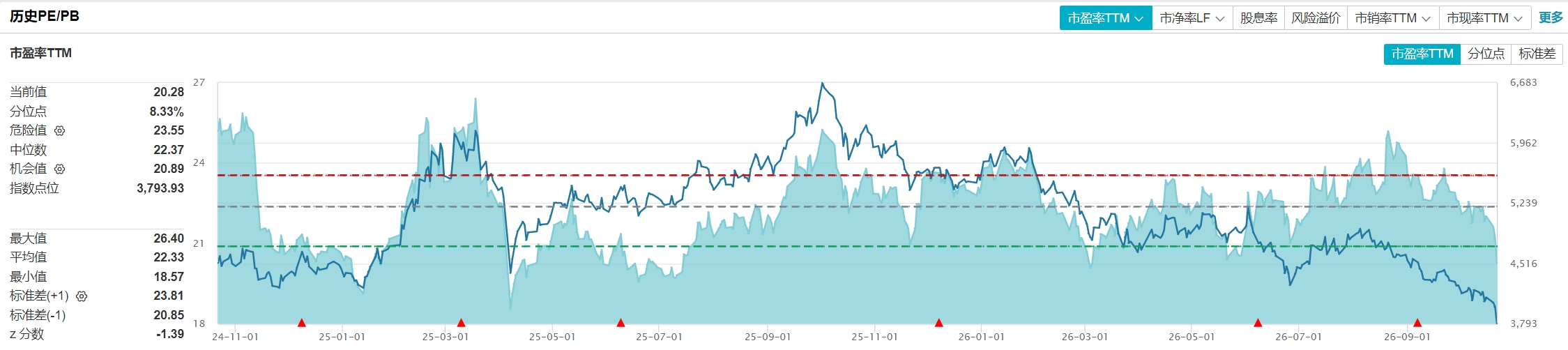
The current P/E ratio of the Hang Seng Index is 20.28.
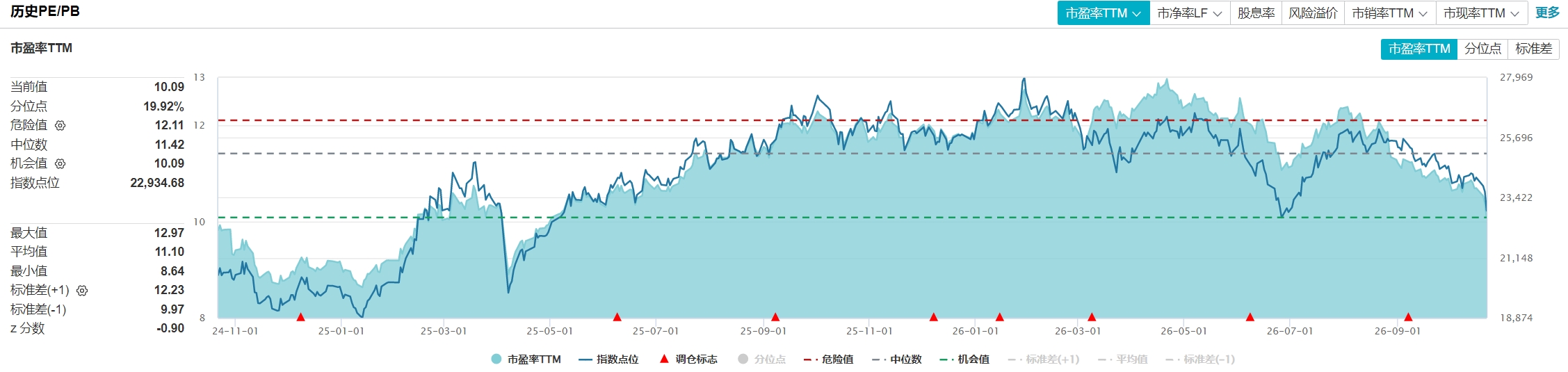
The current P/E ratio of the Hang Seng Index is 10.09.
But the more critical factor lies in the differences, which make it difficult for us to simply replicate the deep V‑shaped market rally—where indices doubled in two months and individual stocks surged across the board—that unfolded after November 2022.
At the heart of the matter lies the differing slope of the turning point in global liquidity. At the end of 2022, the Federal Reserve executed a sharp policy U‑turn: with inflation falling rapidly, market expectations for rate hikes were swiftly revised downward from 75 basis points to 50 basis points, followed by an abrupt shift toward pricing in rate cuts. U.S. Treasury yields plunged, and capital flows reversed with extraordinary force.
The prevailing market consensus is that "high interest rates will persist for longer." Even if the Federal Reserve halts rate hikes, it will be difficult to issue swift guidance on rate cuts. As a result, U.S. Treasury yields are more likely to trade in a range at elevated levels rather than decline rapidly, and the pace of capital repatriation will be considerably more gradual.
At the same time, the impact of domestic policies has varied significantly. November 2022 marked a transformative policy inflection point—characterized by the optimization of COVID‑19 control measures and the successive introduction of the "three arrows" for the real estate sector—delivering an explosive boost to market expectations.
At present, domestic policies are focused on gradual optimization and structural support, with an emphasis on targeted measures to bolster high-end manufacturing and technological self-reliance. However, they lack a powerful, one-off catalyst capable of fundamentally reshaping the overall landscape, suggesting that the recovery will be slower and more tortuous.
03 Which markets have experienced oversold conditions?
So, which sectors are currently oversold?
Core AI‑related stocks spanning mature‑process foundry services, semiconductor equipment and materials, and computing‑power hardware have been among the sectors most heavily sold off by foreign investors during this round of declines.
The decline stems, on the one hand, from a global AI‑driven valuation correction; in a high‑interest‑rate environment, investors are reluctant to assign a premium to the long‑term domestic substitution narrative.
On the other hand, the market has treated the long-term trend of domestic substitution as a short-term speculative theme: when prices rise, it bets on future expectations; when they fall, it sells off indiscriminately.
However, from a fundamental perspective, domestic substitution is a slow-moving trend—not one that can deliver high growth every year—yet the long-term, inelastic demand and barriers to entry remain intact.
Orders and customer validation at many core companies are progressing steadily, and cash flow remains robust. The short-term liquidity shock has, in fact, highlighted the compelling value of long-term allocations.
Leading internet stocks also posted sharp corrections in this round, mirroring the broader market. Today,$TENCENT (00700.HK)$Fell below HK$400,$BABA-W (09988.HK)$It fell below HK$100, with selling pressure so intense it's strikingly reminiscent of the oversold sector that dominated in 2022.
The market's current valuations for these companies not only reflect the drag from the broader AI sector's downturn but also embed a pessimistic assumption that their growth has stalled and their profits are on a permanent downward trajectory.
However, in reality, the core business foundations of these industry leaders remain robust; their operating cash flows are exceptionally strong, capital expenditures continue to be optimized, and many companies are still actively repurchasing shares.
The core reason for the decline is merely a short-term shift in capital allocation, with little to do with the company's fundamentals.
In other words, it's not that these companies have stopped making money; rather, the market is no longer willing to pay a premium for their future cash flows.
Once U.S. Treasury yields peak and begin to decline, triggering a return of foreign capital, these stocks will exhibit the strongest valuation‑recovery upside among all sectors—mirroring the very same rally dynamics seen in 2022.
The new-energy sector is currently the most polarized segment in the market, with stark internal divergence that defies blanket generalizations.
In midstream segments characterized by low barriers to entry and overcapacity—such as certain battery materials and module manufacturers—the declines are driven by fundamentals and represent a rational revaluation of intrinsic value.
However, leading companies that hold a dominant global market share and enjoy cost advantages and technological barriers are already showing signs of being overbought.
The market has come to view price wars and overcapacity as permanent structural features, thereby directly depressing their future cash‑flow valuations in the energy‑storage and overseas markets.
But in reality, leading enterprises…$CATL (03750.HK)$Its cost advantages, supply-chain capabilities, and overseas manufacturing footprint are all in place, and its second growth curve is gradually being realized.
Their problem is cyclical volatility, not value destruction.
When the pace of supply‑demand equilibrium is faster than expected, or when demand shows marginal improvement, there remains substantial room for valuation repair.
Including mature‑process foundry services, semiconductor equipment and materials, and core computing‑hardware stocks, this sector has also experienced a sharp correction in tandem with the broader market.
Looking back at the rebound that began after the October 2022 bottom, the Hang Seng Tech Index surged from 2,720 points to a peak of 4,800 within two months, nearly doubling. Leading internet giants generally posted gains of over 50%, while more volatile stocks even doubled.
The sectors leading the rally are precisely those that previously faced the heaviest selling pressure from foreign investors and were most oversold—namely, internet, innovative pharmaceuticals, and new energy.
In this round, should valuation repair materialize, the core areas of opportunity will still be these sectors—because the sharp selloff triggered by liquidity shocks leaves them severely undervalued; once a turning point in liquidity emerges, their upside potential will invariably be the greatest.
However, we should also maintain reasonable expectations regarding the pace and magnitude of the rebound; it is highly unlikely to resemble the sharp, deep V‑shaped reversal seen in 2022, and will more likely take the form of a choppy, stepwise recovery.
A true inflection point requires the resonance of two conditions:
First, U.S. Treasury yields have clearly peaked and begun to decline, and the Federal Reserve has signaled a clear pause in rate hikes, with the possibility of rate cuts. This is an essential precondition for foreign capital to flow back into Hong Kong stocks and for the valuation of long-duration assets to recover.
Second, if the domestic economy introduces unanticipated policies to stabilize growth and consumption, or if key industries reach a policy inflection point, this could reverse the market's pessimistic outlook on corporate earnings.
Before these two signals emerge simultaneously, the market will likely remain in a bottom‑building phase, trading in a range as it consolidates.
04. Conclusion
In fact, each round of a sharp market decline driven by liquidity is, at its core, a stress test for high-quality assets.
When the tide recedes, both good companies and poor ones will fall—but when the tide returns, only assets backed by solid fundamentals will rebound.
In today's market, there's no need for excessive panic; what's more crucial is the ability to discern: which stocks represent value traps stemming from deteriorating fundamentals that should be avoided, and which are high-quality assets temporarily undervalued due to liquidity headwinds.
History has repeatedly shown that oversold conditions triggered by supply-side shocks ultimately give way to valuation recovery; and each time the market reaches its most pessimistic phase, it often presents a prime opportunity for long-term positioning.
 Want to pick stocks or analyze them? Curious about your portfolio's opportunities and risks? For all your investment questions,Just ask Futubull AI!