
In this collusion between U.S. regulators and Wall Street institutions, the cost of compliance may well be borne by retail investors in the secondary market.
Author: DeepTech Flow
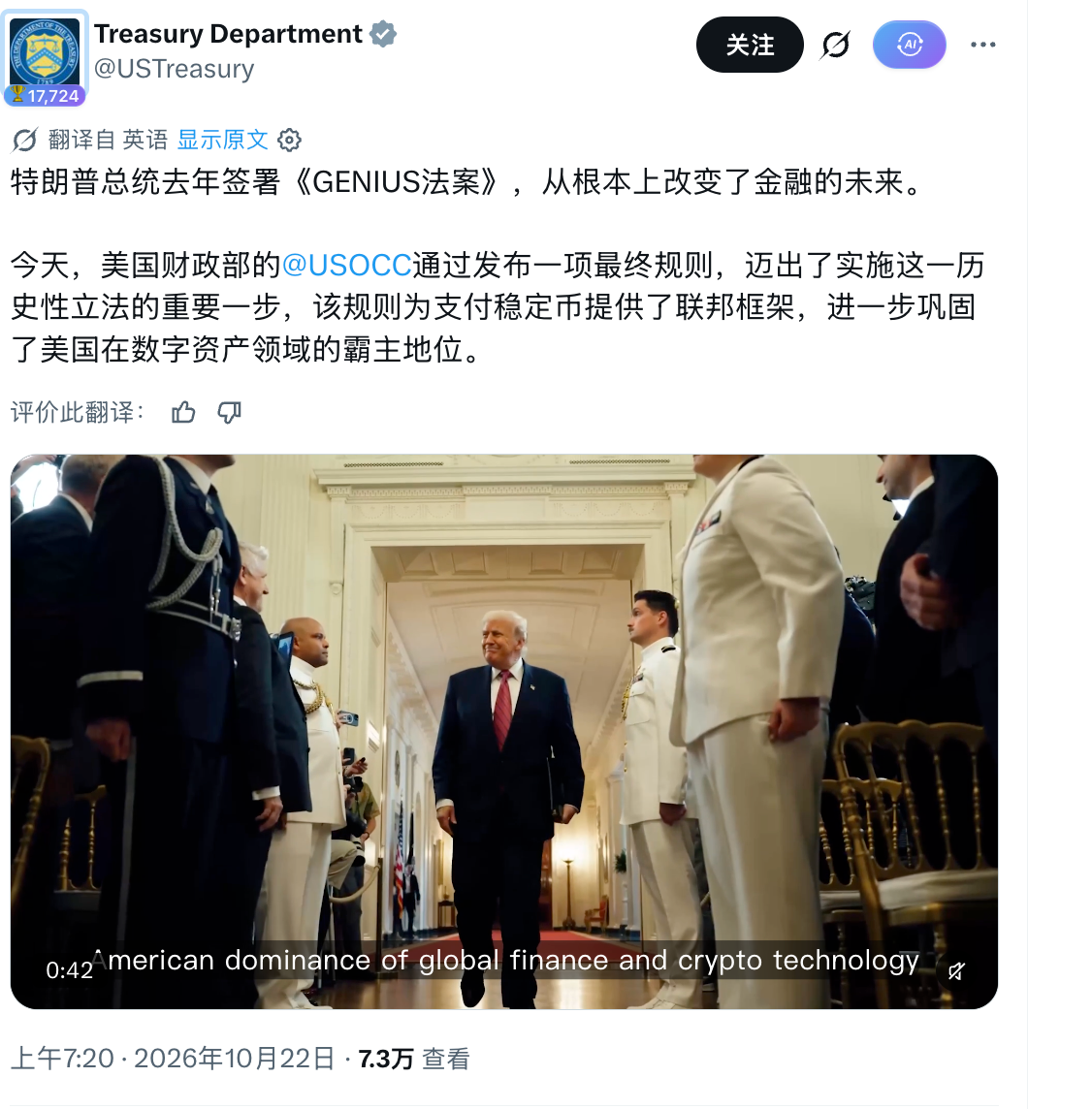
Deep Tide Digest: Recently, the U.S. Department of the Treasury and the Office of the Comptroller of the Currency (OCC) officially released the final regulatory framework for stablecoins under the GENIUS Act. Within the broader narrative of U.S. authorities, this marks a historic step toward cementing America's global leadership in the digital assets space.
 But if you examine the regulatory framework set to take effect in January 2027, you'll find that it is far more than a mere "industry‑protection guide"—it amounts to an exquisitely calibrated, nation‑level resource allocation. By imposing compliance‑driven constraints, it effectively transforms hundreds of billions of dollars in crypto liquidity into the most reliable underwriters of U.S. Treasury securities; at the same time, under the banner of "risk prevention," it legally severs ordinary retail holders' avenues for earning yields on stablecoins. In this collusion between U.S. regulators and Wall Street institutions, the price of compliance may well be footed by retail investors in the secondary market.
OCC Finalizes Federal Regulatory "Tightening Spell"
To clarify the true nature of this regulatory standoff, we must first review the timeline of the bill's implementation.
The GENIUS Act, signed by President Trump in July 2025, is the United States' first federal regulatory framework for payment stablecoins. Recently, the OCC (Office of the Comptroller of the Currency, hereinafter referred to as the OCC) officially released the final implementing rules for this legislation and specified that they will take effect on January 18, 2027.
Compared with the ambiguity of the previous proposal, the OCC's finalized rule this time lays out three strict, non‑negotiable mandates:
First, a 1:1 reserve of high-quality assets: Behind every stablecoin must lie genuine cash and eligible assets such as U.S. Treasury securities.
Second, an absolute "interest‑prohibition order": It explicitly forbids paying interest to users solely on the basis of their holdings of stablecoins.
Third, the redemption‑triggered circuit breaker mechanism: If daily redemptions exceed 10% of the total outstanding shares, an immediate report must be filed, and the regulatory authority will determine whether to permit a delay in processing.
These three rules may appear to safeguard system stability, but if you trace the flow of capital—"Follow the Money"—you'll uncover the underlying business and macroeconomic logic.
Turning crypto liquidity into a "ATM" for U.S. Treasuries
Why is the Ministry of Finance so invested in this bill, going so far as to personally take to Twitter to endorse it?
In the author's view, the answer lies in the "1:1 reserve of high-quality assets."
In the traditional crypto world, the reserve assets backing some stablecoins have long been opaque black boxes. By contrast, the GENIUS Act establishes a clear federal rule: to obtain a U.S. license to issue digital assets, issuers must hold underlying reserves that consist exclusively of U.S. Treasury securities or cash.
The global stablecoin market capitalization has now approached $200 billion. As regulatory frameworks take shape and traditional financial institutions rush to enter the space, this pool of liquidity is set to expand exponentially. In effect, the U.S. government has established, in a roundabout way, a massive, fully controlled "legal‑tender purchase mechanism" for U.S. Treasury securities within the crypto ecosystem. At its core, this amounts to channeling crypto‑related liquidity into the most stable anchor for U.S. Treasuries.
The end of the "risk-free investment" dividend for U.S. retail investors onshore?
This is a negative development for certain stablecoin‑related investment products.
Currently, short-term U.S. Treasury yields are extremely attractive; issuers like Circle use users' funds to purchase Treasuries, pocketing billions of dollars in risk-free interest each year. However, the OCC's final rule explicitly prohibits returning this income directly to users in the form of "interest on held coins."
What does this mean? It means that, in the compliant U.S. market, stablecoin issuers capture all the income generated by the underlying assets, while the broader retail investor base bears the brunt of fiat‑currency inflation.
Furthermore, this directly signals the end of the "high-yield stablecoin investment"红利 for certain CEXs (centralized exchanges). For established players seeking U.S. licenses—such as Coinbase and the USDC ecosystem—the high-yield investment channel will be completely shut down.
The OCC has made it clear that while third-party or exchange‑based reward schemes are not inherently unlawful, regulators will progressively assess whether they constitute circumvention. This stringent compliance pressure will compel compliant platforms to proactively sever retail investors' access to yield‑generating opportunities.
DeFi May Become the Last Bastion of Stablecoin Wealth Management
The GENIUS Act governs "dividends paid by issuers backed by U.S. Treasury securities," but it cannot curb outright market-driven borrowing demand.
In the DeFi ecosystem, decentralized lending protocols like Aave and Compound derive their stablecoin APY from interest paid by real on-chain borrowers—such as traders leveraging to speculate on cryptocurrencies—or from trading fees generated under AMM mechanisms.
This organic yield, driven by "genuine market supply and demand," is difficult to classify under legal frameworks as a disguised dividend from the issuer. Consequently, when certain CEXs can no longer offer attractive stablecoin‑based investment products, retail and institutional investors, seeking to hedge against inflation and secure stable returns, are left with no choice but to deposit their compliant stablecoins—such as USDC—into DeFi protocols.
In other words, the GENIUS Act's "usury ban," while squeezing retail investors, could very well inadvertently serve as a catalyst for an on-chain DeFi boom. Under the squeeze of regulatory compliance, DeFi lending and liquidity pools are likely to absorb excess capital, triggering a passive surge in TVL.
The Polarization Between Compliance and Offshore Operations
Overall, the GENIUS Act is not stifling stablecoins; it is merely "redistributing their profits." While cementing the U.S. dollar's dominance over the crypto world, it also effectively legalizes the extraction of risk-free returns from retail investors.
The future stablecoin market will undergo a complete fragmentation:
On one hand, there are highly regulated, compliant stablecoins backed by the U.S. government—extremely secure and favored by Wall Street institutional investors—yet retail investors receive no yield on their holdings.
On the other hand, there are offshore exchanges and offshore stablecoins (such as USDT) that operate entirely outside the United States. As long as they do not seek U.S. regulatory licenses, they can, in theory, continue to offer retail investors yield‑bearing liquidity through market making or on‑chain protocols.
When "absolute compliance" means taking on all the risk while forgoing any share of the profits, a mass exodus of tens of billions in capital—voting with their feet between "U.S. licenses" and "high interest rates"—has only just begun.