
In the week ending October 21, global equity funds attracted inflows for the fifth consecutive week, as softer government bond yields and strong early‑season corporate earnings boosted investor sentiment. Net inflows into global equity funds totaled $28.16 billion that week, compared with $19.88 billion in the prior week.
Zhitong Finance APP learned that just as the U.S. stock semiconductor sector suffered a sharp setback on Thursday, Asian markets were snapping up popular AI computing and semiconductor stocks at lower prices. On October 22,$Philadelphia Semiconductor Index (.SOX.US)$Down 6.72%,$Nasdaq Composite Index (.IXIC.US)$Down 2.60%,$NVIDIA (NVDA.US)$、$Micron Technology (MU.US)$They fell by 4.40% and 6.26%, respectively. The next day,$Korea Composite Index (.KOSPI.KR)$Reversing from a midday decline of over 4% to close up 0.30%,$SK Hynix (SKHY.US)$Up 4.42%,$Samsung Electronics (005930.KR)$A slight increase of 0.47%; ChinaGrowth Enterprise Market Index (399006.SZ)Stocks rebounded from a midday decline of over 3% to close up 4.16%, with total trading volume across the Shanghai, Shenzhen, and Beijing markets reaching approximately RMB 1.97 trillion. The recovery in leading stocks in the memory‑chip and optical‑communications sectors has been a key driver behind this round of reversal in China‑South Korea tech shares.
$SK Hynix (000660.KR)$Suspending the valuation of Solidigm's IPO has eased investors' concerns about duplicate listings and valuation discounts.$Xinyisheng (300502.SZ)$The announcement of share buyback programs totaling RMB 800 million to RMB 1 billion, coupled with operational updates from several optical‑communication companies, has bolstered market confidence in order backlogs and product upgrades. Bottom‑fishing following oversold conditions, combined with positive corporate news, has reinforced this sentiment, driving a wave of early recovery among leading tech stocks.
 A seasoned analyst noted that, following a concentrated sell-off in tech stocks across the Chinese and South Korean markets over the past two weeks, some investors may have already booked profits on their short positions, while capital seeking to buy at lower levels has begun to enter the market. As fresh selling pressure eases and both short-covering and bargain-hunting demand emerge, this could explain the sharp rebound seen Friday in semiconductor and broader tech stocks on the Chinese and South Korean exchanges.
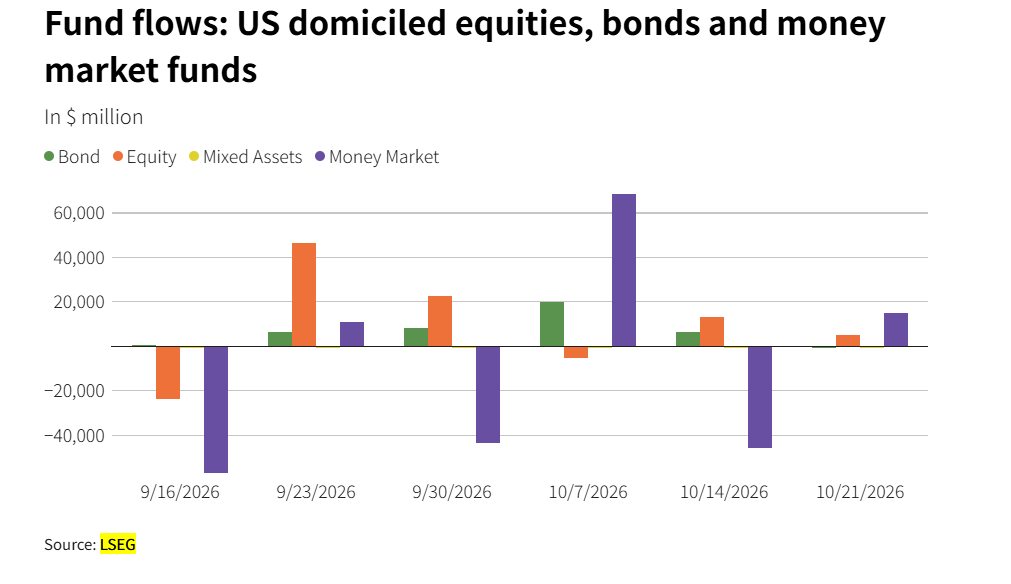
According to LSEG Lipper fund‑flow data, equity‑fund subscription trends offer a broader picture of capital flows. For the week ending October 21, global equity funds recorded net inflows of $28.16 billion, up from $19.88 billion the previous week, marking the fifth consecutive week of net asset accumulation. In particular, Asian equity funds saw robust net inflows of $11.53 billion, the highest level since at least December 2022, while European equity funds attracted $9.14 billion and U.S. equity funds drew $5.07 billion.
However, despite posting net inflows for the second consecutive week, U.S. equity funds saw their assets under management decline by roughly 62% from the previous week's $13.37 billion. These figures reflect a relatively optimistic allocation stance among global investors prior to Thursday's sharp sell-off in U.S. stocks—namely, that investors continued to increase their equity exposure, notably pouring into Asian markets, which had lagged behind U.S. equities and were undergoing a correction, while scaling back their buying momentum in U.S. stocks, which had recently reached record highs.
Undoubtedly, the two key drivers behind the broader bullish momentum in the stock market are the downward trajectory of the 10-year U.S. Treasury yield and the realization of earnings by semiconductor and cloud‑computing giants tied to the AI computing‑power theme.$U.S. 10-Year Treasury Yield (US10Y.BD)$It has retreated nearly 38 basis points from the 24-and-a-half-year high of 5.3645% recorded in early October, falling below 5%. Among the roughly 24% of S&P 500 companies that have reported earnings, about 82% posted profits that exceeded expectations; meanwhile, among the approximately 18% of constituents in the MSCI All Country World Index that have disclosed results, roughly 73% beat estimates. Although the MSCI World Index still declined by 1.31% on October 22, the semiconductor sector—closely tied to AI‑related computing power—has seen robust profit expansion and easing discount‑rate pressures, laying the groundwork for investors to reassess technology stocks.
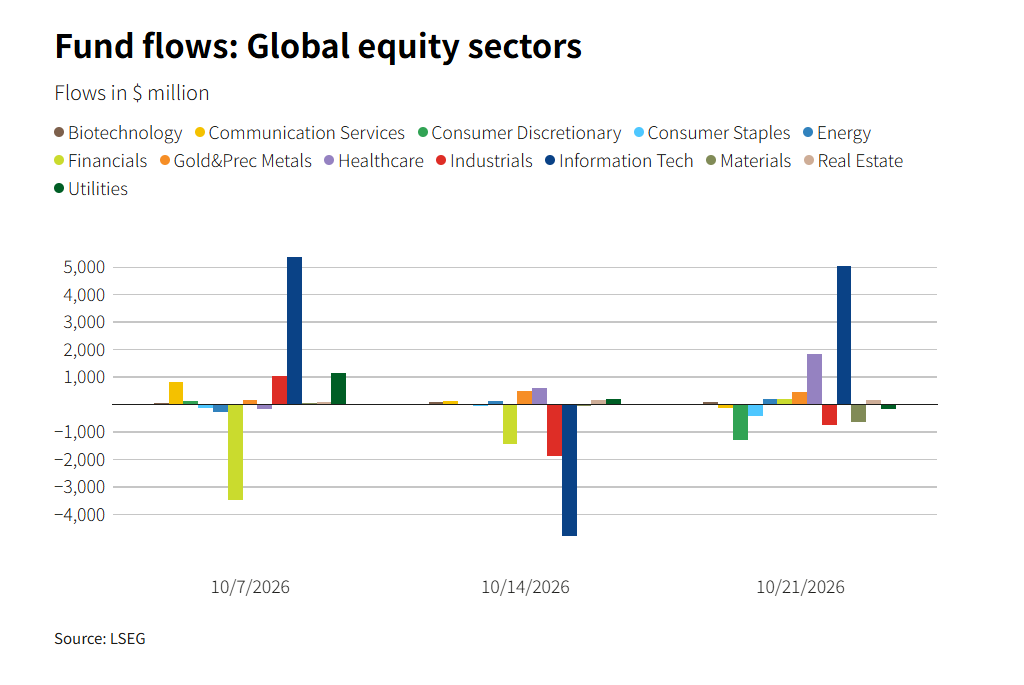
As for the eye of the storm in AI‑driven trading and the sell‑off in tech stocks—the storage‑chip sector, which has recently taken a severe hit—LSEG Lipper data show that global technology‑sector funds posted net inflows of $5.05 billion this week, reversing last week's sharp outflows. Meanwhile, optimism on the fundamentals remains strong: recent Asia‑focused research from KeyBanc indicates that AI data centers continue to absorb substantial supplies of storage and other AI‑computing resources, keeping price increases extending into 2027.
The firm forecasts that HBM composite prices could surge by 80% to 100% in the first quarter of 2027. On the DRAM front, KeyBanc projects a quarter-over-quarter increase of 15% to 20% in the fourth quarter of 2026, following a strong price hike in the third quarter, with an additional 10% to 15% rise in the first quarter of 2027. As for NAND pricing, the outlook anticipates a quarter-over-quarter gain of roughly 20% in the fourth quarter of 2026, based on the robust third-quarter base, followed by another 10% to 15% increase in the first quarter of 2027.
Tech repatriation and credit reallocation: Capital is now sorting out "who can withstand the financing test."
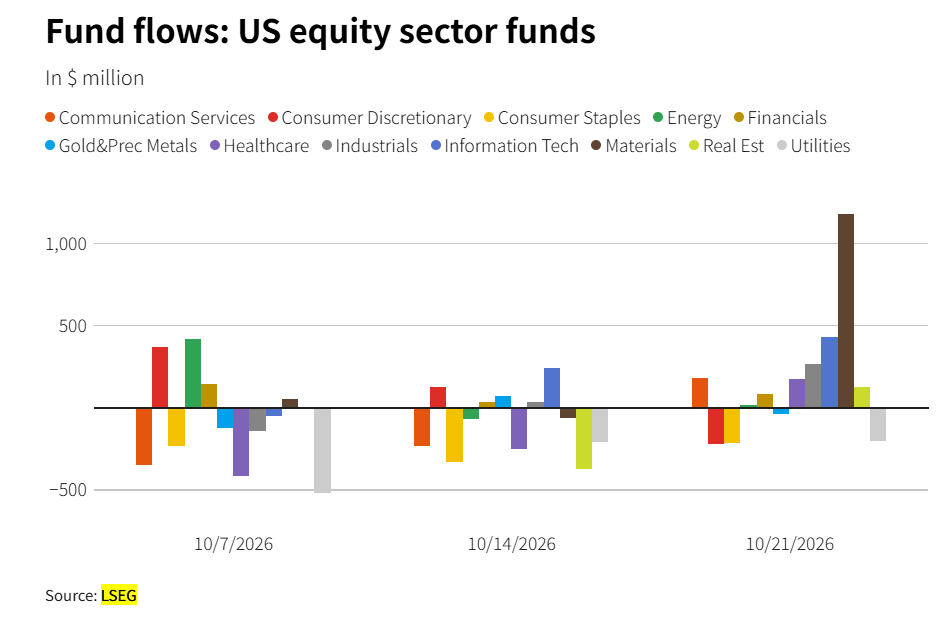
According to LSEG Lipper fund flow data, global investors are increasing their exposure to the technology sector while raising their criteria for corporate size, liquidity, and financing capacity. Global technology-sector funds recorded net inflows of $5.05 billion this week, reversing last week's $4.77 billion outflows; healthcare funds attracted $1.83 billion, while non‑essential consumer goods funds saw outflows of $1.29 billion.
In the U.S. market, large-cap and mid-cap funds attracted $8.63 billion and $1.92 billion, respectively, while small-cap funds saw outflows of $4.24 billion. U.S. sector funds ended two consecutive weeks of redemptions, posting total inflows of $1.8 billion, with metals and mining, technology, and industrials drawing net inflows of $1.18 billion, $429 million, and $269 million, respectively.
The most noteworthy allocation trend here is that global capital is increasingly willing to take on the investment risks associated with equity markets backed by robust earnings, while continuing to steer clear of companies with weaker financial resilience. This also explains why Asian equity markets—home to the vast majority of fundamentally strong, leading players in the global AI computing‑power value chain—are attracting ever‑stronger inflows of capital.
The bond market is also showing signs of divergence. Global bond funds have attracted inflows for the fifth consecutive week, with net inflows totaling $9.44 billion—of which Swiss‑franc‑denominated bond funds drew $6.8 billion, the highest level since at least November 2024, while short‑term bond funds saw $2.78 billion in inflows. By contrast, high‑yield and government bond funds experienced outflows of $1.68 billion and $550 million, respectively. Meanwhile, U.S. bond funds posted net outflows of $969 million, ending a streak of 26 consecutive weeks of net buying: long‑term government and Treasury bond funds saw outflows of $3.3 billion, while short‑ and medium‑term funds of the same type, along with municipal bond funds, recorded inflows of $1.76 billion and $1.56 billion, respectively.
The outlook for benchmark interest rates, amid receding expectations of Fed rate hikes, along with the downward trajectory of 10-year and 30-year U.S. Treasury yields, has markedly improved the valuation environment; nonetheless, investors continue to proactively manage credit risk and duration risk.
Cash and safe-haven assets have also retained their investment appeal. Global money market funds reversed last week's outflows of $47.51 billion into inflows of $15.86 billion, with U.S. money market funds shifting from outflows of $45.93 billion to inflows of $14.82 billion. Gold and other precious metals funds attracted $1.29 billion, marking the fifth net inflow in the past six weeks, while energy funds drew $41.5 million.
Data covering 29,174 emerging-market funds show that equity funds attracted $6.28 billion, the highest level since August 5, while bond funds experienced a modest outflow of $48.72 million. Overall positioning reflects a portfolio mix characterized by "selective equity overweighting, cash preservation for flexibility, and stringent credit‑quality screening."
These global fund flow dynamics and broader trends, as reflected in LSEG Lipper's data, also help explain why JPMorgan and UBS Group still see room for bottom-fishing and additional positioning in AI computing power as well as the broader semiconductor and technology sectors.
JPMorgan estimates, based on its tech-sector sample and models, that this year's cash flow will be approximately $2.2 trillion, with corresponding investments of about $1.8 trillion, resulting in a financing surplus of roughly $400 billion. New cloud‑provider financing is under pressure, which may shift who builds certain projects but is unlikely to end the broader AI capital‑expenditure cycle. Meanwhile, the bank estimates that semiconductors account for roughly 21% of global equity‑portfolio risk, yet represent only about 13% of market‑capitalization weight; concentrated holdings and adjustments to risk limits could amplify short-term declines.
UBS Group, meanwhile, pointed out that,$Hang Seng Tech Index (800700.HK)$and$CSI 300 (399300.SZ)$The relative strength indices have fallen to around 27 and 23.9, respectively, while short positions in U.S. equities remain elevated, increasing the likelihood of a oversold bounce and short covering. Together, these two factors point to one key conclusion: selling pressure is easing, and the leading players in the AI‑computing‑power value chain—those with strong fundamentals backed by robust cash flows and order books—are best positioned to lead the way in re‑pricing.
Against the backdrop of AI monetization and a relay of computing power orders, NVIDIA remains the absolute optimistic pricing anchor for Wall Street bulls.
Parent company of Facebook and Instagram$Meta Platforms(META.US)$The financial report highlights the core contradiction in today's AI‑driven business: commercialization around the AI boom is accelerating, while infrastructure spending is burning through cash at an even faster pace. The company reported third‑quarter revenue of $64.601 billion, up 26% year over year, with advertising revenue reaching $63.061 billion. Excluding $9.89 billion in legal expenses, operating profit grew 11% year over year, and the company's fourth‑quarter revenue guidance stands at $73.0–$76.0 billion.
However, capital expenditures for the quarter reached $34.91 billion, while free cash flow stood at negative $2.12 billion. The full-year capital expenditure guidance has been revised upward, with the lower bound raised from $130 billion to $135 billion and the upper bound remaining unchanged at $145 billion. Meanwhile, approximately $825 billion in future spending commitments further extend the time horizon over which the market assesses investment returns; nonetheless, these represent multi-year leasing and procurement arrangements rather than one‑year capital outlays.
The revenue contribution of AI can already be observed in advertising performance:$Meta Platforms(META.US)$Following the expansion of the GEM ad model, off-site conversion ads and app ads saw conversion volumes increase by 1.7% and 9.6%, respectively. Meanwhile, Muse attracted over 10 million sign-ups within roughly six weeks of its U.S. and Canadian launch, with approximately 25% of new users engaging daily.
Meta is advancing fee‑based transaction services and both personal and enterprise subscriptions, while projecting that, over the next year, it will improve Muse's computational cost efficiency by more than tenfold. Its advertising business continues to generate strong cash flow, and Muse opens up new avenues for user and transaction growth; however, since Muse has not yet disclosed its revenue separately, consumer spending on the platform cannot be directly attributed to Meta's top line. The newly created non‑voting shares were initially issued through a distribution to existing shareholders, effectively amounting to a stock split rather than an equity raise; nonetheless, their intended use in future financing has heightened market scrutiny of funding costs and capital requirements.
From an infrastructure‑mechanism perspective, as intelligent agents like Muse expand their scope of use, they simultaneously increase demands on model inference, tool execution, and state management: GPUs and custom accelerators handle model computations, CPUs manage browsers, database queries, and business orchestration, HBM and server DRAM store models, context, and concurrent workloads, enterprise‑grade SSDs archive indexes and persistent states, HDDs accommodate long‑term retained data that has been filtered, compressed, and deduplicated, while networking, optical interconnects, power systems, and liquid cooling collectively support continuous operation.
This corresponds to$NVIDIA (NVDA.US)$、$Advanced Micro Devices (AMD.US)$accelerated computing,$Broadcom (AVGO.US)$custom chips and interconnects,$Micron Technology (MU.US)$、$SK Hynix (SKHY.US)$of memory,$Seagate Technology (STX.US)$、$Western Digital (WDC.US)$large-capacity storage, as well as$Taiwan Semiconductor (TSM.US)$、$Aimark Technology (AMKR.US)$Manufacturing and packaging/testing opportunities. The expansion of capital expenditures is bolstering the demand base across the entire industry chain, though specific orders and profitability will still depend on each company's product market share and delivery capabilities.
Wall Street financial giant Bank of America's bullish outlook on the storage industry also centers on HBM4 adoption and the SOCAMM and enterprise‑grade SSD demand driven by advanced GPU and ASIC upgrades. Memory and storage at different tiers serve distinct purposes, and changes in the configuration of a single GPU cannot be directly equated with a decline in overall data center demand.
The DSX POD unveiled at GTC Berlin integrates computing, networking, power supply, and liquid cooling directly into the manufacturing process. In facilities where power, cooling, and networking infrastructure are already in place, it reduces on-site deployment time to as little as 14 days and is slated for delivery in early 2027. Its investment rationale lies in accelerating the conversion cycle from equipment delivery to compute‑power activation and service revenue generation, rather than eliminating constraints related to power supply and site‑construction requirements.
$SpaceX(SPCX.US)$It provided another set of evidence of revenue realization: the company reported third-quarter revenue of $14.575 billion, up 161% year over year; revenue from its super‑intelligent business—encompassing cloud services, software, and advertising—totaled $7.560 billion, a year-over-year increase of 830%, with operating profit turning positive at $431 million. Management stated that prices for short-term compute‑capacity contracts continue to rise and projected that by the end of 2027, deployed compute capacity will reach at least 13 gigawatts.
Following the earnings report, Bank of America raised its price target from $235 to $275 while maintaining a "Buy" rating, citing the Q1 2027 revenue guidance of $33–$37 billion—significantly above the pre‑earnings market consensus of roughly $22 billion. Compared with Thursday's closing price of $144.75, the new target implies approximately 90% upside potential.
$SpaceX(SPCX.US)$Strong financial results and outlook also provide demand-side support for NVIDIA's narrative of expanding computing power at GTC Berlin. Musk further stated that he expects the computing capacity to reach 2.5–3 gigawatts by year-end, and is confident of adding another 10 gigawatts by 2027, with next year's deployments primarily utilizing$NVIDIA (NVDA.US)$The Vera Rubin platform. This expansion plan echoes the DSX POD accelerated on-site deployment and the key supply chain's capacity expansion showcased at GTC: customers need to gain operational-ready computing power more quickly, while NVIDIA is focused on shortening the gap between hardware delivery and the generation of revenue from computing services.
For the semiconductor market, the realization of AI‑related revenue and the next‑generation computing‑power procurement plans reinforce each other, providing more concrete support for order‑growth expectations across the entire AI‑computing‑power supply chain—including NVIDIA's AI GPUs and HBM, high‑speed optical interconnects for data centers, power supplies, and liquid‑cooling systems—and further bolstering the fundamental catalysts behind the "AI bull‑market narrative."
With a market capitalization of approximately US$5.1 trillion$NVIDIA (NVDA.US)$, it remains Wall Street's key bullish pricing anchor amid this round of bullish–bearish divergence. On October 22, Citi maintained its "Buy" rating with a $315 price target; Morgan Stanley kept its $300 target and reinstated its "Semiconductor Top Pick" status in October; Bank of America set a $350 price target in August. Based on the closing price of $212.21 on October 22, the $300, $315, and $350 targets correspond to potential upside of approximately 41.4%, 48.4%, and 64.9%, respectively.
At the heart of these price‑target bets is the expectation that the delivery of next‑generation platforms, the ramp‑up of customer compute capacity, and sustained procurement will drive earnings growth. For the semiconductor sector and the broader tech‑stock market, a return of capital flows and a correction from oversold conditions have set the stage for a rebound, while order conversion and cash‑flow returns will determine how far the rally can extend.
Edited by melody