On Friday, the three major U.S. stock indexes declined, with the Dow Jones Industrial Average falling 1.23%. Apple hit an intraday record high but closed down 0.14%; Microsoft rose 0.66%. Micron Technology gained 2.46%, and Marvell Technology advanced 2.26%. Spot gold settled at $3,996.96, down 0.67%. Spot silver fell 1.21%, and natural gas futures dropped 3.23%.
A sharp rally in oil prices has reignited inflation concerns, prompting investors to accelerate their exit from risk assets on the eve of the Federal Reserve's interest-rate decision, sending both U.S. stocks and Treasury yields lower.
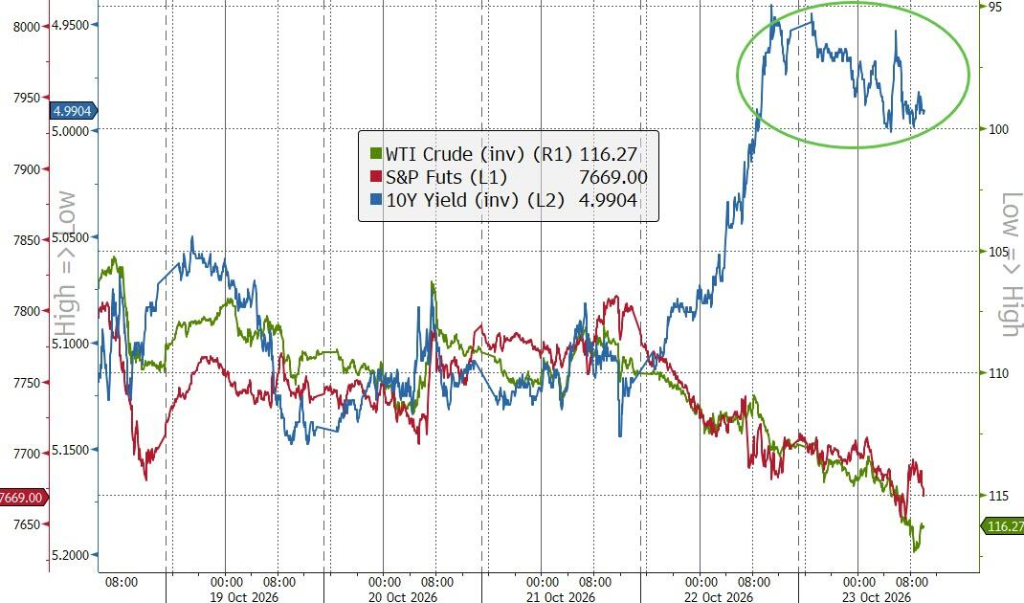
Brent crude oil closed near $117 per barrel, as escalating tensions in the Middle East stoked concerns about supply disruptions. The S&P 500 fell 0.5%, while the Dow Jones Industrial Average dropped 1.2%. Meanwhile, the yield on the 10-year U.S. Treasury note rose by 5 basis points to 5.00%, erasing most of the previous day's gains in the bond market.
 Bank of America strategist Michael Hartnett warns that investor risk aversion could persist through mid-November, with cooling AI-driven trading and uncertainty surrounding the midterm elections serving as key headwinds. Bloomberg macro strategist Michael Ball also notes:
Rising oil prices are now replacing credit concerns as the primary risk threatening the S&P 500's structural rotation.
Oil prices have surged, and inflationary pressures are resurging.
Escalating tensions in the Middle East are threatening global crude oil supplies, with Brent crude settling near $117 this week and WTI posting a daily gain of 4.2% to $103.63 per barrel.
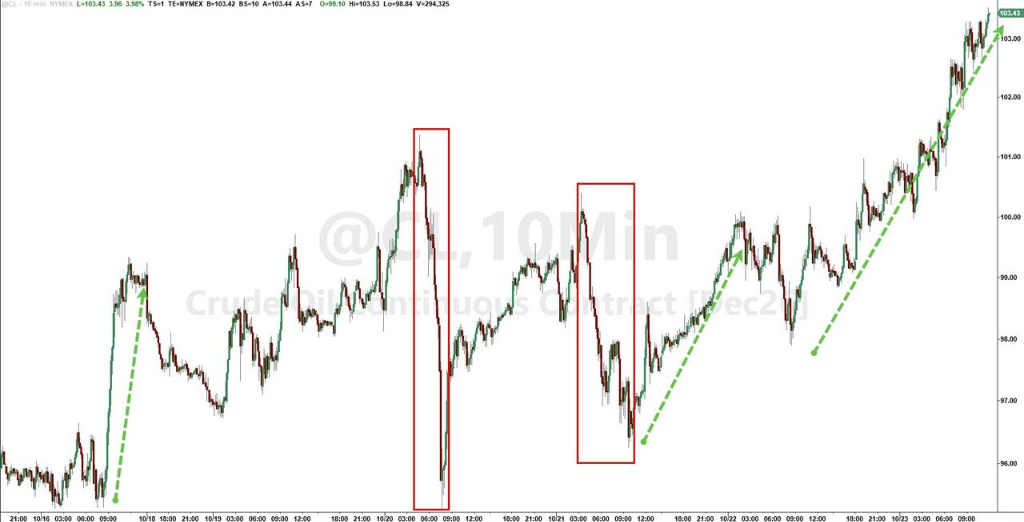
The immediate driver of the price increase has been a series of supply disruptions. In just two days, Houthi forces launched their fourth attack on Saudi oil facilities and targets in the capital region; Saudi Aramco's Shaybah oilfield was struck by drones, prompting the company to evacuate some staff from its Dhahran headquarters. Meanwhile, Iran's Islamic Revolutionary Guard Corps announced that "irregular" shipping through the Strait of Hormuz has come to a complete halt.
Several hedging measures on the supply side failed to take effect that day. The Group of Seven released 100 million barrels from its strategic petroleum reserves, while Germany's national oil reserve agency held its first-ever tender to sell diesel, heating oil, and crude oil, with a committed volume of up to 15 million barrels. Meanwhile, Russia said it could export 500,000 tons of diesel globally in October, with the first three tankers already en route to the U.S. East Coast. Diesel prices in both the United States and the European Union continued to hit fresh cycle highs.
Goldman Sachs analyst Peter Hackett believes the market has already priced in a risk premium of over $20 per barrel, and only a full-scale war would push Brent back above $120.
Morgan Stanley's estimates offer another perspective. Middle Eastern crude oil exports are now about 94% of pre-conflict levels, and market pricing reflects the costs of shipping this crude, as well as the still-missing refined products.
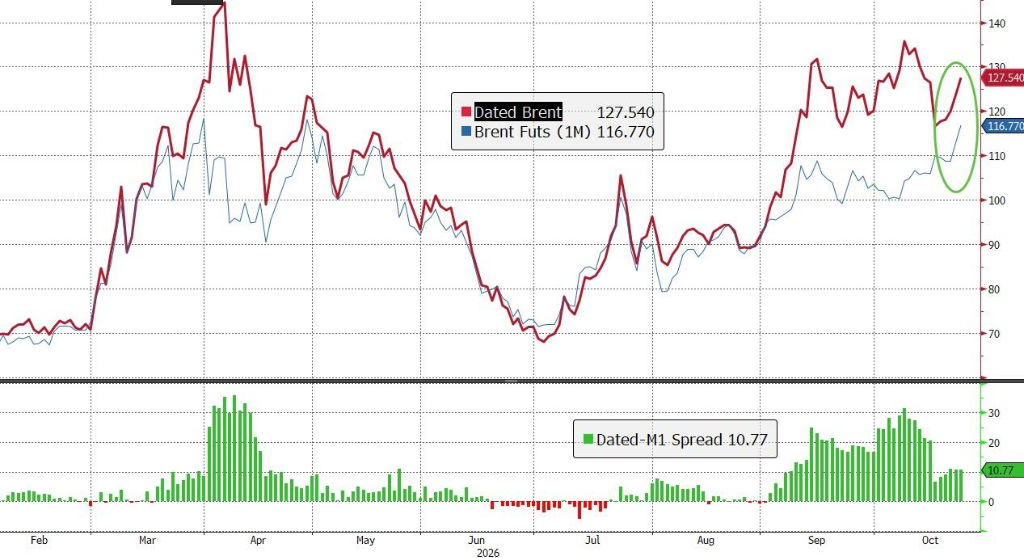
Tightness in the physical market exceeds what futures prices suggest. According to Bloomberg data, the spot Brent crude oil price used for settling cash‑settled transactions stands at $127.54 per barrel, $10.77 higher than the corresponding‑term futures contract.
The rapid surge in oil prices has sharply heightened market concerns about inflation on the eve of the Federal Reserve's interest-rate meeting. Florian Ielpo of Lombard Odier Asset Management attributes the recent market volatility to a tug-of-war among four key forces:
A robust earnings season and attractive bond yields provide support, while rising financing costs and heightened selectivity in sovereign debt markets weigh on the outlook.
He also pointed out that the key issue at present is not overly high equity valuations, but rather the fact that bonds are no longer cheap.
Tiffany Wilding of PIMCO stated that the Federal Reserve is fully aware that artificial intelligence is driving an expansion in U.S. domestic demand, and that, with inflation running above target, a prudent policy approach would be to temper this momentum by making modest adjustments to interest rates and tightening financial conditions. She added:
However, with inflation remaining elevated but not accelerating, the Federal Reserve may have room to proceed in a prudent, gradual manner.
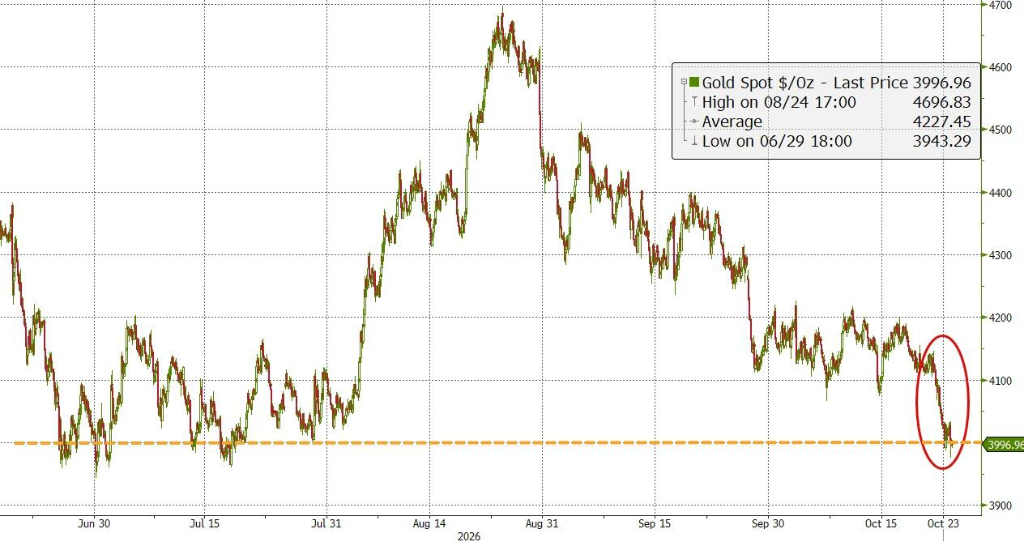
Gold did not rise on risk-aversion sentiment. Spot gold settled at $3,996.96 per ounce, down 0.67%, with an intraday low of $3,975.65—the first time it has fallen below the $4,000 mark since July 29.
Spot silver fell 1.21% to $53.78 per ounce, while natural gas futures on the New York Mercantile Exchange dropped 3.23% to $3.054.
Inflation data weighed on U.S. equity defensive sectors, while energy stocks bucked the trend to hit record highs.
On Friday, the three major U.S. stock indexes declined. The Dow Jones Industrial Average fell 1.23%, closing at 52,215.16 points; the S&P 500 dropped 0.52%, ending at 7,623.68 points; and the Nasdaq Composite slipped 0.21%, settling at 25,955.34 points.
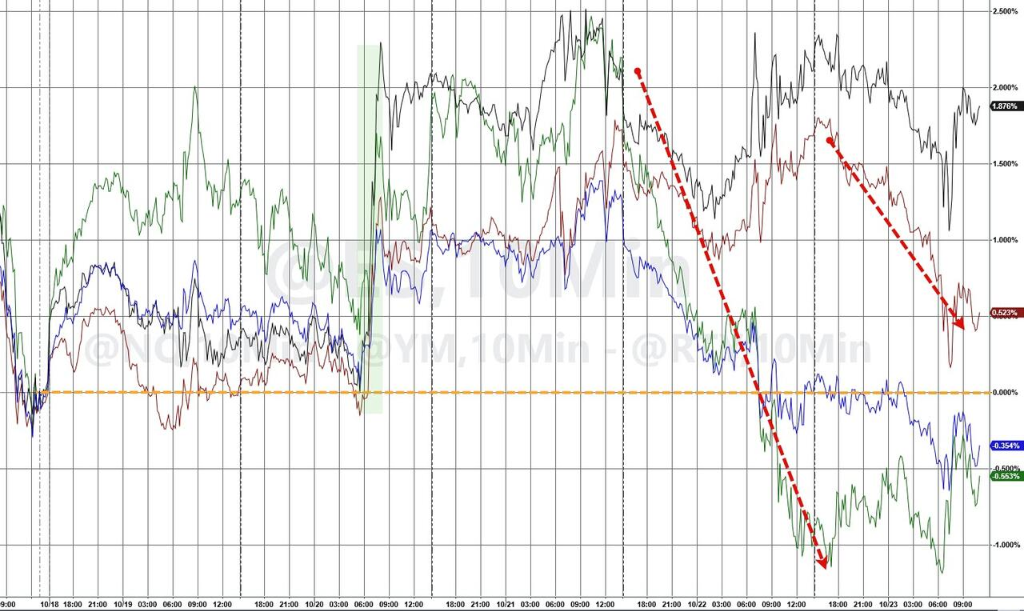
On the sector front, the consumer staples sector led losses with a 1.83% decline, while the energy sector gained 2.51% and the technology sector rose 0.35%.
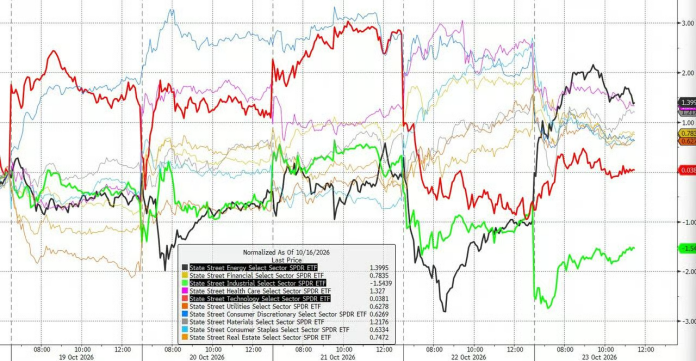
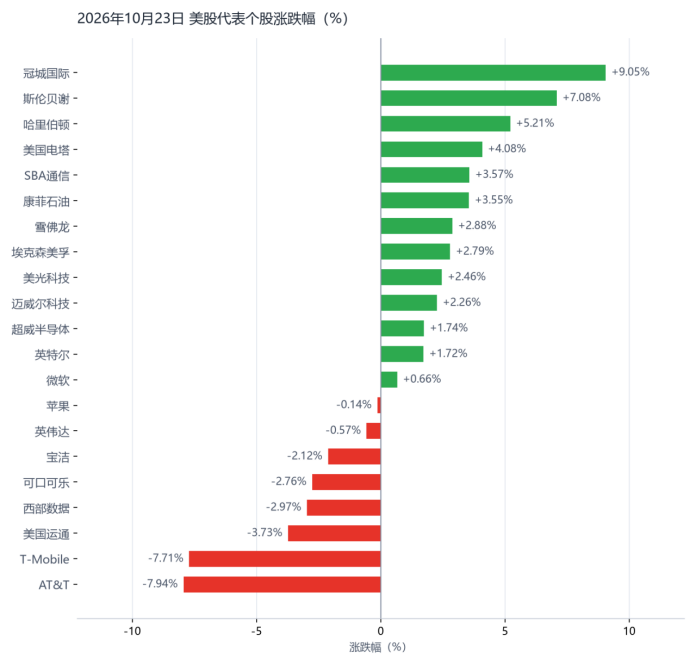
Defensive assets are sold first.$Coca-Cola (KO.US)$Down 2.76%,$Procter & Gamble (PG.US)$Down 2.12%, these two companies' valuations are more sensitive to interest rates and consumer demand than to changes in their own earnings outlooks. As yields rise, their relative attractiveness declines accordingly.
The energy sector was one of the few that posted gains on the day, with its index hitting a record high. Schlumberger's third-quarter results exceeded expectations, and its North American revenue surged, driving its stock up 7.08%; Halliburton rose 5.21%,$ConocoPhillips (COP.US)$Up 3.55%, Exxon Mobil rose 2.79%.
S&P Global's chief business economist, Chris Williamson, stated that the October composite output reading corresponds to an annualized GDP growth rate of around 5%, but selling prices posted their largest increase in over four years, with this round of price hikes driven by oil prices. The combination of rising growth and inflation is hard to interpret as positive.
Risk-aversion sentiment persists, and AI-driven trading differentiation intensifies.
The stabilization of tech stocks is limited.$Apple (AAPL.US)$It hit an all-time high during trading, with its market capitalization briefly surpassing…$NVIDIA (NVDA.US)$, closed down 0.14%; Microsoft rose 0.66%.
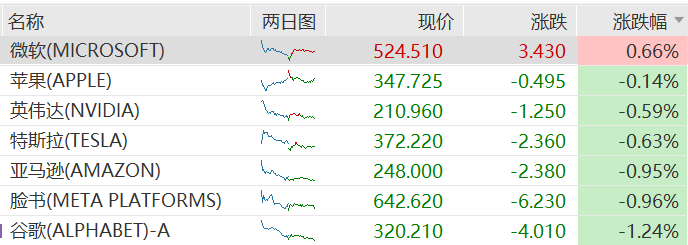
$Apple (AAPL.US)$ 、 $Microsoft (MSFT.US)$Meanwhile, most of the Big Seven are still down: Google fell 1.24%, Meta dropped 0.96%, Amazon declined 0.95%, Tesla slipped 0.65%, and NVIDIA edged down 0.57%.
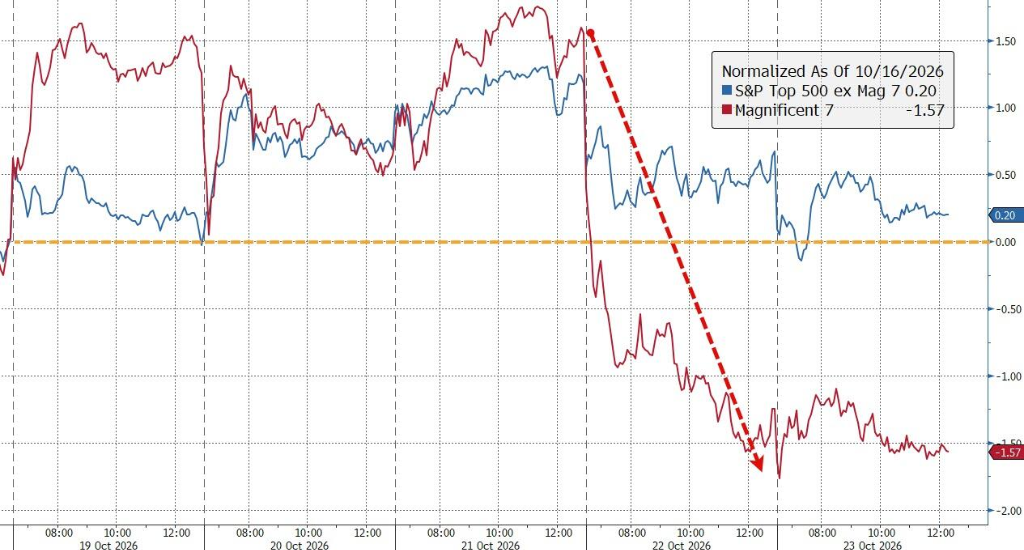
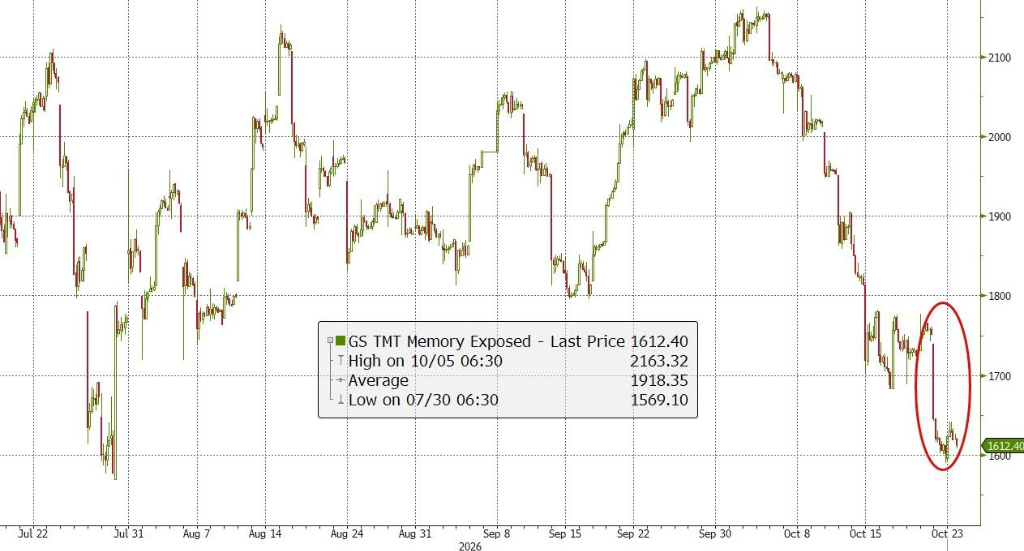
Chip stocks rebounded after a sharp decline in the previous trading session.$Micron Technology (MU.US)$Up 2.46%,$Marvell Technology (MRVL.US)$Up 2.26%, Advanced Micro Devices rose 1.74%, and Intel gained 1.72%.
The trend in the storage sector continues to diverge.$Western Digital (WDC.US)$Down 2.97%, Seagate Technology fell 1.82%,$SanDisk (SNDK.US)$Down 1.82%.
$Cybersecurity (LIST2570.US)$Leading gains,$CrowdStrike (CRWD.US)$Up 8.25%,$Palo Alto Networks (PANW.US)$It rose by 7.22%. The CEO of CrowdStrike stated that in the coming months, there will be a surge in intrusion incidents caused by PHP vulnerabilities.
In a client report released on Friday, Bank of America strategist Michael Hartnett stated unequivocally:
We are maintaining a tactical risk-off stance through mid-November, with expectations of lower yields, weaker equities, and a weaker U.S. dollar.
The recent pullback in AI-related stocks has once again highlighted the risks of highly concentrated holdings. Brian Jacobsen of Annex Wealth Management notes that when everyone bets on the same narrative, even a minor disappointment can trigger a mass exodus.
He said:
The practical lesson is not to sell growth stocks outright, but rather to assess whether a particular theme, after a prolonged rally, has quietly come to dominate the entire portfolio. Rebalancing—reducing overweight positions and adding underperforming assets—is a straightforward way to manage risk, without needing to try to predict the next market move.
Despite heightened short-term volatility, some institutions still maintain a constructive stance on equity assets. Ulrike Hoffmann-Burchardi of UBS Group's Chief Investment Office stated:
The latest market developments have not altered our outlook—strong earnings growth should continue to underpin equities. Demand for AI remains robust, and current bond yields offer an attractive source of income; geopolitical headwinds alone are insufficient to justify a fully defensive investment stance.
American Express's earnings report weighed on the Dow, dragging it lower, as signals of a consumption slowdown amplified the decline.
The Dow's lead in declines is linked to its price-weighted methodology, and the component stock that fell the most that day was$American Express (AXP.US)$The company's third-quarter card‑based spending totaled $454 billion, below the market consensus of $456.9 billion; it also announced plans to cut roughly 5% of its global workforce, affecting approximately 3,500 employees. Shares fell 3.73%.
The rest of the earnings report wasn't bad. Adjusted EPS of $4.68 beat expectations, and the full-year EPS guidance was raised to a range of $18.30 to $18.60. Yet the market didn't react positively; the signs of a cooling consumer environment proved more compelling than the profit figures.
Truist Securities analyst Brian Fahren said that the slowdown in credit-card spending was slightly disappointing, adding that the report was generally positive, though the details were mixed.
Financial stocks weakened in tandem,$Goldman Sachs (GS.US)$It fell 1.75%, with JPMorgan down 1.47%. Deckers Outdoor dropped 4.91% after lowering its full-year sales guidance.
Even so, the Dow Jones Industrial Average rose 0.4% for the week, marking its third consecutive weekly gain; the S&P 500 fell 0.5% for the week, and the Nasdaq Composite dropped 0.7% over the same period.
The decline in the communications services sector stems from$SpaceX (SPCX.US)$A new development: SpaceX is in talks to acquire at least 80,000 U.S. cellular communication sites to establish a fourth nationwide wireless carrier, having already secured the corresponding low-frequency radio spectrum.
$AT&T (T.US)$Down 7.94%,$T-Mobile US (TMUS.US)$Shares fell 7.71%, while Verizon dropped 1.19%. Once a new competitor enters the market, the existing three operators will need to reassess their subscriber bases and pricing plans.
Another party in the new network construction has received a buy order.$Crown Castle (CCI.US)$Up 9.05%,$American Tower Corp (AMT.US)$Shares rose 4.08%, with SBA Communications gaining 3.57%. Bernstein noted that the full impact of this competition may not materialize for several years, but as long as such expectations persist, they will continue to weigh on sentiment in the telecom sector.
U.S. Treasury yields gave back Thursday's gains, approaching 5%, while French yield spreads remain elevated alongside the U.S. dollar.
The yield on the 10-year U.S. Treasury note closed at 4.989%, rising 3.6 basis points over the day and trading in a range of 4.955% to 5.003%. The 5-year yield increased by 3.7 basis points to 4.805%, while the 30-year yield climbed 2.9 basis points to 5.316%.
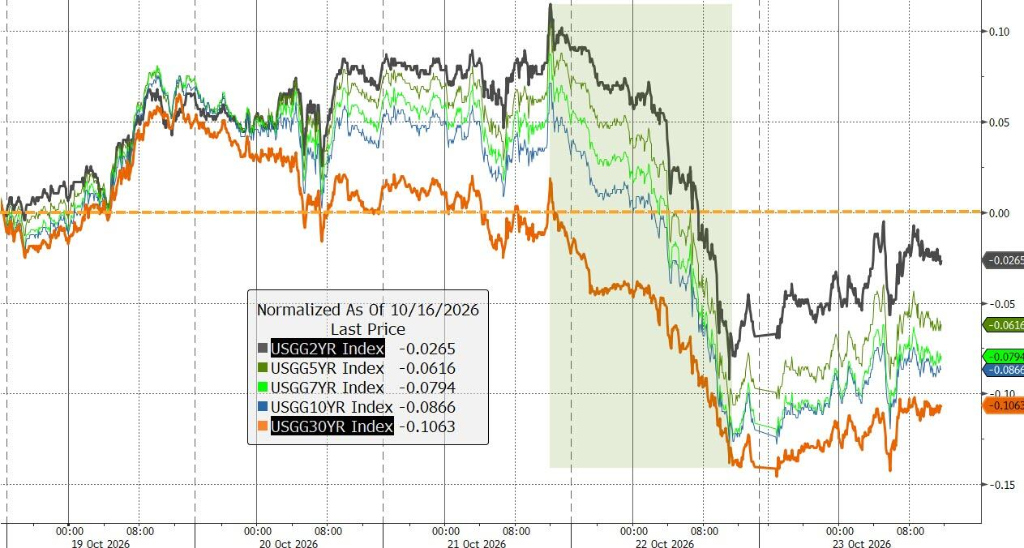
This brought this week's wild ride in the bond market to a halt midway. On Monday, a flurry of investment-grade corporate bond issuances pushed the 10-year yield to 5.14%; on Wednesday, weak results from the auction of an additional 20-year Treasury bond issuance sent tail-end yields to their highest level since January 1986.
On Thursday, an AI-driven sell-off sparked the largest single-day buying surge in over a year, with yields closing at 4.97%, marking the first time in a month they've settled below 5%. Friday's data erased roughly a quarter of that gain.
The shift in pricing is reflected in the federal funds futures for the same day. Goldman Sachs's macro roadmap released on Friday shows that the rate hike priced into the October meeting stands at just 2.1 basis points, while for December it is 22.1 basis points; the December contract no longer fully prices in another rate hike within the year.
Pressure on Europe has not eased. On Friday, the yield spread between French and German government bonds briefly widened to 176 basis points at the open—the highest since 2011—before French bonds outperformed and the spread narrowed to 169 basis points. Meanwhile, French credit default swap spreads rose above 100 basis points for the first time since 2012, while the yield on Germany's 10-year government bond fell by 9 basis points to 3.33%.
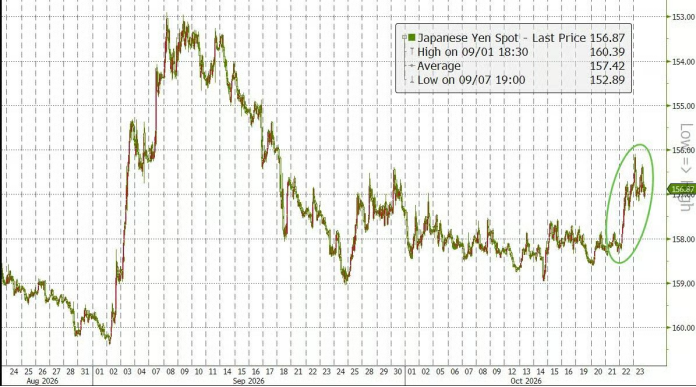
The U.S. dollar index rose 0.2% on the day, closing at 101.811 in late New York trading. The euro was at $1.1193, and the U.S. dollar stood at 156.87 yen. Over the week, the dollar index declined for the second consecutive week, remaining near the upper end of its 18-month range.
Nomura Holdings strategist Charlie McElroy said that bonds can once again hedge against losses from stock declines, a relationship that has repeatedly broken down this year but has now been reestablished.
Market conditions can be highly volatile. Rather than rushing to sell once the trend becomes clear, it's better to prepare for both scenarios in advance. OCO (One Cancels the Other) orders let you place two linked orders simultaneously: when one is executed, the other is automatically canceled, giving you the flexibility to adapt to a wide range of market movements.

Editor/stephen