
Bank of America strategist Hartnett believes that the U.S. midterm elections, turbulence in the French bond market, and risks associated with AI financing remain to be digested, which could weigh on U.S. equities and the dollar in the short term, while the yield on the 30-year U.S. Treasury is likely to retreat to 5%. Despite continued global capital inflows into technology stocks, divergence is emerging within the market.
Looking ahead to 2027, three possible market scenarios could emerge: the continuation of the AI bubble and moderate economic growth driving broad-based market gains, or a credit tightening triggering a deflationary recession.
Global capital is flowing rapidly into equities and the technology sector, but Bank of America strategist Michael Hartnett advises investors to remain tactically cautious through mid-November. He believes the market must digest three sources of uncertainty—U.S. midterm elections, turmoil in the French bond market, and risks associated with AI financing—which could weigh on U.S. stocks and the dollar in the near term, while the yield on the 30-year Treasury may retreat toward 5%.
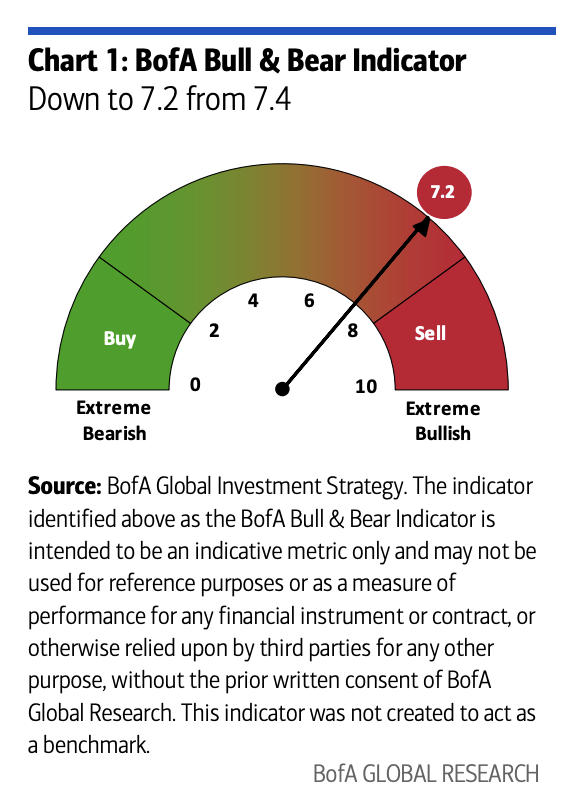
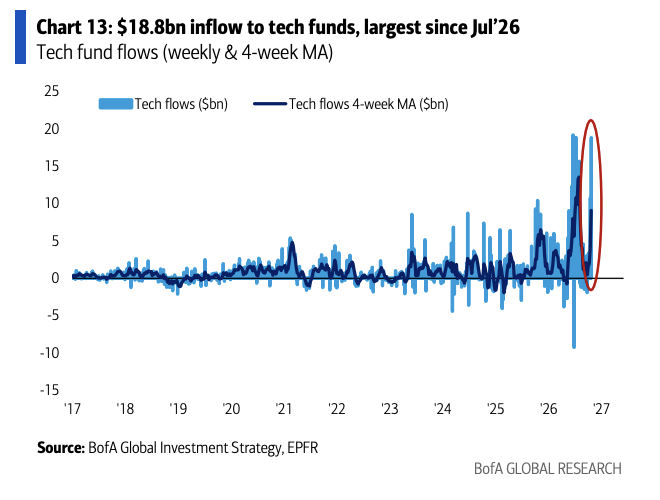
 According to Bank of America's latest Flow Show report, global equity funds attracted $55.6 billion this week, while technology‑focused funds saw inflows of $18.8 billion, the highest level since July. However, Bank of America's Bull/Bear Indicator edged down from 7.4 to 7.2, and consumer staples and utilities funds experienced outflows of $2.1 billion and $1.6 billion, respectively—both representing the second-largest weekly outflows on record. Capital continues to flow into tech stocks, but divergence within the market is widening.
Bank of America's strategy team will continue to maintain its tactical outlook of "lower bond yields, lower equities, and a weaker U.S. dollar," expecting…$USD (USDindex.FX)$Falling below 100,$U.S. 30-Year Treasury Bonds Yield (US30Y.BD)$Moving closer to 5%. Whether this forecast can be realized hinges on whether the market can absorb three key risks.
Three key factors will determine the short-term market trend.
First, the policy risks associated with the U.S. midterm elections need to be fully priced in. Bank of America is closely watching the possibility of Democrats sweeping Congress. If this scenario materializes, the market may reassess whether the low-tax, low-regulation policy environment can persist, as well as the Trump administration's leadership in the strategic competition surrounding AI. As the election draws nearer, these expectations could become key factors influencing U.S. equities and the U.S. dollar.
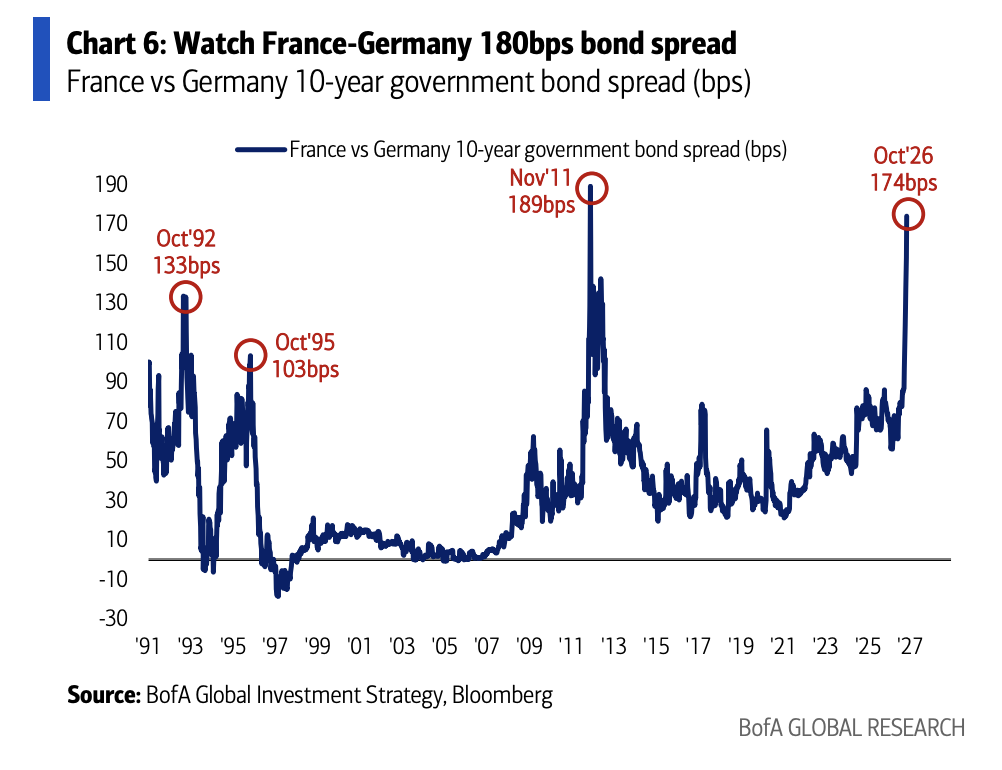
Second, Europe needs to curb the selling pressure on French government bonds. According to a Bank of America report, the yield spread between French and German 10-year government bonds has widened to 180 basis points, approaching the November 2011 peak of 189 basis points. Whether the European Central Bank and the French government can stabilize the bond market will shape the evolution of sovereign debt risks in Europe and could further unsettle global bond markets.
Third, AI capital spending and financing risks need to reach an inflection point. Bank of America warns that if major cloud‑computing firms cut AI‑related capital expenditures or announce large share issuances, the credit spreads of these companies could peak. The report identifies a breach of 200 basis points in the bond spreads of ultra‑large cloud‑computing firms as a key downside risk; currently, this spread stands at around 130 basis points. Should funding costs continue to rise, it could trigger deleveraging among investors and transmit pressure to shadow banks and the broader credit market.
Short-term risks are not one-sided. If the United States announces peace agreements between Russia and Ukraine, as well as with Iran, oil prices could fall by $10 to $20 per barrel, easing inflationary pressures and downward pressure on interest rates. Conversely, if credit spreads for cloud‑computing firms widen rapidly, the AI investment boom could shift from valuation concerns to financing challenges.
Three Scenarios for 2027: an AI Bubble, a Broad-Based Rally, and a Deflationary Recession
Looking ahead to 2027, Bank of America outlines three possible market scenarios: the AI bubble continuing to inflate, moderate economic growth driving broad-based market gains, and credit tightening triggering a deflationary downturn.
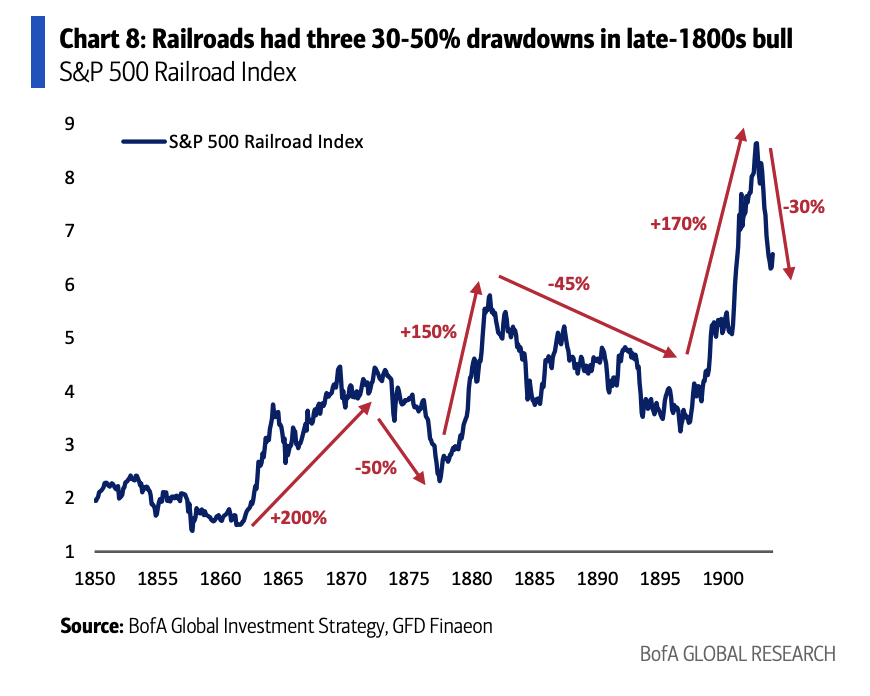
Under an optimistic scenario, the AI industry could follow a growth trajectory similar to that of the 19th-century railway revolution, with government policy support and investors' tendency to buy on dips further bolstering market conditions. Another scenario envisions "Goldilocks"‑style economic growth—characterized by sustained expansion and easing inflationary pressures. Market consensus expects U.S. Treasury yields to decline by 40 basis points,$S&P 500 Index (.SPX.US)$Earnings per share grew by 15%; if this scenario materializes, small- and mid-cap stocks with price-to-earnings ratios around 15 times, as well as S&P 500 constituents outside the AI sector trading at P/E ratios below 20 times, could see a valuation recovery.
However, Bank of America believes that market confidence in the first two scenarios may be overly high. Its October fund manager survey shows that 50% of respondents expect a "no‑landing" scenario, 40% anticipate a "soft landing," and only 6% foresee a "hard landing," suggesting that investors remain relatively underprepared to guard against recession risks.
Under a pessimistic scenario, lower-than-expected returns on AI investments and tighter financing conditions could force companies to cut capital expenditures. Bank of America notes that hyperscale cloud computing firms have projected capital spending as high as $1.2 trillion by 2027; should the funding environment deteriorate, both their investment plans and earnings expectations for technology stocks could come under pressure. Meanwhile, current market forecasts—projecting U.S. nominal GDP growth of 4.7% and global tech‑sector earnings per share growth of 43% by 2027—also face downside risks.
Funds are still flowing in, yet the market is showing signs of divergence.
This week, global equity funds recorded net inflows of $55.6 billion, with ETFs attracting $67.3 billion and mutual funds seeing outflows of $11.7 billion. Bond funds posted net inflows for the 78th consecutive week, totaling $12.1 billion, while precious‑metal funds logged net inflows for the 16th straight week, amounting to $2.6 billion. Cryptocurrency funds, by contrast, saw only $200 million in inflows.
On the sector front, technology funds saw inflows of $18.8 billion, marking the largest weekly net inflow since July, while energy funds attracted $1.1 billion, the highest level since April. By contrast, U.S. small-cap funds experienced outflows of $7.5 billion, and consumer staples and utilities funds also recorded substantial redemptions, suggesting that capital is not broadly bullish across all equity sectors.
The Bank of America Bull/Bear Indicator slipped from 7.4 to 7.2, signaling that market sentiment has cooled from its extremely bullish levels over the summer. A broadening weakness across global equity markets, hedge funds' increased short positions in oil and S&P 500 futures, and widening high-yield bond spreads all weighed on the indicator.
Meanwhile, 30% of global equity indices are trading below their 50-day and 200-day moving averages, still well short of the 88% threshold required to trigger Bank of America's contrarian buy signal. This suggests that, although the risk-reward profile of some assets may be improving, the market has yet to reach typically extreme oversold levels.
Overall, Hartnett's short-term view does not suggest that capital has fully fled equities; rather, it holds that the market has yet to fully price in policy risks, sovereign‑debt concerns, and AI‑related financing risks. Until clearer progress emerges on these three fronts, Bank of America remains inclined to maintain a tactical risk‑off stance. As for whether the market in 2027 will see a prolonged AI bubble, a broad‑based rally, or a deflationary recession, the outcome will hinge on whether AI‑related capital spending translates into profitability and whether financing conditions remain stable.
Editor/melody