
Nomura Securities argues that the AI investment narrative is mired in an internal contradiction: if hyperscale cloud providers accelerate capital expenditures, their free cash flow will continue to erode, raising doubts about the sustainability of their financing; but if they slow down, it would signal a failure to meet expectations for AI demand and earnings prospects. Either path points to sell-offs.
The crowded long positions built up during the September "smart‑money rally" triggered massive stop‑losses when negative catalysts kicked in, spreading to U.S. Treasury bonds, currency markets, and commodity markets and setting off a systemic deleveraging process.
The AI investment narrative is grappling with an internal contradiction in its own logic. Market perceptions of the capital‑expenditure trajectory for ultra‑large cloud computing players have shifted from the earlier "winning no matter what" stance to a current dilemma of "choosing the lesser of two evils": accelerating growth puts pressure on free cash flow, while slowing down raises doubts about demand prospects—both paths pointing to sell‑offs in AI‑related assets.
 According to a report by Charlie McElligott, an cross-asset strategist at Nomura Securities, published on October 23, the past week has seen a succession of negative sentiment catalysts emerge within the AI ecosystem. Combined with the long positions built up during the September "AI hype" rally, the market has undergone large-scale forced liquidations.
Only during the most severe single-day sell-offs did 47 of the 124 U.S. equity long-short pairs monitored by Nomura experience daily moves exceeding three standard deviations, with six reaching extreme deviations of five or more standard deviations.
This market turbulence not only hit core AI‑related stocks but, through a cascade of liquidations in crowded positions, spread to U.S. Treasury bonds, currency markets, and commodity markets, triggering systemic deleveraging across asset classes.
This week, the market is set to see an exceptionally large wave of earnings reports from major companies, including…$Alphabet-A (GOOGL.US)$、$Amazon (AMZN.US)$、$Microsoft (MSFT.US)$Coupled with the Federal Reserve's interest-rate meeting, market direction will face a critical test in the near term.
The "Prisoner's Dilemma" of Capital Expenditures
The core narrative of AI-driven trading has shifted sharply from the previous one-sided logic of "positive outcomes across the board" to a two-way dilemma where "everything looks like a negative."
In his report, McElligott described the situation as "either option is poison":
First, if capital expenditures by ultra-large-scale manufacturers continue to accelerate. As…$Meta Platforms (META.US)$The trends revealed in the latest financial report have the market closely focused on the continued erosion of free cash flow, while further raising questions about the overall sustainability of financing.
This path entails nonlinear risks, implying that debt must be issued on a larger scale and at wider yield spreads, while AI‑driven trading remains under pressure due to the "unsustainable" narrative.
Second, if capital expenditures by ultra-large‑scale firms were to decelerate substantially, it would signal that the "optimal scenario" previously priced into the market—encompassing AI demand, technology adoption, profitability, and improvements in end‑user productivity—is unraveling, exposing AI‑related equities to a more severe sell‑off.
The emergence of this predicament is closely linked to the rapid rebuilding of long positions during the September rally triggered by the "agent‑based AI" theme. At that time, substantial capital flowed into core AI‑related stocks, accompanied by sizable speculative purchases of call options, sowing the seeds for a subsequent panic‑driven sell‑off.
Stop-loss triggers spark cross-market deleveraging.
Position congestion is the root cause of the exceptionally sharp volatility in this round.
According to data from Nomura's trading desk, during the most severe single-day sell-off, a total of 124 U.S. equity long-short pairs triggered stop-loss orders, with 47 of these pairs experiencing price swings exceeding ±3 standard deviations, 26 exceeding ±4 standard deviations, and 6 surpassing ±5 standard deviations.
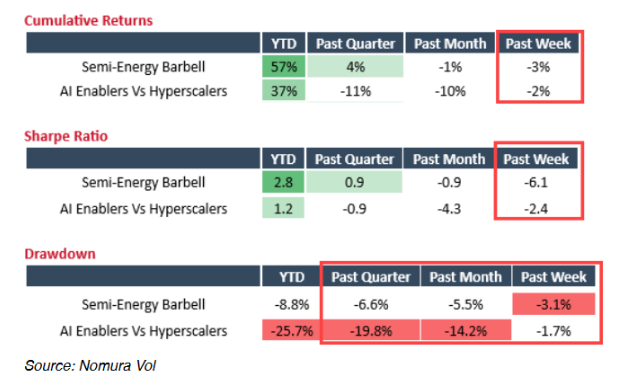
McElligott argues that the root cause of this round of stop-loss liquidations lies in the extreme concentration of "high‑Sharpe‑ratio trading" throughout 2026, where carry strategies and trend‑following strategies have been in prolonged resonance, giving rise to a rare broad‑based winner effect.
At this juncture, as the fourth quarter draws to a close, fund managers are under year-end performance pressure. In an already challenging environment marked by drawdowns, the incentive to take proactive risks in pursuit of a rebound falls far short of the risk-averse instinct to "preserve capital and navigate the year safely"—a "de-risking and position‑closing" dynamic has come to dominate market behavior.
Meanwhile, the reset in AI-driven narratives is accelerating position adjustments within systematic trend‑following strategies, with a particular focus on previously heavily crowded short positions in U.S. Treasuries and short-term interest rates.
According to Nomura QIS data, over the past two weeks, CTA trend‑following strategies have closed roughly $68 billion in short positions on U.S. Treasury futures and $38 billion in short positions on short-term interest‑rate futures. Nevertheless, their net exposure remains negative, suggesting that if the bond market rally persists, the potential scale of forced covering could still be substantial.
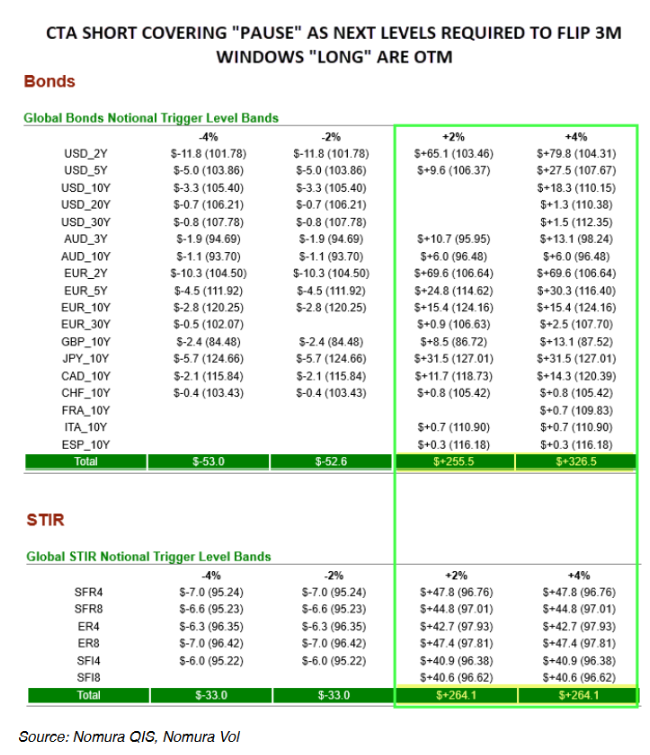
(In the past two weeks, CTAs have already covered over $100 billion in short positions. To trigger the next strong buying wave—worth roughly $50 billion—within the green box, bond prices must first break above the +2% trigger threshold.)
McElligott believes that, with the short-term rebalancing largely complete, the squeeze on bond shorts has temporarily paused. Both the 2‑week and 1‑month trend models have flipped to "long" signals, but for the 3‑month model to turn bullish from its current level, bond prices would still need to post a substantial further rally.
Macro Resonance: The Shift in Correlation Between Bonds and the Stock Market
This AI-driven narrative reset has simultaneously triggered shifts in the internal correlation structure of both the bond and equity markets, a signal that warrants close attention at the level of market mechanisms.
On the bond front, the "negative correlation between stocks and bonds" has reemerged as a protective feature. McElligott notes that, on the previous trading day, substantial capital flows shifted asset allocations by selling equity futures and buying Treasury futures, once again positioning bonds as a risk-hedging instrument.
After remaining absent for much of the year, this feature has now reemerged as the "growth panic" scenario gains traction.
The stock market, by contrast, has undergone a reversal. For much of 2026, the Nasdaq and the semiconductor sector exhibited the rare pattern of "higher volatility on up days than on down days"; however, this relationship has now flipped back to a "negative spot–volatility correlation," meaning that volatility is greater when stock prices decline.
This shift is most pronounced in the Nasdaq and SMH (semiconductor ETF) space, directly reflecting the market's repricing of the sustainability of AI capital expenditures.
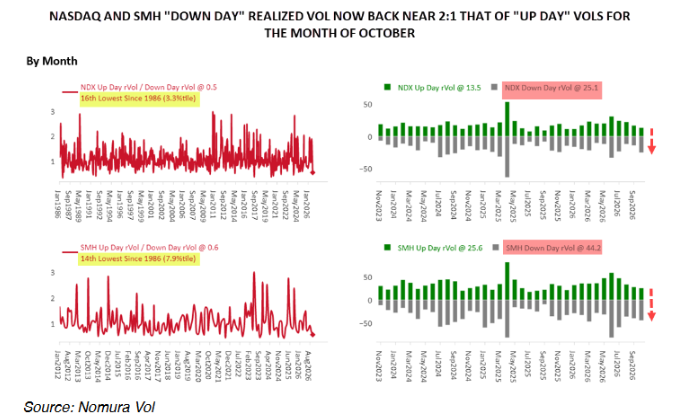
It is worth noting that, at the S&P 500 index level,$CBOE Volatility S&P 500 Index (.VIX.US)$Volatility has remained relatively mild. McElligott attributes this to the "reverse dispersion" effect: tech bulls have taken a severe hit, while rate‑sensitive sectors and other short‑selling targets have staged a sharp rebound; the offsetting moves have prevented a dramatic spike in overall index‑level correlation.
Large‑cap options signals: Contrarian capital is still positioning for an AI rally.
Despite overall market sentiment remaining under pressure, the options market has nonetheless signaled several contrarian positioning opportunities worth watching, primarily reflected in call options on certain leading AI‑related stocks.
According to McElligott's observations, the following notable bullish options buying activity has emerged over the past week:
$CoreWeave (CRWV.US)$Total royalty payments amounted to approximately US$69 million, covering an option‑related notional exposure of about US$170 million.
$NEBIUS (NBIS.US)$Total royalty payments amounted to approximately US$25.7 million, covering a notional exposure of about US$80 million.
$Micron Technology (MU.US)$Total royalty payments amounted to approximately US$20 million, covering a notional exposure of about US$85 million.
The aforementioned trades involve out-of-the-money call options expiring between March and April 2025, indicating that some capital continues to maintain a directional bet on a medium-term rebound in the AI sector amid current market volatility.
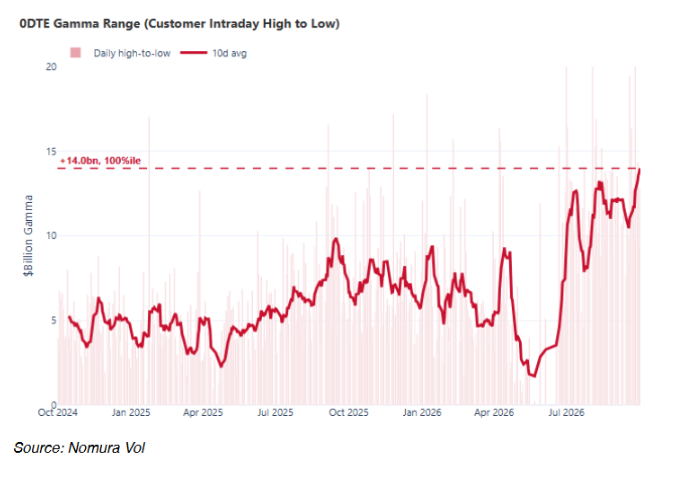
Regarding the conditions for potential stabilization, McElligott believes the key lies in whether volatility risk‑premium (VRP) sellers are willing to follow the historical pattern of "shorting on volatility spikes." In particular, the stabilizing effect of 0DTE gamma‑selling strategies—buying on dips and selling on rallies—will serve as a crucial indicator for assessing whether volatility can once again converge.
Edited by melody