
$Alphabet-C (GOOG.US)$、$Microsoft (MSFT.US)$、$Amazon (AMZN.US)$All three companies are expected to report strong quarterly results, with revenue growth projected to be in the double digits. However, investors are closely watching the scale of capital expenditures and the trajectory of free cash flow. A further downward revision to free cash flow forecasts would heighten market concerns about the sustainability of AI‑related spending and spill over into the cloud computing sector; by contrast, an upward revision would signal that the most challenging phase of the spending cycle has passed.
This week, the three tech giants—Alphabet, Microsoft, and Amazon—will release their earnings reports in quick succession. At a time when AI-related capital spending has raised serious concerns in the market, robust revenue growth may no longer be enough to reassure investors—the real factor driving market sentiment will be how much these companies are investing in AI and when they can expect a return on that investment.
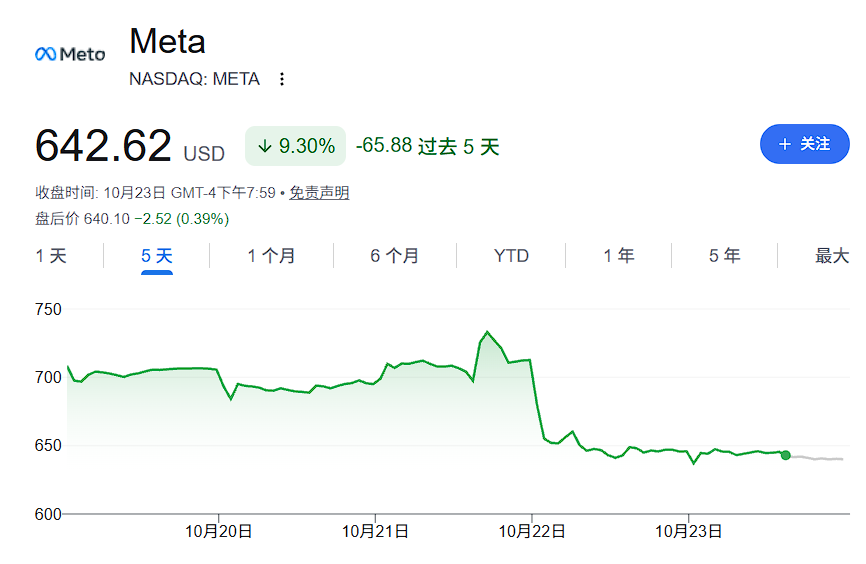
According to a Bloomberg report on October 25, the three companies are all expected to post double-digit quarterly revenue growth, with a combined market capitalization exceeding $10 trillion. However,$Meta Platforms (META.US)$Last week's earnings report triggered a sharp market reaction, setting the tone for this week: Following Meta's announcement that it would raise its future capital‑expenditure plan by $125 billion to $825 billion, its free cash flow turned negative for the first time in history, at $2.12 billion (compared with $10.6 billion in the same period last year). The stock plunged 6.1% the next day—the largest single‑day drop since July—and the five‑year credit default swap spread surged to a record high.
 Market sentiment was already fragile. Brent crude oil prices surged to their highest level since April,$U.S. 10-Year Treasury Notes Yield (US10Y.BD)$After a month, the 5% threshold has once again been breached, and with ongoing tensions in Iran and the U.S. midterm elections looming next week, the macroeconomic backdrop remains fraught with uncertainty. Against this backdrop, every figure in AI capital spending could well prove to be the final straw that breaks the market's back.
Big Three Earnings Reports: Strong Growth Expectations, But Free Cash Flow Is the Real Key
Alphabet, Microsoft, and Amazon are all expected to report strong quarterly results, with revenue growth projected to reach double digits across the board. However, what investors are really watching closely is the scale of capital expenditures and the trajectory of free cash flow.
Massive investments in AI have transformed several tech giants from "cash cows" into companies with negative free cash flow, a shift that has left the market highly sensitive. Shea of BNY notes,
"If we once again find ourselves in a situation where we have to lower our free cash flow outlook, it will heighten market concerns about the sustainability of AI spending and its reliance on incremental capital, spilling over into emerging cloud‑computing companies and other sectors. However, if the free cash flow forecast is revised upward, the market will breathe a sigh of relief, believing that the downside has bottomed out and that the most challenging phase of the spending cycle has passed."
Kim Forrest, Chief Investment Officer at Bokeh Capital Partners, stated bluntly, "The 'Four Horsemen' of new cloud computing—Meta, Microsoft, Google, and Amazon—currently show no sign of regret; they will continue to push ahead with their spending plans, which may be unsettling investors."
Meta's earnings report sounds the alarm: capital expenditures have become a market "minefield."
The dramatic trajectory of Meta's earnings report last week has clearly laid bare the current market's nerve center.
Following the earnings release, Meta's stock surged in after-hours trading, with the results signaling a positive trend. However, as the market digested the news of a substantial increase in its capital‑expenditure plan, sentiment reversed sharply. The next day, the stock closed down 6.1%, marking its worst single‑day performance since July, while the price of five-year credit default swaps also climbed to a new high—raising concerns that such a large spending program would force the company to issue bonds on a significant scale.
"Investors today have 'absolutely no patience' for higher capital spending," said John Belton, portfolio manager at Gabelli Funds. "The stock market can turn a blind eye for now, but eventually this will take its toll—or at least leave the market more vulnerable."
Kevin Shea, a senior equity analyst at BNY Wealth, noted, "This is a particularly pivotal earnings season. The market is discounting large-cap growth stocks as it grows increasingly uncertain about whether such growth is sustainable."
Notably, the fallout from Meta's earnings report is not an isolated incident; a series of recent signals are collectively eroding market confidence in the returns of AI investments.
First, debt-financing risks have come to the fore. Cloud computing service providers$CoreWeave (CRWV.US)$Such statements have left the market deeply concerned about the extent to which AI infrastructure development relies on debt financing, while persistently rising interest rates have further amplified this risk. According to research firm Gartner, if AI revenues fail to justify the associated expenditures, more than $3.5 trillion in AI infrastructure investments could face impairment by 2030.
Second, AI revenue growth is showing signs of slowing. Anthropic, a leading AI lab expected to go public next month, disclosed to potential investors that its third-quarter revenue grew by approximately 45% year over year, a deceleration compared with the second quarter, casting a shadow over the broader narrative.
"This is a tough combination—harsh macro conditions, slowing AI revenue growth, and accelerating AI capital spending," said Belton of Gabelli.
Jed Ellerbroek, portfolio manager at Argent Capital Management, said, "We are now in a highly risk-averse mode. Investors are fleeing stocks tied to data-center capital expenditures, as well as the technology and data-center sectors."
Valuations are already trading at a discount, but the market is still hoping for "better-than-expected" results.
Despite widespread concerns, some Wall Street analysts still view large-cap tech stocks as a relatively safe bet in the current market—this year's pullback has already brought valuations significantly lower.
Bloomberg data shows that the "Mag 7" index has risen only 6.5% so far this year, far below the S&P 500's 11% gain and the Nasdaq 100's 15% rise; among the seven constituent stocks, only$Apple (AAPL.US)$and$NVIDIA (NVDA.US)$Outperforming the broader market. The S&P 500 excluding tech giants has risen 12% this year.
From a valuation perspective, the Mag 7 Index currently trades at a price-to-earnings ratio of less than 24 times expected earnings, below its roughly 29-times 10-year average and also lower than last year's 33 times. Both Microsoft and Alphabet are trading at valuations below their respective long-term averages, while Amazon's P/E ratio has fallen below 20 times, approaching its lowest level since 2008.
Meanwhile, the outlook for earnings growth remains robust. According to Bloomberg data, "Mag 7" companies are expected to post roughly 34% earnings growth this year, outpacing the S&P 500's overall 29% pace; by 2027, earnings are forecast to expand by 27%, a consensus estimate that has been sharply revised upward in recent weeks—just two months ago, analysts were projecting less than 19%.
However, the coexistence of low valuations and high growth expectations also means that the market has very limited tolerance for earnings disappointments. Tiffany McGhee, CEO of Pivotal Advisors, stated:
"The bar has been set ever higher, so when these companies meet expectations, the market is almost left disappointed. What investors want to see is a substantial outperformance."
Editor/Deng