
Wall Street strategists warn that the decline in shares of AI and cloud-computing providers could spread to other segments of the tech sector, potentially dragging U.S. equities down to their June lows.
Zhitong Finance APP has learned that Wall Street strategists are warning: the decline in the stock prices of AI cloud computing service providers could spill over into other segments of tech trading and potentially drag the U.S. stock market all the way back to its June lows.
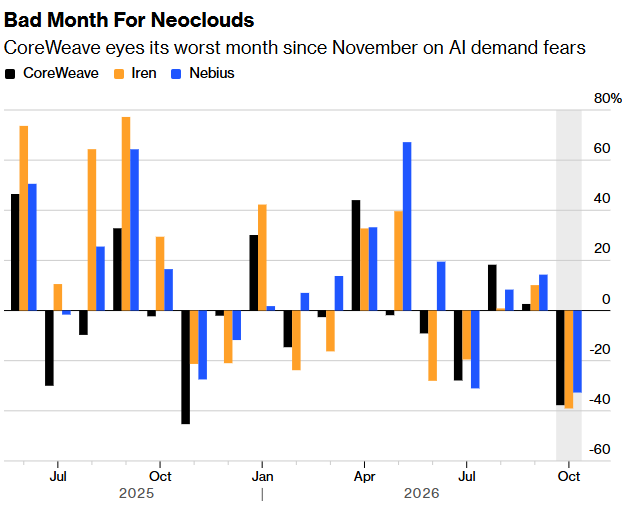
At the eye of the storm is$CoreWeave (CRWV.US)$Since its bonds fell to distressed levels this month, the company's stock has tumbled 41% since October 6—the day major U.S. equity indices hit all-time highs. Over the same period, other "neocloud" firms—companies that rent computing power to those building and running AI models—have also posted double-digit declines:$IREN Ltd (IREN.US)$Down 40%,$NEBIUS (NBIS.US)$Down 36%.
 Bonds rang the bell first, not stocks.
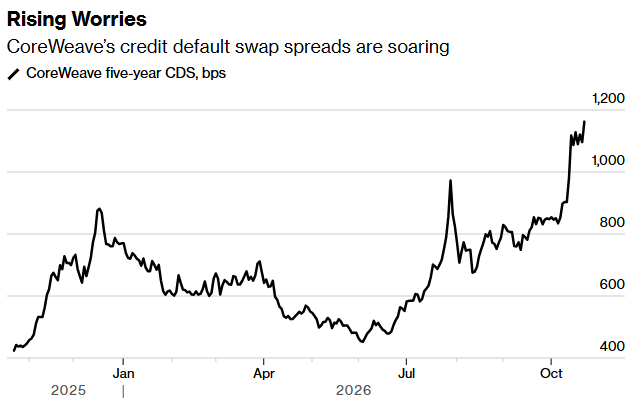
It was debt that ran into trouble first. On October 14, a CoreWeave bond maturing in 2032 with a coupon rate of 9.625% saw its secondary-market yield briefly climb to 15%; venture capitalist Chamath Palihapitiya posted this yield curve on social media, and Musk replied with a single word: "Yikes." At the same time, CoreWeave's five-year credit default swap (CDS) spread surged past 1,000 basis points—by comparison, SoftBank Group's stood at about 424 basis points, and Oracle's at roughly 288 basis points; the implied probability of default embedded in the five-year CDS rose to around 60%.
Behind the numbers lies the shape of this business: CoreWeave buys GPUs in bulk, builds data centers, and then rents out computing power by the hour to AI companies, with expansion almost entirely financed through debt. Its total debt has surged from roughly $15 billion a year ago to about $52 billion as of the end of June; interest expenses for the second quarter reached $640 million, compared with $267 million in the same period last year; quarterly revenue more than doubled to $2.58 billion, yet the company still posted a net loss of $626 million. One analyst put it bluntly: if the company borrows at a 9% cost while these investments can generate at best a 5% return, then every step of expansion is eroding corporate value.
Wall Street has dubbed it the "canary in the coal mine" of AI‑driven trading. The reason isn't its size, but rather that it's one of the few segments in the AI capital‑expenditure chain with frequent, publicly available credit pricing: bonds price cash flows, while equities price narratives, so the warning signs invariably emerge first in the bond market.
It's not just the secondary-market valve that's being tightened. In mid-October, South Korean AI computing power provider Elice plunged 32% on its Seoul stock market debut; Australia's Firmus Grid abandoned its plans for a public listing; and Britain's Nscale ran into headwinds at its targeted IPO valuation. In an internal memo, CoreWeave CEO Mike Intrator also acknowledged that "weakness and delays surrounding competitors' IPOs and debt financing" are seeping into CoreWeave's narrative, while describing market performance as "irrational."
From "Micro" to "Macro"
Investors' concerns extend beyond how much they've already borrowed to how much they'll need to borrow after earnings season. Last week, credit risk indicators for several major tech companies with hefty AI spending surged to new highs.
On that grueling Thursday, October 22, the Nasdaq-100 index fell nearly 3%, the S&P 500 posted its worst single-day performance since late July, and the Philadelphia Semiconductor Index plunged 6.72% in one day. Prior to this, the semiconductor sector had already declined for eight consecutive trading days—the longest losing streak since the 2008 financial crisis.
"It's now shifting from a micro‑event to a macro‑event," said Brian Reynolds, chief market strategist at Reynolds Strategy LLC, referring to the sell-off in tech stocks. "In other words, it's not just hitting tech—it's rippling through the entire credit market and then spilling over into equities."
Reynolds expects further selling, which could push the S&P 500 back to its early-June lows—implying a 4.7% drop from the index's Friday close. Based on the S&P 500's October 23 close of 7,623.68 and its June 10 low of 7,265.99, this decline would be roughly 4.7%, in line with his estimate. He also noted that the S&P 500 fell below its 50-day moving average on Thursday, potentially heading all the way back to the June low—precisely the level at which he'd be willing to buy. "I'm staying defensive over the next few weeks," Reynolds said. "I'd really like to step in at that lower level around 7,200."
How are financing costs passed on to chips?
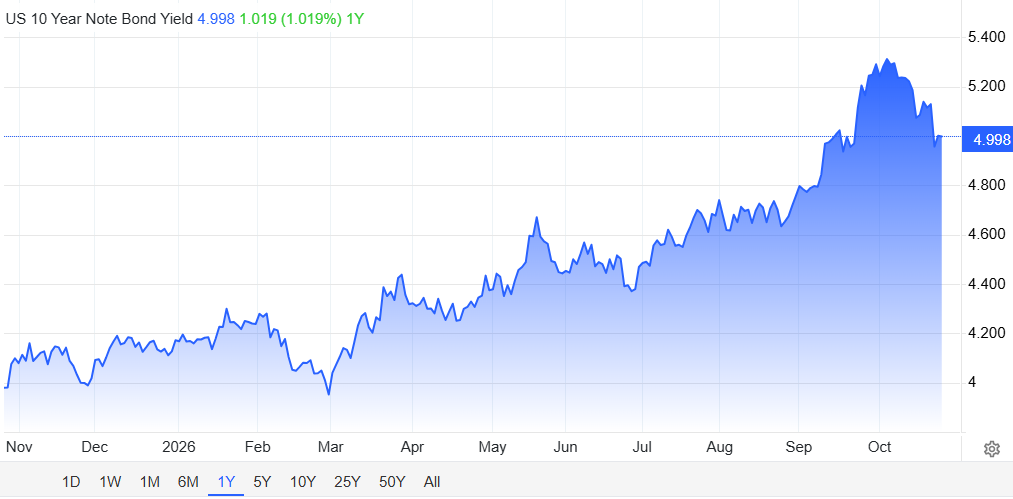
Xinyun Company relies heavily on bond issuance to fund its expenditures. As U.S. Treasury yields rise and inflation remains stubbornly high, financing costs are climbing.
Luis Alvarado, co-head of global fixed-income strategy at Wells Fargo & Co.'s investment research institute, put it more bluntly: the wave of easy financing experienced in the first nine months of this year is beginning to recede. "Now, every new dollar of capital—especially marginal new capital—is subject to much closer scrutiny," he said, adding that investors will carefully assess how much additional yield issuers are willing to offer as compensation.
CoreWeave is also seeking cheaper funding—according to reports, the company is working to secure investment-grade ratings for more chip-backed debt in order to tap into insurance institutions' capital pools; co-founder Brannin McBee says that insurance-sector capital "is limitless" and stresses that he does not view this type of debt as "terrifying."
Ohsung Kwon, chief equity strategist at Wells Fargo & Co, pointed out that if New Cloud cuts its future capital expenditure plans to reassure investors, it would become a major headwind for the semiconductor sector—whose revenues come directly from data center developers who pay hefty sums for chips.
"If they start to perceive risks on the financing side, and the market becomes far more reluctant to support their capital expenditures than it is today, then any cuts in capital spending next year would pose a risk to the semiconductor industry," Kwon said in an interview.
This concern has weighed on the Philadelphia Semiconductor Index, which has fallen 15% since October.
More Than Technology: A "Reality Check"
It's not just tech stocks. Several Wall Street strategists warn that the collapse of the "new‑cloud" sector is delivering a "reality check" to the broader market—just as investors are already anxious about an AI bubble.
"If the AI bubble is set to burst, it will likely begin with a credit event: defaults on new‑cloud and high‑risk AI‑related debt, triggering a cascade of valuation write-downs, spending cuts, and contraction—both valuation multiples and growth rates will shrink," wrote Tom Essaye, founder of the Sevens Report, in a report last week. He added that he continues to monitor for warning signs in the credit markets.
Barclays' strategist team, led by Venu Krishna, noted that new‑economy stocks are currently responding to credit pressures in an "asymmetric" manner: "Widening yield spreads have triggered disproportionately sharp declines, while the relief from narrowing spreads has been quite limited, underscoring market skepticism about the durability of these companies' business models," they wrote in a report last week.
However, Krishna also noted that while he is watching for "signs of contagion" in the equity market, there is currently no evidence that the concerns have spread beyond tech and growth stocks. Investors have been rotating out of high‑flying tech shares into defensive sectors, a move that appears more reflective of uncertainty around AI‑driven trading than a broad, indiscriminate sell‑off affecting all asset classes.
However, once the sector with the largest weighting is sold off, it drags the index lower. Also on Thursday, the S&P 500 fell by more than 1%, even though the number of advancing stocks actually exceeded the number of decliners that day.
"Does the tail wag the dog, or is it the wolf that's crying 'Wolf!'?"
The market remains divided on how to interpret this warning. One view holds that CoreWeave, with its limited scale and relatively high leverage, occupies a minor position in the industry chain; yet it has now, in turn, disrupted the trillion-dollar AI market—classic "the tail wagging the dog"—as a genuine localized credit event has been overly extrapolated into a reversal of the entire AI sector. Another perspective emphasizes that the pressure has already spread from the bond market to the stock market,$NVIDIA (NVDA.US)$Tech giants such as Meta have also been caught up in the sell-off.
The earnings season has been intriguing: Meta's revenue beat expectations, yet the stock plunged due to hefty capital expenditures and cash-flow pressures.$Super Micro Computer (SMCI.US)$Despite disclosing strong preliminary revenue figures, concerns remain.$Tesla (TSLA.US)$The downward revision of the capital expenditure plan has once again raised concerns about insufficient investment in AI.$Western Digital (WDC.US)$Even a flawless earnings report fails to win investors' favor. Simply put, stocks fall when expectations are overly high, and they also decline when performance falls short of forecasts—what was once a hotly pursued AI narrative has suddenly run into discerning analysts.
Gartner, meanwhile, issues a longer-term warning: more than $3.5 trillion in AI infrastructure investments face impairment risks, and by 2030, over 80% of new cloud service providers may struggle to operate independently.
There are several key events this week: the Federal Reserve's monetary policy meeting on October 27–28 (with market expectations pointing to no change), as well as…$Microsoft (MSFT.US)$、 $Alphabet-A (GOOGL.US)$ 、$Amazon (AMZN.US)$The financial reports will all provide fresh evidence on technology spending and profitability. Reynolds has chosen to sit on the sidelines for a few weeks—waiting for that 7,200-point level.