
Gold fell below $4,000 last week, plunging 2.8% in a single day, as widespread stop-loss orders triggered a rapid exodus of short-term capital—managed funds slashed their exposure to precious metals by $3.6 billion in one week. Meanwhile, physical demand from China bucked the trend, propping up prices, while central bank gold purchases have expanded fivefold compared with pre-pandemic levels.
UBS Group's technical model has turned bullish, with a target of $4,400, but the shadow of Fed rate hikes and year-end position‑holding sentiment have led most traders to remain on the sidelines.
$XAU/USD (XAUUSD.CFD)$Last week, it fell below the $4,000 mark, triggering large-scale stop-loss orders and plunging the market into a slump. According to UBS Group's latest report, technical indicators have begun to show bottoming signals, but traders are largely adopting a wait-and-see approach—no one is willing to take on additional risk exposure to gold before year-end.
 Last Thursday, gold fell 2.8% in a single day, breaking below $4,050 and hitting a three-month low, while the Nasdaq dropped 2.9% and the yield on the 10-year U.S. Treasury note declined by 17 basis points—conditions that would normally constitute textbook bullish terrain for gold. Yet gold moved in the opposite direction, triggering stop-loss liquidations across numerous short-term positions.
The UBS Group precious metals sales desk characterized the current market conditions as "structurally bullish, tactically cautious," noting that as year-end approaches, market participants are increasingly focused on protecting their existing profits and losses rather than taking on new risks.
Currently$XAU/USD (XAUUSD.CFD)$Trading near $4,015, the market remains in what UBS Group describes as a "low‑confidence range": buying support at the bottom and a lack of momentum at the top. UBS technical analyst Jason Perl's DeMark model turned bullish last Friday, with a key breakout level set at $4,082.80—should it break through decisively, the target would be $4,400; if it falls below, support lies at $3,975, $3,923, and $3,871, respectively.
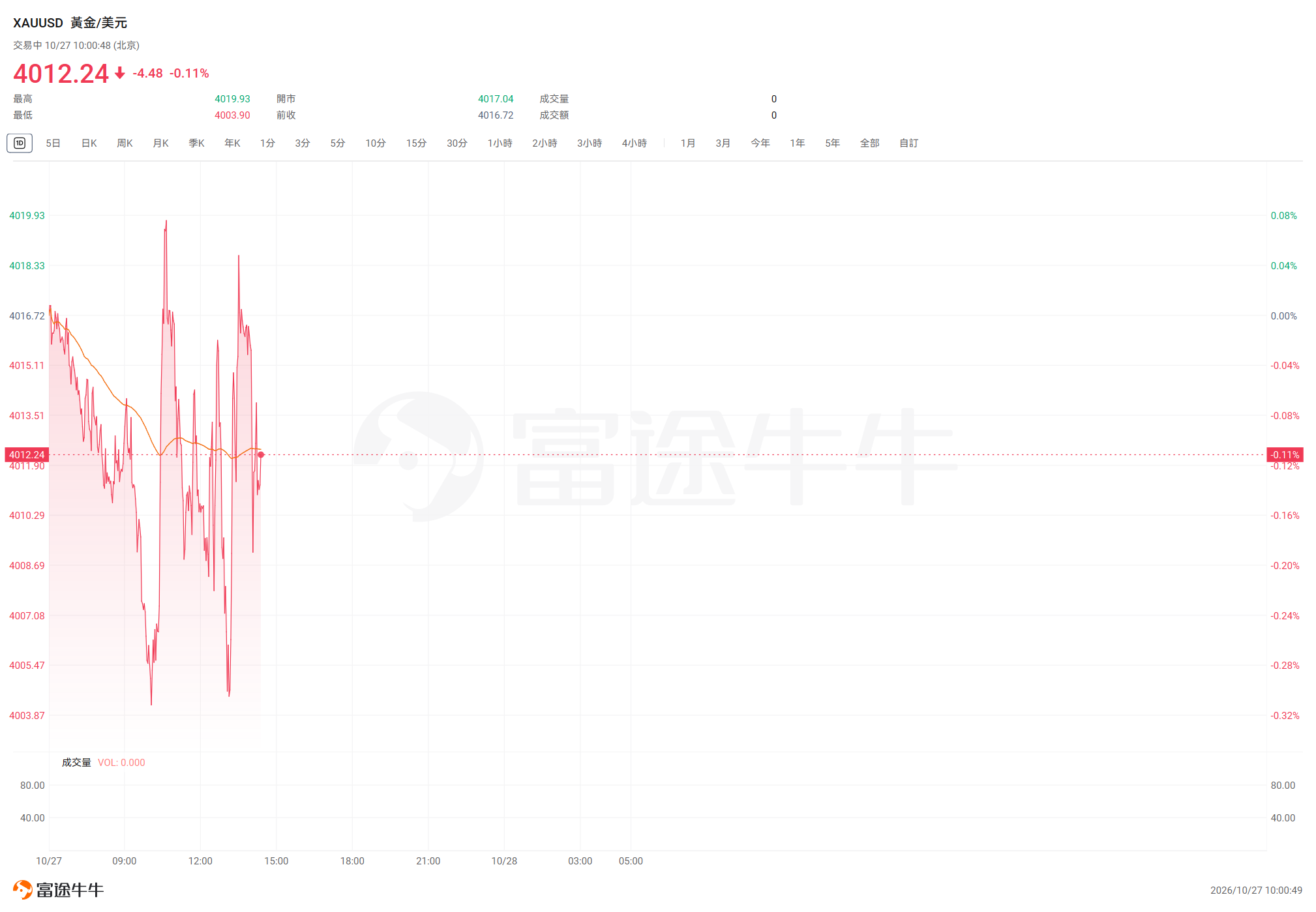
Quick-money stop-loss exits have dealt a blow to market confidence.
Last Thursday's market action was the pivotal event of this round of correction. According to UBS Group's flow data, on October 22, the single-day electronic XAUUSD turnover accounted for roughly 26% of the week's total, and asset management firms executed 30% of their weekly gold trading volume that day—typical of a concentrated liquidation pattern.
Speculative capital is retreating in tandem. According to data from Goldman Sachs' commodities team, as of the week ending October 20, managed funds reduced their net exposure to precious metals by $3.6 billion—second only to grains (-$5.7 billion) among the asset classes tracked by Goldman Sachs. Notably, these figures do not yet reflect the additional sell-offs that occurred last Thursday.
The UBS Group's New York precious metals desk described the current market as "extremely thin, with an unusually narrow trading range, particularly in the afternoon, underscoring the market's stagnation." Volatility strategy participants have stepped aside, as the current price action "offers very limited opportunities for meaningful exposure."
Physical demand in Asia remains robust against the trend, with Chinese buying providing a floor.
In stark contrast to the sluggishness of the paper market, physical gold demand in Asia remains robust. According to a UBS Group report, driven primarily by demand for kilogram bars flowing into China, Asian physical buying has been steadily surging since early October—arriving earlier than the usual seasonal peak—and refinery capacity is already under strain, making it increasingly difficult to secure production orders and available refining slots.
The report also notes that some market participants have expressed a willingness to settle gold transactions in renminbi rather than U.S. dollars, reflecting the extension of de-dollarization trends into the precious metals market.
Goldman Sachs estimates that global central banks purchased 79 tonnes of gold in August this year, equivalent to an annualized rate of roughly 85 tonnes per month after seasonal adjustment—five times the pre-2022 average of 17 tonnes per month. China was the largest buyer, with Goldman Sachs's model projecting purchases of about 25 tonnes in August. The firm believes that emerging-market central banks, particularly China, remain underweight relative to their long-term optimal allocation targets, suggesting there is still considerable room for further gold buying.
UBS Group's conclusion is: hot money determines the range, and Chinese buying determines the bottom.
The technical picture has turned bullish, but the timing is awkward.
UBS Group technical analyst Jason Perl previously stated that$XAU/USD (XAUUSD.CFD)$Adopt a cautious stance and wait for the ABC correction pattern to complete. Last Friday, gold hit a low of $3,996.10, meeting the minimum completion criteria for this pattern, whereupon Perl promptly upgraded its outlook on gold to bullish.
According to the DeMark model, if gold breaks above $4,082.80, it will sequentially open up upside targets at $4,145.82, $4,217.31, $4,315.76, and $4,399.60; support levels lie at $3,975.75, $3,923.24, and $3,870.74, respectively.
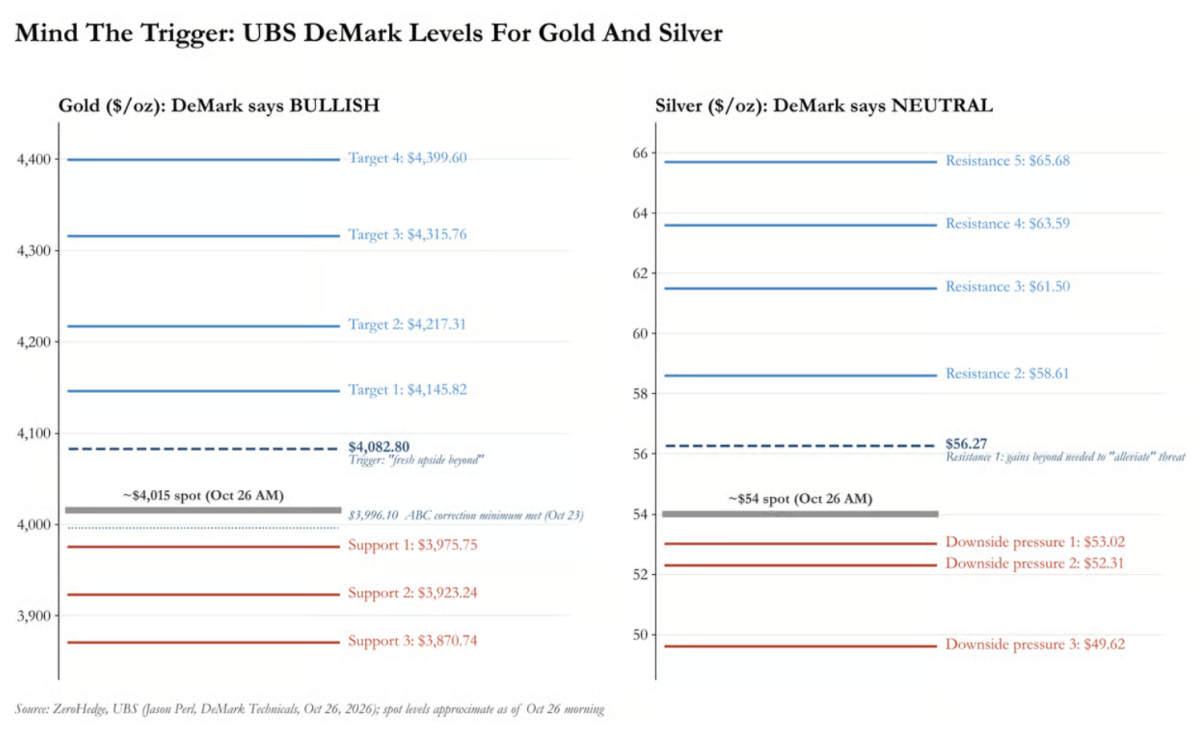
However, the timing of the technical shift to bullish is rather delicate—occurring just as client sentiment turns cautious. UBS Group acknowledges that this could mean technical analysts are ahead of the market, or that clients are about to miss out.
Macro-level pressures remain, and appetite for increasing positions is subdued ahead of year-end.
The macroeconomic factors constraining gold's upside should not be overlooked either. Goldman Sachs economists expect the Federal Reserve to pause rate hikes at its policy meeting this Wednesday, but they still anticipate another hike in December. For gold, which does not generate yields, betting against a Fed that continues to raise rates is a tough proposition.
The UBS Group report clearly states, "The backdrop of tightening monetary policy continues to cap upside potential, leaving the market hesitant and offering little reason for discretionary participants to build large positions."
On the macro catalyst front, UBS Group cited the U.S. election, European political developments, and broader nationalist political trends, while cautioning that the direct link between European politics and gold "remains too speculative," with U.S. and Chinese buying patterns having a more immediate impact on the precious metals market.
Overall, the gold market is currently locked in a structural tug-of-war: the Fed's rate-hike trajectory is capping the upside, while the People's Bank of China and physical demand are underpinning the downside. Until this dynamic becomes clearer, proactively increasing gold exposure before year-end remains a move that most market participants are reluctant to make.
Edited by melody